TL;DR:
- AI is increasingly accessible to UK flooring businesses, enabling smarter marketing, lead capture, and customer engagement. It personalizes offers, automates responses, and provides real-time attribution, leading to measurable growth and improved ROI. Effective AI implementation relies on proper data, integration, and human oversight to maximize its potential.
AI is not reserved for tech giants with enormous budgets. A growing number of UK flooring businesses are already using it to generate more enquiries, serve customers around the clock, and make smarter marketing decisions. Grosvenor Flooring partnered with Merchi.ai to introduce AI-generated SEO content, a room visualiser, and a 24/7 smart showroom, expanding their service availability from 45 to 168 hours per week. That is real, measurable growth. This guide explains what works, what to avoid, and how to get started.
Key Takeaways
| Point | Details |
|---|---|
| AI drives measurable growth | Real-world UK flooring brands have seen sales and engagement soar by using AI-driven tools and platforms. |
| Personalisation boosts results | AI-powered recommendations and content significantly increase order values and lead conversion rates. |
| Attribution justifies spend | Closed-loop AI attribution makes it easy to track which marketing activities create revenue. |
| AI empowers, not replaces | The most successful showrooms use AI to support staff and enhance the customer experience, not to cut human roles. |
| Competitive advantage is real-time | Flooring companies that link AI insights to human decision-making move faster and maintain their edge in the market. |
Why AI matters for flooring businesses
The UK flooring sector is more competitive online than ever. Ad costs on Google are rising. Customers research extensively before visiting a showroom. And most flooring businesses still rely on gut instinct to judge which marketing channels are actually working.
These are not small problems. They eat into margins and slow growth. We see it constantly when working on digital marketing for UK flooring businesses. The pressure is real, and traditional approaches are not keeping up.
AI addresses these challenges in three practical ways:
- It personalises offers and product suggestions based on browsing behaviour, so customers see what is relevant to them rather than a generic catalogue.
- It automates routine responses, follow-up emails, and lead qualification, freeing up your sales team for high-value conversations.
- It visualises flooring products in a customer’s own room, reducing hesitation and accelerating purchase decisions.
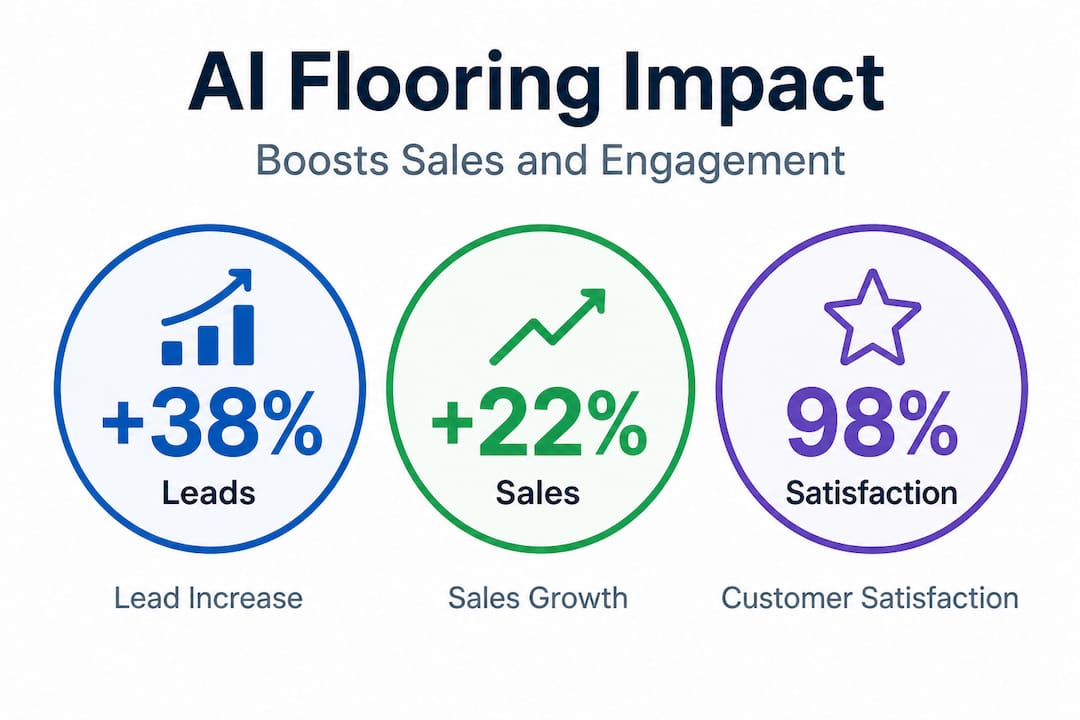
The numbers back this up. AI visualisation tools increase customer satisfaction by 22%, personalised AI recommendations boost average order value by 18%, and 50% of AI-targeted leads achieve higher conversion rates. These are not marginal gains.
“The biggest shift AI brings is not automation. It is relevance. When customers feel understood, they buy faster and spend more.”
Pro Tip: Before investing in any AI tool, audit your current customer data. The quality of AI outputs depends heavily on the data you feed in. Clean, well-organised CRM records will produce far better results than scattered spreadsheets.
For inspiration on what well-structured flooring campaigns look like before adding AI into the mix, reviewing flooring ads examples gives you a useful baseline to compare against AI-enhanced results.
The core point here is straightforward. AI does not require a large team or a large budget to deliver results. It requires the right tools applied to the right problems. For flooring businesses, those problems are clear: rising acquisition costs, low engagement, and difficulty proving ROI. AI tackles all three.
Key AI applications in UK flooring marketing
With the importance of AI established, let us outline precisely where UK flooring companies see the most impact. There are four areas that consistently produce strong results.
AI-generated website and SEO content. Writing product descriptions, landing pages, and blog posts is time-consuming. AI tools can generate optimised content at scale, targeting the long-tail search terms your customers actually use. Queries like “best LVT flooring for a kitchen with underfloor heating” are now answerable with detailed, search-optimised pages that would have taken a copywriter days to produce.
Room visualiser tools. These allow customers to upload a photo of their room and see how a specific floor would look before purchasing. The impact on engagement is significant. Customers spend longer on site, return more often, and convert at higher rates. Understanding digital touchpoints in flooring shows clearly that the visualiser is now one of the highest-performing touchpoints in the flooring customer journey.
Conversational AI and WhatsApp assistants. Most flooring showrooms close at 5pm or 6pm. Customers browsing online at 9pm have no way to ask a question. AI chatbots and WhatsApp assistants fill that gap. They answer product queries, collect contact details, qualify leads, and book appointments. All without a member of staff being present. Grosvenor Flooring’s experience shows how AI-driven 24/7 access can expand effective service hours dramatically, boosting engagement without increasing headcount or operational spend.
AI personalisation. When a customer visits your site for the second time, AI can surface products similar to those they viewed previously, show offers relevant to their room type or budget, and trigger follow-up emails with targeted content. This is the same principle used by large e-commerce retailers, now accessible to independent flooring businesses.
Statistic: AI personalisation tools boost average order value by 18% and increase customer satisfaction scores by 22% across flooring retail environments.
Pro Tip: Start with conversational AI before tackling personalisation. It is easier to implement, delivers immediate results with out-of-hours leads, and gives you clean data to feed into personalisation tools later.
Thinking about your overall digital presence alongside these tools is worth the effort. A strong digital branding approach for flooring brands ensures that AI-generated content and automated interactions feel consistent with your brand tone, not generic or impersonal.
AI-powered attribution and ROI tracking
Once you are using AI in your marketing mix, understanding and measuring the impact is crucial. This is where many flooring businesses miss out. They invest in digital campaigns but cannot connect clicks and impressions to actual showroom visits or sales. Traditional analytics tools only tell part of the story.
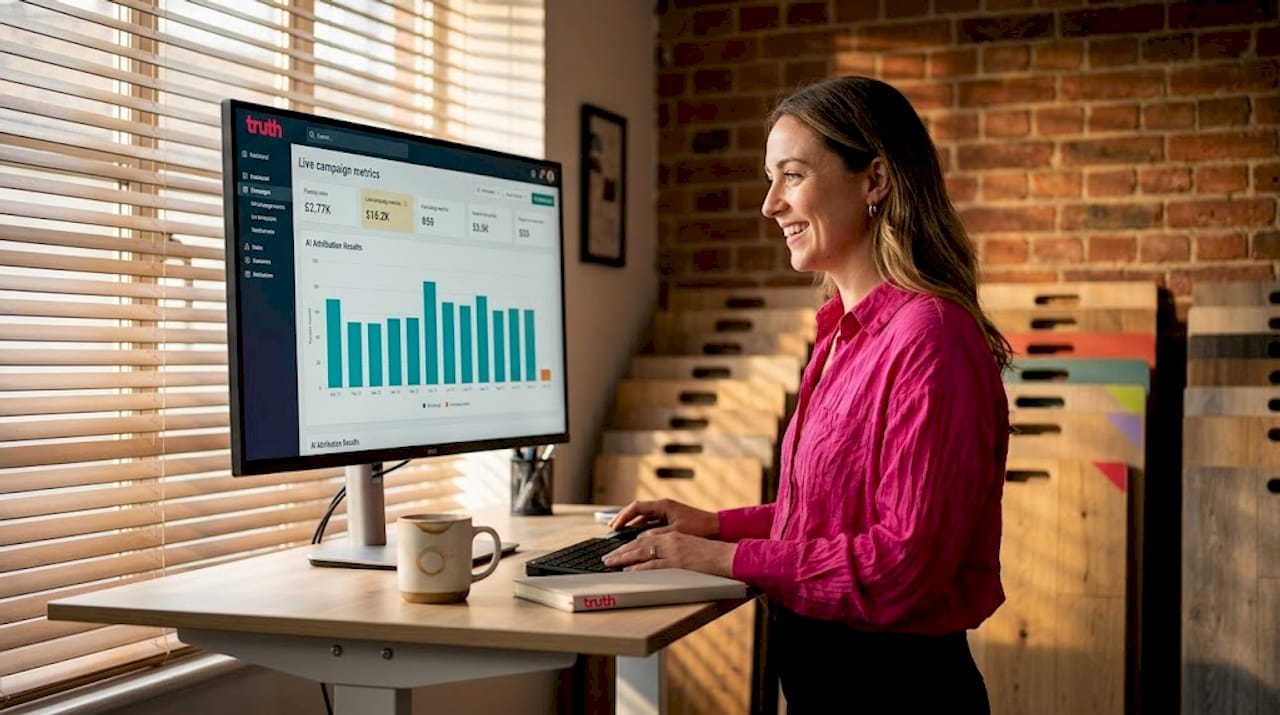
AI-powered attribution changes this entirely.
| Feature | Manual attribution | AI attribution |
|---|---|---|
| Data sources | Single channel (e.g. Google Ads only) | Cross-channel (ads, CRM, POS, footfall) |
| Reporting speed | Weekly or monthly static reports | Real-time dashboards |
| Accuracy | Estimated and often guessed | Data-driven and precise |
| Human input required | High (manual data merging) | Low (automated integrations) |
| Actionability | Slow to adjust campaigns | Immediate optimisation |
The table above illustrates why manual attribution falls short. When you are spending money across Google Ads, social media, and local SEO, you need to know which channel drove the customer who bought 80 square metres of engineered oak flooring last Tuesday. Manual reporting simply cannot do that reliably.
Closed-loop attribution platforms like Mackdata connect your marketing spend directly to revenue by integrating with your CRM and point-of-sale system. Every pound spent is traceable to an outcome. That is a fundamentally different way of running a marketing budget.
“Closed-loop attribution is not a nice-to-have. For any flooring business spending more than £1,000 per month on ads, it is essential.”
Real-time dashboards are a practical benefit too. Rather than waiting for a monthly report to discover that a campaign underperformed, you can see declining performance within days and reallocate budget immediately. This kind of agility was previously only available to large retail chains with dedicated analytics teams.
For flooring companies looking to understand how data-driven decisions support long-term growth, the work done through digital consultancy for flooring growth covers attribution and measurement as a core pillar of sustainable business development.
The bottom line: if you cannot measure it accurately, you cannot improve it. AI attribution removes the guesswork and gives you genuine control over your marketing spend.
Beyond the basics: Advanced AI, edge cases, and human synergy
With the fundamentals clear, it is time to uncover some advanced and nuanced uses for AI in your business. Getting these right separates flooring companies that see consistent growth from those that implement AI and then wonder why it is not working.
One area that is often overlooked is footfall analytics. Many flooring showrooms track visitor numbers, but the raw data includes staff, contractors, delivery drivers, and cleaning personnel. That noise skews your understanding of genuine customer traffic. AI Re-identification (Re-ID) technology filters out these non-customers automatically, giving you an accurate picture of real footfall. The United Carpets case study demonstrates how filtering non-customer traffic through AI Re-ID delivers far more precise showroom analytics, enabling better staffing decisions and more accurate conversion tracking.
Commercial and retail leads behave very differently from one another.
- Retail customers often decide within one or two visits. They respond well to urgency, visualisation tools, and personalised product recommendations.
- Commercial leads (offices, hotels, property developers) involve longer decision cycles, multiple stakeholders, and formal quotation processes.
AI can detect these patterns early by analysing browsing behaviour, enquiry type, and form submissions. It then routes commercial leads to a dedicated sales team and nurtures retail leads with automated follow-up sequences. Without this kind of intelligent routing, high-value commercial enquiries can sit in a generic inbox for days.
Pro Tip: Set up two separate lead flows in your CRM from the start. One for retail, one for commercial. Train your AI tools to classify leads into these flows based on keywords, enquiry size, and source. It saves significant time and prevents valuable commercial opportunities from being missed.
The human element matters enormously here. Industry experts note that AI works best when it augments human sales capability rather than attempting to replace it. A sales consultant supported by real-time AI insights closes more consistently than one operating purely on instinct. The AI provides context. The human provides relationship.
Integrated systems are non-negotiable if you want AI to function properly across your business. If your website, CRM, email platform, and POS system do not communicate with each other, data is lost at every junction. Building connected systems supports the kind of closed-loop performance that strong marketing funnels for flooring brands require.
Our take: What UK flooring leaders miss about AI
Most flooring businesses we speak to view AI as either a magic solution or a distant threat. Neither view is helpful.
The businesses that see real results treat AI as a practical tool. One that requires setup, data, and human oversight to function well. They do not expect it to replace their sales team. They use it to make their sales team better.
Here is what we consistently observe: flooring companies spend weeks deliberating over which AI tool to buy, then rush the implementation. They connect a chatbot to their website without feeding it proper product data. They run AI-generated content without reviewing it for accuracy or brand tone. Then they conclude that AI does not work for flooring.
That is not an AI problem. That is a deployment problem.
The real edge of AI for flooring businesses lies in real-time, actionable insight. Not the chatbot answering basic questions. Not even the room visualiser, as useful as it is. The genuine advantage is knowing, right now, which campaigns are producing revenue, which leads are ready to buy, and which customers are about to churn. That level of insight changes every decision you make.
Delaying AI adoption does leave easy wins on the table. We see competitors move faster and capture market share as a result. But rushing in without a plan is equally costly.
Our view, shaped by working exclusively with flooring businesses across the UK, is that AI works best as an enhancer for human judgement. The businesses that build consistent, confident decision-making by linking AI data with experienced sales people are the ones that grow most reliably. That is the real opportunity.
If you want to understand how a specialist approach makes a difference, read about why we are the no.1 digital marketing agency for the flooring industry and what that means for flooring businesses looking to grow sustainably.
Get started: AI-ready marketing for flooring brands
If you are serious about putting AI to work in your flooring business, the right next steps are practical and achievable. You do not need to overhaul everything at once.
Start with an audit of your current digital setup. Is your website fast, mobile-friendly, and structured for SEO? Our flooring website development service ensures your site is ready to support AI tools and integrations from day one. From there, improving your organic visibility through SEO for flooring companies gives AI content tools the right foundation to generate results. And for paid campaigns, our Google Ads management for flooring brands brings data-driven targeting to your ad spend, with attribution built in. Book a strategy session with us to review your current position and identify where AI can deliver the fastest, most measurable results for your business.
Frequently asked questions
How can AI increase my flooring showroom sales?
AI enables virtual room visualisation, 24/7 smart showrooms, and targeted recommendations that directly lift customer engagement and conversion rates. Grosvenor Flooring’s AI implementation expanded their service availability from 45 to 168 hours per week, capturing enquiries that would otherwise have been missed.
Is AI only for big flooring retailers?
AI platforms are now accessible and cost-effective for local showrooms and independent flooring businesses, not just large retailers. As Grosvenor Flooring’s case demonstrates, independent UK brands are already achieving national recognition through targeted AI adoption.
What is closed-loop attribution and why does it matter?
Closed-loop attribution connects your marketing spend to actual sales, letting you understand which campaigns drive revenue. Platforms like Mackdata achieve this by integrating with your CRM and point-of-sale system to give a complete, accurate picture of marketing performance.
How does AI improve marketing ROI for UK flooring companies?
AI delivers higher lead conversion rates, increased average order values, and better customer satisfaction by targeting the right prospects and personalising their journeys. Industry statistics show that AI-targeted leads achieve 50% higher conversion rates and AI personalisation boosts average order value by 18%.