


Two flooring businesses. Same city. Same monthly ad spend. One generates 40 enquiries a month, the other barely scrapes 8. The difference is rarely budget or even website quality. It is click-through rate, the metric that determines how many people who see your business actually bother to click. Most flooring business owners focus on getting more traffic, but if your CTR is poor, more traffic just means more wasted opportunity. This guide explains what CTR is, where it matters most for flooring firms, and exactly how to improve it.
Key Takeaways
| Point | Details |
|---|---|
| CTR is crucial | Click-through rate turns online views into real customer enquiries for flooring businesses. |
| Optimise visuals and keywords | Authentic images and high-intent local keywords can double or triple your CTR. |
| Test and measure results | Regular A/B testing, tracking, and refining your approach are essential for CTR improvement. |
| Avoid common mistakes | Steer clear of broad keywords and generic images, as they often decrease your CTR. |
| Multi-channel boosts performance | Combining Google, Meta, and SEO channels can increase conversions fivefold over single-channel approaches. |
What is CTR and why does it matter for flooring websites?
CTR, or click-through rate, is a straightforward calculation: clicks divided by impressions, multiplied by 100. If 1,000 people see your Google Ad and 30 click it, your CTR is 3%. Simple enough. But what that number reveals is far more important than the maths.
A high CTR tells you that your ad, listing, or call to action is relevant, compelling, and well-targeted. A low CTR tells you that people are seeing your business and choosing to scroll past. For a flooring company, that is a missed sale every single time.
CTR is not just a vanity metric. It directly affects your Google Ads quality score, which in turn affects how much you pay per click and how prominently your ads appear. Better CTR often means lower costs and more visibility, without increasing your budget.
The table below shows how CTR connects to real business outcomes for a flooring website:
| CTR level | What it signals | Business impact |
|---|---|---|
| Below 1% | Poor relevance or targeting | High spend, few enquiries |
| 1% to 3% | Average performance | Moderate enquiry volume |
| 3% to 6% | Strong relevance and copy | Good enquiry flow |
| Above 6% | Excellent targeting and creative | High ROI, strong lead pipeline |
“A flooring website with a 5% CTR on Google Ads will generate roughly five times more enquiries than one sitting at 1%, even with identical budgets and traffic volumes.”
It is also worth noting that CTR affects more than paid ads. Organic search listings, email campaigns, and social media posts all have click-through rates. Ignoring any one of them means leaving enquiries on the table. Avoiding flooring website mistakes that reduce relevance is a good starting point for lifting CTR across the board.
Where CTR matters: key channels for flooring businesses
CTR does not live in one place. It shows up across every digital channel your flooring business uses, and each one behaves slightly differently. Understanding where your clicks are coming from, and where they are not, is the first step to fixing the gaps.
Google Ads is where CTR has the most immediate financial impact. Every time someone searches “carpet fitter in Bristol” or “LVT flooring near me” and your ad appears, that is an impression. If your headline is weak or your offer is unclear, they will click a competitor instead. CTR applies directly to Google Ads, organic search results, and display and social ads, making it a universal measure of digital performance.
Organic search listings are often overlooked as a CTR opportunity. Your meta title and description are essentially free ad copy. A well-written description that mentions your location, your specialism, and a clear benefit will consistently outperform a generic one.
Meta (Facebook and Instagram) and Google Display ads rely heavily on visual impact. Strong imagery and concise copy can dramatically lift engagement. Running flooring ad examples across multiple platforms is not just about reach. Multi-channel campaigns outperform single-channel by up to 5x in conversions, which makes blending paid and organic channels a smart long-term strategy.
Here is how the main channels compare for flooring businesses:
| Channel | Average CTR range | Key CTR driver |
|---|---|---|
| Google Ads (search) | 2% to 6% | Headline relevance, keyword match |
| Organic search (SEO) | 1% to 8% | Meta title, position, rich snippets |
| Google Display | 0.1% to 0.5% | Visual creative, audience targeting |
| Meta (Facebook/Instagram) | 0.5% to 2% | Image quality, offer clarity |
The most effective digital marketing strategies for flooring businesses combine at least two of these channels. Relying on a single source of traffic is fragile. Combining Google Ads with strong organic SEO and occasional Meta campaigns creates a more resilient and higher-converting presence.
- Use Google Ads for immediate, high-intent traffic
- Use SEO for long-term visibility and lower cost-per-click
- Use Meta for brand awareness and retargeting warm audiences
- Use Google Display to stay visible to past website visitors
What influences CTR for flooring websites?
Knowing that CTR matters is one thing. Knowing what actually moves it is another. There are four primary levers that flooring businesses can pull to improve click-through rates across all channels.
Imagery is the biggest lever on paid and social channels. Authentic renovation images double CTR compared to stock photos, and benefit-driven headlines boost CTR by 3.2 times. Real before-and-after shots of a herringbone oak floor you installed in a Manchester semi-detached will always outperform a generic image of a smiling couple standing on carpet.

Headlines and copy need to lead with the benefit, not the feature. “Transform your home with engineered oak flooring” will outperform “We supply and fit engineered oak flooring” every time. The first speaks to the customer’s desire. The second just describes what you do.
Here are the top five factors that influence CTR for flooring websites:
- Headline specificity — include the flooring type, location, and a clear benefit
- Authentic imagery — use real project photos, not stock visuals
- High-intent keywords — phrases like “LVT fitter in Leeds” attract buyers, not browsers
- Clear calls to action — “Get a free quote today” beats “Contact us”
- Consistent brand visuals — recognisable colours and fonts build trust across channels
Keyword targeting deserves special attention. Broad terms like “flooring” attract enormous volumes of irrelevant traffic. Specific, location-based phrases attract people who are ready to buy. Running well-structured Google Ads for flooring with tightly grouped ad sets and matched landing pages is one of the fastest ways to lift CTR and reduce wasted spend. A well-managed Google Ads strategy built around high-intent terms will consistently outperform a broad, untargeted campaign.
Pro Tip: Test two versions of every ad headline simultaneously. Run them for two weeks, then keep the winner and test a new challenger. This simple habit compounds into significant CTR gains over a quarter.
Benchmarking and improving your CTR: practical steps
Before you can improve your CTR, you need to know where you stand. Most flooring businesses have no idea what their current click-through rates are, which makes optimisation guesswork. Pull your data from Google Ads and Google Search Console first.
Here are realistic CTR benchmarks for UK flooring businesses in 2026:
| Channel | Weak CTR | Average CTR | Strong CTR |
|---|---|---|---|
| Google Ads (search) | Below 1.5% | 2% to 3.5% | Above 4% |
| Organic search | Below 1% | 2% to 4% | Above 5% |
| Meta ads | Below 0.4% | 0.6% to 1.2% | Above 1.5% |
| Google Display | Below 0.1% | 0.2% to 0.4% | Above 0.5% |
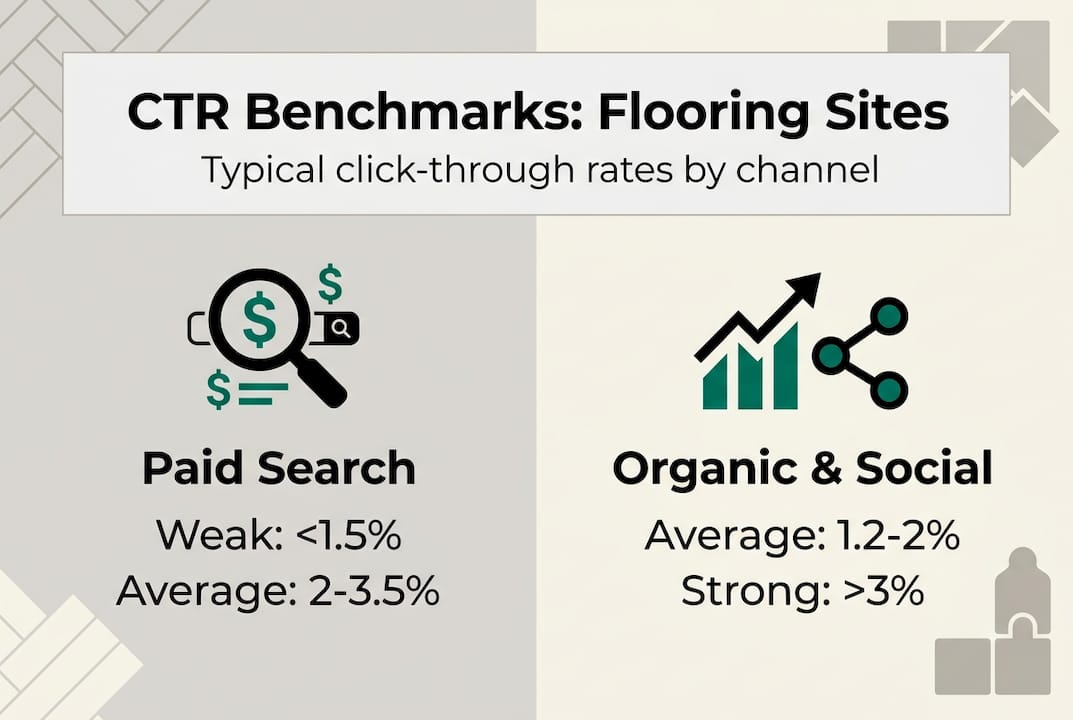
For a full breakdown of CTR benchmarks across industries, it is worth reviewing sector-specific data rather than relying on generic averages.
Once you know your baseline, follow this five-step process to improve it:
- Audit your current headlines and descriptions — are they benefit-led and location-specific?
- Replace stock images with real project photography across all paid campaigns
- Refine your keyword list using phrase and exact match targeting to cut irrelevant impressions
- Split-test landing pages to ensure the page matches the promise in the ad
- Monitor performance weekly and make one change at a time so you know what is working
Allocating around 10% of your paid budget to testing new creative and copy is a proven method for sustained CTR improvement. Small, consistent experiments beat occasional large overhauls. Download the Free Flooring Growth Pack to get a structured framework for tracking and improving your digital performance.
Pro Tip: Combine PPC, Meta, and SEO efforts rather than treating them as separate campaigns. A customer who sees your Google Ad, then your Instagram post, then finds you organically is far more likely to enquire than one who only encounters you once.
Common pitfalls and quick fixes for CTR losses
Even flooring businesses with solid marketing budgets can haemorrhage clicks through avoidable mistakes. Recognising these patterns early saves both money and momentum.
Broad keyword targeting is the most common and costly error. Bidding on terms like “flooring” or “carpets” means your ads appear for searches like “flooring ideas for dollhouses” or “carpet cleaning tips.” These impressions drag your CTR down and burn budget. High-intent local keywords and authentic visuals consistently outperform broad targeting in both CTR and conversion rate.
Here are the most frequent CTR pitfalls and how to fix them:
- Broad keywords: Switch to phrase and exact match; add negative keywords to block irrelevant searches
- Stock imagery: Replace with real project photos; even smartphone shots of your work outperform generic visuals
- No local relevance: Mention your service area in headlines, descriptions, and landing pages
- Missing conversion tracking: Without tracking, you cannot tell which clicks lead to enquiries
- Mismatched landing pages: If your ad says “oak flooring Bristol” but the page is generic, visitors leave immediately
Neglecting to localise your landing page content is a particularly damaging mistake. A customer in Sheffield who clicks an ad for “wood flooring Sheffield” and lands on a page that mentions no location loses trust instantly. Relevance between ad and page is one of the strongest signals for both CTR and conversion. Reviewing common mistakes to avoid on your flooring website is a practical way to identify where you may be losing clicks before they become enquiries.
Pro Tip: Set up conversion tracking in Google Ads before you spend another penny. Knowing which keywords and ads generate actual enquiries, not just clicks, is the only way to optimise with confidence.
Taking your flooring website CTR further: expert support
Improving CTR is not a one-off task. It is an ongoing process of testing, refining, and adapting to what your customers respond to. The flooring businesses that consistently generate strong enquiry volumes are the ones that treat digital marketing as a discipline, not a set-and-forget activity.
At Truth Digital, we work exclusively with flooring businesses across the UK, which means we understand the specific search behaviours, seasonal patterns, and competitive pressures you face. Our flooring SEO services and Google Ads management are built around driving qualified clicks that turn into real enquiries, not just traffic. You can also explore our flooring website success stories to see the kind of results we deliver for businesses like yours. If you want a clear picture of where your CTR stands and what to do about it, get in touch for a straightforward conversation about your digital performance.
Frequently asked questions
What is a good CTR for flooring websites in the UK?
A good CTR for Google Ads in the UK flooring sector sits between 2% and 6%, while strong organic click-through rates can reach 3% to 8% depending on your search position and how well your meta description is written.
Why is my flooring website’s CTR low, even with lots of impressions?
High impressions with low CTR almost always point to weak headlines, stock imagery, or poor keyword targeting. Benefit-driven headlines and authentic project photos are the fastest fixes.
Which keywords improve CTR most for flooring companies?
High-intent local phrases such as “engineered oak flooring Leeds” or “carpet fitter near me” attract buyers who are ready to enquire, rather than browsers who are still in the research phase. Prioritising local keywords consistently delivers better CTR and lower cost per enquiry.
How often should I review and optimise my flooring website CTR?
Review CTR data weekly and run fresh creative tests monthly. Tracking conversions daily and allocating around 10% of your paid budget to testing ensures your campaigns keep improving rather than plateauing.

