


TL;DR:
- Building a flooring ads funnel involves integrating Google Ads, Meta Ads, and CRM systems to effectively attract and convert leads throughout a multi-week decision cycle. Proper infrastructure, including GCLID tracking, segmented landing pages, and offline conversion imports, is essential for measurable results. Segmenting campaigns by product type and audience intent, along with fast follow-up, significantly improves lead quality and revenue.
A flooring ads funnel is a strategic marketing system designed to attract, qualify, and convert leads through targeted advertising and structured follow-up processes. Most flooring businesses run ads without one, which means they pay for clicks that never become customers. By combining Google Ads, Meta Ads, CRM integration, and offline conversion tracking, you can build a flooring marketing funnel that generates measurable revenue, not just traffic. This guide walks you through every stage: from the technology stack you need, to multi-channel campaign structure, to the nurture sequences that close sales during the typical four to six week flooring decision cycle.
How to build a flooring ads funnel: tools and prerequisites
Before you run a single ad, you need the right infrastructure in place. Without it, you cannot measure what is working, and you will optimise for the wrong signals.
Here is what you need before launching:
- Google Ads account with conversion tracking enabled and auto-tagging switched on to capture GCLID parameters
- Meta Ads account with the Meta Pixel installed on your website and events configured for lead form submissions
- CRM system capable of storing lead records alongside GCLID values and hashed first-party data (HubSpot, Salesforce, and Zoho CRM all support this)
- Landing pages segmented by flooring product type, such as carpet, LVT, wood flooring, and commercial flooring
- Lead capture forms that pass the GCLID parameter into a hidden field and store it with each submission
- Offline conversion import method: manual CSV upload, Google Sheets integration, or API automation via Zapier
- Email and SMS automation configured to trigger immediately after lead capture
| Tool | Purpose | Minimum requirement |
|---|---|---|
| Google Ads | Search and display acquisition | Conversion tracking active |
| Meta Ads | Demand generation and retargeting | Pixel installed, events firing |
| CRM | Lead storage and GCLID capture | Custom field for GCLID |
| Landing page builder | Segment-specific conversion pages | One page per flooring type |
| Email/SMS platform | Automated nurture sequences | Day 0 trigger configured |
Pro Tip: Set up your CRM’s hidden GCLID field before you write a single ad. If you launch campaigns first and add tracking later, you will lose attribution data that cannot be recovered.
How should you structure your flooring ad funnel campaigns?
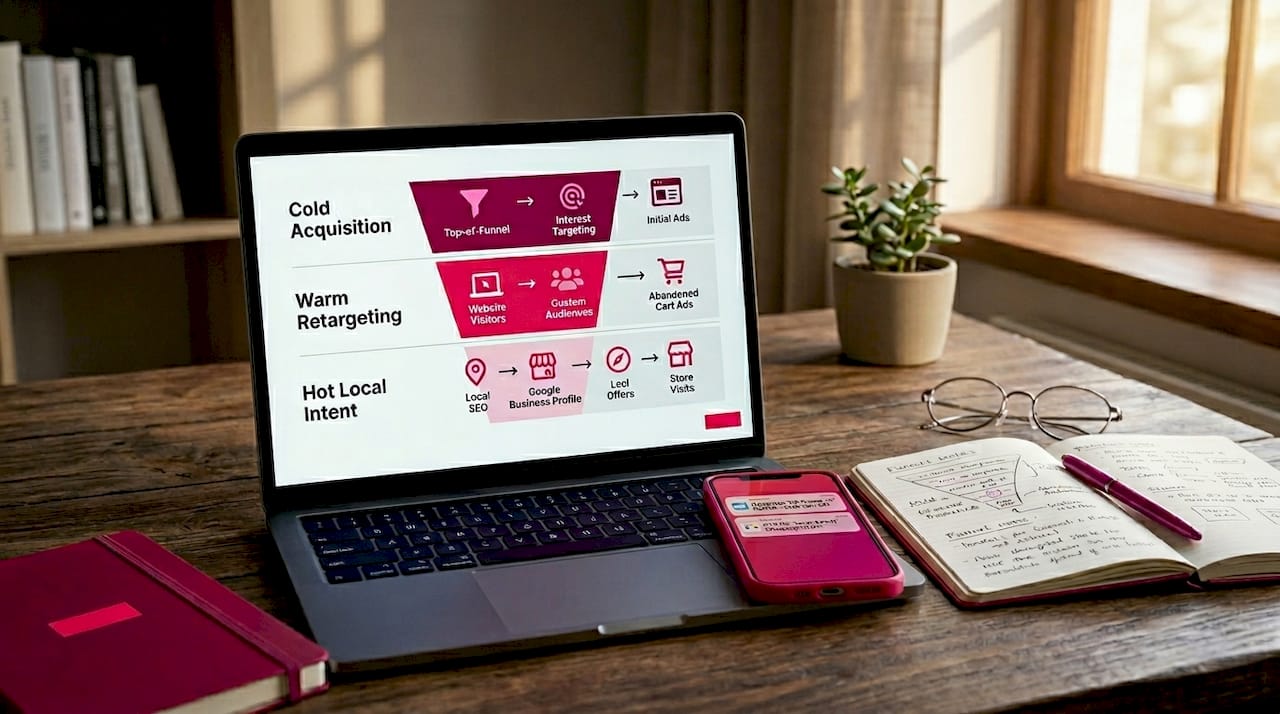
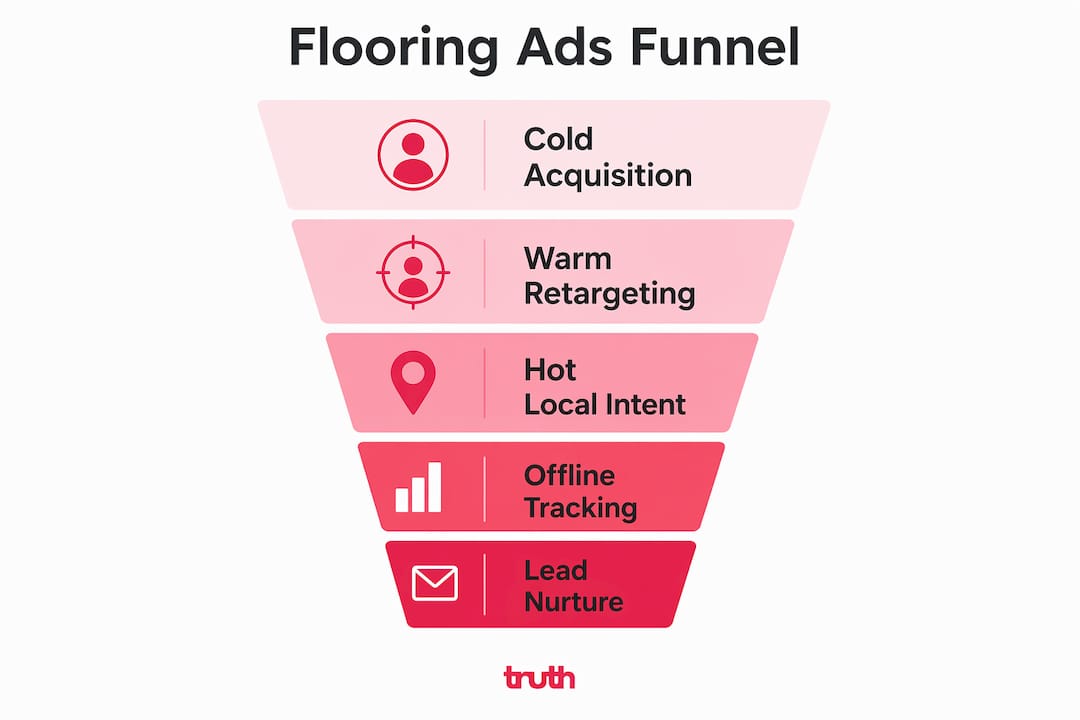
A well-built flooring ad funnel strategy operates across three distinct layers: cold acquisition, warm retargeting, and hot local intent. Each layer requires different platforms, messaging, and calls to action.
Cold acquisition: Google Ads and Meta Ads
Google Ads captures people who are already searching for flooring. These are decision-stage buyers typing queries like “LVT flooring fitter near me” or “carpet installation quote.” Your Google campaigns should target high-intent keywords and send traffic to product-specific landing pages, not your homepage. Adding Meta Ads alongside Google lifts conversions from 2% to 11% in flooring funnel case studies. That is because Google captures demand, while Meta nurtures consideration among people who have not yet started searching.
Meta campaigns at the cold stage should use segmented ad sets by flooring type. A campaign targeting homeowners interested in home renovation will perform differently to one targeting landlords or commercial property managers. Separate them from day one.
Warm retargeting: keeping your brand visible
Retargeting campaigns yield a 34% close rate versus 18% for cold traffic, which reflects the reality that most flooring buyers research for four to six weeks before committing. Retargeting keeps you visible throughout that cycle. The most effective creative format at this stage is the “before and after” transformation. Show a tired, dated floor alongside the finished result. It is specific, visual, and directly relevant to what the buyer is imagining for their own home.
Hot local intent: the Map Pack lane
Google Map Pack listings drive 40% of local flooring search traffic, and the lead quality is higher than Google Ads alone because Map Pack users are further along in the buying process. They need frictionless next steps: a click-to-call button, a directions link, or a simple estimate request form. Do not send Map Pack traffic to a generic landing page. These buyers want to act now. Give them a direct route to contact you. You can find detailed guidance on this in our local listings optimisation guide.
| Funnel layer | Platform | Primary CTA | Audience temperature |
|---|---|---|---|
| Cold acquisition | Google Ads, Meta Ads | Request a quote | Cold |
| Warm retargeting | Meta Ads, Google Display | View portfolio, book visit | Warm |
| Hot local intent | Google Map Pack | Call now, get directions | Hot |
Pro Tip: Use geo-targeting by neighbourhood for your Meta retargeting campaigns. Flooring is a local business. Showing ads to people within a 10-mile radius of your showroom dramatically improves relevance and reduces wasted spend.
How does offline conversion tracking work for flooring funnels?
Offline conversion tracking is the process of linking ad clicks to revenue by capturing the GCLID parameter from each ad click and importing the resulting sale or qualified lead back into Google Ads. Without it, Google’s Smart Bidding optimises for form fills, not customers. With it, you tell the algorithm which clicks actually turned into booked jobs.
Here is the step-by-step setup:
- Enable auto-tagging in your Google Ads account settings. This appends the GCLID parameter to every ad click URL automatically.
- Add a hidden form field labelled “gclid” to every landing page form. Use JavaScript to populate it from the URL parameter on page load.
- Store the GCLID in your CRM alongside the lead’s name, email, phone number, and flooring product interest. Create a dedicated custom field for this.
- Create conversion actions in Google Ads for each meaningful funnel stage: quote requested, appointment booked, and job won.
- Import offline conversions using one of four methods: manual CSV upload, Google Sheets with a scheduled refresh, Zapier automation, or direct API integration.
- Assign dynamic conversion values based on job size. A commercial flooring installation is worth more than a single-room carpet fit. Feed that difference back to Google so Smart Bidding can prioritise higher-value clicks.
| Import method | Best for | Technical requirement |
|---|---|---|
| Manual CSV upload | Very small businesses | None |
| Google Sheets import | Small to mid-size businesses | Basic spreadsheet skills |
| Zapier automation | Businesses using popular CRMs | Zapier account |
| API integration | Larger operations | Developer resource |
The most common issue with GCLID capture is that the parameter gets stripped by redirects or cookie consent tools. Test your setup by clicking your own ad, submitting the form, and checking whether the GCLID appears in your CRM record. If it does not, the hidden field is not firing correctly.
Pro Tip: Automate your offline conversion imports on a daily schedule rather than uploading manually. Continuous automated imports feed Smart Bidding faster and reduce the risk of formatting errors that cause rejected uploads.
What does an effective lead nurture sequence look like?
A lead captured from a flooring ad is rarely ready to buy on the same day. The typical flooring decision cycle runs four to six weeks, and most businesses lose sales simply by failing to follow up consistently. A timed drip nurture system using email and SMS keeps your business front of mind throughout that window.
Here is what a practical nurture sequence looks like:
- Day 0: Automated email confirming receipt of the enquiry, including your portfolio link and a clear next step (book a home visit or visit the showroom)
- Day 1: SMS follow-up from the sales team to confirm the enquiry and offer a call
- Day 3: Email featuring a relevant case study or before-and-after project matched to the flooring type the lead enquired about
- Day 7: If no sales owner has been assigned or the lead has not responded, trigger an internal alert and send a second email with a time-sensitive offer
- Day 14: Retargeting ad served via Meta Ads showing social proof content such as reviews or completed projects
- Day 21 and Day 30: Final nurture emails with a soft close and a direct booking link
Personalise every message around the flooring product the lead originally enquired about. A lead who asked about engineered oak flooring should not receive a generic carpet email. Your CRM should store the product interest field and your email platform should use it to pull the correct content block.
Route leads to your sales team the moment they show buying signals: replying to an email, clicking a booking link, or calling your number. A broader appointment funnel that covers marketing, lead collection, persuasion, automation, and follow-up improves booking-to-sale ratios more than any single landing page change.
Pro Tip: Split your nurture sequences by lead source. Google Ads leads are typically further along in the decision process than Meta Ads leads. Google leads can receive a shorter, more direct sequence. Meta leads often need more education and inspiration before they are ready to book.
Common mistakes when building and optimising flooring funnels
Most flooring businesses make the same errors when they first build a funnel. Recognising them early saves significant budget.
- Not capturing GCLID at all. If your forms do not store the GCLID, every offline conversion is invisible to Google. You end up optimising for clicks, not customers.
- Running one campaign for all flooring types. Carpet buyers and commercial LVT buyers have completely different motivations, budgets, and timelines. Mixing them into one campaign dilutes your messaging and raises your cost per lead.
- Skipping retargeting entirely. Cold traffic rarely converts on the first visit. Without a retargeting layer, you are paying to introduce your brand to people and then letting competitors close them.
- Ignoring the Map Pack. Separate funnel lanes for Map Pack traffic versus paid ad traffic are necessary because the intent and urgency are fundamentally different. Treating them the same wastes high-quality local leads.
- Following up too slowly. A lead that does not receive contact within the first hour is significantly less likely to convert. Speed matters more than the quality of your follow-up message.
- Uploading offline conversions irregularly. Infrequent imports mean Smart Bidding is working with stale data. Schedule daily imports and check for formatting errors weekly.
“The flooring businesses that win with paid advertising are not necessarily the ones with the biggest budgets. They are the ones with the tightest systems: accurate tracking, fast follow-up, and campaigns that speak directly to what each type of buyer actually wants.”
What I have learned from building flooring funnels that actually work
After working with flooring businesses across the UK, one thing is consistently true: the businesses that see the best results from paid advertising are not the ones spending the most. They are the ones with the most disciplined systems behind their ads.
Single-platform campaigns almost always underperform. The moment we add Meta retargeting alongside Google Ads, lead quality improves and cost per acquisition drops. The two platforms serve different psychological moments in the buyer’s journey, and you need both.
Offline conversion tracking is the single biggest unlock I have seen for flooring ad performance. Before it, campaigns optimise for form fills. After it, they optimise for booked jobs and revenue. That shift changes everything about how Smart Bidding allocates budget.
Segmentation is not optional. A flooring business running one generic campaign for carpets, wood flooring, LVT, and commercial work is leaving money on the table. Each product type needs its own campaign, its own landing page, and its own nurture sequence. The extra setup time pays back quickly in lower cost per lead and higher close rates.
Fast follow-up is the variable most businesses underestimate. The nurture sequence matters, but nothing replaces a phone call or SMS within the first hour of a lead coming in. Automate the first touch. Then get a human on it.
— John
Ready to build a flooring ads funnel that generates real enquiries?
At Truthdigital, we build and manage complete digital marketing systems for flooring businesses across the UK. From high-converting flooring business websites built to capture leads, to fully managed Google Ads for flooring companies with offline conversion tracking built in, we handle the technical setup so you can focus on the jobs.
We also run flooring SEO campaigns and email marketing sequences that complement your paid ads and keep leads moving through the funnel. If you want a funnel that actually connects ad spend to revenue, get in touch and we will map out exactly what that looks like for your business.
FAQ
What is a flooring ads funnel?
A flooring ads funnel is a structured marketing system that uses paid advertising, landing pages, CRM integration, and automated follow-up to attract, qualify, and convert flooring leads into booked jobs. It spans multiple channels including Google Ads, Meta Ads, and local Map Pack listings.
How long does it take to see results from a flooring marketing funnel?
Most flooring businesses see initial lead data within the first two to four weeks of launching campaigns, but meaningful optimisation data from offline conversion tracking typically takes six to eight weeks to accumulate. The nurture sequences deliver compounding results over the four to six week decision cycle.
Why is GCLID capture important for flooring ad funnels?
GCLID capture links each ad click to the eventual offline sale, enabling Google’s Smart Bidding to optimise for revenue rather than form fills. Without it, your campaigns cannot distinguish between a click that became a £5,000 job and one that went nowhere.
Which platform works better for flooring ads: Google or Meta?
Neither platform works best in isolation. Google Ads captures high-intent buyers who are actively searching, while Meta Ads nurtures consideration among people earlier in the research process. Combining both platforms lifts conversion rates substantially compared to running either alone.
How do I segment my flooring ad campaigns effectively?
Segment campaigns by flooring product type (carpet, LVT, wood flooring, commercial) and by audience intent level (cold, warm, local). Each segment should have its own ad creative, landing page, and nurture sequence to match the specific motivations and buying timeline of that buyer type.

