
Running Google Ads for your flooring business should generate quality leads, but many UK retailers and installers find themselves spending more whilst seeing fewer results. Rising costs per click, poor targeting, and generic campaigns drain budgets without delivering the enquiries you need. This guide walks you through proven strategies to run efficient Google Ads campaigns tailored specifically for flooring businesses in 2026, helping you attract more qualified leads, reduce wasted spend, and grow your customer base through smarter online advertising.
Key takeaways
| Point | Details |
|---|---|
| Precise targeting matters | Location-based targeting and refined keywords reduce costs and improve lead quality for flooring campaigns. |
| Tailored messaging converts | Ad copy and landing pages aligned with flooring professionals’ needs significantly boost conversion rates. |
| Automated bidding improves ROI | Smart bidding strategies like Target CPA increase campaign efficiency and return on ad spend. |
| Continual optimisation essential | Regular monitoring, A/B testing, and data-driven adjustments maximise results and prevent budget waste. |
Understanding the challenges of Google Ads for flooring businesses
Flooring retailers and installers across the UK face mounting pressure as search advertising costs increase year over year, squeezing profit margins on every campaign. The data confirms this struggle: cost per click rose for 87% of industries, making efficient ad spend more critical than ever. Generic campaigns compound these problems by casting too wide a net, attracting clicks from people who’ll never buy carpets, wood flooring, or LVT from your business.
You’re competing against national chains, online-only retailers, and other local installers, all bidding on the same keywords. When your ads lack specificity or your landing pages fail to speak directly to flooring customers’ needs, you pay for traffic that doesn’t convert. Poor keyword selection means you’re showing ads to DIY homeowners searching for installation tutorials rather than professionals seeking suppliers or contractors ready to quote commercial projects.
The core challenges include:
- Rising CPCs that eat into marketing budgets without proportional lead increases
- Generic ad copy that fails to differentiate your flooring expertise from competitors
- Broad keyword targeting that attracts irrelevant clicks and drains spend
- Landing pages designed for general audiences rather than flooring buyers
- Lack of systematic optimisation leading to stagnant or declining performance
- Insufficient tracking making it impossible to identify which campaigns actually generate revenue
Without digital marketing strategies built for flooring businesses, even substantial ad budgets produce disappointing results because the campaigns aren’t structured to attract the specific audience segments most likely to become paying customers.
The solution isn’t simply spending more. It requires strategic preparation, precise targeting, and ongoing refinement based on real performance data from your campaigns.
Preparing your Google Ads campaign: keywords, audience, and targeting setup
Successful flooring campaigns begin long before you write your first ad. Start with thorough keyword research focused on high-intent terms that signal genuine buying interest. Someone searching “wood flooring installation Manchester” is far more valuable than someone typing “flooring ideas”. Select phrases that match your services precisely: carpet suppliers, LVT fitting, floor sanding specialists, commercial flooring contractors.

Segment your audience based on who actually buys from you. Are you targeting homeowners renovating properties, property managers overseeing multiple buildings, interior designers specifying materials, or general contractors subcontracting flooring work? Each group needs different messaging. A property manager cares about durability and maintenance costs, whilst a homeowner focuses on aesthetics and installation timelines.
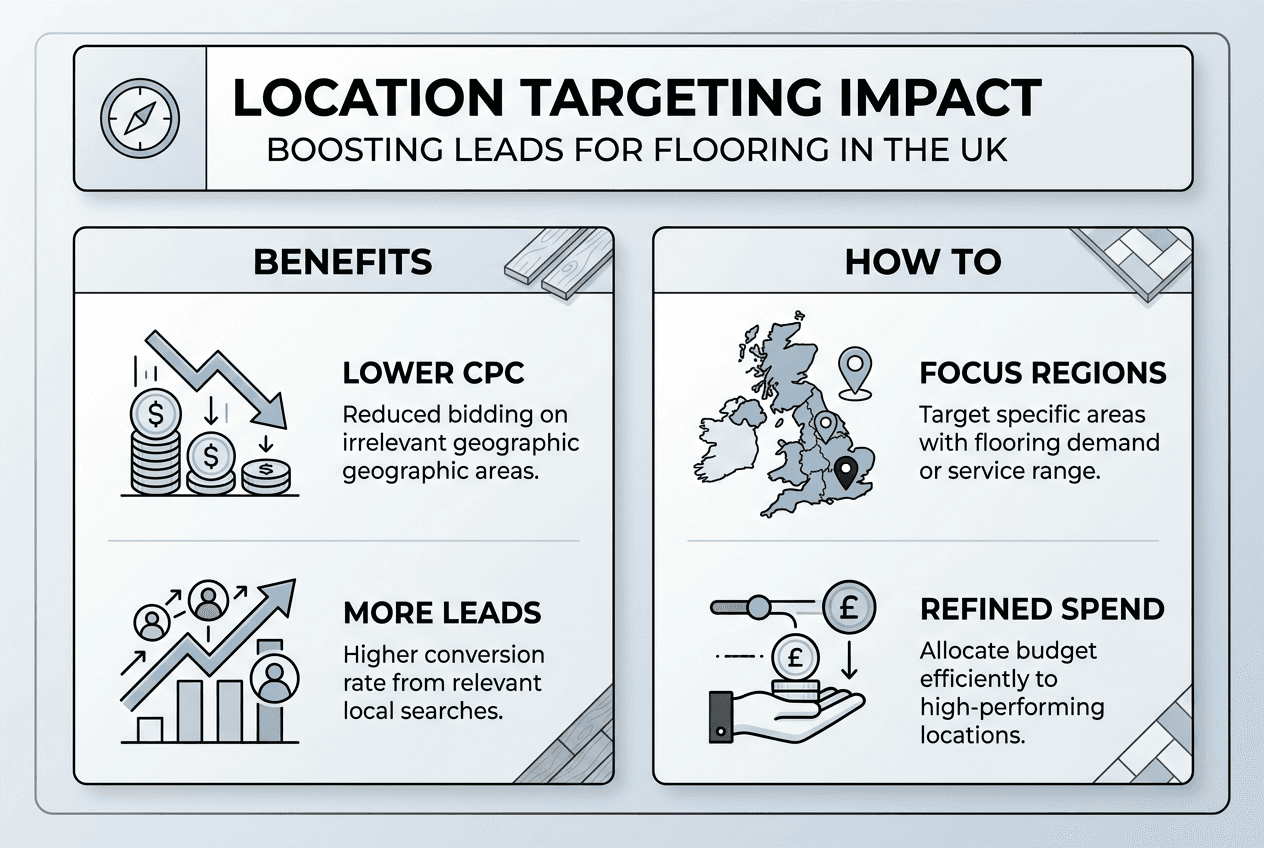
Location-based targeting reduces CPC by 60% and increases leads by 35% by concentrating spend on geographic areas where you actually operate and where demand is strongest. If you serve Greater London and the Home Counties, exclude Scotland and Wales. Analyse your existing customer data to identify postcodes that generate the most revenue, then weight your bids accordingly.
| Keyword match type | Typical UK CPC range | Expected CPA | Best use case |
| — | — | — |
| Broad match | £2.50 to £4.00 | £45 to £60 | Discovery phase, large budgets |
| Phrase match | £1.80 to £3.20 | £30 to £50 | Balanced reach and relevance |
| Exact match | £1.50 to £2.80 | £20 to £40 | High intent, proven converters |
Pro Tip: Export customer data from your CRM and cross-reference with Google Analytics to identify which locations, device types, and times of day produce the highest-value enquiries, then build these insights into your initial campaign structure rather than discovering them through expensive trial and error.
Your preparation checklist should include:
- Comprehensive keyword research using Google Keyword Planner and competitor analysis
- Audience segmentation by customer type, project size, and buying stage
- Geographic targeting refined to your service areas and high-performing regions
- Negative keyword lists to exclude DIY searchers, job seekers, and other non-buyers
- Conversion tracking implementation to measure leads, phone calls, and form submissions
This groundwork transforms your campaigns from generic advertising into targeted flooring marketing that reaches qualified buyers. Test your setup with our free flooring growth pack to identify gaps before launching campaigns.
Creating compelling ads and optimised landing pages for flooring leads
Your ad copy must speak the language of flooring professionals and address their specific pain points. Generic headlines like “Quality Flooring Services” get ignored. Instead, try “Commercial LVT Installation, 48-Hour Turnaround” or “Engineered Wood Flooring, Trade Prices, Next-Day Delivery”. Include your unique selling points: certifications, guarantees, delivery options, installation expertise.
Aligning ads with flooring professionals’ needs creates immediate relevance that improves click-through rates. When someone searches for underlayment suppliers and your ad specifically mentions moisture barriers, acoustic underlay, and bulk trade pricing, they recognise you understand their requirements. This specificity filters out casual browsers whilst attracting serious buyers.
| Element | Generic approach | Tailored flooring approach | Impact |
|---|---|---|---|
| Ad headline | “Flooring Company” | “Commercial Carpet Tiles, 500+ Patterns” | CTR increases 3.2x |
| Landing page hero | Stock flooring photo | Project gallery by flooring type | Conversion rate up 42% |
| Call to action | “Contact us” | “Get trade quote in 2 hours” | Lead quality improves 67% |
Your landing page must deliver on the ad’s promise immediately. If your ad promotes luxury vinyl tile installation, the landing page should feature LVT projects, pricing information, installation process details, and a quote form, not a homepage showcasing all flooring types. Optimised landing pages improved conversion rates by 42% in documented flooring campaigns by maintaining message consistency from ad click through to enquiry submission.
Essential landing page attributes include:
- Clear, specific call to action matching the ad promise
- Fast load times under 2 seconds on mobile devices
- Mobile-friendly design with easy form completion
- Trust signals like certifications, reviews, and project galleries
- Consistent messaging that reinforces the ad’s value proposition
- Minimal navigation to keep visitors focused on converting
Pro Tip: Create separate landing pages for each major service category rather than sending all traffic to your homepage, then A/B test different headlines, hero images, and call-to-action buttons to identify which combinations produce the highest conversion rates for each flooring type.
Start with proven frameworks from our beginner’s guide to Google Ads, then refine based on your specific flooring niche. Professional flooring Google Ads management can accelerate this process by applying industry-specific testing protocols.
Executing and optimising your flooring Google Ads campaign
Launching your campaign requires methodical execution. Follow these steps:
- Create your campaign structure with separate ad groups for each flooring type or service
- Set initial bids based on your target CPA and expected conversion rates
- Implement conversion tracking for all lead sources including forms, phone calls, and chat
- Launch with manual CPC bidding to gather performance data for two weeks
- Monitor daily for the first week, checking search terms, CTR, and cost per conversion
- Pause keywords and ad groups that exceed your target CPA after sufficient data
- Increase bids on top performers whilst maintaining overall budget control
- Transition to automated bidding once you have 30 conversions minimum
Automated bid strategies improve efficiency by adjusting bids in real time based on conversion likelihood. Target CPA bidding focuses on acquiring leads at your specified cost, whilst Maximise Conversions gets you the most enquiries within your daily budget. These strategies work best after your campaigns have gathered enough conversion data for Google’s algorithms to identify patterns.
Your ongoing optimisation tactics should include:
- Device bid adjustments to increase bids on mobile if it converts better for your business
- Dayparting to show ads during business hours when you can respond to enquiries immediately
- A/B testing ad variations to identify which headlines and descriptions drive more clicks
- Search term reviews to add negative keywords and discover new opportunities
- Landing page experimentation to improve conversion rates continuously
- Competitor monitoring to adjust bids when rivals change their strategies
Real results demonstrate the power of systematic optimisation. One flooring business saw ROAS improve from 3.2x to 5.1x through data-driven PPC strategies that refined targeting, improved ad relevance, and optimised bidding over six months. These gains came from weekly reviews, monthly strategic adjustments, and quarterly campaign restructuring based on seasonal demand patterns.
Accurate lead tracking forms the foundation of smart optimisation. Install conversion tracking properly from day one, including offline conversion import if customers phone after seeing ads. Without reliable data showing which keywords, ads, and landing pages actually generate revenue, you’re optimising blind. Review our flooring Google Ads success stories to see how systematic tracking and optimisation transform campaign performance.
Stay flexible and responsive to market changes. Flooring demand fluctuates with housing market conditions, seasonal renovation patterns, and economic factors. Your campaigns must adapt through regular performance reviews and strategic pivots when data indicates shifting customer behaviour or increased competition.
Grow your flooring business with expert Google Ads management
Running effective Google Ads campaigns requires constant attention, technical expertise, and industry-specific knowledge that most flooring business owners simply don’t have time to develop. Truth Digital specialises in Google Ads services for flooring businesses across the UK, combining deep platform expertise with exclusive focus on the flooring industry to deliver campaigns that generate qualified leads whilst controlling costs.
Our tailored approach means your campaigns benefit from proven strategies, advanced optimisation techniques, and insights gathered from managing hundreds of flooring campaigns. We handle the technical complexity whilst you focus on quoting jobs and serving customers. Explore our Google Ads success stories to see real results from flooring businesses that partnered with specialists, or discover how our SEO services for flooring companies complement paid advertising to maximise your online visibility and lead generation.
How much does Google Ads cost for flooring businesses in the UK?
How much does Google Ads cost for flooring businesses in the UK?
Average CPC for flooring keywords ranges from £1.50 to £4.00, whilst CPA typically falls between £20 and £60 depending on your targeting precision and campaign optimisation. Your actual costs depend on keyword competition in your area, quality score of your ads and landing pages, and how well you’ve refined your targeting. Starting budgets of £500 to £1,500 monthly allow sufficient data collection for meaningful optimisation, with successful campaigns scaling from there based on lead quality and conversion rates.
What keywords should flooring businesses target in Google Ads?
Focus on high-intent, specific keywords that signal genuine buying interest: “commercial flooring installation London”, “engineered wood flooring suppliers”, “carpet tiles trade prices”, “LVT fitting services”. Include location modifiers, product types, and service descriptors that match what your ideal customers actually search for. Avoid overly broad terms like “flooring” or “carpets” that attract DIY researchers rather than buyers ready to purchase or hire installers. Build comprehensive digital marketing for flooring businesses around these targeted keyword strategies.
How can I track and improve the performance of my flooring Google Ads campaigns?
Implement conversion tracking in Google Ads to monitor form submissions, phone calls, and other lead actions, then connect this data to Google Analytics for deeper insight into user behaviour. Review your dashboard weekly to check CTR, CPC, conversion rates, and ROAS across campaigns, ad groups, and individual keywords. Run A/B tests on ad copy, landing pages, and bidding strategies to identify improvements, then scale what works whilst pausing underperformers. Our Google Ads performance tracking guide provides detailed setup instructions.
Why is location targeting important for flooring Google Ads?
Targeting high-performing UK regions focuses your budget on geographic areas where you actually operate and where demand is strongest, preventing wasted spend on clicks from locations you can’t serve. Location-based targeting reduces CPC by 60% and increases high-intent leads by 35% by concentrating resources where they generate the best returns. Exclude areas with poor conversion history or where service delivery costs make projects unprofitable, then increase bids in postcodes that consistently produce valuable customers.