

TL;DR:
- High-quality, realistic flooring photography that emphasizes accurate colour and lifestyle settings significantly increases customer trust and online inquiries. Consistent imaging across digital channels prevents doubts, reduces returns, and enhances brand credibility, ultimately driving more sales. Proper planning, professional execution, and meticulous image review are essential for effective flooring marketing that reflects genuine product appearance.
You could have the most beautiful floors in the UK and still struggle to generate online enquiries. That frustration is more common than you might think. The problem is rarely the product itself. It is usually the photography. Specifically, it is the details most retailers overlook: colour accuracy, consistent tones, and imagery that reflects how flooring actually looks inside a real home. Professional flooring photography for UK campaigns emphasises natural lifestyle imagery alongside precise colour management, because both elements drive purchasing decisions in ways that polished but inaccurate photos simply cannot.
Key Takeaways
| Point | Details |
|---|---|
| Colour accuracy is crucial | Accurate colour and tone in flooring images builds customer trust and reduces returns. |
| Lifestyle images build connection | Showing flooring in real-life homes makes marketing more effective and relatable. |
| Professional photos drive sales | High-quality, consistent photos directly increase flooring enquiries and conversions. |
| Technical details matter | Controlled lighting and image consistency set top brands apart in digital marketing. |
Why photography matters in flooring marketing
Flooring is a tactile product. Customers want to touch it, walk on it, and see it in person. When they cannot do that, photography has to do the heavy lifting. Your images become the product experience.
This makes photography one of the most commercially important elements of your digital presence. A customer browsing your website is making rapid judgements. Poor images signal a poor product. Accurate, well-lit, context-rich images signal quality, professionalism, and trustworthiness.
There is a direct line between image quality and enquiry volume. Customers who cannot visualise a product in their own home will not commit to a showroom visit or an online request. They will move on to a competitor whose website gives them the confidence they need.
Here is what strong flooring photography actually achieves for your business:
- Builds immediate trust with first-time website visitors
- Reduces the number of questions customers need to ask before enquiring
- Lowers the risk of returns or disappointment by setting accurate expectations
- Supports your flooring visual identity across all digital touchpoints
- Increases time spent on product pages, which improves SEO signals
“Photography is not just decoration on a flooring website. It is a sales tool. When images show accurate colours and real-world settings, customers are more prepared to buy before they have even visited a showroom.”
The professional flooring photography case study for the Luvanto wooden flooring campaign illustrates this clearly. The shoot focused on maintaining accurate, consistent colour tones throughout, recognising that customers rely on what they see online to make high-value purchasing decisions. That level of precision is what separates effective flooring imagery from imagery that simply looks attractive.
Strong visual content strategies build on this foundation. Images need to work across your website, your Google Ads, your social channels, and your printed materials. Consistency across all of those environments depends on getting the technical details right from the start.
The power of colour accuracy and consistency
Colour is where most flooring imagery falls apart. It sounds like a small detail, but it has a huge commercial impact.
A customer sees a “warm oak” LVT on your website. They order samples, visit your showroom, or make a direct purchase. When the product arrives, the colour looks different. The warm tones they saw online appear cooler in their home. The trust is broken. Returns happen. Negative reviews follow.
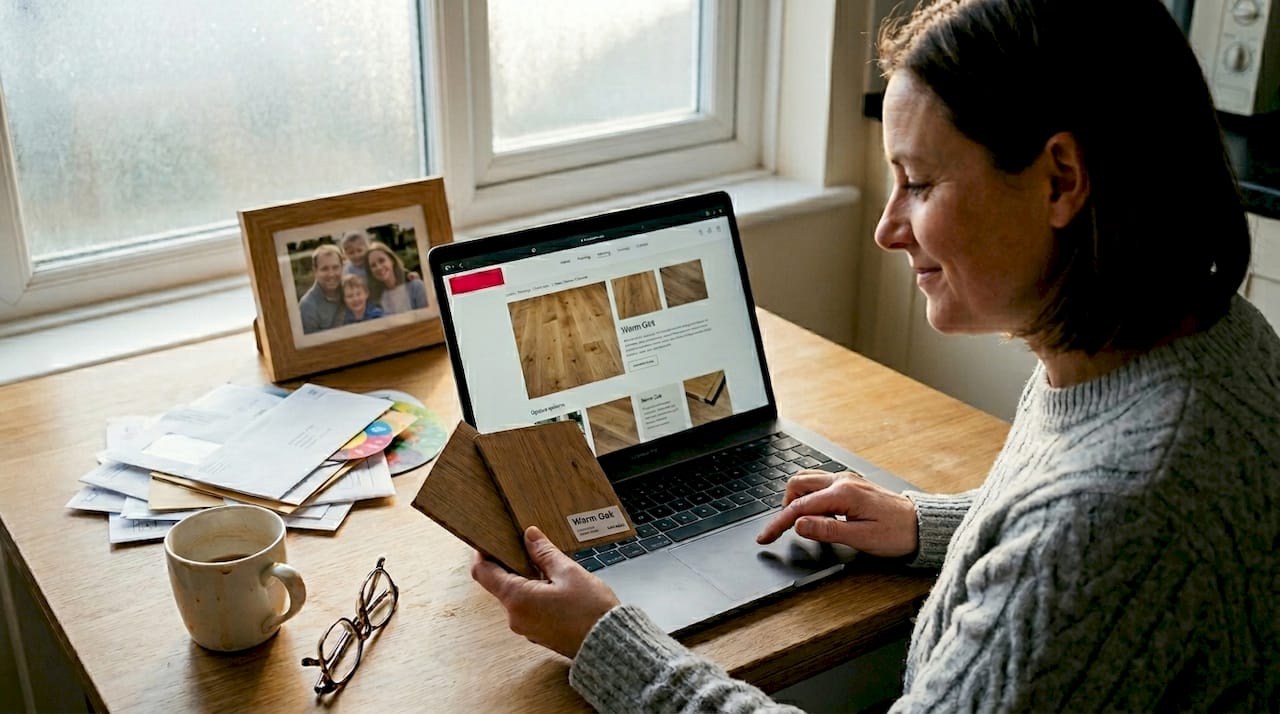
This is not a product problem. It is a photography problem. Colour accuracy in flooring photography is a major issue precisely because lighting conditions between a photography studio, a showroom, and a customer’s home can vary enormously. Professional shoots address this through controlled lighting setups and rigorous post-production colour management.
Here is a comparison between amateur and professional approaches to colour in flooring imagery:
| Factor | Amateur photography | Professional photography |
|---|---|---|
| Lighting setup | Natural or uncontrolled artificial light | Controlled, calibrated studio lighting |
| Colour consistency | Varies between shots and locations | Consistent across entire product range |
| Post-production | Basic auto-correction | Manual colour grading to match product specs |
| Output formats | Single version for web | Optimised for web, print, and advertising |
| Risk of misrepresentation | High | Low |
| Impact on returns | Higher return rates likely | Fewer returns due to accurate expectations |
The table above shows a clear operational difference. Amateur photography introduces colour inconsistency at every stage. Professional photography controls for it. That control protects your reputation and your margins.
Consistency also matters at a brand level. When customers see your flooring advertised on Google, then visit your website, then look at your brochure, all three should show the same product in the same colour. Inconsistency across channels creates doubt. Doubt kills enquiries.
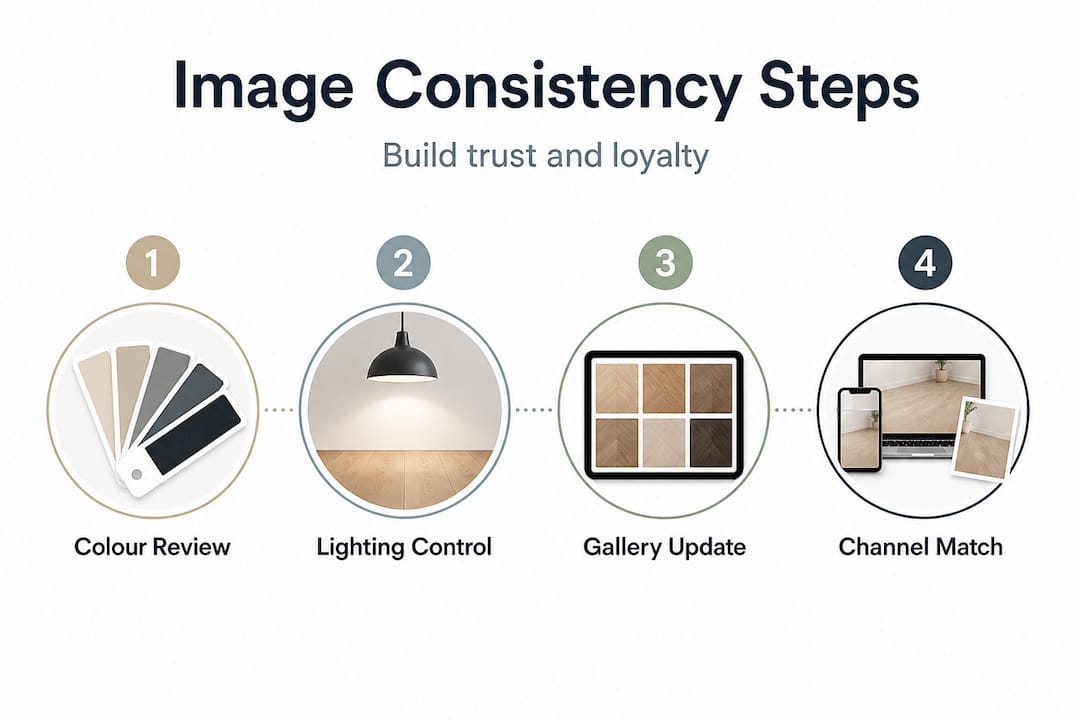
Pro Tip: Ask your photographer to provide a test shot calibrated against the physical product before committing to a full shoot. If the colours do not match in the test, they will not match across a full catalogue.
Your gallery photo optimisation approach should include a colour review stage where product images are checked against physical samples in multiple lighting conditions before they go live. This step is rarely done but makes a measurable difference to customer confidence.
Lifestyle imagery: selling more than just floors
Product shots matter. But lifestyle imagery is where flooring actually sells.
A standalone product image shows what the floor looks like. A lifestyle image shows what a customer’s life could look like with that floor in their home. That emotional connection is genuinely powerful. It is the difference between a customer thinking “that looks nice” and thinking “I want that in my living room.”
Professional UK flooring campaigns consistently emphasise natural lifestyle imagery because it works. Customers need to see flooring in a realistic setting to make a confident decision. That means showing the right furniture, natural light, room dimensions, and complementary décor.
Here is what effective lifestyle flooring imagery should communicate:
- How the floor looks with natural daylight versus artificial lighting
- How the scale and texture appear in a full room setting
- What furniture styles and colour palettes the product complements
- How the floor performs in busy areas like kitchens or hallways
- How different finishes appear under everyday living conditions
Look at the impact of installation imagery on customer decision-making. When customers can see a floor installed and looking lived-in, they are far more likely to commit to a purchase. The uncertainty drops. The confidence rises.
Here is a breakdown of how lifestyle image usage affects marketing performance across key digital channels:
| Channel | Image type used | Effect on performance |
|---|---|---|
| Website product pages | Lifestyle rooms + close-up detail | Higher time on page, more enquiries |
| Google Ads | Lifestyle rooms | Improved click-through rates |
| Social media | Lifestyle rooms, real homes | Greater organic engagement |
| Email campaigns | Lifestyle + seasonal rooms | Better open-to-click conversion |
| Printed brochures | Full-room lifestyle shots | Stronger showroom conversion |
Every channel benefits from realistic, high-quality lifestyle imagery. The returns compound when your photography is consistent across all of them.
There is also a practical benefit to realistic lifestyle imagery. When customers see a floor in a room that resembles their own home, their expectations are accurate. Post-purchase disappointment drops. Customer satisfaction improves. You generate more referrals.
These successful ad examples show exactly how lifestyle imagery lifts performance across paid campaigns. The flooring businesses generating the most enquiries through Google Ads are almost always using lifestyle photography rather than isolated product shots.
Turning great images into sales: best practices
Having excellent photography is only the first step. You also need to deploy it strategically across your website and marketing channels. Colour accuracy affects purchasing decisions at every touchpoint, so your implementation needs to be just as deliberate as your photography.
Follow these steps to make your flooring imagery drive real commercial results:
Invest in professional photography from the outset. The cost of a quality shoot is small compared to the revenue impact of better imagery. Prioritise lifestyle shots alongside detailed product close-ups.
Stage your environments with care. The room you shoot in matters. Choose spaces that reflect your target customer’s home. Avoid overly aspirational settings that look unattainable. Realism converts better than perfection.
Maintain a consistent visual style. Use the same lighting approach, colour palette, and staging aesthetic across your entire product range. Inconsistency undermines professionalism.
Optimise every image for web performance. Large, uncompressed images slow your website down significantly. A slow website loses customers before they even see your products. Use image compression tools to reduce file size without sacrificing visual quality. Tools like WebP format can reduce file sizes by 30 to 50 percent versus JPEG without any visible quality loss.
Conduct A/B testing on key pages. Replace lower-quality images with professional lifestyle shots on your top product pages and measure the difference in enquiry rates over a four-week period. The data will show you exactly what the imagery upgrade is worth commercially.
Apply consistent quality control before publishing. Every image that goes live should be reviewed against the physical product and against your existing imagery library. One inconsistent image in a gallery undermines the credibility of the rest.
Use images strategically in your paid campaigns. Google Ads and social campaigns that use lifestyle imagery consistently outperform those using plain product shots. Match your imagery to the intent of each channel.
Your flooring graphic design choices should complement your photography, not compete with it. Clean layouts, minimal text overlays, and adequate white space allow your images to do the selling.
Pro Tip: Do not just optimise images for size. Add descriptive alt text to every image on your website. This improves accessibility and gives Google more context about your products, which supports your search rankings.
The website essentials for leads go beyond imagery alone, but photography remains one of the highest-impact changes you can make to a flooring website quickly and measurably.
What most flooring brands miss about photography
We see the same pattern repeatedly. A flooring business invests in a new website, spends time on SEO and Google Ads, and then wonders why enquiry rates are still flat. Almost every time, the photography is the weak link.
The mistake is prioritising style over substance. Aspirational photography looks impressive. Perfect interiors, designer furniture, immaculate rooms. But customers in the UK are buying floors for their actual homes, not for magazine covers. When the imagery looks too perfect, customers disengage. They cannot picture themselves in that setting.
The biggest commercial returns we see come from honest, context-rich photography. Images that show flooring in realistic rooms. Images that answer the questions customers are actually asking: how does this look near a patio door? How does it hold up in a busy hallway? What does this oak finish look like under a warm bulb versus daylight?
Colour and tone accuracy sits at the centre of all of this. Flooring photography that misrepresents colour may generate clicks, but it will not generate satisfied customers. And satisfied customers are the only ones who leave positive reviews, return for future purchases, and refer your business to friends and family.
This is why photography strategy matters to flooring rebranding efforts too. If your business is repositioning or updating its brand, your imagery needs to lead that change. Outdated or inconsistent photography undermines even the strongest brand messaging.
Long-term reputation is built on trust. Trust is built when customers receive exactly what they expected. And accurate, honest photography is what sets those expectations correctly from the very first website visit.
The flooring brands that build real customer loyalty are not always the ones with the most stylised campaigns. They are the ones whose customers never feel misled.
Take your flooring brand’s imagery to the next level
Getting photography right is just one piece of the digital marketing picture. If your imagery is strong but your website is slow, poorly structured, or hard to find on Google, you will still miss out on enquiries.
At Truth Digital, we work exclusively with flooring businesses across the UK. We help you build a flooring website that showcases your imagery to its full potential, loads quickly, and converts visitors into enquiries. Our flooring SEO solutions make sure customers can actually find you on Google when they are searching for flooring in your area. And our practical guides, including resources on how to improve flooring photo galleries, give you the tools to keep raising your standards. If you are ready to make your imagery work harder for your business, let’s talk.
Frequently asked questions
How does poor photo quality affect flooring sales?
Poor photo quality reduces trust, makes colours appear inaccurate, and can lead to significantly lower online enquiry rates. As flooring imagery best practice shows, product-realism controls like colour accuracy are essential to converting online browsers into customers.
Why is colour accuracy a challenge in flooring imagery?
Lighting differences between showroom and home make it genuinely difficult to represent flooring colours accurately online without professional photography. Controlled lighting setups and post-production colour management are the most reliable solution.
What types of imagery work best for flooring marketing?
Natural lifestyle images in real home settings, with accurate and consistent colour tones, perform best across all digital channels. UK flooring campaigns consistently achieve better results with realistic, lived-in settings rather than overly stylised interiors.
How can flooring retailers ensure their photos are accurate?
Use professional photography with controlled lighting and consistent tones throughout the shoot, and always review images against physical product samples before publishing them to your website or marketing materials.

