


TL;DR:
- Digital visibility goes beyond merely having a website or Facebook page; it involves being consistently found, recognized, and engaged with across all relevant digital channels. It influences consumer decisions early in the buyer journey and requires ongoing optimization across search, social media, content, local listings, and AI platforms to generate sustainable growth. Monitoring assisted conversions and prioritizing continuous efforts are essential for maximizing your online presence and business success.
Most business owners assume that having a website and a Facebook page means they are visible online. It is a reasonable assumption. But it is wrong. What is digital visibility, really? It goes far beyond simply existing on the internet. True digital visibility means your brand is consistently found, recognised, and engaged with by the right people, across every relevant digital channel, at every stage of their buying journey. Get it right and you generate more enquiries, stronger competitive positioning, and sustainable growth.
What is digital visibility and why it matters
Digital visibility is how easily your brand is found, recognised, and engaged with across digital channels including search, social media, content platforms, and local directories. It is not a single metric. It is a collection of presence signals that together determine whether potential customers encounter your brand or your competitor’s.
There are five core dimensions worth understanding:
- Search visibility: How prominently your website appears in organic search results for relevant queries. This includes standard blue-link results, featured snippets, image packs, and local map listings.
- Social visibility: How discoverable your brand is on platforms like Facebook, Instagram, and LinkedIn. This covers profile completeness, engagement rates, and whether your content surfaces in feeds and searches.
- Content visibility: Whether your articles, guides, and resources are shared, linked to, and referenced by others online. High content visibility builds authority.
- Local visibility: How easily people in your geographic area find your business through Google Business Profile, local directories, and map results.
- Answer-engine visibility: An emerging and increasingly important dimension. AI-generated answers cite and mention brands based on trust signals, structured data, and sentiment. If your brand is not mentioned in AI answers, you are invisible to a growing segment of searchers.
The distinction between digital visibility and brand awareness is worth clarifying. Visibility is the input; awareness is the output. Visibility drives exposure. Awareness is what builds in the customer’s mind after repeated exposure. You cannot manufacture awareness without first owning visibility.
Pro Tip: Do not think of your digital presence as a single channel. Map each visibility dimension separately and you will quickly spot where the gaps are costing you enquiries.
Why digital visibility drives business growth
Without strong visibility, even the best products go unnoticed, leading to lost revenue that you will never even be aware of. That is the uncomfortable reality for businesses that invest in quality but neglect their online presence.
Visibility functions as a key input across the entire buyer journey. A homeowner searching for wood flooring in Manchester will encounter multiple brands before making a decision. The business that appears in Google’s local pack, has an active and informative website, and shows up in relevant social feeds holds a significant advantage. The business that relies solely on word of mouth simply does not get considered.
“Visibility earlier in the buyer journey is often missed if measuring only last-click conversions. Assisted conversions provide a fuller picture of brand influence on revenue.” Source
This matters practically. If you only track enquiries from people who clicked your website and immediately got in touch, you miss everyone who saw your brand on Google, scrolled past your Instagram post, read a review, and then came back three weeks later to book a quote. That assisted journey is where visibility earns its return.
Competitive advantage is real here too. Most flooring businesses do not invest consistently in their digital presence. That gap is an opportunity. Businesses that prioritise online brand visibility now will be the ones capturing enquiries when their competitors are invisible.

Pro Tip: Set up assisted conversion tracking in Google Analytics 4 before you do anything else. You need the full picture of how your visibility is influencing decisions, not just the last click.
Strategies to improve your digital visibility
Effective digital visibility requires optimisation across multiple channels, including SEO, social media, content marketing, local listings, and emerging AI platforms. Here is a structured approach to building it.
Own your search real estate. Think beyond individual keyword rankings. Organic search visibility reflects your total SERP presence, including featured snippets, image results, and map packs. Focus on building content that answers specific flooring queries your customers are actually asking. Read our guide on organic search for flooring to understand how this works in practice.
Build social discoverability. Complete every profile fully. Post consistently and focus on content that attracts saves and shares, not just likes. Respond to every comment and question. The platforms reward engagement with wider reach.
Invest in content that earns links. Publish guides, how-to articles, and flooring advice that other websites want to reference. Each inbound link improves your authority in Google’s eyes and extends your content’s reach.
Sort your local SEO. For most flooring businesses, local visibility is the most commercially important dimension. Get found locally by ensuring your Google Business Profile is accurate, your NAP (name, address, phone) data is consistent across all directories, and you are actively collecting reviews.
Prepare for AI search. Answer engines use mentions, citations, and sentiment to decide which brands to surface in AI-generated responses. Use structured data on your website, maintain a consistent and credible online presence, and focus on earning positive reviews and third-party mentions. This is where AI visibility tools for local services are becoming genuinely useful.
Here is a quick comparison of traditional SEO versus answer-engine optimisation to clarify the difference:
| Factor | Traditional SEO | Answer-engine optimisation |
|---|---|---|
| Primary goal | Rank for keywords in SERPs | Be cited in AI-generated answers |
| Key signals | Backlinks, content quality, technical SEO | Entity clarity, sentiment, structured data |
| Measurement | Keyword rankings, organic traffic | Mentions, citations, share of voice in AI |
| Time horizon | Months to years | Ongoing reputation management |
| Format priority | Web pages and blog content | Concise, authoritative, structured content |
Measuring your digital visibility
You cannot manage what you do not measure. The good news is that each visibility dimension has trackable metrics.
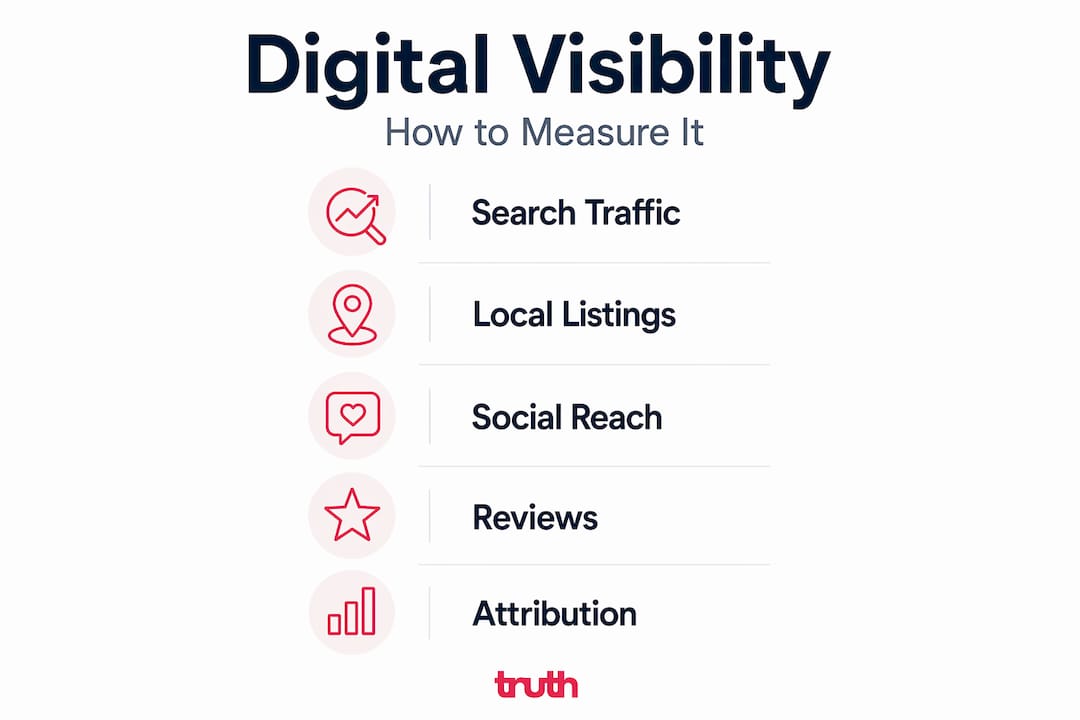
| Visibility type | Key metrics | Useful tools |
|---|---|---|
| Search visibility | SERP presence score, organic traffic, ranking positions | Google Search Console, Semrush |
| Social visibility | Follower growth, reach, mentions, engagement rate | Native platform analytics |
| Content visibility | Backlinks, referral traffic, content shares | Ahrefs, Moz |
| Local visibility | Local pack appearances, citation accuracy, review count | Google Business Profile, BrightLocal |
| Answer-engine visibility | AI mentions, sentiment, share of voice | Emerging tools, manual monitoring |
Attribution modelling using assisted conversions gives you a more accurate link between your visibility investments and actual business results. Relying solely on last-click conversions will consistently undervalue your SEO and content efforts.
When tracking social visibility, look beyond follower counts. Reach and sentiment matter far more. A post seen by 500 highly relevant local homeowners outperforms a post seen by 5,000 random accounts.
For local visibility, run regular citation audits. Inconsistent business information across directories actively suppresses your local rankings. Answer-engine visibility tracking currently requires a combination of manual checks, brand mention monitoring tools, and emerging AI-specific analytics platforms.
- Check Google Search Console monthly for coverage and query data
- Monitor your Google Business Profile for new reviews weekly
- Run a citation audit quarterly to catch inconsistencies
- Track branded search volume over time as a proxy for growing awareness
Getting started: a practical action plan
Improving your digital visibility does not require a complete overhaul overnight. Start with these steps and build momentum from there.
Audit where you stand. Review your website’s technical health, your Google Business Profile, your social profiles, and your content. Identify the biggest gaps first. Our free flooring growth pack includes a practical visibility assessment to help you benchmark your current position.
Set goals tied to business outcomes. Do not just aim for “more website traffic.” Set targets like “increase enquiry form submissions by 20% in six months” and work back to the visibility metrics that drive that result.
Fix your local SEO first. For most flooring businesses, this is where the fastest wins are. Claim and optimise your Google Business Profile, build local citations, and start collecting reviews systematically.
Publish content that answers real questions. Think about what your customers ask before they buy. “How long does LVT take to fit?” “What is the best flooring for a kitchen?” These are real queries with real search volume. Answer them clearly and you start to own search real estate.
Build your AI visibility foundations. Add structured schema markup to your website, keep your NAP data consistent, and focus on earning genuine positive reviews. These signals are exactly what AI systems use to determine brand trust.
Track and adjust monthly. Review your key metrics each month. What is improving? What is not moving? Adjust your efforts accordingly.
Pro Tip: The biggest mistake we see is treating digital visibility as a launch activity. You set up a website, tick the box, and move on. Visibility requires ongoing attention. Businesses that treat it as a continuous process consistently outperform those that treat it as a one-time project.
Common mistakes to avoid include ignoring assisted conversions when measuring ROI, neglecting review management, failing to update outdated directory listings, and producing content without considering search intent. Each of these costs you visibility you could easily own.
My take: visibility is your most undervalued asset
I have worked with flooring businesses that had genuinely excellent products, great customer service, and beautiful showrooms. Yet they were barely visible online. Their competitors, sometimes less impressive in every practical sense, were capturing all the enquiries because they owned the search results, the map pack, and the local review landscape.
What I have learned is that most business owners underestimate just how much of the buying decision happens before a customer ever contacts them. By the time someone fills in your enquiry form, they have already made several micro-decisions based on what they found online. Your visibility at each of those earlier moments is what gets you to the conversation.
I also think the shift from last-click attribution to assisted conversion reporting is one of the most important changes in how we think about digital marketing. Once you see the full picture, you realise visibility investments pay back far more than simple conversion tracking suggests.
Answer-engine visibility is the area I am watching most closely right now. AI search is changing how people discover information and brands. The businesses building credibility and clear brand signals today will be the ones cited in AI answers tomorrow. It is not science fiction. It is already happening.
Treat digital visibility as a foundational business asset, not a marketing campaign. It compounds over time, and the earlier you invest, the stronger your position becomes.
— John
How Truthdigital helps flooring businesses get found
If you are a flooring business looking to improve your digital visibility and generate more enquiries, Truthdigital specialises in exactly that.
We work exclusively with flooring retailers, installers, and sanding specialists across the UK. That means our SEO for flooring companies is built around the specific queries your customers are searching, not generic keyword strategies. Our website development for flooring businesses produces fast, well-structured sites designed to perform in search and convert visitors into enquiries. Whether you need a full visibility overhaul or targeted improvements to your local presence, we can help. Get in touch to talk through where you are now and what a practical improvement plan looks like for your business.
FAQ
What is digital visibility in simple terms?
Digital visibility is how easily potential customers can find and engage with your brand across online channels including search engines, social media, local directories, and AI-generated answers.
How does digital visibility differ from brand awareness?
Visibility is the input and awareness is the output. Visibility drives exposure across digital channels; brand awareness builds in customers’ minds as a result of repeated visibility.
What affects digital visibility most?
The key factors include your website’s SEO performance, Google Business Profile quality, social media activity, the volume and consistency of your online reviews, and how your brand is cited across third-party websites and AI tools.
How do you measure digital visibility?
Measure it across each dimension: organic search traffic and SERP presence scores, local listing accuracy, social reach and engagement, backlink profile, and emerging metrics like AI mention volume and share of voice.
Why is local visibility particularly important for flooring businesses?
Most flooring purchases are local decisions. Appearing in Google’s local map pack and maintaining accurate directory listings puts your business in front of customers who are ready to buy in your area.