


TL;DR:
- Most flooring customers enter showrooms feeling uncertain about visualizing products in their homes and judging textures from small samples. Improving sample size, tactile displays, varied lighting, strategic zoning, digital tools, and interactive experiences significantly enhances customer confidence and engagement. Measuring dwell time and implementing digital solutions create a data-driven, seamless shopping journey that boosts conversions and showroom impact.
Most flooring customers walk into a showroom already feeling uncertain. They cannot picture how a product will look in their home, they struggle to judge texture from a small swatch, and the lighting rarely matches their living room. These are not minor inconveniences. They are the moments that lead to hesitation, abandoned visits, and avoidable returns. There are many ways to improve flooring showroom design that go well beyond a fresh coat of paint or rearranging display stands. This article covers the practical, evidence-backed strategies that help UK flooring retailers turn browsers into buyers.
Ways to improve flooring showroom design: start with tactility and sample size
This is where most retailers get it wrong. They invest in sleek fixtures and bold signage, then display samples so small that customers cannot properly feel the pile or appreciate the grain. That is a costly mistake.
Larger samples for carpet pile and wood grain allow customers to feel texture and pattern variation, which directly drives sales. A swatch the size of a paperback book simply does not cut it for a customer trying to judge a textured loop pile or a brushed oak board.
Here is what good sample display looks like in practice:
- Floor-level carpet squares of at least 50cm x 50cm so customers can stand on them
- Wood and LVT boards shown at 60cm minimum length to reveal grain continuity
- Samples mounted at an angle rather than flat, to mimic how they appear on a floor
- Tactile labels indicating hardness, softness, and suitability for underfloor heating
- Separate take-home samples available so customers can test in natural home lighting
Space is a real constraint for high-street and boutique retailers. The solution is not to display fewer samples but to be more selective. Fewer, larger samples from your core ranges outperform a wall of tiny swatches every time.
Pro Tip: Group your largest samples near a consultation seating area. Customers who sit down with a sample in hand stay longer and ask better questions, which moves them closer to a decision.
With tactility and sample size established as critical, lighting plays an equally vital role in how customers perceive flooring options.
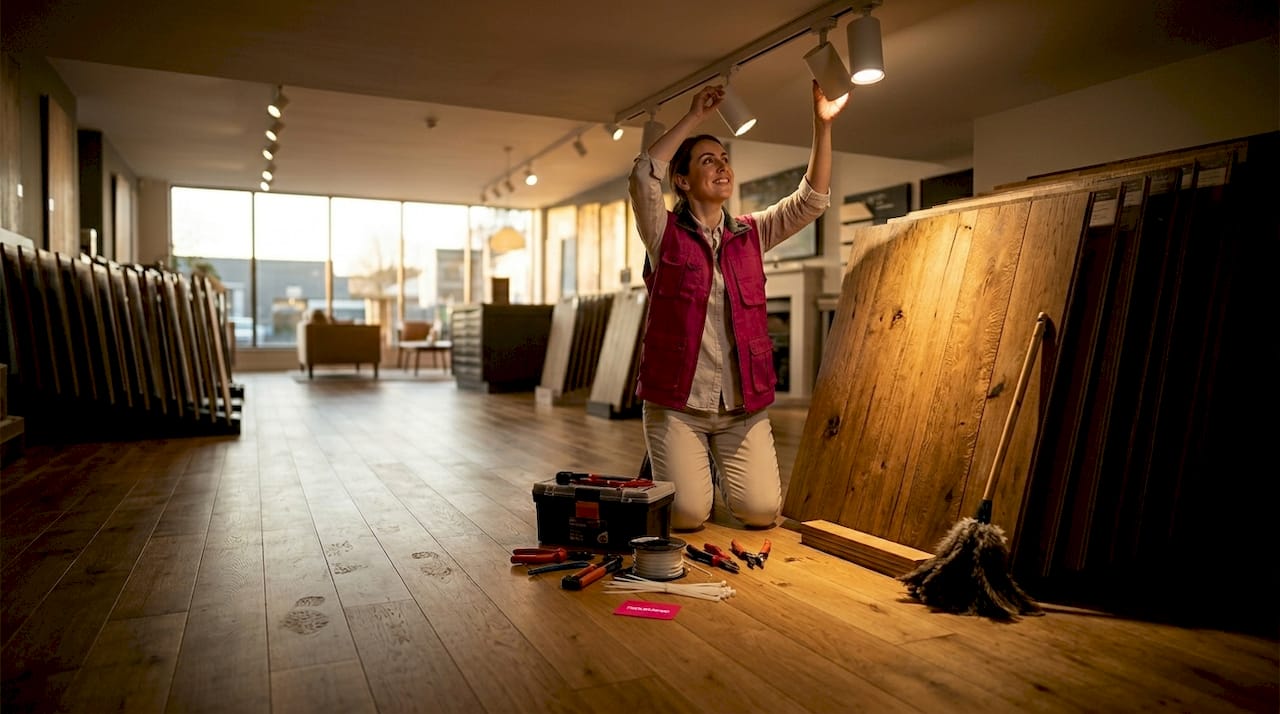
Lighting that reveals true flooring colours and textures
Uniform ceiling lighting is one of the most common mistakes in flooring showrooms. It flattens textures and distorts colour. A dark grey LVT plank under a cold white LED looks entirely different in a warm, lamp-lit living room. That gap in expectation is a major source of customer dissatisfaction after installation.
Varied lighting conditions that let shoppers see flooring under warm, cool, bright, dim, and daylight-like settings help avoid colour misjudgements and increase conversion rates. This is one of the most cost-effective investments a showroom can make.
Practical lighting improvements to consider:
- Install adjustable colour temperature track lighting above key display zones (2700K for warm, 4000K for cool, 6500K for daylight simulation)
- Add low-level task lighting at sample comparison counters
- Create a dedicated “home simulation” bay with a ceiling lamp, pendant, and skirting-level lighting to mimic a real room
- Avoid mixing fluorescent and LED sources in the same zone, as this creates inaccurate colour rendering
- Position spotlights to graze textured flooring from a low angle to reveal depth and pattern
These adjustments pair directly with your showroom imagery strategy, whether you are shooting product photos for your website or creating in-store visual content. Well-lit products look better everywhere, not just in the showroom.
Beyond sample size and lighting, how customers move through the showroom shapes their buying journey entirely.
Zoning and curated navigation to tell a product story
Think of your showroom layout as a guided route, not a warehouse. Customers who enter and immediately face an overwhelming grid of options tend to disengage. A deliberate path removes that friction.
Distinct zones that tell a story with sightline-friendly circulation guide customers naturally from entrance to purchase. Here is a practical flow that works well for most UK flooring showrooms:
- Entrance zone: New arrivals, seasonal promotions, and bestsellers. High visual impact. Draws customers in.
- Exploration zone: Full range by category, wood, carpet, LVT, tile. Clearly labelled, well-lit, with large samples accessible.
- Comparison zone: Side-by-side display boards where customers can pull samples and place them together. Seating nearby.
- Consultation zone: Staff desk or table area, swatches, pricing guides, and a visualiser screen.
- Exit zone: Installation guides, care product upsells, and a call to action to book a measure.
Themed “project bundles” within zones are particularly effective. A “period home” zone showing reclaimed oak with complementary grout and skirting creates an emotional connection and increases average order value. This is the structured navigation principle applied to physical space.
With guided navigation set, digital tools can further empower customers browsing independently in the showroom.
Integrating digital tools to support independent browsing
Not every customer wants to speak to a sales adviser immediately. Many prefer to browse, research, and build confidence on their own terms. Digital tools support that independence without removing the human element when it matters.
QR-coded signage and pricing guides provide instant answers and reduce reliance on sales staff, improving customer comfort and trust. Place them on every display rack, not just on featured products.
Key digital tools worth considering:
- QR codes linking to product specification sheets, installation videos, and real-home photography
- In-store visualiser screens where customers can upload a photo of their room and overlay flooring options
- Tablets at the consultation zone preloaded with your product catalogue and pricing tool
- Digital signage that rotates between project inspiration imagery, current promotions, and care guides
One of the more forward-thinking applications is the smart showroom model, which offers 24/7 independent browsing with smart-lock access and QR-coded resources to facilitate decision-making without any sales pressure. For a UK retailer with the right space, this can generate weekend and evening visits that would otherwise be lost.
Pairing these tools with a strong digital presence ensures the journey continues seamlessly when customers leave the showroom.
Beyond digital and physical integration, interactive experiences add memorable engagement.
Using interactive and sensory experiences to boost engagement
Interactive elements do not need to be complex or expensive. Even small, well-placed sensory features change how long customers stay and how they feel about the brand.
Step-activated LED floors with real-time visuals and synchronised sound create multisensory experiences that heighten brand perception and customer engagement. A smaller-scale version of this, a motion-sensitive light strip under a feature display, can achieve a similar effect.
Benefits of interactive showroom elements:
- Longer dwell time, which correlates directly with higher conversion rates
- Memorable visits that prompt word-of-mouth recommendation
- Differentiation from competitor showrooms in the same area
- Reduced reliance on staff to generate excitement about products
| Interactive element | Estimated cost | Dwell time impact |
|---|---|---|
| Motion-sensitive LED display strip | Low | Moderate increase |
| Step-activated floor panel | Medium | High increase |
| In-store room visualiser screen | Medium | High increase |
| Full AR/VR headset station | High | Variable |
Pro Tip: Place any interactive element at the start of your exploration zone, not at the entrance. Customers who have already engaged with samples are more receptive to a sensory demo, and it deepens their commitment to the visit rather than creating a distraction at the door. For a real-world example, take a look at how Active Flooring approached customer engagement in their showroom context.
Measuring how visitors use these design features helps retailers refine layouts over time.
Measuring and iterating showroom design with dwell time data
Design changes without measurement are guesswork. Dwell time tracking removes that uncertainty and gives you evidence to act on.
Dwell time combined with heatmaps reveals where customers pause, enabling targeted layout tweaks to improve engagement and sales. Basic people-counting sensors with zone tracking are now affordable for independent retailers.
How to use dwell time data effectively:
- Baseline your current layout for four to six weeks before making changes
- Compare average dwell times in each zone after a single change, for example, adding a lighting upgrade or repositioning a sample rack
- Identify zones where customers pass through quickly and ask why. Poor lighting, clutter, or lack of signage are common culprits
- Use high-dwell zones for premium or higher-margin product displays, as customers are already in a receptive mindset there
- Review data monthly and treat showroom design as an ongoing process, not a one-off project
| Zone | Before redesign avg. dwell | After redesign avg. dwell | Change |
|---|---|---|---|
| Entrance zone | 45 seconds | 90 seconds | +100% |
| Carpet exploration | 3 minutes | 5.5 minutes | +83% |
| Comparison zone | 2 minutes | 4 minutes | +100% |
| Consultation zone | 8 minutes | 11 minutes | +38% |
These are the kinds of improvements that compound. Every extra minute a customer spends in a well-designed zone is time spent building confidence and reducing purchase hesitation. Pairing this with data-driven marketing insights online creates a joined-up picture of customer behaviour.
Comparing design strategies and choosing the right improvements
Not every retailer has the same budget, space, or customer base. Here is a clear comparison of the strategies covered in this article.
| Strategy | Impact on sales | Typical investment | Ease of implementation |
|---|---|---|---|
| Large, tactile samples | High | Low to medium | Easy |
| Varied lighting zones | High | Medium | Moderate |
| Zoning and navigation | High | Low | Easy |
| Digital QR tools | Medium to high | Low | Easy |
| Interactive sensory features | Medium | Medium to high | Moderate |
| Dwell time data tracking | Long-term high | Low to medium | Moderate |
A balanced showroom design integrates tactile samples, varied lighting, clear zoning, digital support, interactivity, and data-driven iteration for the best results. You do not need all six at once. Start with samples and lighting. Add zoning. Layer in digital tools. Measure as you go.
Key recommendations by retailer type:
- Boutique independent retailer: Focus on large samples, warm lighting zones, and one digital QR code system
- Mid-size high-street retailer: Add full zoning, a visualiser screen, and basic dwell time tracking
- Large specialist showroom: Invest in interactive features, smart-lock access, and full heatmap analytics
For a joined-up approach between your physical showroom and your online presence, a well-structured flooring website can extend the same logic of zoning, navigation, and product storytelling into the digital experience.
Rethinking priorities: why habit can hold showroom design back
We see this pattern regularly. A retailer spends significant budget on a shopfit that looks great in a photograph, new cabinets, branded signage, polished fixtures, but then wonders why conversion rates have not moved. The problem is that visual aesthetics and measurable engagement are not the same thing.
Retailers gravitate to displays that are easy for staff to use and maintain but often neglect digital tools that empower customers. That is a habit built on internal convenience, not customer behaviour.
The most overlooked shift in showroom thinking is this: customer autonomy drives conversion. When a customer can browse freely, answer their own questions via QR codes, test flooring under different lighting conditions, and compare samples without waiting for a sales person, they move through the decision process faster and with more confidence. Pressure-free browsing is not a luxury. It is a conversion strategy.
Dwell time data is the tool that makes this measurable. Yet most retailers we speak with have never tracked it. They rely on gut feel about which areas of the showroom are “working.” That is the equivalent of running a Google Ads campaign without checking the click-through rate.
The retailers who are pulling ahead are not necessarily the ones with the biggest showrooms or the highest budgets. They are the ones treating showroom design as a living system, measuring it, adjusting it, and iterating based on what the data actually shows.
Boost your flooring showroom impact with expert digital solutions
Improving your showroom is one part of the picture. The other part is making sure customers can find you before they even step through the door.
At Truth Digital, we work exclusively with UK flooring retailers and manufacturers to build the kind of online presence that drives real showroom visits and enquiries. From flooring business websites that showcase your showroom and product range, to SEO services that get you found on Google when customers are searching for flooring in your area, to Google Ads campaigns that put you in front of buyers at exactly the right moment. We know flooring, we know digital, and we get results. Get in touch with the Truth Digital team today.
Frequently asked questions
Why are larger flooring samples important in showroom design?
Larger samples allow customers to feel carpet pile and wood grain texture and pattern variation, giving them the confidence to commit to a purchase rather than second-guess their choice.
How does lighting affect customer perception of flooring in showrooms?
Different lighting conditions change how flooring colours and textures appear, so varied lighting helps customers see products more accurately and avoid costly colour mismatches after installation.
What role do digital tools play in modern flooring showrooms?
QR-coded signage and pricing guides give customers instant product details and reduce their reliance on sales staff, making the browsing experience more comfortable and self-directed.
How can dwell time data improve showroom design?
Tracking where customers linger, using heatmaps and sensors, shows which displays engage visitors most, allowing you to make targeted changes that improve both the customer experience and conversion rates.
What is a smart showroom and how does it help customers?
A smart showroom enables 24/7 independent access via smart-lock codes and uses QR codes for instant product information, so customers can browse at their own pace without any sales pressure.