

TL;DR:
- Proper site structure guides visitors and improves SEO for flooring websites.
- Clear navigation and logical page hierarchy increase user engagement and enquiry rates.
- Regular reviews and restructuring are essential for ongoing website performance and lead generation.
Most flooring retailers put their energy into making their website look great. New photos, fresh colours, a modern layout. And that’s not wrong. But here’s the thing: a beautiful site that’s poorly structured will still lose you enquiries every single day. Structure is what guides a visitor from landing on your homepage to picking up the phone or filling in a quote form. Get it wrong and even the best-looking site will underperform. This guide covers what site structure actually means for flooring businesses, why it matters for both SEO and conversions, and the practical steps you can take to fix it.
Key Takeaways
| Point | Details |
|---|---|
| Site structure matters | A clear and logical website structure is essential for attracting customer enquiries and building trust. |
| Best practices boost enquiries | Organising your main pages and using effective linking strategies leads to more engagement and conversions. |
| Avoid common errors | Steer clear of typical mistakes like messy navigation and missing calls to action to maximise results. |
| Professional help accelerates growth | Partnering with web and SEO experts helps optimise your site structure and reach more customers. |
Understanding site structure for flooring websites
Site structure is how your pages are organised, connected, and presented to both visitors and search engines. It’s not just about having a navigation bar at the top. It covers your page hierarchy, how pages link to one another, and how clearly your content is grouped.
For flooring businesses, this matters more than most people realise. A customer searching for LVT installation in their area will land on your site with a specific intent. If they can’t quickly find what they need, they leave. It’s that simple.
Site structure affects both user experience and SEO ranking, which means getting it right has a double benefit. You keep visitors engaged and you improve your position on Google at the same time.
Here are the core components of a well-structured flooring website:
- Navigation: Clear, logical menus that reflect how customers think, not how you organise your business internally
- Page hierarchy: A homepage at the top, then service pages, then deeper content such as FAQs or product details
- Internal linking: Pages that reference and connect to each other naturally, helping both users and search engines move through your site
- URL structure: Clean, readable URLs that reflect the page content (for example, /services/carpet-fitting rather than /page?id=42)
- Category grouping: Flooring types such as carpet, wood, LVT, and vinyl each having their own dedicated space
The primary pages every flooring website needs are: home, services (with individual pages per flooring type), gallery, testimonials, and contact. These aren’t optional extras. They’re the foundation.
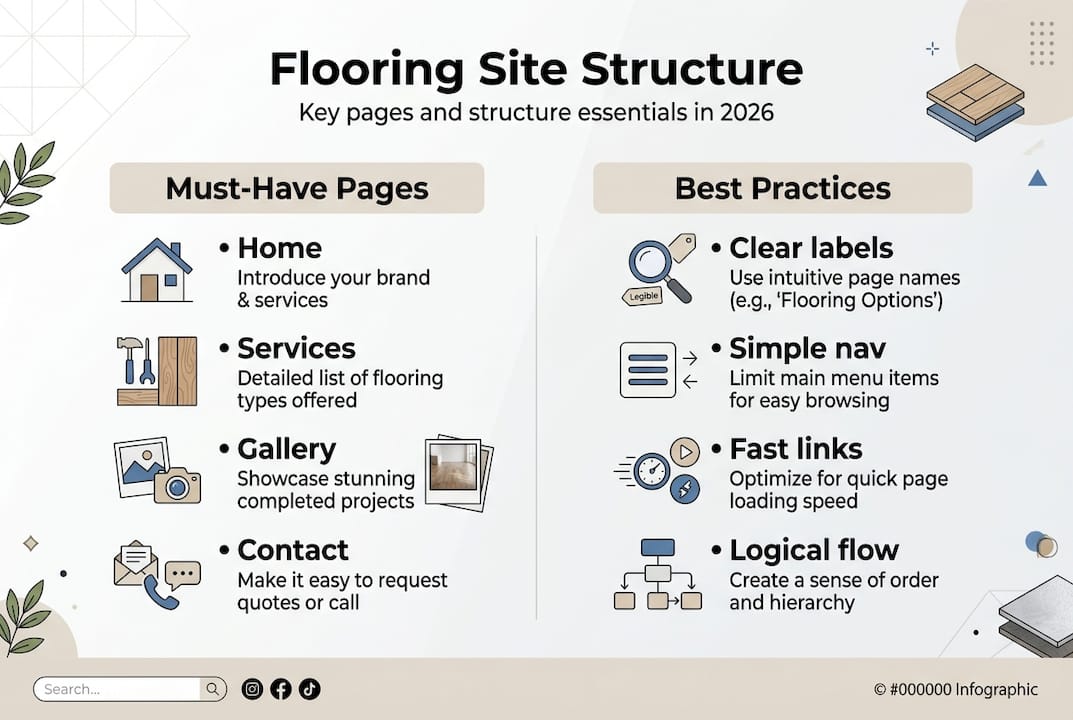
Good website maintenance keeps this structure intact over time. Pages get added, old content gets buried, and navigation becomes cluttered if no one is actively managing it. Reviewing your website must-haves periodically ensures nothing critical gets lost.
Small UX improvements to how pages connect and flow can have a significant impact on how long visitors stay and whether they take action. Structure is the backbone. Everything else builds on top of it.
Why strong site structure drives more enquiries
A well-organised site doesn’t just look professional. It actively moves people towards contacting you. When a visitor can find what they need in two or three clicks, the barrier to enquiring drops significantly.

The data backs this up. Structuring your site increases user retention and enquiry rates, which means the investment in getting structure right pays off directly in more leads.
Here’s a comparison of what typically happens with structured versus unstructured flooring sites:
| Feature | Structured site | Unstructured site |
|---|---|---|
| Average time on site | 3 to 5 minutes | Under 1 minute |
| Pages viewed per visit | 4 or more | 1 to 2 |
| Enquiry conversion rate | 3% to 6% | Under 1% |
| Google ranking potential | High | Low |
| Bounce rate | Below 50% | Above 70% |
Those numbers represent real enquiries won or lost. A flooring business getting 500 visitors a month on an unstructured site might generate 4 or 5 leads. The same traffic on a structured site could generate 20 or more.
“The most common issue we see with flooring websites isn’t the design. It’s that customers land on a page and have no clear next step. No obvious route to a quote, no visible contact option, no logical flow. That’s where enquiries die.”
Your enquiry handling guide matters just as much as the enquiry itself. If someone fills in a form and hears nothing for 48 hours, the structure of your follow-up process is broken too.
Pro Tip: Map out the journey from your homepage to your contact or quote form. Count the clicks. If it takes more than three, you’re losing people. Reduce friction at every step.
Your photo gallery tips and lead-boosting essentials all feed into this. A gallery that’s hard to find, or a services page with no call to action, breaks the flow and costs you business.
Best practices for structuring a flooring website
Building a well-structured flooring site doesn’t require a complete rebuild. In most cases, it’s about reorganising what you already have and filling in the gaps.
Here’s a step-by-step approach:
- Start with your homepage. It should immediately communicate what you do, where you work, and what the visitor should do next. One clear call to action above the fold.
- Create individual service pages. One page per flooring type: carpet, wood, LVT, vinyl, commercial. Each page should explain the service, show examples, and include a quote or contact prompt.
- Build a gallery that’s easy to browse. Organise it by flooring type or room type. Make it simple to navigate and link it from your service pages.
- Add a testimonials page. Real reviews build trust. Link to it from your homepage and service pages.
- Make your contact page impossible to miss. It should be in the main navigation, linked from every service page, and accessible from the footer.
A structured framework increases user engagement, and reviewing how your competitor site review is structured can reveal gaps in your own setup.
Here’s how good and poor structure compare in practice:
| Element | Good structure | Poor structure |
|---|---|---|
| Navigation | Clear labels, max 6 items | Too many items, vague labels |
| Service pages | One per flooring type | All services on one page |
| Internal links | Contextual, relevant | Random or absent |
| Calls to action | On every key page | Only on the contact page |
| Mobile layout | Clean and easy to use | Cluttered, hard to tap |
Avoiding common mistakes is just as important as following best practices. Many flooring sites have the right content but in the wrong places.
Pro Tip: Use breadcrumb navigation for deeper service categories. For example: Home > Services > Wood Flooring > Engineered Oak. It helps users know where they are and helps Google understand your site hierarchy.
Common mistakes and how to fix them
Even well-intentioned flooring websites fall into structural traps. Knowing what to look for makes fixing them straightforward.
Addressing structural errors directly leads to improved enquiry rates, so here are the most common issues and how to resolve them:
- Poor navigation: Menus with too many items, vague labels like “Products” or “Info,” or navigation that changes between pages. Fix it by simplifying to five or six clear labels and keeping them consistent across the entire site.
- Cluttered homepage: Too much text, too many images, competing messages. Fix it by leading with one clear statement of what you do, one visual, and one call to action.
- Missing calls to action: Service pages that describe your offering but don’t tell the visitor what to do next. Fix it by adding a quote request button or phone number at the bottom of every service page.
- Duplicate content: The same description used across multiple flooring type pages. Fix it by writing unique content for each page. Google penalises duplication and it confuses visitors.
- Broken internal links: Pages that link to other pages that no longer exist. Fix it by running a regular link audit. Tools like Screaming Frog can identify these quickly.
Your gallery enhancement strategy and site upkeep tips both contribute to keeping these issues from creeping back in over time.
Pro Tip: Ask a genuine customer, someone unfamiliar with your site, to try and find your contact page and request a quote. Watch where they get stuck. Their experience is more honest than any analytics report.
A fresh perspective on flooring site structure
Here’s something we see repeatedly. A flooring business invests in a new website, the design looks brilliant, and yet the enquiries don’t improve. The reason is almost always structure, not aesthetics.
Visual design gets the attention. Structure does the work.
We’ve seen this play out with real businesses. When The Flooring Outlet shifted focus from cosmetic updates to logical page flow and clear calls to action, the results were measurable and fast. Similarly, Active Flooring saw meaningful growth in enquiries after restructuring their service pages and navigation, not after redesigning their logo.
The uncomfortable truth is that most flooring websites are built to impress, not to convert. A site that impresses but doesn’t guide visitors towards an enquiry is not doing its job.
Clear navigation and logical flow are not glamorous. But they are what turn browsers into buyers. If you’re weighing up whether to invest in a visual refresh or a structural overhaul, the structural work will almost always deliver better returns.
Build a stronger flooring website with expert support
Getting site structure right takes more than good intentions. It takes experience, the right tools, and an understanding of how flooring customers actually behave online.
At Truth Digital, we work exclusively with flooring businesses across the UK. We build and restructure websites that are designed to generate enquiries, not just look good. From flooring website development to flooring SEO services and Google Ads management, every service we offer is built around getting you more leads. If your current site isn’t performing the way it should, let’s talk about what’s holding it back and how to fix it.
Frequently asked questions
What is site structure in flooring websites?
Site structure affects both user experience and SEO ranking, so it covers how your pages, navigation, and internal links are organised to help visitors and search engines find information with ease.
How does poor site structure affect enquiries?
A poorly structured site makes it hard for visitors to find what they need, which reduces trust and leads to fewer people making contact. Structuring your site increases user retention and enquiry rates, so the impact of poor structure is directly measurable.
What are the most important pages on a flooring website?
A structured framework increases user engagement, and the pages that matter most are your homepage, individual service pages, gallery, testimonials, and contact page. Each must be clearly accessible from the main navigation.
Is website structure important for SEO?
Yes. A logical, well-linked structure helps search engines crawl and index your site correctly, which directly improves your visibility in search results. Site structure affects both user experience and SEO ranking, making it one of the most impactful technical factors you can control.
How often should flooring websites review their site structure?
Review your site structure at least once a year and after any significant update or content addition. Addressing structural errors directly leads to improved enquiry rates, so regular reviews are worth the time.