TL;DR:
- Most flooring businesses underestimate the importance of effective CTAs, missing opportunities to increase conversions. Strategically placed physical and digital call-to-action elements guide customers toward higher-margin products and booking actions, boosting sales and engagement. Integrating measurable QR codes, clear messaging, and focused online CTAs dramatically improves inquiry rates and business growth.
Most flooring businesses treat CTAs as an afterthought. A small “contact us” button buried at the bottom of a webpage, or nothing at all on the showroom floor. That’s a costly mistake. Understanding why use call to action flooring strategies matters is the first step to turning more browsers into buyers. Whether you run a flooring retail showroom, an installation firm, or a sanding specialist, your CTAs, both physical and digital, are doing far more work than most owners realise. Get them right and you’ll see measurable lifts in enquiries, footfall, and booked jobs.
Why use call to action flooring in your business
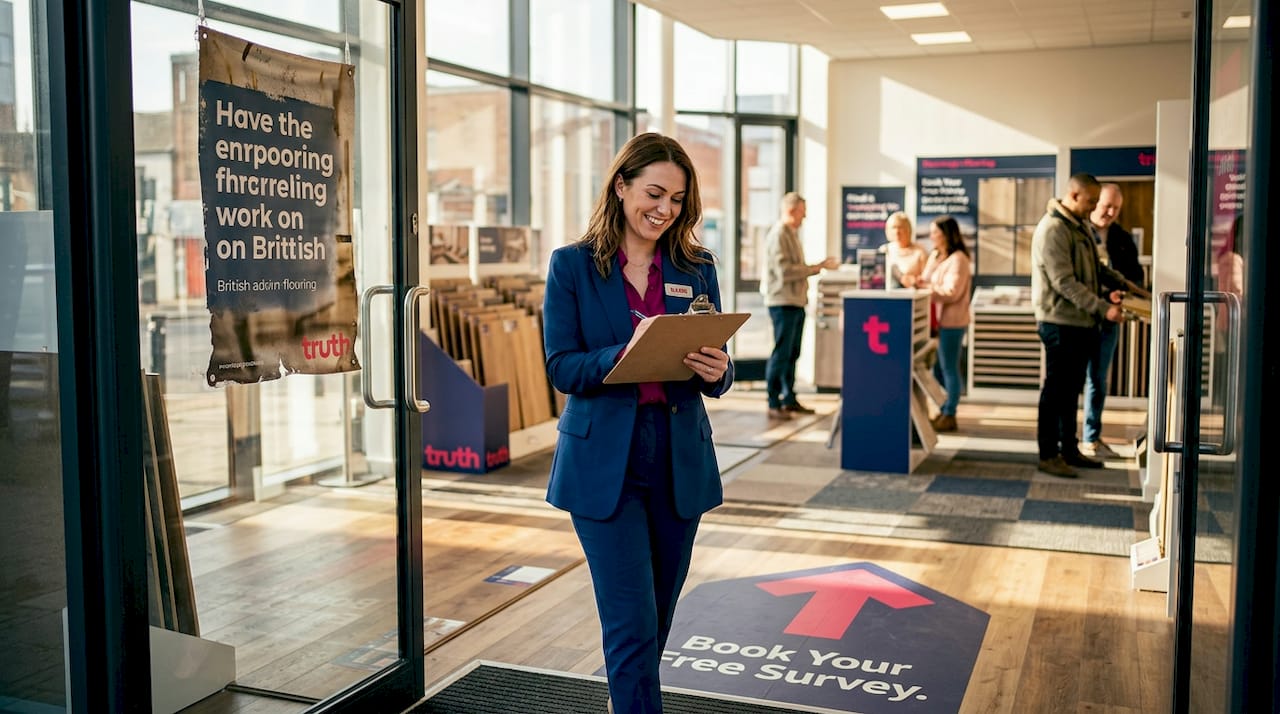
Let’s define this clearly. In flooring, a call to action (CTA) is any prompt that encourages a customer to take a specific next step. That could be a floor graphic in your showroom directing shoppers toward a new LVT range. It could be a button on your website saying “Book your free measure.” Both are CTAs. Both drive behaviour.
The psychology is straightforward. Customers, whether in-store or online, need to be told what to do next. Without clear direction, they wander, hesitate, and leave. A well-placed CTA removes that friction. It gives the customer a clear, low-effort path to the outcome you both want.
For flooring businesses specifically, the role of call-to-action is significant across every customer touchpoint:
- Directing showroom visitors toward high-margin product displays
- Prompting website visitors to request a quote or book a home survey
- Encouraging social media followers to visit your showroom or website
- Guiding phone enquiries toward booking a consultation rather than just asking prices
- Pushing past customers to leave reviews or refer a friend
Defining call to action flooring as both a physical and digital discipline is the first mindset shift many business owners need to make. It is not just a button on a webpage. It is a system.
How floor graphics drive sales and attention
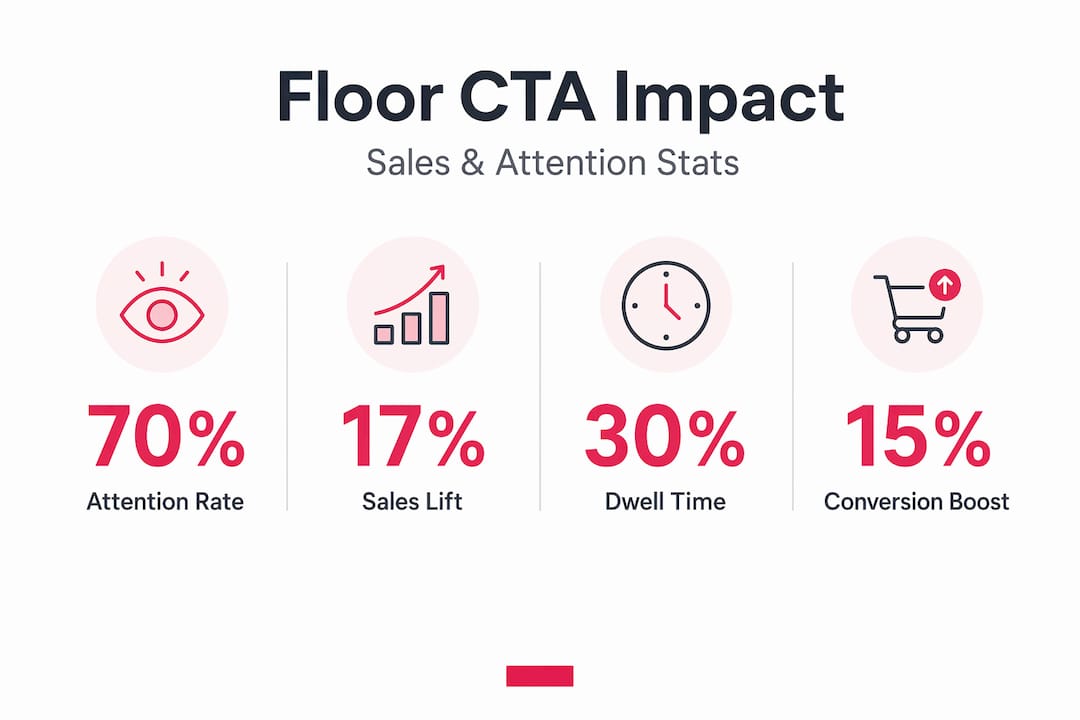
This is where most flooring showroom owners leave money on the table. Floor space is genuinely underused in retail marketing. Wall displays, ceiling banners, and window graphics all compete for a customer’s attention in a crowded visual field. The floor is comparatively clear. That is why floor graphics capture attention at a rate of 70 to 90%, and products promoted with floor graphics can see sales increases of up to 17%.
Retailers using strategic floor graphics also report a 30% increase in customer dwell time and conversion uplifts of 15 to 20%. For a flooring showroom, that kind of uplift is substantial. More time in store means more samples touched, more conversations had, more sales made.
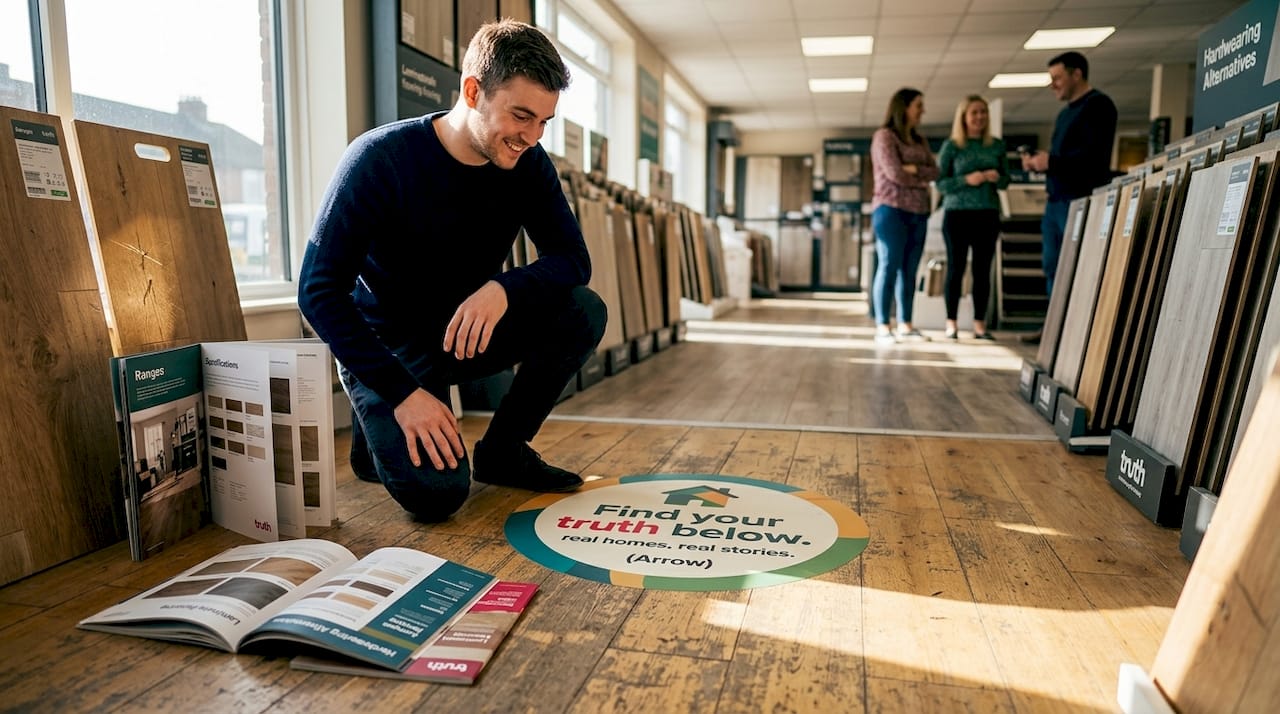
The psychology behind this is also worth understanding. Directional floor graphics guide customers toward products unconsciously. An arrow, a footprint trail, or a simple floor sticker pointing toward your latest engineered wood display will increase traffic to that area without any staff effort. Customers follow visual cues without even noticing they are doing it.
Where you place floor graphics matters enormously. The highest-impact locations are:
- Entrances, to capture attention from the moment a customer walks in
- Aisle intersections, where buying decisions get made
- Near checkout areas, to prompt last-minute upsells or accessory purchases
- At decision points next to competing product categories
Design also plays a role. Keep messaging short. Use icons where possible. High-contrast colours against the floor background help. Stick to one clear message per graphic.
Pro Tip: Floor graphics perform best on smooth surfaces like tile, wood, and linoleum. They are not suited to carpet or heavily textured concrete. When removing decals, peel at a 180-degree angle to protect the floor surface and extend the graphic’s working life.
CTA best practices for flooring websites
Your website is where most of your digital leads get won or lost. And one of the biggest reasons flooring websites underperform is poor CTA design and copy.
Vague CTAs like “contact us” fail because they communicate no value. The visitor doesn’t know what happens next. Are they filling in a form? Calling someone? Getting a quote? Uncertainty kills action. Benefit-focused copy fixes this immediately. “Get your free consultation” tells the customer exactly what they receive and that it costs them nothing. That’s a completely different psychological proposition.
A well-designed CTA can increase conversion rates by up to 161%. That number should stop you in your tracks. You don’t need more traffic. You need to convert the traffic you already have.
Here are the key factors that separate high-performing website CTAs from the ones that get ignored:
- Place your primary CTA above the fold, visible before any scrolling
- Use high-contrast button colours that stand out from the page background
- Write copy that emphasises the customer benefit, not your process
- Add urgency where genuine, such as “Limited survey slots this month”
- Use social proof near CTAs, such as star ratings or number of jobs completed
- Give each page a single focused CTA to avoid overwhelming the visitor
That last point is critical. A single focused CTA per page increases conversion rates by 266% compared to pages with multiple competing actions. Decision paralysis is real. Give customers one clear next step.
Mobile also cannot be ignored. Over 63% of web traffic is mobile, which means your CTA buttons need to be large enough to tap, ideally full-width on smaller screens, and preferably pinned as sticky footers so they remain visible while the user scrolls.
Pro Tip: Avoid writing flooring website CTAs in the third person. “Book a survey” works. “Customers can book a survey here” is weaker. Speak directly to the person reading.
You can find more detail on CTA placement within a broader site context in this UX improvements guide from Truthdigital.
The cost of weak CTAs in flooring
Poor CTAs are not just a missed opportunity. They have a direct cost. In flooring, missed calls directly reduce booked jobs and income. A prospect who calls, gets no answer, and moves on will almost always call the next business on their list, not yours.
This is a particularly acute problem in flooring because purchases are high-consideration. Customers are spending hundreds or thousands of pounds. They want reassurance and responsiveness. Fast responses to leads massively improve conversion in this environment because the window for capturing a hot lead is short.
Common operational problems that compound poor CTA performance include:
- No callback system for missed phone enquiries
- Website forms that don’t notify staff in real time
- Slow quote turnaround reducing perceived professionalism
- No automated acknowledgement when a web form is submitted
- Social media enquiries going unanswered for days
“Every missed call in a flooring business is a potential job handed to a competitor. A strong CTA gets the lead in. A fast response closes it.”
The solutions are practical. CRM systems can track every enquiry from every channel. Automated email or SMS responses to form submissions reassure the lead instantly. Appointment booking tools embedded directly in your website CTA flow remove the friction of back-and-forth scheduling entirely. Multi-channel CTA management, across phone, website, and social, keeps you responsive wherever customers try to reach you.
If you want to understand how common website errors cost you leads day after day, the flooring website mistakes guide from Truthdigital covers this in detail.
Integrating physical and digital CTAs
The smartest flooring businesses do not treat in-store and online CTAs as separate systems. They connect them.
QR codes on floor decals are one of the simplest and most effective ways to do this. A floor graphic in your showroom directing customers to “Scan for today’s offers” transforms a passive display into a measurable digital asset. You can track how many people scanned, which products they viewed, and whether they submitted an enquiry. Physical marketing becomes accountable.
Here is a step-by-step process for building an integrated CTA strategy:
- Identify the key decision points in your showroom and map them to a buyer journey stage
- Design floor graphics with messaging that matches that stage (awareness, consideration, or purchase)
- Add QR codes that link to product pages, offer landing pages, or booking forms on your website
- Track QR scan rates and web form submissions together to measure the full path
- Align website CTA messaging with in-store language for consistent brand recognition
- Test different CTA placements and copy variations every 60 to 90 days, then adjust based on data
Consistency between physical and digital messaging is often overlooked. If your floor graphic says “Free home survey this month” but your website button says “Contact us for a quote,” you create confusion. Consistent messaging at every stage builds trust and recognition.
Here is a quick comparison of CTA types and their primary uses:
| CTA type | Best used for | Key success factor |
|---|---|---|
| Floor graphic | In-store direction and promotion | Placement at decision points |
| Website button | Lead capture and bookings | Benefit-focused copy and contrast |
| QR code on decal | Connecting physical to digital | Clear value offer when scanned |
| Social media CTA | Traffic and awareness | Urgency and specific action |
| Phone CTA | Direct enquiries | Fast, consistent response time |
Pro Tip: When adding QR codes to floor graphics, always link to a mobile-optimised landing page. Most people scanning a floor QR code are already on their phone. A desktop-only page will kill the conversion immediately.
My honest take on CTA strategy in flooring
I’ve worked with flooring businesses across the UK, and the same pattern comes up constantly. Owners know their products inside out. They know materials, installation techniques, and customer service. But CTAs? They either copy what everyone else does or they ignore them entirely.
The generic “get in touch” button is everywhere. It is on almost every flooring website I’ve audited, often in a low-contrast grey in the footer. It communicates nothing and converts almost no one. What I find more surprising is how little attention gets paid to the physical space. Showrooms with beautiful sample displays but zero floor-level messaging. Thousands of pounds spent on stock, zero spent on a floor graphic that could direct customers straight to the highest-margin range.
What I’ve seen actually shift results is the combination. A flooring business that puts a well-designed floor graphic at the showroom entrance, links it to a mobile landing page via QR code, and has a clear “Book your free home survey” button above the fold on a fast website. That combination turns browsers into enquiries and enquiries into booked jobs. It’s not complicated. It just requires treating CTAs as a deliberate system rather than a design afterthought.
The businesses that test, adjust, and refine their CTAs based on real data consistently outperform those that set and forget. Start with one change, measure it, and build from there.
— John
How Truthdigital helps flooring businesses convert more leads
At Truthdigital, we work exclusively with flooring businesses. We understand the buying journey, the seasonal demand patterns, and the specific friction points that cause flooring websites to underperform.
We build websites with CTAs that are positioned, worded, and designed to generate real enquiries, not just traffic. We manage flooring SEO campaigns that bring the right customers to your site, and we make sure those visitors have a clear, compelling reason to get in touch when they arrive. We also run Google Ads for flooring businesses, where a poorly placed CTA can cost you every penny of your ad spend. Our clients see measurable improvements in enquiry volumes because we treat CTA optimisation as a core part of every project, not a finishing touch. If you want to see how we’ve done it for other flooring businesses, view our SEO results. Ready to talk? Let’s sort your CTAs and get more leads coming in.
FAQ
What is call to action flooring?
Call to action flooring refers to both in-store floor graphics and website CTAs used by flooring businesses to prompt customers to take a specific action, such as booking a survey, requesting a quote, or visiting a product display. It combines physical and digital marketing techniques to guide customers through the buying process.
Why should flooring businesses use floor graphics as CTAs?
Floor graphics capture customer attention at a 70 to 90% rate and can increase sales of promoted products by up to 17%, making them one of the most cost-effective in-store marketing tools available to flooring retailers and showrooms.
What makes a good CTA on a flooring website?
A strong flooring website CTA uses benefit-focused copy such as “Get your free home survey,” appears above the fold, uses a high-contrast button, and focuses on a single action per page. Research shows a single focused CTA can increase conversions by 266%.
How does poor CTA strategy cost flooring businesses money?
Missed calls, slow response times, and vague website buttons all reduce the number of enquiries that convert into booked jobs. In a high-consideration purchase environment like flooring, prospects who don’t hear back quickly will contact a competitor instead.
How do QR codes connect physical and digital CTAs in flooring?
Adding a QR code to a floor decal or showroom graphic links the physical space directly to a digital landing page or booking form. This makes in-store marketing measurable and creates a clear path from showroom browsing to online enquiry.