


TL;DR:
- Most flooring companies rely solely on technical specifications, assuming strong products sell themselves, but storytelling builds trust and loyalty.
- Effective brand narratives differentiate brands emotionally, reflect genuine customer experiences, and reduce marketing costs by fostering long-term relationships.
- Training sales staff to internalize and communicate authentic stories ensures consistent messaging that resonates and sustains customer loyalty over time.
Most flooring manufacturers assume a strong product sells itself. List the AC ratings, the wear layer thickness, the warranty terms, and buyers will choose on merit. That assumption is costing you customers. Research into why brand storytelling flooring manufacturers rely on is now showing that the businesses pulling ahead are not the ones with the longest spec sheets. They are the ones telling stories that resonate. This article breaks down what brand storytelling actually means in a flooring context, why it works, and exactly how you can use it to build real loyalty and reduce what it costs you to win new business.
Why brand storytelling matters for flooring manufacturers
Brand storytelling is not a marketing buzzword. It is the way you organise meaning around your business so that customers understand not just what you sell, but why they should trust you over everyone else.
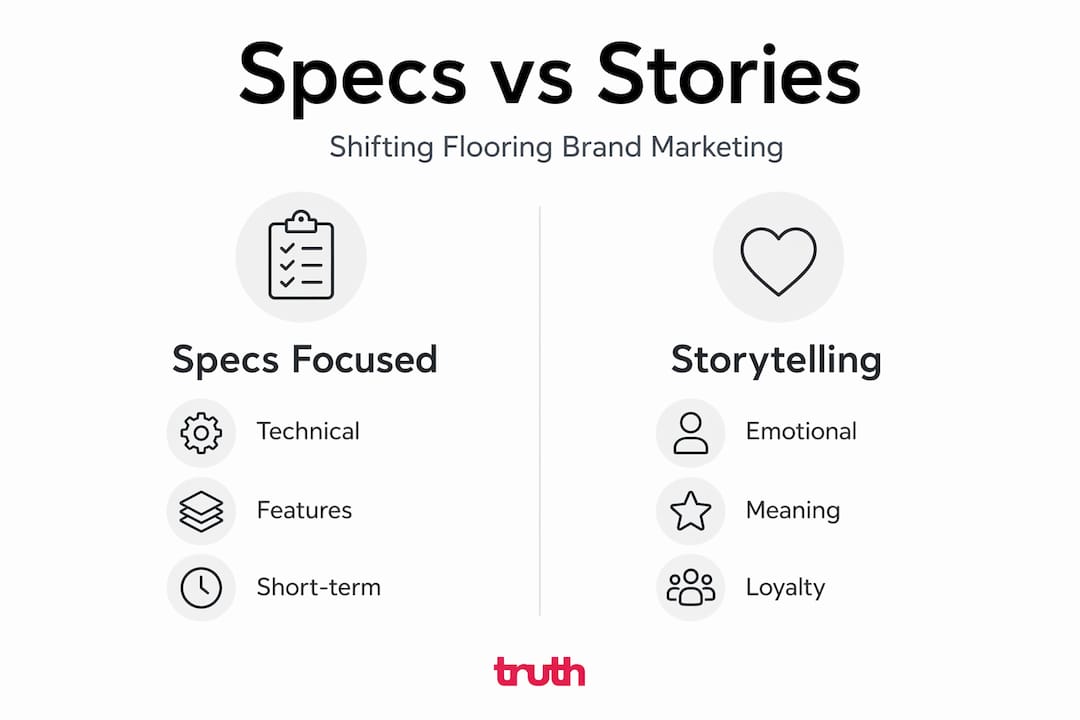
In a market where product specs are increasingly similar across manufacturers, storytelling creates sustainable competitive advantage by shifting the buying decision from features to identity alignment. Customers do not just ask “does this floor work?” They ask “does this brand reflect who I am and what I care about?”
Here is what the role of brand storytelling flooring businesses are starting to recognise includes:
- Emotional differentiation: a brand narrative that goes beyond durability to capture what home life actually feels like
- Trust building: showing the people, values, and craftsmanship behind the product
- Loyalty: customers who connect with a brand story return and refer others
- Reduced price sensitivity: buyers willing to pay more when they feel aligned with a brand
Brands that treat storytelling as architecture of meaning consistently outperform those using it as a last-minute campaign bolt-on. That is a pattern we see repeated across both premium and mid-market flooring businesses. The difference is rarely the product. It is nearly always the story.
Real-world shifts in flooring brand marketing
Nowhere is the shift from specs to stories more visible than in how leading flooring brands are rebuilding their marketing around customer voices.
Tapi is a standout example. Rather than produce a conventional campaign, their Q2 2026 strategy was built almost entirely from real customer feedback and Trustpilot reviews. The result was a campaign that felt genuine because it was genuine. Customers saw their own experiences reflected back at them, which built trust at a level no polished advertising copywriter could manufacture.
The shift towards lifestyle narratives is equally pronounced in the product category level. Flooring brands including Shaw and Mohawk have repositioned pet-friendly flooring around the emotional stakes of owning a dog or cat, not just the technical scratch resistance of the product. That framing speaks directly to how buyers are actually thinking when they walk into a showroom.
“Transparency throughout the product lifecycle, including after-sales, is critical for premium flooring brand trust.” — Neha Mahajan, Toyama Floors, on authentic customer relationships
This matters commercially, not just creatively. Storytelling reduces customer acquisition costs and increases lifetime value by building relationships rather than chasing one-off transactions. When your brand story is strong, marketing becomes less about interruption and more about recognition.
Integrating technical features with emotional storytelling
The biggest mistake flooring manufacturers make with storytelling is treating it as separate from product information. They put specs in the brochure and “lifestyle content” on Instagram, and the two never connect. The result is disjointed messaging that satisfies nobody.
Integrating hard specs with emotional outcomes prevents exactly this problem. A pet-proof warranty is not just a technical feature. Told well, it is peace of mind for a family with two labradors and a muddy garden. Durability stats are not abstract numbers. They are the reason a young couple buys once and does not have to think about it again for fifteen years.
Here is a comparison of the two approaches:
| Approach | What you say | What the customer hears |
|---|---|---|
| Spec-led | “AC4 rating, 12mm wear layer, 25-year warranty” | “I don’t know what that means” |
| Story-led | “Built for real family life, backed by 25 years of peace of mind” | “That sounds like it was made for me” |
| Integrated | “AC4-rated for heavy use, so your home stays beautiful even with kids, pets, and everything in between” | “This brand understands my life” |
The integrated approach does not abandon the spec. It earns the spec’s credibility by putting it in context. Successful storytelling articulates how hard specs translate into elevated lifestyle experiences. That is the craft of flooring brand marketing done properly.
Pro Tip: When reviewing your product pages or showroom materials, test every spec against this question: “So what does that mean for a real customer?” If you cannot answer it in one plain sentence, your story is incomplete.
The role of sales associates in brand storytelling
Here is the insight most flooring manufacturers miss entirely. Your most important storytelling audience is not the end customer. It is your retail sales associates.
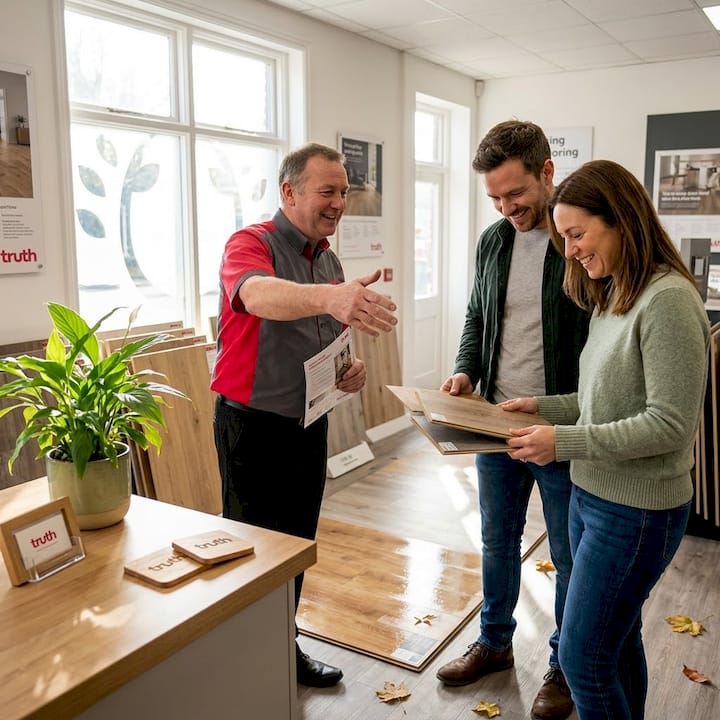
Sales associates influence customer perception far more than any direct advertisement. They are the live, human version of your brand story. If they do not understand or believe that story, they default to price and spec selling. All the brand investment you have made disappears the moment someone on the showroom floor says “well, it depends on your budget really.”
Without sales staff buy-in through storytelling training, brand narratives fail to influence purchase decisions where it counts most. So how do you fix it? Here is a practical approach:
- Brief your team on the brand story, not just the product range. Run sessions that cover your brand’s mission, values, and the customer problems you exist to solve. Make it a conversation, not a lecture.
- Give them stories, not scripts. Provide two or three real customer anecdotes for each product range. Stories are easier to remember and easier to tell than bullet points.
- Create simple reference assets. One-page story cards for each product line work well. They cover the emotional angle, the key spec in plain English, and a relevant customer scenario.
- Reinforce regularly. Brand storytelling is not a one-off training day. Incorporate it into regular team meetings and use real customer feedback as ongoing source material.
Pro Tip: Ask your sales team how they would describe your brand to a friend who has never heard of you. Their answers will tell you immediately how well your story is landing internally.
Practical steps to craft your brand story
Getting started does not require a big agency or a complete rebrand. It requires clarity, consistency, and the discipline to collect and share real stories. Here is where to focus:
- Define your core mission in plain language. Not “delivering quality flooring solutions” but something specific: why you started, who you serve best, and what you stand for that your competitors do not.
- Collect authentic customer feedback consistently. Authentic, real customer feedback outperforms polished stock imagery and generic testimonials every time. Build a process for capturing reviews, project photos, and customer quotes.
- Create visual assets that reflect real homes, not show homes. The role of storytelling in flooring marketing includes the images you choose. Real rooms with real families beat aspirational interiors that no one actually lives in.
- Apply your story consistently across every touchpoint. Website, social media, showroom signage, brochures, and email. The flooring brand awareness you build online only compounds when the story is the same everywhere.
- Measure what matters. Track repeat purchase rates, referral rates, average order values, and time to conversion. These are your storytelling KPIs. If loyalty is growing, the story is working.
Branding in flooring must start with lived company culture before external marketing can be effective. That means the story has to be real inside your business before it goes out to the world.
My honest take on storytelling in flooring
I have worked with flooring businesses long enough to say this plainly: the ones that treat storytelling as a “nice to have” are the ones competing on price and losing margin every year. The ones that commit to it build businesses customers actually feel loyal to.
What I have learned is that authenticity wins, every time. Not polished copy. Not a clever strapline. Real customer voices, real projects, and a brand that is honest about what it stands for. The Tapi approach of building a campaign from their own reviews was not a creative gamble. It was the logical outcome of a business that had actually earned trust and knew it.
I have also seen how storytelling helps flooring brands compete on identity rather than on price. That defence against commoditisation is not theoretical. It shows up in margins, in customer retention, and in the conversations sales staff have on the floor.
The hardest part is internal alignment. Getting your whole team, from product development to the showroom associate, to tell the same story with the same conviction. That is where most manufacturers fall short. Not because they lack a good story, but because they have never invested in sharing it internally.
One more thing: do not chase short-term campaign spikes. A brand story is a long-term asset. Commit to it for twelve months before you judge it. The compounding effect is real, but it takes time to build.
— John
How Truthdigital helps flooring brands tell better stories
At Truthdigital, we work exclusively with flooring businesses. That means we understand the specific challenges of flooring brand marketing, from translating technical specs into compelling web copy to building websites that feel like an extension of your brand story rather than a generic product catalogue.
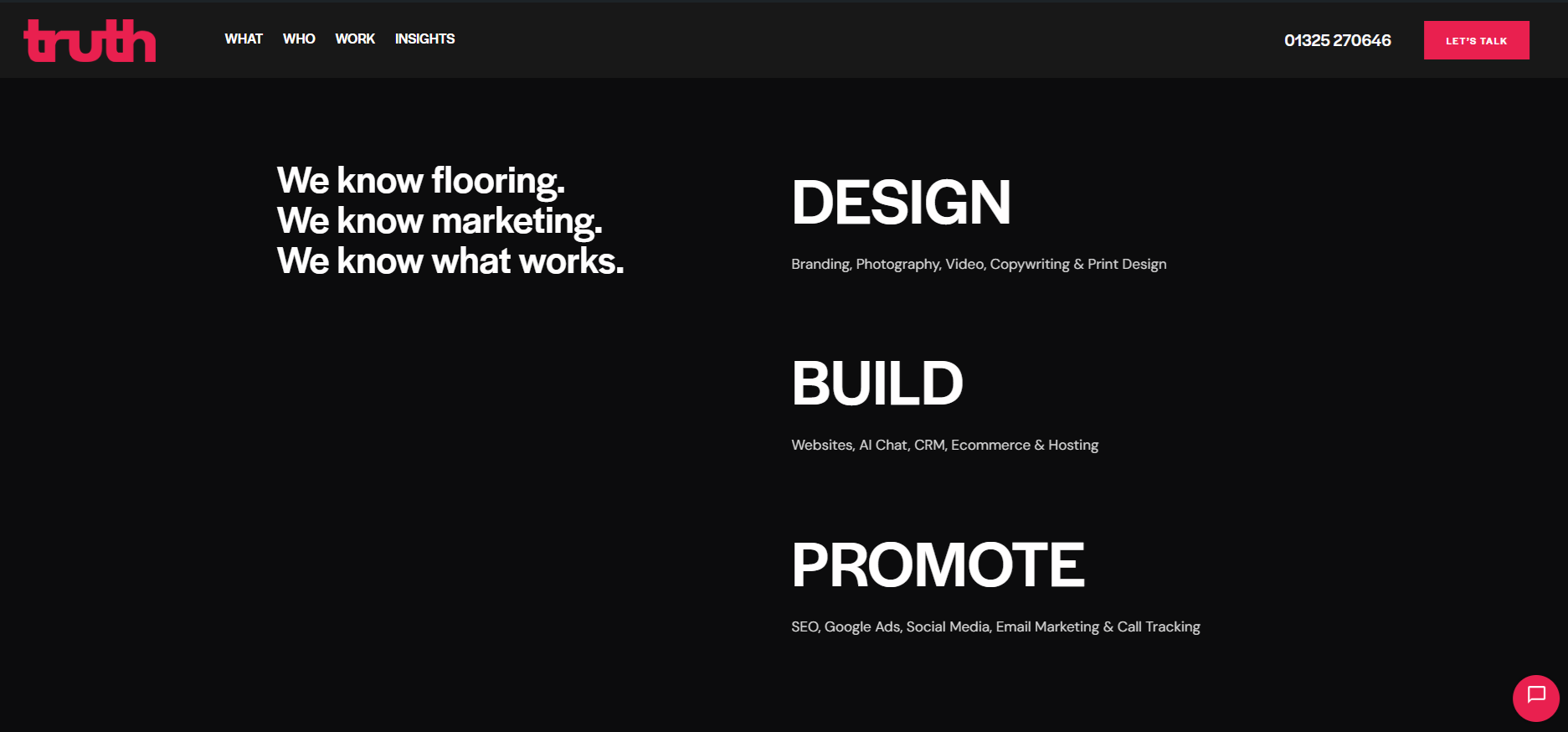
We build websites for flooring businesses that put your brand narrative front and centre, alongside SEO and Google Ads campaigns that attract buyers who are already looking for what you offer. Our website success stories show what happens when strong storytelling meets properly structured digital marketing. More enquiries, better-quality leads, and customers who already understand why you are the right choice before they pick up the phone.
If you are ready to make your brand story work harder online, let us talk.
FAQ
What is brand storytelling for flooring manufacturers?
Brand storytelling is the way a flooring manufacturer communicates its values, purpose, and customer experience through narrative rather than product specifications alone. It connects buyers emotionally to the brand, making them more likely to choose it over a competitor with similar specs.
Why does storytelling reduce customer acquisition costs?
When your brand story builds trust over time, potential customers arrive already familiar with and favourably disposed towards your business. This shortens the sales cycle and reduces how much you need to spend on persuasion-driven advertising.
How do sales associates affect brand storytelling success?
Sales associates are the human voice of your brand in the showroom. If they do not know or believe your brand story, they default to price and spec comparisons, which undermines all your marketing investment. Training staff to tell the brand story consistently is one of the highest-leverage things a manufacturer can do.
What makes a flooring brand story authentic?
Real customer feedback, genuine project photography, and honest communication about the product’s strengths and limits. Authentic project photography and real feedback consistently outperform polished, staged marketing content in flooring.
How do I measure whether my brand storytelling is working?
Track repeat purchase rates, referral volumes, average order value, and time from first contact to conversion. Improvements in these metrics over six to twelve months indicate that your brand story is building genuine customer loyalty rather than just generating short-term interest.

