TL;DR:
- Authentic project images double click-through rates and trust compared to stock photos.
- Structured, optimized galleries and before-and-after content significantly boost conversions and lead quality.
- Fast-loading, mobile-friendly images enhance SEO and increase sales opportunities for flooring businesses.
Stock images are costing your flooring business money. That might sound blunt, but the evidence is clear. Authentic visual content significantly outperforms stock photography in flooring marketing, doubling click-through rates and ad engagement. Buyers researching new flooring are not inspired by generic showroom shots lifted from a manufacturer’s catalogue. They want proof. Real rooms. Real results. Real transformations. In this article, we cover why visuals are now the primary battleground for flooring brands online, how to structure your gallery for conversions, why before-and-after content builds trust faster than anything else, and how technical optimisation keeps all of it working at full speed.
Key Takeaways
| Point | Details |
|---|---|
| Authentic visuals win | Real project images double click-through rates compared to stock photos for flooring sites. |
| Gallery structure matters | Organising visual galleries by room and type boosts conversions by up to 45%. |
| UGC builds trust | Before-after photos and client testimonials lead to higher-value projects and close rates. |
| Optimisation is essential | Proper image optimisation makes sites faster, more SEO-friendly, and mobile-ready. |
Why visual content is the new battleground for flooring brands
Flooring is one of the most visually driven purchase decisions a homeowner makes. People cannot touch your samples through a screen. They cannot walk across your showroom floor from their sofa. What they can do is look at images, and those images will either convince them to contact you or send them straight to a competitor.
This is why stock photography is such a problem. Stock images are recognisable. Buyers have seen them dozens of times across dozens of websites. They signal inauthenticity, and in a market built on trust, that is a serious problem. Flooring ad examples consistently show that authentic project photography doubles click-through rates compared to stock alternatives.
The business case is straightforward. Better images mean more clicks. More clicks mean more enquiries. More enquiries mean more revenue. Visual credibility is not a branding exercise. It is a direct driver of commercial performance.
Here is a quick comparison of how stock images perform against authentic project photos across key metrics:
| Metric | Stock images | Authentic project photos |
|---|---|---|
| Click-through rate | Low | Up to 2x higher |
| Visitor trust | Weak | Strong |
| Ad engagement | Average | Significantly higher |
| Lead quality | Poor | Noticeably better |
| SEO impact | Minimal | Positive with optimisation |
Flooring websites win or lose on visuals in a handful of critical areas:
- Hero images on the homepage
- Project gallery pages organised by room or flooring type
- Google Ads creative and display assets
- Social media imagery used in retargeting
- Before-and-after content that tells a real story
Your flooring website must-haves include high-quality project photography as a core requirement, not an optional extra. And from a branding perspective, consistent, authentic imagery is what separates credible businesses from those that look like everyone else.
Visual content is no longer just about looking good. It is about performing. Every image on your site should be earning its place.
Structure your gallery for maximum conversions
A gallery full of random project photos is better than stock images, but it is still leaving results on the table. Structure matters enormously. How you organise, present, and caption your images directly affects whether visitors stay, explore, and enquire.
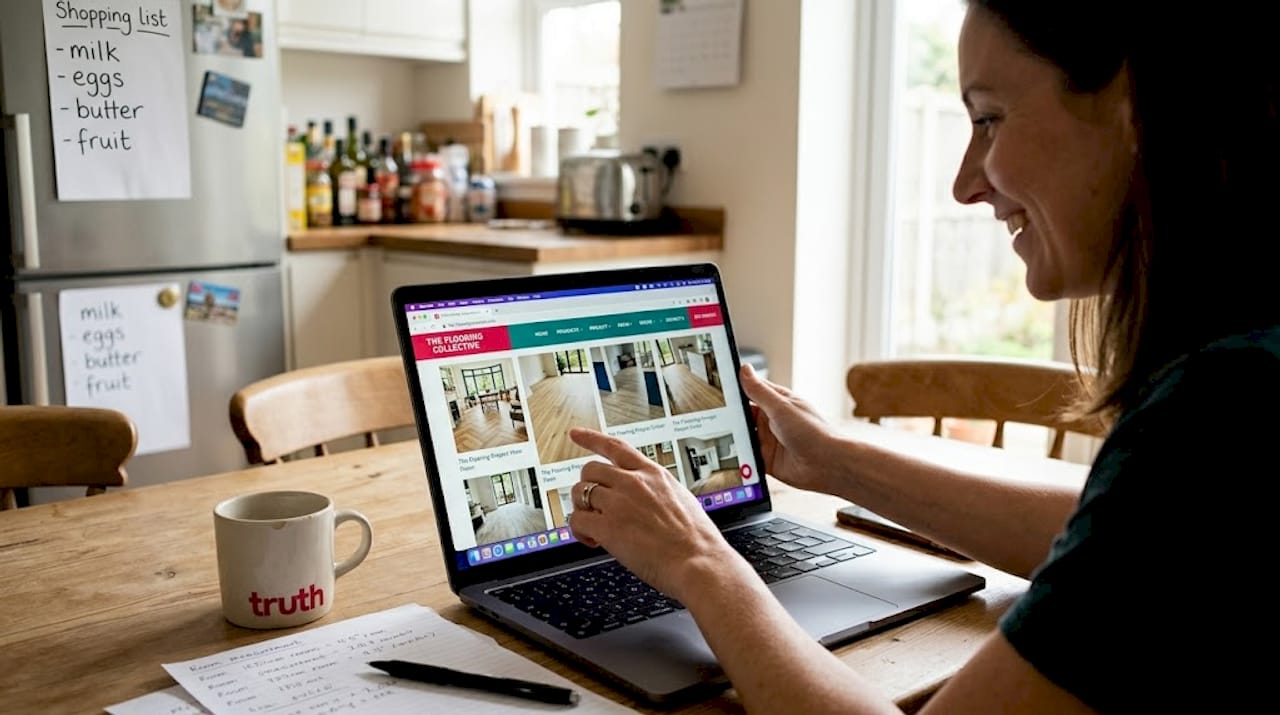
Optimised image galleries with authentic project photos boost conversions by 30 to 45% for flooring websites. That is a significant uplift from a relatively straightforward change. Structured galleries organised by room type and flooring category also increase visitor engagement and the quality of leads coming through.
Here is a framework to implement:
- Categorise by room: kitchen, bathroom, living room, bedroom, hallway, commercial spaces.
- Categorise by flooring type: carpet, LVT, engineered wood, laminate, solid wood, tile.
- Add descriptive captions to every image: include the product, the room size if possible, and any relevant detail.
- Build before-and-after series for your strongest transformations.
- Include user-generated content (UGC) from customers who share photos post-installation.
- Feature your top 10 to 15 projects prominently rather than burying them in a long unsorted grid.
Here is a quick look at how different gallery approaches affect performance:
| Gallery type | Visitor engagement | Lead quality |
|---|---|---|
| Unsorted grid of project photos | Moderate | Average |
| Categorised by room and type | High | Strong |
| Before-and-after series | Very high | Excellent |
| UGC integrated with project photos | High | Very strong |
Pro Tip: Do not treat your gallery as an archive. Think of it as your most persuasive sales tool. Lead with your most impressive transformations and rotate featured projects seasonally to keep the content feeling current.
From a UX perspective, galleries should load quickly, display cleanly on mobile, and make it easy for visitors to find the type of flooring or room they are interested in. Friction in the browsing experience is a direct conversion killer.
The credibility multiplier: real transformations and user stories
Before-and-after content is one of the most powerful formats in home services marketing. It does something stock images simply cannot: it shows a real problem being solved. A tired, worn carpet replaced with beautiful engineered wood. A dated kitchen floor transformed with luxury vinyl tile. The contrast tells the story instantly.
Before-and-after visuals and user-generated content build credibility and demonstrate real-world transformations, leading to higher close rates and better-quality enquiries. Businesses that use structured portfolio content close up to 45% more high-value projects.
Here is what makes UGC and transformation content so effective for flooring businesses:
- It is relatable. Visitors see homes that look like their own, not staged showrooms.
- It builds trust without you having to ask for it.
- It provides social proof that your work delivers on its promises.
- It generates fresh, keyword-relevant content that supports SEO.
- It gives you shareable material for social media and Google Business Profile.
Collecting this content does not need to be complicated. After every install, send a simple follow-up message asking the customer to share a photo or leave a Google review. Many will do both if you make it easy. A short link directly to your Google review page removes all friction.
“The flooring businesses that win online are those that let their completed projects do the talking. Real rooms, real customers, real results. That is what builds trust faster than any ad copy ever will.”
Pro Tip: Pair your best transformation images with the corresponding Google review on the same page. Seeing a stunning result alongside a genuine five-star review from a named customer is one of the strongest trust combinations available to a flooring marketing strategy.
We work with flooring businesses every day, and the ones generating the most enquiries are consistently those who treat their completed work as marketing content. If you want to understand what a fully developed visual strategy looks like in practice, our approach to flooring marketing is built around exactly this.
Optimising your visual content: speed, SEO, and mobile performance
Great images that load slowly are worse than average images that load fast. Page speed is a Google ranking factor and a direct conversion driver. Visitors will not wait. If your gallery takes more than two seconds to display, a significant portion of your traffic will leave before they see a single project photo.
Image optimisation reduces load times by 50 to 70%, boosting conversions by 30% and improving SEO performance simultaneously. That is a measurable return from a technical process that, once set up correctly, runs in the background.
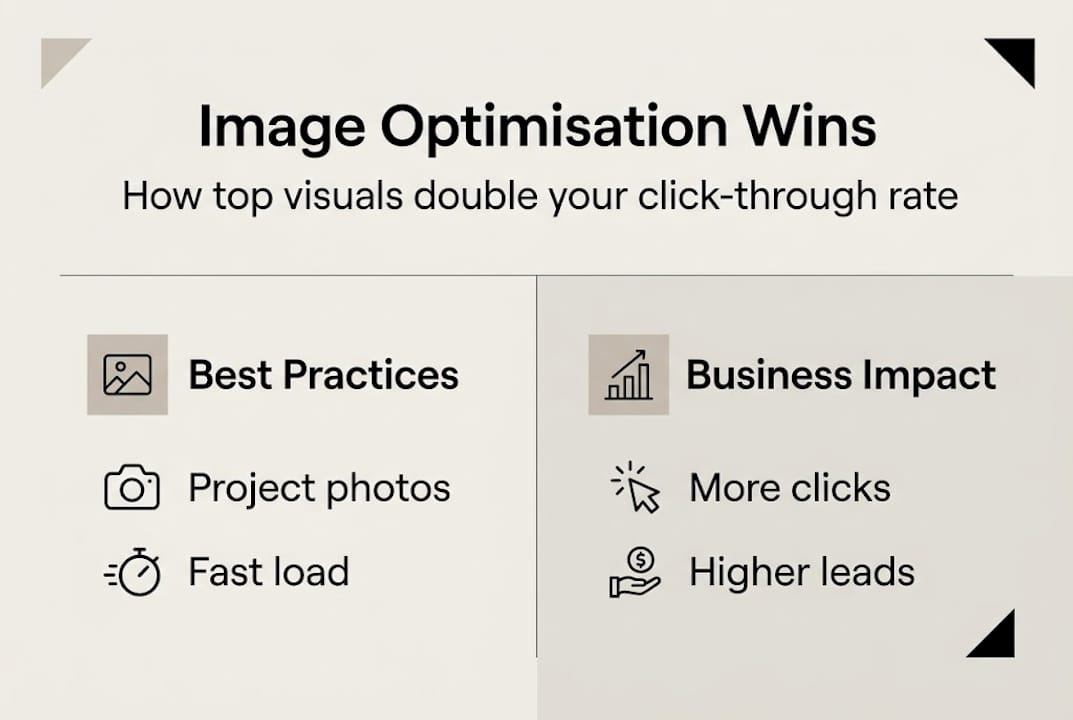
With 70% of flooring web traffic arriving via mobile devices, mobile-first optimisation is not optional. Images must scale correctly, load fast on 4G connections, and display without horizontal scrolling or cropping issues.
Here is a step-by-step optimisation workflow:
- Convert all images to WebP format. It delivers high quality at roughly half the file size of JPEG.
- Compress every image to under 200KB before uploading.
- Write descriptive alt text for every image. Include the flooring type, room, and location where relevant.
- Use lazy loading so images below the fold only load when needed.
- Implement a content delivery network (CDN) to serve images from servers closest to the visitor.
- Test page speed monthly using Google PageSpeed Insights and act on any flagged issues.
Pro Tip: Review and refresh your visual content seasonally. Autumn and spring are peak enquiry periods for flooring. Updating your website content with fresh seasonal project images signals relevance to both visitors and search engines, and gives you a reason to re-promote your gallery across social channels.
Augmented reality (AR) visualisers are also worth considering for businesses selling carpets, LVT, or wood flooring online. These tools let visitors overlay flooring samples into photos of their own rooms, which reduces hesitation and increases purchase confidence significantly.
Why most flooring businesses miss the mark with visual content
Here is our honest take. Most flooring businesses invest in a website, add a handful of decent project photos, and then consider the visual content job done. It is not done. Not even close.
The issue is not a lack of good work. Most flooring businesses do exceptional installations. The issue is that the work is not being documented, organised, or optimised in a way that converts visitors into enquiries.
We see three consistent failure points. First, businesses rely on a small static gallery that never gets updated. Second, they ignore mobile performance until someone mentions their site is slow. Third, they have no process for collecting UGC or before-and-after content after each job.
Nice images are not enough. The question is whether your photo gallery strategies are connected to a measurable sales outcome. Are you tracking which gallery pages generate enquiries? Are you A/B testing different image formats? Are you using AR where it could reduce drop-off?
Visual content should be treated as a commercial asset, not a design feature. The businesses growing fastest online are those measuring the impact of every image and making data-driven decisions about what to show and how to show it.
Ready to elevate your flooring brand with visuals that convert?
If this article has highlighted gaps in your current visual strategy, we can help you close them. At Truth Digital, we build high-performing websites and marketing systems specifically for flooring businesses across the UK.
Our flooring design services cover gallery structure, image optimisation, and mobile performance as standard. Our SEO for flooring companies ensures your optimised content ranks where your customers are searching. And if you want to see what results look like in practice, our website success stories show exactly what is possible. Get in touch and let us build a visual strategy that generates real enquiries for your business.
Frequently asked questions
What visual content converts best for UK flooring businesses?
Authentic project photos, before-and-after galleries, and user-generated content achieve the highest engagement and conversion rates. Optimised galleries with real project images can boost conversions by 30 to 45% compared to standard stock imagery.
How much can visual content improve my flooring website performance?
Switching to authentic images and structured galleries can double click-through rates and increase conversions by up to 45%, making it one of the highest-impact improvements available to flooring websites. Structured gallery improvements compound that effect further.
Does image optimisation really affect SEO and sales?
Yes. Faster-loading, optimised images can cut load times by 50 to 70%, deliver 30% more conversions, and improve search engine rankings, particularly on mobile devices where most flooring searches now originate.
Should I use stock photos or only project images?
Avoid stock photos wherever possible. Authentic project visuals consistently outperform stock in every key metric including trust, clicks, and conversion, making real project photography the clear commercial choice for any flooring business.