TL;DR:
- Organic search offers free, long-term visibility for local flooring businesses in targeted areas.
- Optimizing on-page, off-page, and technical SEO improves Google rankings and increases enquiries.
- A well-maintained Google Business Profile and tailored local pages significantly boost local search traffic.
Many UK flooring businesses assume that showing up on Google means spending money on ads. It’s a common belief, and it’s costing them enquiries. Organic search, which means appearing in unpaid results because Google judges your site as relevant and trustworthy, is one of the most powerful tools available to flooring retailers and installers. The core mechanics of organic SEO include on-page optimisation, off-page authority, technical SEO, and content that answers real customer questions. Done well, it generates a steady stream of enquiries without a per-click cost. This guide breaks down exactly how to make it work for your flooring business.
Key Takeaways
| Point | Details |
|---|---|
| Organic search = free visibility | Appearing in unpaid search results draws more flooring enquiries without ad costs. |
| SEO builds trust and traffic | A robust organic strategy attracts better-fit local customers ready to enquire. |
| Local focus wins leads | Optimising for local keywords and Google Business Profile multiplies your chances of getting found. |
| Trends shape content | Aligning your site with flooring market trends captures growing customer demand before competitors. |
| Turn visitors into customers | Optimised pages and trust signals convert organic website traffic into real flooring enquiries. |
Demystifying organic search in the flooring industry
Organic search simply means the unpaid listings that appear when someone types a query into Google. When a homeowner searches “carpet fitter in Leeds,” the results that appear below the ads are organic. They are earned, not bought.
Contrast that with paid ads. A Google Ad puts you at the top immediately, but you pay each time someone clicks. Organic rankings take longer to achieve, but once you are there, the traffic flows without ongoing cost per click. For flooring businesses operating on tight margins, that distinction matters.
Local service businesses like flooring retailers and installers benefit from organic search in a specific way. Most customers search with location in mind. They are not browsing nationally. They want a fitter nearby, a showroom they can visit, or a specialist in their town. That makes organic search highly targeted by nature.
The value is persistent. A well-optimised page for “LVT installation in Bristol” can attract enquiries for months or even years. You do not reset to zero when a budget runs out.
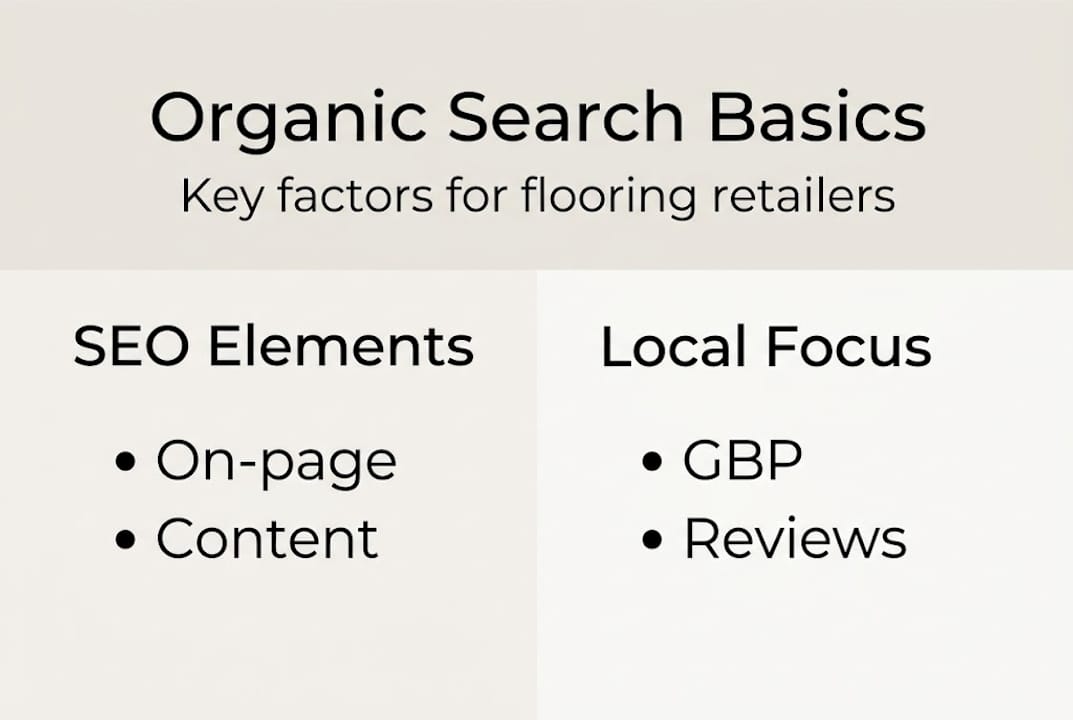
Understanding SERPs for flooring (Search Engine Results Pages, the page Google shows after a search) is a useful starting point. The three pillars that determine your organic position are:
- On-page SEO: the content, headings, and keywords on your website pages
- Off-page SEO: external websites linking back to yours, building authority
- Technical SEO: site speed, mobile usability, and how well Google can read your site
“Organic search relies on multiple SEO pillars including content, technical, and off-site authority.” Nail all three and you build a platform that keeps delivering.
Ignoring organic search means leaving the field open to national flooring chains and aggregator sites that already invest heavily in it. The good news is that local, focused businesses have a real advantage in local search.
Core elements of successful organic search strategies for flooring
With organic search defined, the next step is understanding the pillars that make up a winning SEO strategy for flooring businesses.
Here is how each pillar applies specifically to flooring:
| Element | What it means | Flooring example |
|---|---|---|
| On-page SEO | Keywords, headings, page content | A page titled “Engineered oak flooring installer in Manchester” |
| Off-page SEO | Backlinks from other websites | A local trade association or supplier linking to your site |
| Technical SEO | Site speed, mobile layout, indexation | Your site loading in under 3 seconds on a mobile phone |
Core mechanics like keyword placement, backlinks, site speed, and mobile optimisation all work together. Weaknesses in any one area hold back the others.
The most effective organic actions for UK flooring sites include:
- Writing individual service pages for carpet, LVT, wood flooring, and commercial fitting
- Adding location pages for each town or area you serve
- Collecting and publishing genuine customer reviews on your site and Google
- Ensuring your site loads quickly on mobile devices
- Publishing answers to the questions your customers actually ask
Pro Tip: Do not just stuff keywords onto pages. Answer the genuine questions your customers search for, such as “how long does LVT installation take” or “what underlay do I need for engineered wood.” Google rewards content that genuinely helps.
The essential elements your flooring website needs go hand in hand with SEO. A technically sound, well-structured site is a prerequisite for ranking. And keeping your site content updated signals to Google that your business is active and relevant.
Regular content updates, even small ones like adding a new project photo or refreshing a service page, can lift rankings over time. Organic SEO rewards consistency.
Local SEO: Winning search for flooring in your service area
Understanding the broad elements of SEO, it’s essential to go local. Most flooring customers search for nearby specialists, not national brands.
Local SEO focuses on making your business visible to people searching in your geographic area. The most visible local feature on Google is the Maps 3-pack: the three business listings that appear with a map when someone searches “flooring installer near me.”
To illustrate the difference in search intent, consider this:
| Search term | Monthly searches (approx.) | Intent | Competition |
|---|---|---|---|
| “flooring installer near me” | High local volume | Ready to book | Moderate, local |
| “wood flooring” | Very high | Browsing/research | Very high, national |
| “LVT fitter Birmingham” | Targeted local | High intent | Low to moderate |
High-intent, location-specific keywords and long-tail transactional terms consistently outperform broad terms for actual enquiry conversion.
Here is how to optimise your Google Business Profile (GBP) for flooring:
- Claim and verify your GBP listing at business.google.com
- Add your full business name, address, and phone number exactly as they appear on your website
- Select the correct primary category, such as “Flooring Contractor” or “Carpet Installer”
- Upload high-quality photos of completed flooring projects
- Add all the flooring services you offer in the Services section
- Collect and respond to every customer review
- Post regular updates about new products, offers, or completed projects
Pro Tip: Focus your GBP and your website pages on the specific locations and services you genuinely deliver. Trying to rank for everywhere dilutes your relevance. Tight geographic targeting helps you outperform national brands in your actual service area.
Results from local SEO take time. Realistically, expect 3-12 months before you see strong movement. But combining local SEO with an optimised GBP can generate 7x more clicks compared to an unoptimised listing. Strong online branding for flooring businesses also reinforces trust when customers land on your profile or site.
Flooring market trends: Adapting your SEO to shifting customer demand
Beyond winning local searches, staying ahead of market shifts can set your flooring business apart in organic rankings.
The UK flooring market is evolving. Retrofit and remodelling projects are driving demand as homeowners upgrade rather than move. Non-resilient flooring, including carpet and wood, still leads by volume. But resilient and LVT products are showing the strongest growth trajectory, making them a key opportunity for SEO-focused content.
Popular flooring searches reflecting current demand include:
- “LVT flooring cost UK”
- “best flooring for kitchen renovation”
- “underfloor heating compatible flooring”
- “herringbone LVT installer near me”
- “waterproof flooring for bathroom”
- “engineered wood vs laminate”
These are not just keyword ideas. They reflect real customer questions tied to active buying decisions.
The LVT and resilient flooring category is growing faster than the broader market. Businesses that create specific content around LVT installation, costs, and comparisons are capturing a growing share of relevant searches before national retailers dominate those terms.
Pro Tip: Write content about emerging trends before they peak. If a product category is gaining traction, create a dedicated page or blog post now. Early content ranks faster and holds position longer than content created after the trend is saturated.
Using Google Trends and your own enquiry data together gives you a practical picture of what your customers are searching for right now. Understanding what types of flooring customers you are targeting also helps you match content to intent at different stages of their buying journey.
Turning organic search visits into qualified flooring enquiries
Ranking well only matters if site visitors become customers. Let’s explore how flooring businesses can convert organic visitors into real leads.
Organic traffic is only valuable when it produces enquiries. A page that ranks well but fails to convert is a missed opportunity. The most effective ways to capture leads from organic traffic include:
- Clear contact forms on every service page
- Click-to-call buttons visible on mobile without scrolling
- Quote request forms specific to the type of flooring enquiry
- Strong calls-to-action such as “Get a free quote today” or “Book a home visit”
- Live chat or instant response options for out-of-hours queries
Here is a practical sequence to audit and improve your site’s conversion elements:
- Open each key service page on a mobile device and check whether the contact button is immediately visible
- Test your contact form by submitting a dummy enquiry and measuring response time
- Review your page titles and headings to confirm they match what the visitor searched for
- Add at least three genuine customer reviews or testimonials to each service page
- Include photos of your actual completed work, not stock images
- Check that your phone number, address, and opening hours are accurate and consistent across all pages
After making SEO changes, measure results using Google Search Console and Google Analytics. Track which pages generate the most enquiries and double down on what works.
Trust signals matter enormously in flooring. Customers are inviting you into their home. Photos of real projects, memberships of trade associations, and authentic reviews all reduce friction. Dedicated service pages for each flooring type improve both rankings and conversion rates. Improving UX on your flooring website reduces bounce rates and keeps visitors engaged long enough to enquire. And strong flooring photo galleries can be the deciding factor for a customer choosing between you and a competitor.
Our experience: What most flooring companies miss about organic search
After helping UK flooring businesses succeed in organic search, a few patterns stand out. The most common mistake is chasing high-volume keywords at the expense of relevance. Ranking for “flooring” nationally sounds impressive. It rarely produces enquiries for a regional installer.
Many flooring companies also ignore service and location pages entirely. They have one homepage and a contact form. National competitors and aggregator sites fill that gap, capturing enquiries that should go to local specialists.
Our advice is simple. Focus on fewer, better pages that reflect your actual services and true service area. A well-built page for “carpet fitting in Nottingham” will outperform ten thin, unfocused pages every time. Avoid the common flooring website mistakes that hand business to national brands.
The data backs this up. Combining local SEO with a fully optimised Google Business Profile produces 7x more clicks than leaving your GBP incomplete. That is not a marginal improvement. It is a substantial, measurable uplift from actions entirely within your control.
Take your flooring business further with expert support
Ready to put these tactics into practice? We work exclusively with UK flooring businesses, so everything we do is built around the way your customers search and buy.
Start by exploring our ultimate SERPs guide for a deeper look at how Google ranks flooring businesses. If your website structure needs attention, our flooring website structure guide walks you through the exact setup that attracts enquiries. Or, if you want a fast, personalised snapshot of where your flooring business stands online, grab our free Flooring Growth Pack. No fluff, just actionable insight for your business.
Frequently asked questions
How long does it take for SEO to work for flooring businesses?
SEO typically takes 3-12 months to show meaningful results for flooring companies, depending on the competitiveness of your area and how consistently you update your site.
What keywords work best for UK flooring companies?
The most effective are high-intent, location-based terms and long-tail phrases such as “LVT installer Manchester” or “carpet fitting near me,” which attract visitors who are ready to book.
How does Google Business Profile impact flooring enquiries?
An optimised GBP can increase clicks by up to seven times when paired with a well-structured local SEO strategy, making it one of the highest-return actions available to flooring businesses.
Should flooring businesses create service pages for each product type?
Yes. Service pages per flooring type improve both your rankings for relevant searches and your conversion rate, because visitors land on a page that precisely matches what they were looking for.