


TL;DR:
- A well-structured flooring portfolio showcases projects with detailed stories, photos, and client outcomes to build trust. Consistent updates, categorization, and storytelling significantly enhance credibility and attract inquiries. Avoid common mistakes by providing context, quality images, and relevant details to demonstrate expertise effectively.
Your flooring portfolio is often the first real proof a potential customer sees. Before they call, before they visit your showroom, they’re looking at your website and asking one question: can this business deliver what I need? A modern, well-organised portfolio answers that question immediately. It builds trust, sets you apart from competitors, and directly drives enquiries. This guide covers exactly what to include, how to structure it, and how to keep it working hard for your business.
Key Takeaways
| Point | Details |
|---|---|
| Showcase with categories | Organising projects by flooring type shows your versatility and makes browsing easy for UK customers. |
| Include full transformation stories | Use before-and-after images and key details to show the impact and build customer trust. |
| Focus on outcomes | Highlight clear results and customer satisfaction, not just the products, for better enquiries. |
| Keep portfolios updated | Regularly refresh your portfolio with new case studies to stay competitive and relevant. |
| Professional design boosts results | A well-designed, SEO-optimised portfolio attracts more serious enquiries and maximises your marketing efforts. |
Why an effective flooring portfolio matters
The UK flooring market is competitive. Customers have plenty of choice, and most of them research online before making any contact. A strong portfolio is what separates a business that gets the call from one that gets skipped.
Here is what UK flooring buyers are actually looking for when they browse your portfolio:
- Proof that you have done similar work to what they need
- A clear sense of the quality and finish you deliver
- Reassurance that you handle the full job, not just the fitting
- Confidence that you work with the products and styles they have in mind
Without a portfolio, or with one that is outdated and thin, you lose those customers before they ever get in touch. They move on to the next business.
“If your portfolio is not doing the selling for you, your competitors’ portfolios are doing it for them.”
UK flooring companies structure portfolios by categorising projects by flooring type, such as LVT, Karndean and Amtico, carpets, laminate, wood and commercial jobs, to showcase a diverse range of offerings. This approach works because it lets customers find relevant examples instantly. Nobody wants to scroll through 50 photos hoping something matches their situation.
Common pitfalls we see in poorly built portfolios include blurry or low-resolution images, no project context or descriptions, all photos lumped together with no categories, and no indication of what was involved in the work. These issues erode trust fast. You can avoid them by focusing on boosting photo galleries and understanding what different flooring customer types actually need to see before they enquire.
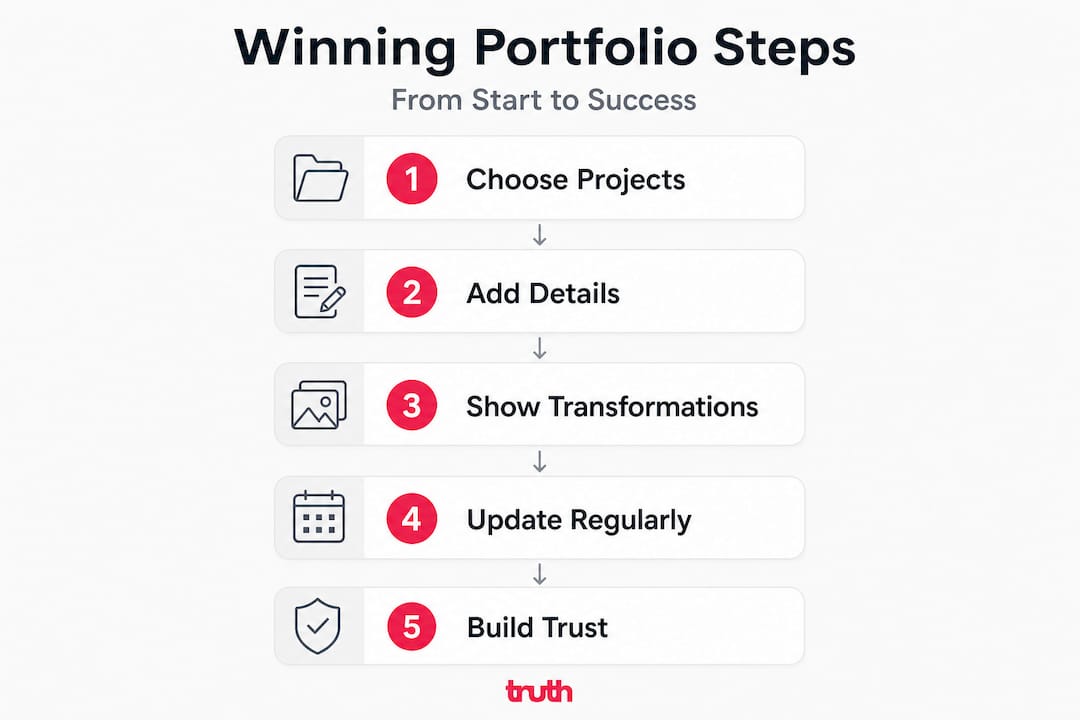
What to include in a winning flooring portfolio
A portfolio is not just a photo gallery. The best ones function more like mini case studies. Each project entry should tell a story and give the customer everything they need to feel confident in your work.
For each project, highlight vital details like subfloor preparation, materials used (such as Amtico Spacia Noble Oak parquet), installation time, and customer outcomes to tell a complete transformation story. This level of detail does something a photo alone cannot: it shows your expertise, your process, and the real-world results you achieve.
Here is the structure we recommend for every project entry:
| Element | What to include |
|---|---|
| Project category | Flooring type and setting (e.g. LVT, residential kitchen) |
| Client objective | What the customer wanted to achieve |
| Challenges | Subfloor issues, awkward spaces, tight timelines |
| Subfloor preparation | What was done before laying the floor |
| Flooring product | Brand, range, and specific product used |
| Before and after photos | Clear, well-lit images of both stages |
| Installation timeline | How long the project took from start to finish |
| Outcome | What the customer got and how they felt about it |
Use powerful imagery throughout. Poor photos undermine even excellent work. Every image should be well-lit, in-focus, and taken at a flattering angle that shows the floor clearly.
The must-have elements for every project entry include:
- A descriptive project title (not just “Job 14”)
- At least one before image and one finished result image
- The specific products used with brand names
- A short written description of the project scope
- Any notable challenges and how you solved them
- A customer quote or satisfaction note where possible
Pro Tip: Ask your fitters to take a photo on arrival before any work starts. That single habit means you always have a “before” shot, which doubles the value of every project for your portfolio.
Good design for trust is also essential. A portfolio that looks cluttered or is hard to navigate loses visitors quickly. Keep each project entry clean and easy to read.
How to structure and categorise your projects
Structure is what turns a collection of images into a useful resource. Without it, visitors feel lost and leave. With it, they find what they need in seconds and stay on your site longer.
UK flooring portfolios often organise examples by types such as Luxury Vinyl Tile (LVT), Karndean, Amtico, carpets, laminate, real wood, or commercial flooring, making it easier for prospects to find relevant work. This categorisation also benefits your SEO. Google can better understand what your pages cover, and customers searching for specific terms like “Karndean installation UK” are more likely to find relevant content.
Here are the four main approaches to categorisation, in order of effectiveness for most UK flooring businesses:
- By flooring type: LVT, carpet, wood, laminate, commercial. This is the most common and usually the most useful for customers.
- By client type: residential versus commercial. Useful if you serve both markets and want to attract each distinctly.
- By room or space: living rooms, kitchens, offices, retail spaces. Works well if you want to appeal to customers renovating a specific area.
- By transformation story: budget makeovers, luxury upgrades, problem-solving projects. This is less common but highly engaging for customers who identify with a specific situation.
| Categorisation approach | Best for | SEO benefit |
|---|---|---|
| By flooring type | Most flooring businesses | High, matches search terms |
| By client type | Mixed residential and commercial | Medium |
| By room or space | Residential specialists | Medium |
| By transformation story | Premium or niche businesses | Lower but high engagement |
Take a look at how categorising flooring types works in practice for businesses that have invested in a structured portfolio approach. The results speak for themselves. Meanwhile, key website features like fast loading, clear navigation, and mobile-friendly layouts make your categories easy to browse on any device.
Staying aware of US flooring portfolio trends can also give you fresh ideas. Markets differ, but good presentation principles travel well.
Pro Tip: Use your categories as website filter tabs rather than separate pages. Customers can click “LVT” or “Carpet” and instantly see only the relevant projects without navigating away from the portfolio page.
Showcasing transformations: Images, storytelling and results
A before-and-after image is one of the most powerful tools in any flooring portfolio. It does not just show quality. It shows change. That is what customers are buying: a transformation of their space.

Include before-and-after images to demonstrate transformations, as seen in UK projects like living room carpet replacements and LVT installations. The impact is immediate. Customers can picture their own rooms going through the same process.
Here is how to create compelling transformation content for each project:
- Take the before photo from the same angle you plan to use for the after shot. Consistency makes the transformation more dramatic.
- Capture progress shots during installation. These show your process and professionalism.
- Take the final photos in good natural light or use a portable lighting setup. Dark or yellow-tinted photos flatten the finish.
- Write a short narrative: what was the situation, what did you do, and what did the customer gain.
- Include a specific, genuine customer comment where possible. First names and general location are enough.
- Mention the exact products used. Customers often research specific ranges and will find your project when they search for that product.
Mini case studies do not need to be long. Three to five sentences covering the goal, the challenge, the solution, and the result is enough. It gives the portfolio entry substance without overwhelming the reader.
“Stories explain the challenge, the solution, and the benefit, creating a connection and credibility that standalone photos simply lack.”
Focus on building visual trust in every image and every word you write. Your portfolio is a direct reflection of your brand. It should feel consistent, professional, and genuinely useful to the person browsing it.
Strong branding strategies tie your portfolio into a wider sense of who you are and what you stand for as a business. That coherence matters. Customers notice it even when they cannot quite explain why they feel confident in one business over another.
If you are looking to explore how technology is changing visual presentation, AI design transformation tools are beginning to offer new possibilities for helping customers visualise flooring options in their own spaces.
Maintaining and maximising your portfolio’s power
A portfolio is not a set-and-forget asset. It needs regular attention to stay relevant and to keep driving enquiries. Stale portfolios with old photos and outdated products send a subtle negative signal to customers: this business is not active or up to date.
Here is what good portfolio maintenance looks like in practice:
- Add new projects at least once a month. Even one strong entry per month compounds over time.
- Remove any projects that no longer reflect your current quality or product range.
- Review your categories every quarter and add new ones if your service offering has grown.
- Update product names and ranges when suppliers update their collections.
- Check image quality across all entries and replace any that have become outdated or low quality.
- Use your portfolio as a source of content for social media, email, and Google Business Profile posts.
Some portfolios use simple galleries, others use detailed case studies with metrics. Detailed ones consistently perform better for attracting discerning UK customers who are comparing multiple businesses before making a decision. The effort you put into each entry shows.
Encouraging customers to share their experience is also part of the process. After completing a job, ask if they would mind you sharing a photo of the finished floor. Most happy customers are glad to say yes. A brief message a week after installation is also a natural moment to request a review or a quote you can use on the portfolio entry.
Pro Tip: Set a recurring calendar reminder every three months to review your portfolio. Treat it like a business task, not an afterthought. Businesses that do this consistently tend to have stronger enquiry rates from their website.
When a project is not generating interest, look at the quality of the photos first, then the description. Weak images are usually the issue. For further ideas on getting more from your portfolio, see how promoting your flooring portfolio through multiple online channels amplifies the investment you have already made.
What most flooring portfolios get wrong (and how to fix it)
We have looked at a lot of flooring websites. And one pattern comes up again and again: businesses treat their portfolio as a gallery when they should treat it as evidence.
A gallery says “here are some photos.” Evidence says “here is what we can do for you, and here is proof.” That distinction matters enormously to a customer who is about to spend several thousand pounds on new floors.
The most common mistake is uploading a batch of photos with no context. No product names, no project descriptions, no before shots, no outcomes. Just finished floors, often photographed poorly, all sitting in one long grid. That kind of portfolio tells a customer very little beyond the fact that you have done some jobs.
The second mistake is irregular or infrequent updates. A portfolio with its most recent project dated over a year ago is a problem. It suggests the business is not busy or not interested in showcasing its work.
The third mistake is ignoring the customer’s perspective. Every element of a portfolio should answer one question: what does this mean for me? Customers are not studying your technique. They are imagining their own home or office. Write your project descriptions with that in mind.
What we find works: short, specific, outcome-focused case studies. Details about the product. A quote from the customer. A clear before and after. That combination builds more trust than fifty anonymous photos ever will.
If you want to understand how your portfolio fits into a broader growth strategy, digital marketing strategies for UK flooring businesses show how every online asset connects and contributes to your overall results.
Get more enquiries with a standout flooring portfolio
A great portfolio needs to be seen to work. That is where design and SEO come in. A well-built, professionally designed portfolio that ranks on Google for relevant search terms in your area will generate consistent, qualified enquiries.
We work exclusively with UK flooring businesses to build portfolios that attract the right customers and convert them into enquiries. Our flooring SEO services ensure your portfolio appears when local customers are searching for the exact work you do. Our design services make sure it looks professional and builds trust from the first click. If you are ready to see where your business stands online and what you could be doing better, our free growth pack is the best place to start. No commitment, just clarity.
Frequently asked questions
What categories should flooring portfolios include for the UK market?
UK flooring companies structure portfolios by categorising projects by flooring type. Categories such as LVT, Karndean, Amtico, carpets, laminate, wood, and commercial work give customers the clearest path to finding relevant examples.
How many photos should be shown for each flooring project?
Include before-and-after images to demonstrate transformations. At least one before and one after shot, plus any key progress or detail images, builds maximum trust with potential UK customers.
What project details help drive more enquiries?
Highlight subfloor prep, materials, installation time, and outcomes for each project. These specifics reassure customers that you handle the complete job and understand what the work actually involves.
How often should flooring portfolios be updated?
Update your portfolio at least quarterly, and ideally monthly, to keep content fresh, signal to Google that your site is active, and show customers that your business is busy and in demand.
Why do transformation stories increase trust more than just photos?
Stories explain the challenge, the solution, and the benefit, creating a connection and credibility that standalone photos lack. They help customers picture their own situation being resolved, which is what drives them to get in touch.