TL;DR:
- Omnichannel marketing delivers a consistent, integrated customer experience across all digital and physical channels for flooring businesses. It outperforms multichannel approaches by unifying customer data and simplifying the sales journey. Building this capability requires systems, staff training, and process adjustments to effectively connect every touchpoint.
Having a showroom and a website is no longer enough. 83% of UK consumers want a seamless blend of online and in-store shopping, and flooring businesses that treat these as separate operations are losing sales daily. This guide cuts through the confusion around omnichannel marketing. We explain what it actually means for a flooring business, how it differs from simply being present on multiple platforms, and what practical steps you can take right now to join up your customer experience and drive more enquiries through every channel you operate.
Key Takeaways
| Point | Details |
|---|---|
| Omnichannel unifies experiences | It delivers a seamless customer journey across online, phone, and in-store touchpoints for flooring brands. |
| UK shoppers expect integration | Over 80% blend online research and physical visits when choosing flooring, so joined-up experiences are critical. |
| Multichannel is not enough | Running sales channels separately misses opportunities and introduces friction that costs leads and sales. |
| Start with system and staff integration | True omnichannel begins with operational changes, not just new tools, focusing on central data and staff readiness. |
| Expert help accelerates results | Flooring businesses see best results when they tap proven digital marketing and omnichannel strategies tailored to their sector. |
What is omnichannel marketing in flooring?
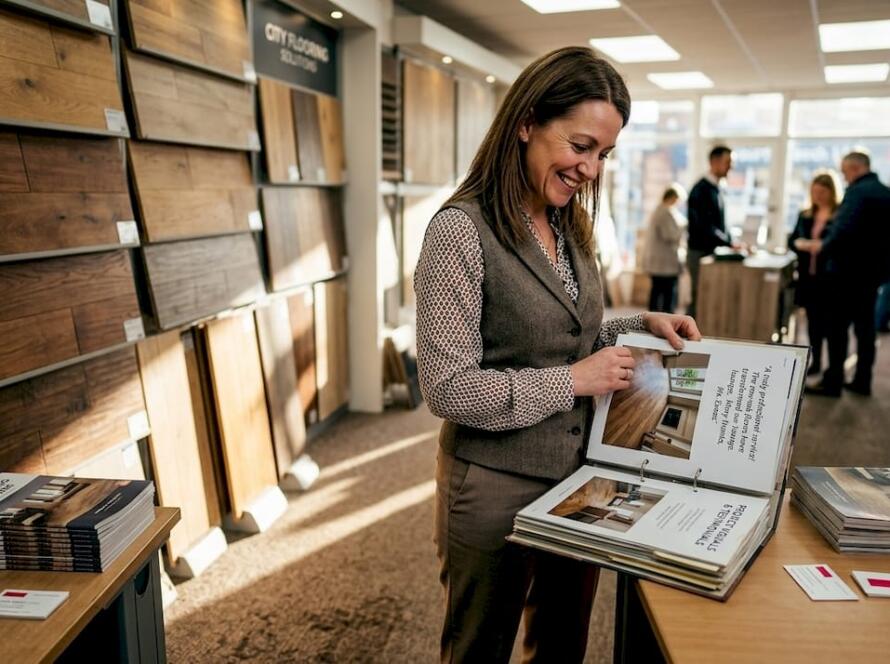
Omnichannel marketing is not a buzzword. It is a practical strategy. Omnichannel marketing delivers a consistent, integrated customer experience across all digital and physical channels and touchpoints. For flooring businesses, that means a customer browsing your wood flooring collection on a mobile at 10pm gets the same product information, pricing signals, and brand feel as when they walk into your showroom on Saturday morning.
The key word is consistency. Not just presence.
Most flooring businesses already use several channels. A website, maybe Google Ads, an Instagram page, a physical showroom, and a phone line. But if those channels do not talk to each other, you do not have omnichannel marketing. You have noise.
Here is why this matters. UK flooring shoppers almost never follow a straight line from discovery to purchase. They might see a carpet on social media, check your website for pricing, phone your showroom with a question, visit in person to see samples, then complete an enquiry form online. Every single one of those digital touchpoints for flooring sales must be connected. If any step feels disconnected, the sale is at risk.
What omnichannel actually looks like in flooring:
- A customer saves a product on your website and your showroom team can see that when they walk in
- Automated follow-up emails reference the specific floor type the customer enquired about, not a generic template
- Google Ads retargeting shows a customer the exact LVT range they viewed on your site
- Your CRM logs all customer interactions whether by phone, web chat, or in-store visit
- Drip marketing in flooring sequences are triggered based on where a customer is in the buying journey
| Channel | What customer sees | What it connects to |
|---|---|---|
| Website | Product ranges, pricing, inspiration | CRM, email, retargeting |
| Showroom | Samples, consultations | CRM history, web enquiries |
| Personalised follow-ups | Web behaviour, purchase history | |
| Social media | Inspiration and offers | Website traffic, retargeting ads |
| Phone | Direct advice | CRM records, previous touchpoints |
This joined-up approach is what separates flooring businesses that consistently convert enquiries from those that wonder why leads go cold.
Omnichannel vs multichannel: key differences for UK flooring brands
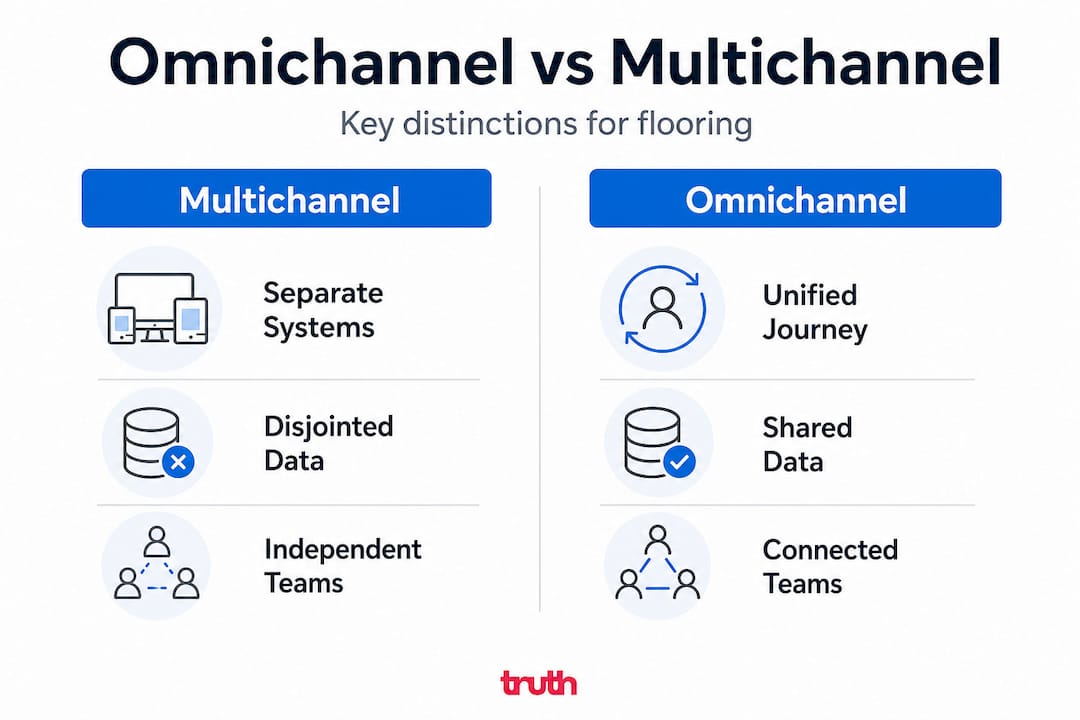
Many flooring businesses already run multiple channels. That is multichannel. But omnichannel connects channels around a single unified customer view rather than running each channel in silos. That is a completely different thing.
With multichannel marketing, your website team does not know what your showroom staff told a customer last week. Your email campaigns go out to everyone, regardless of whether that person already visited and got a quote. Your Google Ads show the same message to someone who has already purchased. Each channel does its own thing. Individually, they might each perform adequately. Together, they create a disjointed, frustrating experience.
Here is how a customer journey breaks down in a disconnected multichannel system:
- Customer submits an online enquiry for engineered oak flooring
- No one follows up with a personalised email referencing their specific interest
- Customer visits the showroom; staff have no record of the enquiry
- Customer has to start the conversation from scratch
- Staff recommend a product the customer already rejected online
- Customer leaves frustrated and buys from a competitor who remembered them
Sound familiar? This is happening in flooring businesses across the UK every single week.
The handoff between online and in-store is where UK flooring brands lose the most sales. A customer who had to repeat themselves three times is already looking elsewhere.
For digital marketing for flooring to actually perform, the underlying customer journey needs to be unified. Without that, you are spending money driving traffic that leaks out of a broken funnel.
| Factor | Multichannel | Omnichannel |
|---|---|---|
| Customer view | Each channel is separate | Single, unified profile |
| Sales process | Disconnected at handoff | Seamless from online to in-store |
| Data use | Siloed per channel | Shared across all touchpoints |
| Conversion | Lost at channel transitions | Supported throughout the journey |
| Customer effort | High (repeat themselves) | Low (staff already informed) |
| Marketing spend efficiency | Lower (no joined-up targeting) | Higher (full journey visibility) |
The shift from multichannel to omnichannel is not about adding more platforms. It is about connecting the ones you already have. Learning about online promotion for flooring is useful, but only when those promotions feed into a joined-up customer view.
How omnichannel marketing improves the UK flooring customer journey
Theory aside, what does omnichannel actually look like day-to-day for a UK flooring business? There are two common customer behaviours you need to understand: webrooming and showrooming.
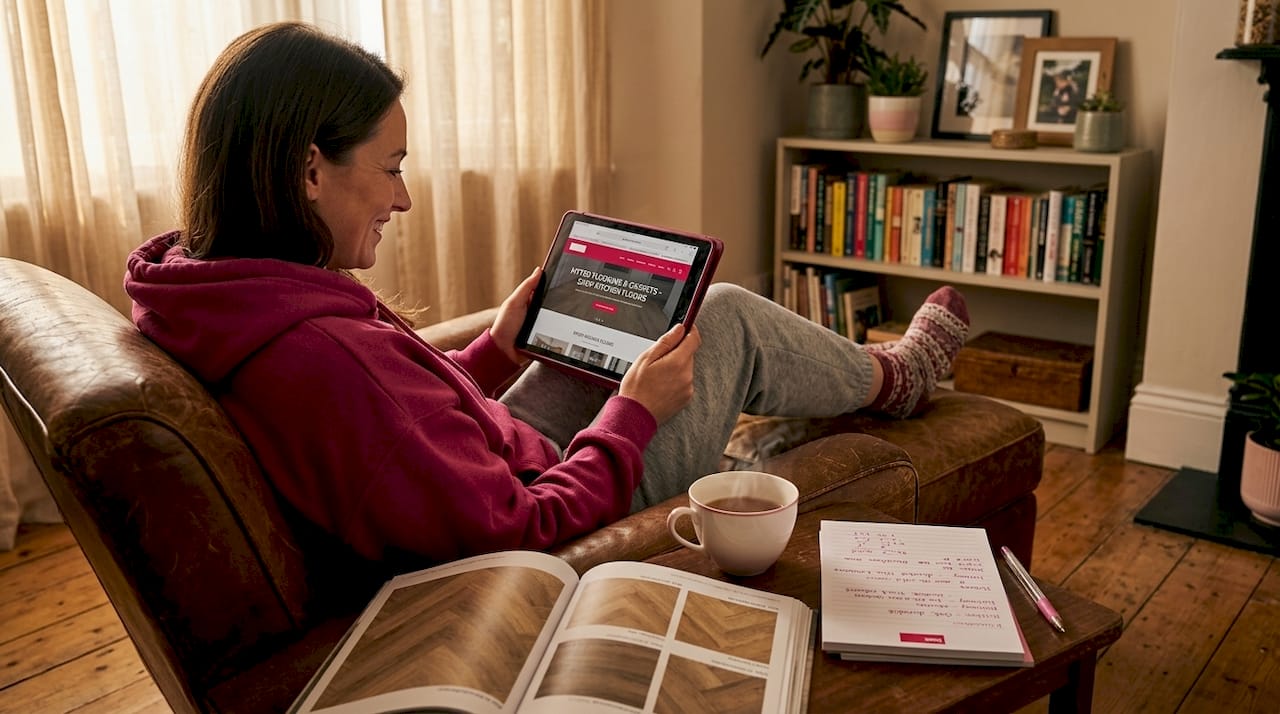
Webrooming is when a customer researches thoroughly online and then visits in-store to buy. They already know what they want. They have seen flooring installation examples, read your product pages, and compared prices. When they arrive at your showroom, they need confirmation, not a sales pitch from scratch.
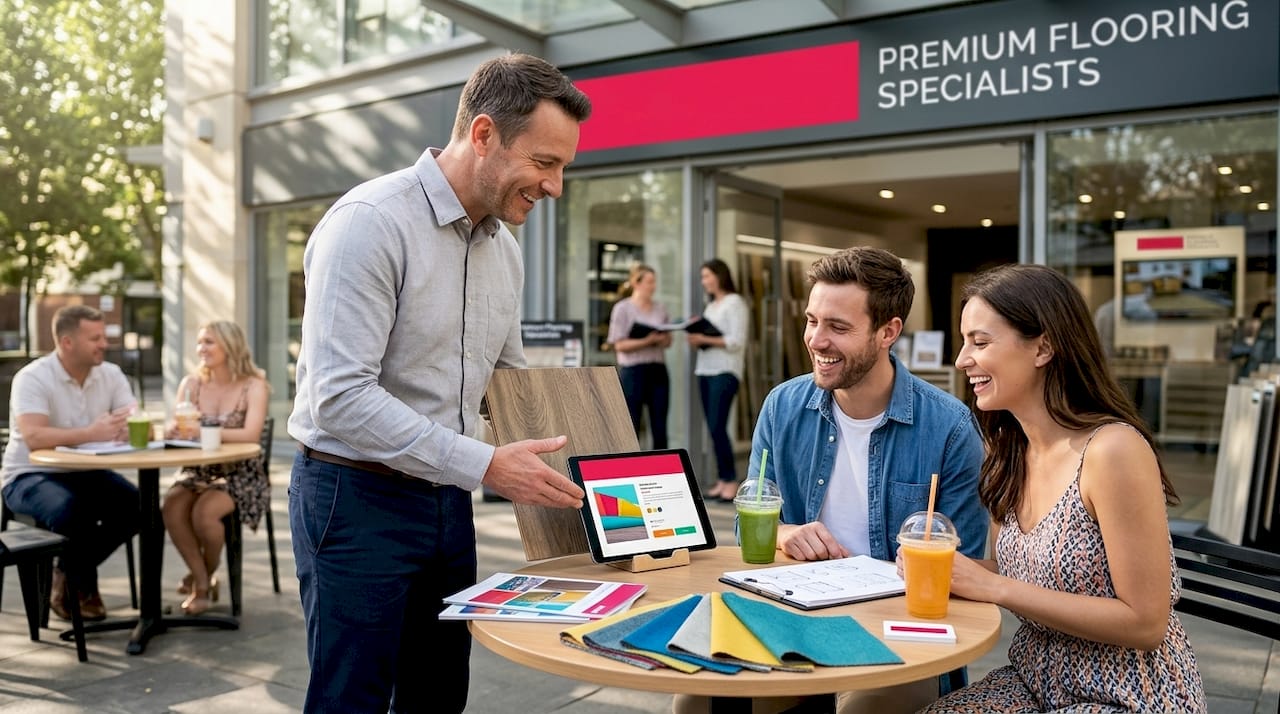
Showrooming is the reverse. A customer visits your showroom first, handles samples, talks to your team, and then goes home to complete the purchase or get a final quote online.
Both behaviours are common in UK flooring sales. Research confirms that shoppers expect a blend of online and in-store experiences, and businesses that cater to both journeys outperform those that focus on one or the other.
A typical omnichannel journey for a UK flooring shopper looks like this:
- Sees a real-life floor transformation on Instagram and clicks through to your website
- Browses your LVT range, uses a room visualiser tool, and saves two options
- Submits an enquiry form requesting a quote
- Receives an automated email with the specific products they viewed and a booking link for the showroom
- Visits the showroom; staff can pull up the enquiry and saved products on their system
- Gets a personalised consultation based on their actual interest and home type
- Receives a follow-up email with a formal quote and payment options
- Books installation online and receives automated confirmation and pre-visit guidance
Every step flows into the next. No repetition. No dropped context. No lost leads.
Pro Tip: Connect your CRM to your website enquiry forms so every submission logs the source page, the product of interest, and the customer’s contact history. When your team receives a showroom visit from someone who enquired online, they should already know the customer’s name, what they are looking for, and what they have already seen. That context turns a cold showroom visit into a warm consultation.
Improving your flooring website experience is one of the most direct ways to reduce friction at the first stage of this journey. If the website is slow, hard to navigate, or does not clearly connect to your showroom, you lose customers before they even reach you.
Good audience targeting for flooring also plays a major role here. If you know a visitor spent time on your herringbone oak pages but did not enquire, retargeting them with a relevant ad or email is far more effective than a generic promotion.
The businesses getting this right are not necessarily spending more on marketing. They are spending smarter, by making sure every customer interaction builds on the last one.
Building omnichannel capability: systems, data, and staff training
Understanding omnichannel is one thing. Building it is another. Omnichannel requires operational capability including systems and data integration such as unified customer views. Breakdowns occur when staff cannot access customer history or preferences. Here is how to start building that capability in your flooring business.
Audit your current touchpoints. List every way a customer can contact you or interact with your brand: website, email, phone, social media, showroom, live chat, Google Business Profile. Identify where data is captured and where it falls off.
Choose a CRM that fits your scale. You do not need enterprise software to start. A simple CRM that logs enquiries, notes product interests, and tracks follow-up activity is enough for most flooring businesses. The goal is a single place where all customer interactions are recorded.
Connect your website to your CRM. Enquiry forms, live chat, and booking tools should feed directly into your CRM. This eliminates manual data entry and ensures your showroom team has full context before every appointment.
Set up basic automation. Automated confirmation emails, follow-up sequences, and quote reminders are quick wins. These keep leads warm between touchpoints without requiring manual effort every time.
Train your staff. This is the step most flooring businesses skip, and it is the one that causes the most damage. Your showroom team needs to understand how to use the CRM, how to access a customer’s online history, and why this context matters. A system no one uses is worthless.
Review your metrics regularly. Track enquiry-to-sale conversion rates, how many leads go cold after the first touchpoint, and which channels are generating the most qualified traffic. Handling flooring enquiries effectively is a process, not a one-off task.
Build your marketing funnels for flooring around the full customer journey. From first click to installation booking, your funnel should account for every stage and every channel.
Pro Tip: The most common mistake we see is flooring businesses investing in new software without preparing their team. A new CRM will not fix a broken handoff process if staff are still writing notes on paper or keeping leads in their personal email inbox. Sort the process first, then match the tool to it.
Simple metrics to monitor as you build omnichannel capability:
- Lead source to conversion rate by channel
- Number of enquiries that result in a showroom visit
- Showroom visit to sale conversion
- Abandoned enquiries and follow-up rate
- Repeat purchases and referral source tracking
The hard truths about omnichannel for flooring businesses
We have helped a lot of flooring businesses with their digital marketing. And we will be honest with you: most guides on omnichannel oversimplify it. They make it sound like buying the right software solves everything. It does not.
The real complexity is operational. It is about people, processes, and habits. A flooring business that has been running for 20 years has deep routines. Staff are used to doing things a certain way. Connecting systems means changing those habits, and that takes leadership, not just a software licence.
The hardest part is not the technology. It is the handoff. The moment an online enquiry becomes a showroom visit, there is a gap. If your website team and your showroom team are two separate worlds, that gap swallows customers whole. We have seen businesses lose repeat orders because the person taking the call had no idea the customer had already bought from them twice.
What the best UK flooring businesses do differently is cross-train their staff. Showroom consultants understand how the website works. Whoever manages online enquiries knows what the showroom can offer. Everyone uses the same system and speaks the same language.
They also measure the full journey. Not just website traffic. Not just showroom footfall. The whole arc from first click to installed floor. That visibility is what makes omnichannel genuinely effective.
If you are thinking about where to start, digital consultancy for flooring growth can help you map your current setup and identify the highest-value gaps to fix first. That kind of strategic clarity saves months of trial and error.
Transform your flooring business with expert support
You now have a clear picture of what omnichannel marketing means for UK flooring businesses and why it outperforms a disconnected approach every time. The next step is practical: review where your current setup falls short and get expert support to close the gaps.
At Truth Digital, we work exclusively with flooring businesses across the UK. We help you build joined-up digital marketing that connects your website, enquiries, and showroom visits into a consistent customer experience. From flooring SEO services that bring the right traffic in, to digital marketing strategies that move buyers through every stage of the journey, we deliver real, measurable results. See how we have done it for others by reading our Active Flooring success story. Ready to take the next step? Let’s talk.
Frequently asked questions
Is omnichannel marketing only suitable for large flooring retailers?
No. Omnichannel benefits all retailers regardless of size, because UK consumers blend online and in-store behaviours for purchases of all values. Even a small independent flooring business with one showroom can benefit from connecting its website enquiries to its in-store conversations.
What is the biggest risk in a flooring omnichannel strategy?
The greatest risk is a breakdown at the digital to in-store handover. Staff who cannot access a customer’s preferences or enquiry history will repeat mistakes that send buyers straight to competitors.
How do I measure the success of omnichannel marketing for my business?
Track enquiry-to-sale conversion rates, repeat purchase frequency, and customer feedback across all channels. A clear picture emerges when you stop measuring each channel in isolation and look at the full journey instead.
Does implementing omnichannel mean I need expensive new software?
Not always. Omnichannel is about integration and a unified customer view first, tools second. Start by connecting the systems you already have before investing in anything new.
Are omnichannel and multichannel marketing the same thing?
No. Omnichannel connects channels into one unified system, whereas multichannel means running separate channels that do not share customer data or context with each other.