

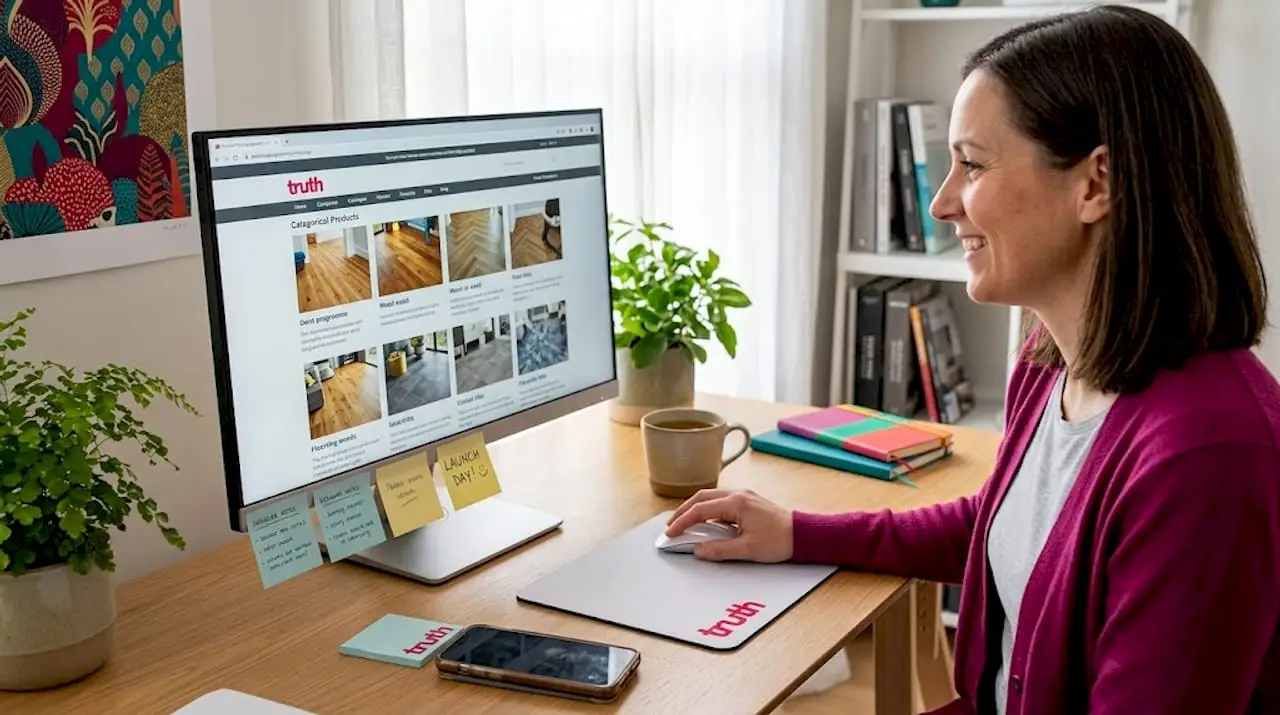
TL;DR:
- Most UK flooring websites fail because their navigation is built on instinct rather than strategic taxonomy, harming search visibility and customer experience. Using product type as the primary organization, coupled with shallow hierarchies and filterable attributes, enhances SEO, scalability, and conversion rates. Proper index control and structured navigation form essential foundations for long-term online success in the flooring industry.
Listing your products by room and hoping for the best is not a strategy. It is a shortcut that costs you customers and search visibility. Many UK flooring retailers and installers build their websites by instinct, grouping products how they feel makes sense, without considering how search engines interpret that structure or how real shoppers actually browse. The result is a site that feels cluttered, ranks poorly, and sends potential customers straight to a competitor. This article gives you a practical framework for building website navigation and product taxonomy that works hard for your flooring business, both for the people visiting your site and the search engines sending them there.
Key Takeaways
| Point | Details |
|---|---|
| Structured taxonomy is key | A clean, scalable category structure improves navigation, conversions, and search visibility. |
| Shallow hierarchy simplifies buying | Limiting category depth to one or two levels keeps shopping easy and reduces confusion. |
| Filters beat deep nesting | Faceted filters let users refine choices without creating navigation chaos or SEO risks. |
| Product type trumps room | Using product type as main categories avoids maintenance headaches and supports cross-room products. |
| Index control stops duplicate pages | Proper indexation ensures search engines focus on high-value content and ignore thin duplicates. |
Why navigation matters for UK flooring websites
Navigation is not decoration. It is the system that guides a visitor from landing on your site to making an enquiry or purchase. Get it right, and shoppers move through your product range confidently. Get it wrong, and they leave within seconds.
For flooring retailers, poor navigation is a widespread problem. Visitors land on a homepage, see a long list of categories or a confusing menu, and quickly feel overwhelmed. They cannot find the specific product type they need. They cannot filter by a relevant attribute like finish or application area. So they leave.
There is also a technical dimension that many flooring businesses overlook entirely. Search engines read your site structure to understand what your business sells and how relevant you are for specific search queries. Your category hierarchy acts as a topical signal. A well-structured taxonomy tells Google clearly that you sell engineered wood flooring, LVT, carpet, and laminate as distinct, authoritative topics. A messy structure muddies that signal.
Product taxonomy ecommerce SEO should be treated as data architecture powering navigation, onsite search, and faceted filters. Messy taxonomy leads to duplicate category pages, thin pages, and wasted crawl budget, all of which directly harm your online visibility.
Common navigation mistakes we see on flooring websites include:
- Duplicate category pages for the same product type listed under multiple room labels
- Top-level menus with 12 or more items, creating decision paralysis
- No filtering system, forcing visitors to scroll through hundreds of products
- Category pages with fewer than five products and no unique content
- Inconsistent naming conventions that confuse both shoppers and search engines
Understanding your flooring website structure and how it connects to customer journeys is the starting point for fixing these issues. The essential website must-haves for a high-performing flooring site all depend on a strong navigational foundation.
“Structure is not about aesthetics. It is about making every page on your site do a specific job, clearly, without competing with another page.”
Building a taxonomy that works: structure vs confusion
Product taxonomy is the way you organise and categorise your product range. It determines what appears in your top-level navigation, what sits beneath it, and how visitors drill down to individual products.

For flooring businesses, there are two dominant approaches: room-based navigation and type-based navigation. Understanding the difference between them is critical.
| Approach | Example top-level categories | Strengths | Weaknesses |
|---|---|---|---|
| Room-based | Kitchen flooring, Bedroom flooring, Hallway flooring | Intuitive for homeowners | Products duplicated across rooms, creates thin pages |
| Type-based | Engineered wood, LVT, Carpet, Laminate | Scalable, clear, SEO-friendly | Requires filters for room context |
| Hybrid (recommended) | Type-based categories with room and scope filters | Best of both, avoids duplication | Requires more development effort upfront |
Room-based navigation feels logical at first. Homeowners do search for “kitchen flooring” and “bathroom flooring.” But the problem is that most flooring products fit multiple rooms. A luxury vinyl tile (LVT) product suitable for kitchens is equally suitable for hallways, bedrooms, and even commercial spaces. If you build room-based top-level categories, that product needs to appear in multiple categories. That creates structural debt and maintenance headaches that only grow as your range expands.
Flooring is also cross-scope. You may sell to domestic customers, trade customers, and commercial clients. Products often span all three. Using room-based top-level categories forces you to duplicate across scope as well.
The practical recommendation is straightforward. Use product type as your primary taxonomy. Then offer room and scope as filterable attributes within those categories.
Here is a simple framework to follow:
- Identify your core product types. For most flooring retailers, this will be five to eight categories: carpet, engineered wood, solid wood, LVT, laminate, vinyl, tiles, and any specialist categories you carry.
- Build one category page per product type. Each should have enough unique content to justify its existence and enough products to give visitors a meaningful range to browse.
- Assign attributes to every product. Room suitability, scope (domestic or commercial), finish, colour family, and price band are all useful filterable attributes.
- Implement a filter system that lets visitors narrow those attributes without leaving the product type category.
Pro Tip: Do not start with room categories and try to retrofit filters later. It is far easier to build type-based categories from the beginning and add room filters on top than to untangle a room-based structure after it has been live for two years.
The UX improvements for flooring sites that generate the most enquiries almost always involve simplifying and restructuring the primary navigation. And the website mistakes flooring businesses make most often start with taxonomy decisions made at the very beginning of a website build.
For practical guidance on how leading e-commerce platforms handle this, the Shopify navigation guide offers useful structural principles that apply equally to WooCommerce and bespoke flooring websites.
Setting the right category depth: shallow hierarchy for flooring
Once you have your primary taxonomy in place, the next question is how deep your category tree should go. The answer, for flooring websites, is: not very deep at all.
Category-tree depth should be limited to avoid overwhelming shoppers. A practical target is a shallow hierarchy with one to two subcategory levels under main categories. Everything else should be handled by filters.
Here is what that looks like in practice:
| Level | Example |
|---|---|
| Level 1 (main category) | LVT |
| Level 2 (subcategory) | Rigid core LVT / Flexible LVT |
| Filter attributes | Room, colour, finish, scope, price |
If you find yourself wanting to create a third subcategory level, that is a signal that you need better filters, not deeper categories.
The logic behind keeping the hierarchy shallow connects directly to customer behaviour. Shoppers do not want to click through five levels of categories to find a product. They want to land on a category page, apply a couple of filters, and see relevant results within two or three clicks. Every extra click you require is a point at which visitors drop off.
From an SEO perspective, shallow hierarchy also strengthens the authority of your category pages. When you have fewer, stronger category pages rather than many thin ones, search engines can more easily identify and rank your most important content.
Practical attributes to include in your filter system for a flooring website:
- Colour family (light, dark, mid, grey, oak tones, and so on)
- Finish (matte, satin, oiled, lacquered, textured)
- Room suitability (kitchen, bathroom, hallway, living room, bedroom)
- Scope (domestic, commercial, contract)
- Thickness or wear layer (especially relevant for LVT and engineered wood)
- Price band (budget, mid-range, premium)
- Plank width or format (for wood and LVT)
Building your better website structure around shallow hierarchy and smart filters directly supports your organic search for flooring performance. You create fewer but stronger pages, each with a clear purpose and enough content to be genuinely useful. The Shopify performance checklist reinforces the same principle: fewer, stronger pages outperform sprawling category trees every time.
Faceted navigation and index control: boosting discoverability
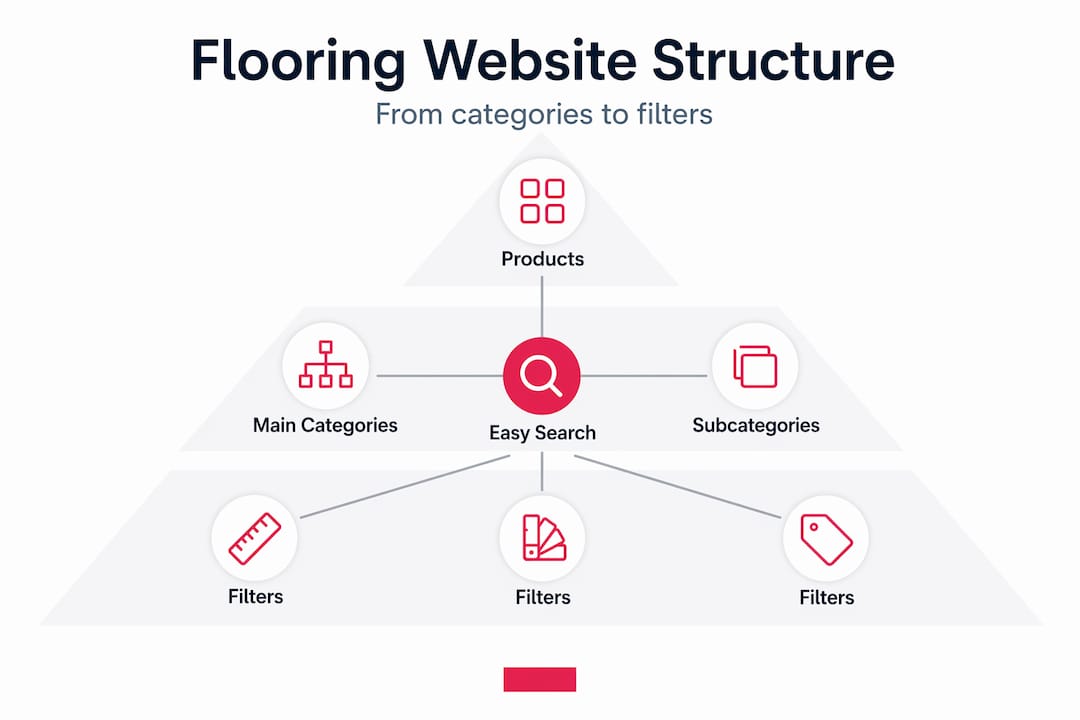
Faceted navigation is the filter system your visitors use to narrow down products by specific attributes. It is one of the most powerful tools available for improving product discoverability on a flooring website. But it comes with an important technical consideration that many retailers and their developers overlook.
When a visitor selects filters, most platforms generate unique URLs for each filter combination. Left unchecked, this can create hundreds or even thousands of pages: one for “grey LVT kitchen,” another for “grey LVT hallway,” another for “grey LVT commercial kitchen,” and so on. Each of those pages is a variation of the same category with minimal unique content.
Search engines crawl every accessible page on your site. If they find hundreds of nearly identical filter-generated pages, they waste their crawl budget on pages that add no value. They may also identify this as thin or near-duplicate content, which harms your rankings. As reinforced by faceted filter best practices, messy taxonomy leads directly to duplicate and near-duplicate category pages, thin pages, and wasted crawl budget.
Index control is the technical solution. It means actively deciding which pages search engines should index and which they should not. The practical approach for most flooring websites is:
- Allow indexation for main product type category pages (your Level 1 and Level 2 pages)
- Allow indexation for filter combinations that hold enough unique value and search volume to justify it (for example, “grey LVT” or “waterproof bathroom flooring” if those terms have meaningful traffic)
- Block indexation for all other filter combinations using noindex tags or parameter handling in Google Search Console
Pro Tip: Do not block filter pages with robots.txt, as this prevents crawling but can still leave pages indexed. Use a noindex meta tag instead, so search engines can see the page but are clearly instructed not to index it.
The benefits of getting this right are significant. Your strongest category pages receive more of the site’s authority. Crawl budget is spent on your most valuable content. And your site avoids the duplicate content penalties that quietly drag down rankings for many flooring websites.
Understanding flooring SERPs and how search engines decide which pages to rank helps explain why index control matters so much. If you are planning a website redesign for leads, building in proper index control from the start is far more effective than trying to fix it retrospectively. For further context on design approaches that support this, the Shopify design optimisation guide covers relevant structural principles.
What most flooring websites miss about structured navigation
Here is our honest take, based on working with flooring businesses across the UK. Most retailers who approach us think navigation is a design problem. They want it to look good and feel modern. That is understandable. But the structural decisions that actually drive performance have almost nothing to do with how the menu looks.
The businesses that struggle most with navigation are the ones that built their site the way they think about their showroom. They organised products by the stories they tell in person: “Here is our heritage wood range,” “Over here is our family-friendly collection.” Those room-based or collection-based groupings feel natural because they match the way a good salesperson talks to a customer face to face.
Online, that logic breaks down. A visitor does not arrive at your website for a guided tour. They arrive with a specific need. They want to find a suitable LVT product for their kitchen within a certain budget. If your navigation does not give them a direct path to that product, you have lost them. Collections and curated ranges are fine as editorial content. They should not be your primary navigation structure.
The other thing most flooring businesses miss is scalability. A taxonomy that just about works with 200 products becomes a liability at 400. Room-based categories grow exponentially as you add products. Type-based taxonomy with filters scales cleanly. We have seen retailers spend significant time and money rebuilding their site structure after three years because the original taxonomy could not cope with their growing range. That rebuild could have been avoided with better planning at the start.
Structured navigation also has an underestimated commercial benefit: it builds confidence. When visitors can find products logically, apply filters, and narrow their choices without feeling overwhelmed, they trust your business more. That trust converts into enquiries and showroom visits. Your photo gallery tips and product descriptions can be excellent, but if visitors cannot find the right category in the first place, none of that effort lands.
Structured navigation is a quiet competitive advantage. Most of your competitors have not built it properly. The retailers who get this right attract more organic traffic, convert more visitors, and maintain their websites far more efficiently over time.
How Truth Digital can help you build smarter navigation
Building the right navigation and taxonomy for a flooring website takes real expertise. It sits at the intersection of website development, UX, and SEO strategy. Get any one of those elements wrong and the whole system underperforms.
At Truth Digital, we specialise exclusively in flooring businesses. We understand the product complexity, the customer journeys, and the search landscape specific to UK flooring retailers and installers. Our website development for flooring service covers everything from taxonomy planning and category architecture to filter implementation and index control. We build sites that are structured to rank, designed to convert, and easy to manage as your range grows. Our SEO for flooring businesses service ensures your taxonomy is aligned with how your customers actually search. And if you want a broader picture of how navigation fits into your overall online growth, our flooring digital marketing guide is a practical starting point.
Frequently asked questions
What is product taxonomy and why is it essential for flooring websites?
Product taxonomy is the structured organisation of product categories, and it powers navigation, search, and filters. As noted in ecommerce taxonomy research, messy taxonomy leads to thin pages and lower search visibility, both of which directly harm your ability to attract and convert customers online.
How deep should the category tree be for a flooring website?
Keeping categories shallow with no more than two levels under your main categories is the practical target, with detailed attributes handled by filters rather than additional subcategory layers. Deep nesting confuses shoppers and dilutes your SEO signal.
Should flooring websites use room or product type as their primary navigation?
Using product type as your primary categories is strongly recommended. As home goods taxonomy guidance makes clear, room-based top-level categories create structural debt and maintenance problems because most flooring products fit multiple rooms. Rooms work far better as filterable attributes.
What is faceted navigation and how does it help flooring customers?
Faceted navigation lets visitors filter products by attributes like room, colour, scope, or finish, making it far easier to find exactly what they need without browsing hundreds of products. It improves the customer experience and increases the likelihood of an enquiry or purchase.
How does structured navigation impact SEO for flooring websites?
Structured navigation sends clear topical signals to search engines, reduces crawl waste from duplicate or thin pages, and helps your most important category pages build authority over time. A well-structured site consistently outperforms a poorly structured one in organic search results.