

TL;DR:
- An outdated flooring website can reduce leads and harm customer trust.
- Modern features include mobile responsiveness, real project galleries, and clear contact options.
- Continuous SEO and content updates are essential for long-term online success.
Your flooring website is often the first impression a potential customer gets of your business. If it looks outdated, loads slowly, or makes it hard to find contact details, you are losing enquiries before you even know it. Outdated web design can drastically reduce online leads and deter potential clients for flooring businesses. This article walks you through why a redesign matters, what to include, how to plan it properly, and how to make SEO work in your favour from day one.
Key Takeaways
| Point | Details |
|---|---|
| Redesign boosts lead generation | Modernising your website can significantly increase trust and customer enquiries. |
| Must-have features matter | Photo galleries, customer reviews, and strong calls-to-action are essential for flooring sites. |
| SEO and local content | Optimising for local search and regularly updating content maximises your visibility. |
| Plan with a step-by-step approach | Structured processes and clear goals ensure redesign success and avoid common mistakes. |
Why flooring brands need a website redesign
Most flooring businesses underestimate how much their website affects sales. A slow, cluttered, or visually tired site sends the wrong message. Customers searching for carpet fitters or wood flooring installers in their area have plenty of choice. If your site does not inspire confidence quickly, they will move on to a competitor.
Common problems we see on outdated flooring websites include:
- No mobile-friendly layout, making the site unusable on phones
- Blurry or stock photos that do not reflect real work
- No visible phone number or contact button above the fold
- Missing or outdated customer reviews
- Slow load times that frustrate visitors and hurt Google rankings
- Confusing navigation that buries key services
Customer expectations have shifted significantly. People now browse on their phones during lunch breaks or in the evening. They expect a fast, clean experience. If your site does not deliver that, trust evaporates instantly. Modern visuals, trust signals, and easy navigation are crucial for flooring customer conversion.
A professional redesign fixes these issues at the root. It is not just about looking better. It is about performing better. A well-structured site generates more enquiries, ranks higher on Google, and builds your reputation in ways an old site simply cannot.
Avoiding flooring website mistakes from the outset saves time and money. And updating website content regularly keeps your site relevant and competitive long after the redesign launches.
If you are unsure where to start, a structured website redesign guide can help you map out priorities before any design work begins.
“A flooring website that does not convert visitors into enquiries is not an asset. It is a liability.”
Pro Tip: Refresh your project photos and gallery at least every quarter. Fresh, high-quality images of recent installations signal to visitors that your business is active and skilled.
Key elements and features for a flooring website redesign
Knowing what to include is just as important as knowing why you need a redesign. The right features turn browsers into buyers. The wrong ones, or missing ones, create friction and lost leads.
Photo galleries, customer reviews, and simplified navigation boost user engagement and trust significantly. These are not optional extras. They are baseline requirements for any flooring website in 2026.
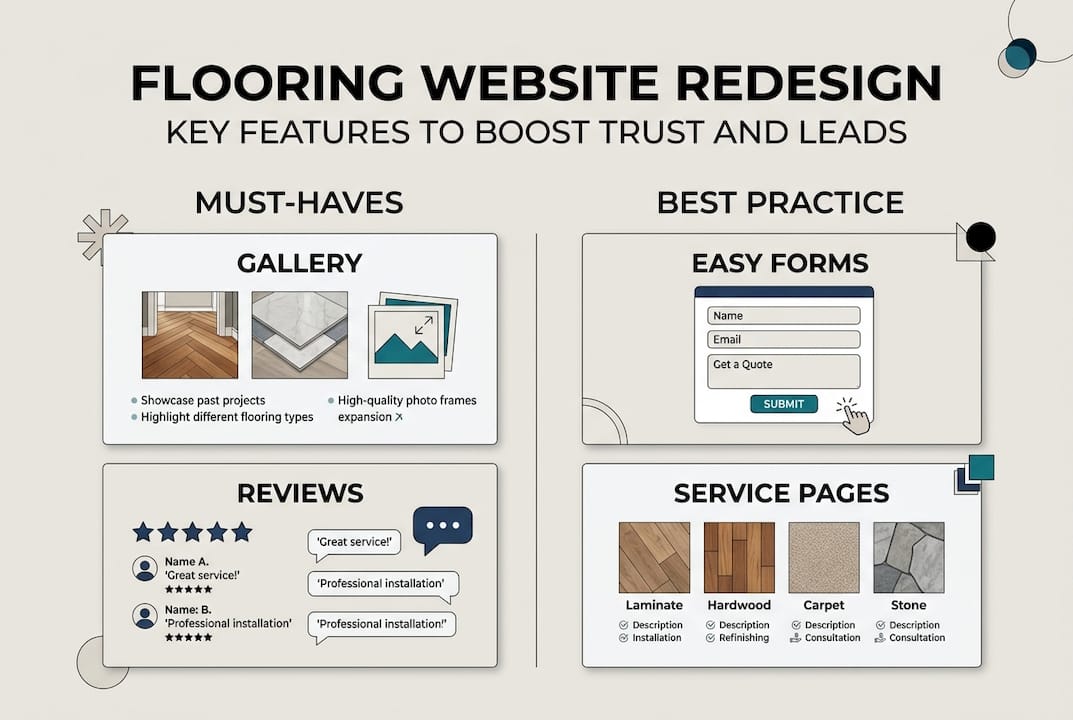
Here is a comparison of outdated versus modern flooring website features:
| Feature | Outdated site | Modern site |
|---|---|---|
| Layout | Fixed desktop only | Fully responsive on all devices |
| Photos | Stock images or low quality | Real project galleries, high resolution |
| Reviews | None or buried | Visible on homepage and service pages |
| Contact options | Email form only | Phone, form, WhatsApp, live chat |
| Page speed | Slow (5+ seconds) | Fast (under 2 seconds) |
| SEO structure | No meta data, no local pages | Optimised pages with local keywords |
Your homepage checklist should include:
- Clear headline stating what you do and where you operate
- High-quality hero image showing real flooring work
- Visible phone number and enquiry button
- Short summary of services with links to dedicated pages
- Recent customer reviews or star rating
- Portfolio or gallery preview with a link to more
- Trust signals such as trade memberships or accreditations
For website must-haves that go beyond the homepage, think about dedicated service pages for carpets, LVT, wood flooring, and sanding. Each page should target a specific search term and include a clear call to action.
Your flooring photo galleries deserve their own page, organised by room type or flooring material. This helps visitors find relevant examples and keeps them on your site longer.
Do not overlook website maintenance either. A redesign is only as good as the ongoing care it receives. Broken links, expired plugins, and slow load times will undo your investment quickly.
For deeper guidance on conversion-focused design elements, there are excellent resources that break down exactly what drives visitors to take action.
Pro Tip: Keep your contact forms short. Name, phone number, and a brief message field is enough. Every extra field you add reduces the chance someone will complete it.
Step-by-step process for a successful redesign
A flooring website redesign without a clear process leads to delays, budget overruns, and a site that still does not perform. Structured redesign processes help reduce delays and ensure better results. Here is a proven approach.
- Audit your current site. Review analytics, identify high-exit pages, and note what is missing. Gather feedback from your sales team about the questions customers ask most.
- Set clear goals. Do you want more phone calls? More quote requests? More showroom visits? Define what success looks like before any design work starts.
- Choose the right platform. WordPress with a quality theme, or a purpose-built CMS, works well for most flooring businesses. Avoid overly restrictive website builders that limit your SEO options.
- Plan your content and structure. Map out every page, what it will say, and what action you want visitors to take. This is where flooring website structure planning pays off.
- Design and build. Work with a designer who understands conversion, not just aesthetics. Every page should guide the visitor towards an enquiry.
- Migrate and optimise. Move existing content carefully. Redirect old URLs to new ones to protect your SEO rankings.
- Test thoroughly. Check every page on mobile and desktop. Test all forms, buttons, and load speeds before going live.
- Launch and monitor. Go live, then watch your analytics closely for the first 30 days. Adjust based on what the data tells you.
Here is a simplified timeline to guide your project:
| Phase | Task | Who is responsible | Timeframe |
|---|---|---|---|
| Preparation | Audit, goals, content plan | Business owner and agency | Weeks 1 to 2 |
| Design | Wireframes and visual design | Web designer | Weeks 3 to 4 |
| Build | Development and content upload | Developer | Weeks 5 to 7 |
| Testing | QA, speed, mobile checks | Agency and client | Week 8 |
| Launch | Go live and monitor | Both parties | Week 9 |
For a detailed website redesign checklist, there are free tools available that walk you through every step.
Focusing on UX improvements during the build phase makes a measurable difference. Clear layouts, logical menus, and fast-loading pages all reduce bounce rates and increase the chance of an enquiry.

Pro Tip: Involve your sales team early. They know exactly what questions customers ask before buying. That insight should shape your page content and FAQs directly.
SEO, content, and local factors for flooring websites
A beautiful redesign that nobody finds is a wasted investment. SEO must be built into your redesign from the start, not added as an afterthought. For UK flooring businesses, local search is where the real opportunity lies.
Updating website content with local keywords and showcasing local projects boosts search rankings for flooring businesses consistently. This is not a one-off task. It is an ongoing commitment.
Essential on-page SEO elements for your flooring website include:
- Unique meta titles and descriptions for every page
- H1 headings that include your main service and location
- Image alt text describing the flooring type and room shown
- Internal links connecting related service and location pages
- Fast page load speeds, ideally under two seconds
- Schema markup for local business information
- A Google Business Profile linked to your website
Local landing pages are one of the most underused tools in flooring SEO. If you serve multiple towns or cities, build a dedicated page for each one. Include local project photos, mention nearby landmarks or areas, and use location-specific keywords throughout.
NAP consistency matters too. NAP stands for Name, Address, and Phone number. Make sure these details are identical across your website, Google Business Profile, and any local directories. Inconsistencies confuse Google and can suppress your local rankings.
Understanding SERPs for flooring (search engine results pages) helps you see exactly where your business appears and what you need to do to climb higher. Knowing how Google ranks local flooring businesses gives you a clear action plan.
For inspiration on what works in paid search too, looking at flooring ads examples can inform both your SEO content strategy and your Google Ads approach.
For a solid grounding in local SEO essentials, Moz provides a thorough breakdown of what UK businesses need to prioritise.
Pro Tip: After every installation, ask the customer for a photo and a review. Upload the photo to your gallery with a caption naming the flooring type and area. This creates fresh, locally relevant content that Google rewards.
Our perspective: Why most flooring website redesigns fall short (and how to get ahead)
We have worked with enough flooring businesses to see the same pattern repeat. A business invests in a new website, it looks great on launch day, and then nothing changes. Enquiries stay flat. Rankings do not improve. The site sits there, quietly underperforming.
The reason is almost always the same. The redesign was treated as a one-off project rather than the start of an ongoing process. Template sites built quickly and cheaply rarely deliver results for specialist flooring brands. They lack the depth, the local relevance, and the conversion thinking that actually generates leads.
What moves the needle is continuous improvement. Regular content updates, conversion testing, and data-driven decisions beat a single big redesign every time. Avoiding common mistakes is only the beginning.
Here is the hard truth. Most of your competitors will never bother doing this properly. That gives you a real edge if you do. Prioritise changes that build trust and make it effortless for someone to contact you. Everything else is secondary.
Take your next step with expert support
If this article has shown you anything, it is that a flooring website redesign done properly is a serious growth opportunity. Not just a cosmetic update.
We work exclusively with flooring businesses across the UK. Our flooring design services are built around generating real enquiries, not just building pretty sites. Pair that with our flooring SEO services and you have a complete digital presence that works hard every day. Want to see what is possible? Browse our success stories and then get in touch for a free audit. We will tell you exactly where your current site is losing leads and what to do about it.
Frequently asked questions
How often should a flooring business redesign its website?
A full redesign is recommended every three to five years, but smaller updates should happen annually. Updating website content for flooring brands boosts both sales and SEO performance throughout the year.
What are the most important features for a new flooring website?
Strong visuals, recent project galleries, clear contact buttons, local SEO, and mobile responsiveness are critical. Photo galleries and user trust features help convert visitors into enquiries for flooring sites.
How can I improve my flooring website’s SEO when redesigning?
Include local keywords, optimise on-page elements like meta titles, and regularly update content to reflect UK projects. Local SEO and content updates boost online visibility for UK flooring businesses significantly.
What is the average cost of a flooring website redesign?
Costs vary widely, but a basic professional redesign typically starts from £2,000 to £5,000 depending on complexity and integrations. Professional website redesign costs are best viewed as an investment in long-term lead generation rather than a one-off expense.