
TL;DR:
- Digital branding involves managing a consistent online identity to build trust and recognition.
- It is essential for flooring businesses as customers research online before purchasing.
- Effective digital branding combines visuals, content, local SEO, and personalization to drive growth.
Most flooring retailers think digital branding means having a logo on their website. It does not. Digital branding is the process of creating, managing, and promoting a brand’s identity across digital channels — and for UK flooring businesses, getting this right is the difference between being found and being forgotten. Consumers now research flooring online before they ever visit a showroom. They form opinions about your business based on what they see, read, and experience digitally. This guide explains exactly what digital branding is, how it works in practice, and what you can do right now to build a stronger, more trusted presence online.
Key Takeaways
| Point | Details |
|---|---|
| Branding is more than a logo | Effective digital branding shapes trust and drives visibility through cohesive multi-channel experiences. |
| Consistency is key | Regular audits and aligned messaging across platforms prevent confusion and build customer loyalty. |
| Personalise for performance | Use data and AI to tailor your digital brand, from visuals to offers, for superior engagement and conversions. |
| Local focus wins in UK | Leveraging local SEO and relevant community content delivers higher impact than broad generic tactics. |
Defining digital branding for flooring businesses
Let’s clear up the confusion. Digital branding involves creating, managing, and promoting a brand’s identity across digital channels to build recognition, trust, and emotional connections. That is a broad definition, so here is what it means specifically for flooring businesses.
Your digital brand is every impression a customer forms about your business online. It includes your website, your Google Business Profile, your social media presence, your email communications, and even the tone of your product descriptions. It is not just visuals. It is the feeling a potential customer gets when they land on your site at 9pm, trying to decide whether to book a survey.
This matters enormously in flooring because trust drives purchasing decisions. Flooring is a considered purchase. Customers spend weeks or months researching before they commit. If your digital presence feels inconsistent, outdated, or unclear, they will move on to a competitor who feels more reliable.
Here is where many flooring brands go wrong. They confuse digital branding with digital marketing. The two are related but distinct.
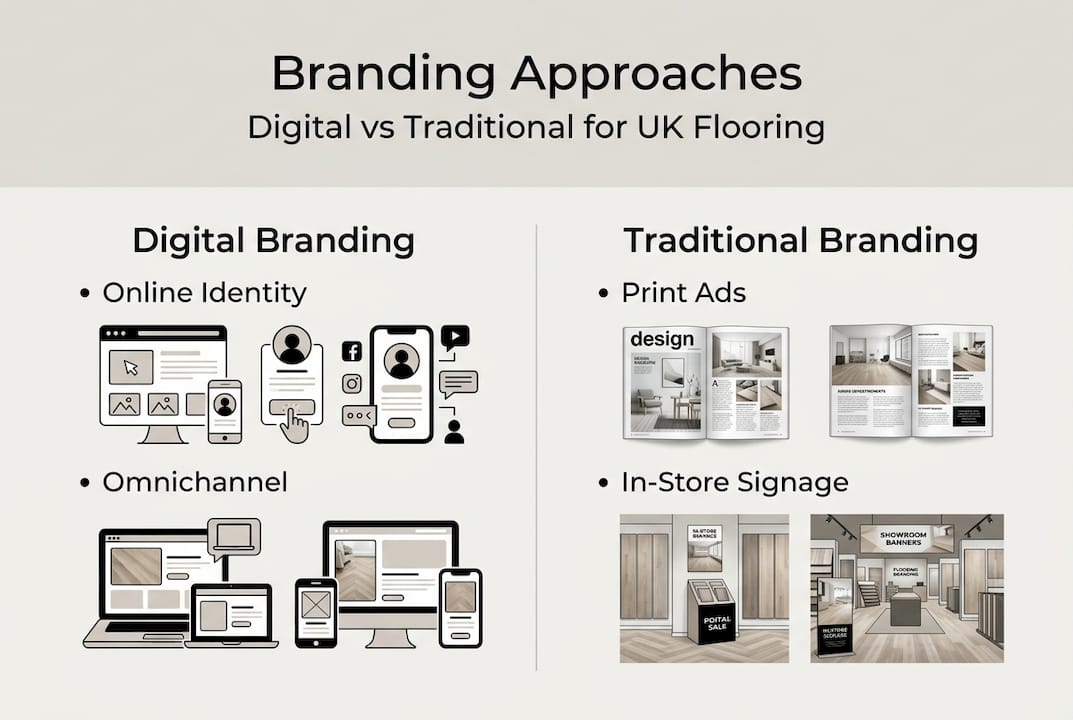
| Digital branding | Digital marketing | Traditional branding | |
|---|---|---|---|
| Primary goal | Build long-term identity and trust | Generate short-term leads and conversions | Build awareness via offline channels |
| Timeframe | Ongoing, long-term | Campaign-based, short-term | Ongoing, long-term |
| Channels | Website, social, email, SEO | PPC, email campaigns, paid social | Print, TV, events, signage |
| Measurement | Brand recall, trust, engagement | Clicks, leads, cost per acquisition | Reach, footfall, recall |
| Flooring example | Consistent visual identity across all platforms | Google Ads for carpet fitting enquiries | Showroom signage and leaflets |
Digital marketing is a tool. Digital branding is the foundation those tools are built on. You can run Google Ads all day, but if your website looks untrustworthy, the clicks will not convert. Understanding digital marketing essentials is important, but it starts with getting your brand identity right first.
Core brand identity elements for flooring businesses include:
- Logo, colour palette, and typography used consistently across all platforms
- Tone of voice in product descriptions, blog posts, and customer communications
- Your brand story and the values that differentiate you from competitors
- A clear value proposition that tells customers why they should choose you
If any of these feel unclear or inconsistent, a website redesign is often the fastest way to realign everything under one coherent identity.
Core components of effective digital branding
Core mechanics of digital branding include defining brand identity, omnichannel consistency, data-driven personalisation, SEO optimisation, and community building. Each of these plays a specific role for flooring retailers and manufacturers.

Omnichannel consistency means your brand looks and sounds the same whether a customer finds you on Google, Instagram, or via an email newsletter. Inconsistency is one of the most common and damaging mistakes we see. A polished website paired with an outdated Facebook page sends mixed signals.
Content is another major component. Educational blog posts about the difference between LVT and engineered wood, room visualiser tools, and sample offer pages all serve dual purposes. They build brand authority and they drive organic search traffic. The essential website features that flooring sites need are closely tied to how well they support this kind of content.
Personalisation is growing fast. AI-driven tools now allow flooring websites to tailor sample suggestions based on browsing behaviour. A customer who has been viewing oak wood flooring pages should see oak-related recommendations, not generic carpet offers. This kind of relevance builds brand affinity quickly.
SEO, particularly local SEO, is non-negotiable. Ranking for searches like “wood flooring Bristol” or “carpet fitters near me” directly drives showroom visits and enquiries. Strong photo galleries on your website also support SEO and build visual brand credibility.
| Component | Flooring brand outcome |
|---|---|
| Consistent visual identity | Increased brand recognition and trust |
| Educational content | Higher organic traffic and authority |
| Local SEO | More showroom visits and local enquiries |
| Personalisation tools | Improved sample requests and conversion rates |
| Social media consistency | Stronger community engagement and referrals |
| Analytics and tracking | Informed decisions and measurable ROI |
Key actions for this stage:
- Audit every digital touchpoint for visual and tonal consistency
- Invest in high-quality product photography for website and social
- Build a content calendar that addresses common customer questions
- Set up local SEO correctly, including Google Business Profile optimisation
Pro Tip: Add an augmented reality (AR) room visualiser to your website. It lets customers see how a floor will look in their own home before ordering samples. This single feature can significantly reduce purchase hesitation and increase conversion rates.
Expert insights: Avoiding pitfalls and maximising digital brand impact
Effective digital branding requires consistency, use of AI for personalisation, leveraging local SEO and social commerce, and measuring success via organic growth. Here is what that looks like in practice for UK flooring brands.
The biggest pitfall we see is inconsistency. A flooring retailer might invest in a new website but leave their social media profiles looking five years out of date. Or they update their logo but forget to change it on Google Maps, email signatures, and PDF brochures. These gaps erode trust. Run a brand audit at least twice a year. Check every platform, every profile, and every piece of customer-facing content.
AI-driven personalisation is no longer a luxury. Tools integrated into your website can track which product categories a visitor browses and serve relevant content automatically. For flooring brands, this means showing the right products to the right customer at the right moment.
Local SEO and social commerce are two areas where UK flooring businesses can gain a real edge. Ranking for location-specific searches and using Instagram Shopping or Pinterest boards to showcase product ranges drives highly qualified traffic. Understanding local SEO is essential for any flooring retailer with a physical showroom.
Flooring winners balance paid and organic tactics. Free sample offers paired with excellent website user experience drive conversions. Relying solely on paid ads without investing in organic brand building is a short-term approach that becomes increasingly expensive over time.
Sustainability messaging is also becoming a genuine differentiator. UK consumers are increasingly loyal to brands that demonstrate environmental responsibility. If you stock sustainably sourced flooring, say so clearly and consistently across all channels.
Common mistakes to avoid include:
- Inconsistent branding across platforms
- Ignoring Google Business Profile updates
- Prioritising paid ads over organic content and SEO
- Failing to respond to reviews, positive or negative
- Using low-quality product images that undermine brand credibility
Pro Tip: Set up a simple monthly brand audit checklist. Check your Google Business Profile, social profiles, website homepage, and email footer. Fifteen minutes a month prevents months of brand erosion.
Applying digital branding: Practical steps for UK flooring brands
The process starts with defining goals and audience, developing identity, optimising presence via SEO and social, and using analytics for personalisation. Here is how to apply that in a structured way.
-
Define your audience and USPs. Who are your ideal customers? Homeowners doing a full renovation? Landlords fitting rental properties? Commercial contractors? Each audience needs a slightly different message. List your top three USPs and make sure they are visible on your homepage.
-
Audit all digital touchpoints. List every place your brand appears online. Website, Google Business Profile, Facebook, Instagram, Houzz, Checkatrade, email templates, and any directory listings. Note inconsistencies in logo, colour, and messaging.
-
Unify your brand identity. Update all profiles with consistent visuals, tone of voice, and contact details. This alone can improve trust signals significantly.
-
Build a content plan. Commit to publishing useful content regularly. Installation guides, flooring comparison articles, and room inspiration posts all build authority and support SEO. Use marketing funnels to plan content that moves customers from awareness to enquiry.
-
Activate local SEO. Optimise your Google Business Profile with fresh photos, updated opening hours, and regular posts. Encourage satisfied customers to leave reviews.
-
Track outcomes. Use Google Analytics and Search Console to monitor organic traffic, enquiry form submissions, and sample requests. A solid content strategy gives you benchmarks to measure against.
Here is a practical example of how a sample journey works. A customer searches “grey LVT flooring Manchester.” They find your site via a local SEO-optimised product page. They use your AR visualiser to see the floor in their living room. They request a free sample. Your automated email follow-up invites them to book a showroom visit. That is digital branding and digital marketing working together seamlessly.
| Checklist item | Status |
|---|---|
| Brand guidelines documented | To do / Done |
| Website updated with consistent visuals | To do / Done |
| Google Business Profile optimised | To do / Done |
| Social profiles aligned with brand | To do / Done |
| Content calendar in place | To do / Done |
| Local SEO keywords targeted | To do / Done |
| Analytics tracking set up | To do / Done |
| AR or room visualiser tool active | To do / Done |
Pro Tip: Tie your free sample offer directly to a tailored landing page that reflects the specific product range a visitor was browsing. Relevance at this stage dramatically increases the chance of a sample request converting to a sale.
Why strong digital branding sets flooring leaders apart
Here is our honest view. Most flooring businesses still treat their website and social media as an afterthought. Something to tick off, not something to invest in. That thinking is increasingly costly.
The competitive gap in 2026 is not about who has the biggest product range. It is about who has the most trusted, most consistent, and most relevant digital presence. Topps Tiles has demonstrated this with their digital-first engagement strategy. UK Flooring Direct has shown what content-driven growth looks like in practice.
Conventional wisdom in flooring retail still leans heavily on word of mouth and local reputation. Those things matter. But they no longer work alone. Customers validate word-of-mouth recommendations online before they act on them. If your digital brand does not back up your offline reputation, you lose the sale.
We believe the flooring businesses that will lead the market are those that treat their digital brand as a profit centre. Not an add-on cost. Not a box to tick. A genuine business asset that generates enquiries, builds loyalty, and supports growth year on year.
Enhance your flooring brand with proven digital solutions
If this guide has clarified what digital branding means for your business, the next step is knowing where to start. We work exclusively with flooring retailers and manufacturers across the UK, so we understand the specific challenges you face.
Whether you need a design refresh, stronger flooring SEO to improve your Google rankings, or specialist design built around your brand identity, we can help. Start with our free growth pack to benchmark your current digital presence and identify the highest-impact opportunities. No jargon. No generic advice. Just practical steps tailored to flooring businesses like yours.
Frequently asked questions
What makes digital branding different from traditional branding?
Digital branding emphasises managing brand identity, trust, and engagement across online channels, offering far more scope for personalisation and direct measurement than traditional branding methods allow.
Why is digital branding so important for flooring retailers in 2026?
With consumers increasingly researching and choosing flooring online, consistent digital identity directly impacts visibility, leads, and customer trust for UK retailers competing in a crowded market.
How can flooring brands measure the impact of their digital branding?
Track growth in organic search traffic, online enquiries, engagement rates, and sample requests. Organic growth and leads are the most reliable indicators of whether your digital branding investment is working.
What is an example of effective digital branding in the UK flooring market?
UK Flooring Direct’s 92% YoY growth demonstrates the power of content-driven, customer-centric digital branding when applied consistently over time.