


TL;DR:
- Step-by-step online quote forms guide flooring customers through measurements and preferences to produce tailored estimates. Using no-code builders like Gravity Forms and Fillout, retailers should gather key data, include waste factors, and structure forms into 10 to 18 manageable steps. Incorporating professional features, transparent breakdowns, and follow-up processes enhances lead quality and trust.
Step-by-step online quote forms for flooring are structured, multi-stage digital tools that guide customers through a series of questions to produce a tailored price estimate for their project. Unlike a single-page contact form, a properly built flooring quote form collects room measurements, flooring type preferences, installation requirements, and contact details in a logical sequence. The result is better data for your sales team and a more confident customer. This guide covers everything independent flooring retailers need to build effective step-by-step online quote forms, from choosing the right tools to adding professional features that improve lead quality and trust.
What tools do you need to build a flooring quote form?
The right tools make the difference between a form that converts and one that confuses. Two of the most widely used no-code form builders for flooring retailers are Gravity Forms and Fillout, both of which support multi-step quote forms without requiring programming skills. Gravity Forms integrates directly with WordPress, which suits most independent flooring websites. Fillout works as a standalone tool and connects to CRM platforms like HubSpot.
Before you build anything, gather the following data inputs:
- Flooring categories you stock (carpet, hardwood, LVP, laminate, tile, bamboo, engineered hardwood)
- Price per square metre for materials in each category
- Installation costs by category and floor condition
- Waste factor applied to each material type
- Additional services such as underlay supply, furniture removal, and subfloor preparation
- Contact fields for name, phone, email, and postcode
You also need a clear pricing structure before the form goes live. Customers expect a breakdown of materials versus labour, not a single lump sum. Transparent cost breakdowns differentiate your form from a basic price generator and build credibility from the first interaction.
| Data Input | Why It Matters |
|---|---|
| Room dimensions | Drives all material quantity calculations |
| Flooring category | Determines material and installation cost bands |
| Waste factor (10–15%) | Prevents underquoting on materials |
| Installation type | Affects labour cost significantly |
| Hidden costs (underlay, disposal) | Sets realistic customer expectations |
How should you structure a step-by-step flooring quote form?
Multi-step forms consistently outperform single long forms for completion rates. Breaking the process into 10–18 logical steps reduces user fatigue and improves the quality of data collected. Each step should ask only one or two related questions so customers never feel overwhelmed.
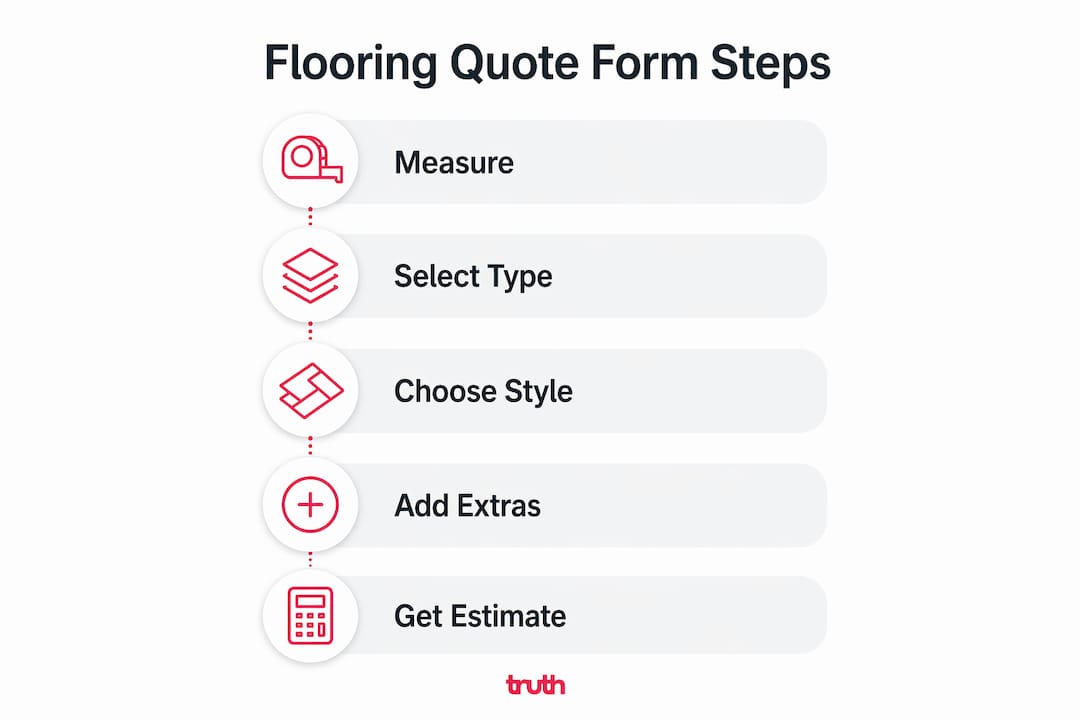
A proven sequence for flooring quote forms looks like this:
- Welcome screen — brief explanation of what the form does and how long it takes
- Room type selection — living room, bedroom, kitchen, hallway, or commercial space
- Room measurements — length and width in metres, with a simple diagram for guidance
- Flooring category — carpet, hardwood, LVP, laminate, tile, bamboo, or engineered hardwood
- Specific product or grade — budget, mid-range, or premium within the chosen category
- Subfloor condition — concrete, timber, or existing floor covering
- Additional services — underlay, furniture removal, old floor disposal, door trimming
- Installation timing — preferred start date or urgency level
- File upload — optional floor plan or photo of the space
- Contact details — name, phone, email, and postcode for follow-up
Collecting measurements before material selection is deliberate. Multi-step forms that gather measurements first deliver higher quality data for sales follow-up because customers are anchored to a specific project rather than browsing abstractly.
Pro Tip: Frame the form as a planning tool, not a binding price. Use language like “Get your free planning estimate” rather than “Get a quote.” This sets realistic expectations and reduces disputes when the final price differs from the online figure.

Save-and-resume functionality is worth adding if your form runs beyond six steps. This feature increases lead capture by letting customers pause on complex questions such as room measurements or file uploads and return later without losing their progress. Gravity Forms and Fillout both support this natively.
Which flooring categories and prices should you include?
Accurate online flooring estimates depend on covering the right product categories with realistic price ranges. Effective flooring quote calculators include at least seven categories to give customers meaningful choices and to keep your pricing data relevant across your full product range.
Here is a comparison of the seven core categories with typical installation cost ranges and standard waste factors:
| Flooring Type | Installation Cost (per sq ft) | Typical Waste Factor |
|---|---|---|
| Hardwood | £10–£20 | 10–15% |
| Engineered Hardwood | £8–£15 | 10–12% |
| Laminate | £3–£8 | 10% |
| Luxury Vinyl Plank (LVP) | £4–£12 | 10% |
| Carpet | £3–£7 | 10–15% |
| Tile | £5–£15 | 10–15% |
| Bamboo | £5–£12 | 10–12% |
Note: Cost ranges are based on 2026 market data and will vary by region and supplier.
Professional calculators apply a 10–15% material waste margin to account for cutting, fitting, and pattern matching. Omitting this from your form leads to underquotes and unhappy customers at the point of sale.
Hidden costs are where most online flooring estimates fall short. Customers regularly underestimate costs such as underlayment, transition strips, and old floor disposal. Your form should surface these as optional line items so customers see a realistic total, not a misleadingly low figure. This transparency is one of the clearest ways to differentiate your business from competitors using basic price calculators.
How do you add professional features that build trust?
A flooring quote form that looks professional converts better. The features below separate a credible online flooring quote system from a generic contact form:
- File upload field for floor plans and photos. Uploading floor plans enables more accurate follow-up estimates and signals to customers that your business takes their project seriously.
- Disclaimer text on the results screen. Disclaimers must clearly exclude costs such as furniture moving and subfloor preparation. Customers should understand the estimate may increase by up to 20% once a surveyor visits.
- Transparent cost breakdown showing materials, labour, and extras as separate line items rather than a single total.
- Postcode field to qualify leads by geography before your team spends time on follow-up.
- Confirmation email sent automatically after submission, summarising the estimate and setting expectations for next steps.
Form validation matters too. Every measurement field should reject non-numeric inputs and flag obviously incorrect values, such as a room length of 200 metres. Clear error messages written in plain English prevent drop-offs caused by frustration.
Pro Tip: Capture the customer’s email address on step three, not the final step. If they abandon the form partway through, you still have a partial lead you can follow up with an automated email sequence.
What are the most common problems with flooring quote forms?
Typical mistakes include ignoring waste allowances, missing hidden costs, and poor mobile optimisation, all of which lead to inaccurate quotes and higher drop-off rates. Knowing these pitfalls before launch saves significant rework.
The most frequent issues and how to fix them:
- Missing waste factor in calculations. Add a fixed 10–15% multiplier to all material quantity outputs. Test the formula manually before going live.
- No guidance on room measurement. Include a simple diagram showing where to measure length and width. Customers measuring incorrectly produce useless data.
- Poor mobile experience. Test the form on iOS and Android before launch. Buttons must be large enough to tap, and input fields must not zoom the page on focus.
- No analytics tracking. Connect the form to Google Analytics 4 and set up a funnel report. Identify which step causes the most drop-offs and simplify it.
- No follow-up process. A quote submission without a follow-up call or email within 24 hours wastes the lead. Connect form submissions to your CRM or set up an automated notification to your sales team.
Tracking form analytics is not optional. Without data on where users abandon the process, you are guessing at improvements. Google Analytics 4, combined with a tool like Hotjar, gives you both quantitative drop-off data and qualitative session recordings to diagnose problems quickly.
What i have learnt building flooring quote forms that actually convert
Working with flooring retailers across the UK, I have seen the same pattern repeat itself. Businesses invest in a website, add a basic contact form, and wonder why enquiries are thin. The problem is almost never traffic. It is the form itself.
The single biggest shift I have seen is moving from flat forms to stepwise ones. Customers do not want to face twelve fields at once. They want to be guided. A well-structured flooring cost estimator that asks one question at a time feels like a conversation, not a chore. Completion rates improve noticeably when you make that change.
Disclaimers are underrated. Retailers worry that showing a higher realistic estimate will put customers off. The opposite is true. When you tell someone upfront that subfloor preparation is not included and costs could increase by up to 20%, they trust you more. They arrive at the showroom with realistic expectations. That makes the sales conversation easier, not harder.
One thing I would push harder on in 2026 is pairing the form with a follow-up email sequence. The estimate is the start of the relationship, not the end. An automated email sent one hour after submission, summarising the estimate and inviting a showroom visit, converts a surprising number of leads that would otherwise go cold. Combine that with Google Ads driving qualified traffic to the form and you have a system that works around the clock.
— John
How Truthdigital helps flooring retailers build and promote quote forms
At Truthdigital, we build custom flooring websites with quote forms designed specifically for independent retailers. We know the flooring sector inside out, and we build forms that reflect real pricing structures, proper waste allowances, and the kind of professional detail that converts browsers into buyers.
Our flooring website design services cover everything from form architecture to mobile optimisation and CRM integration. We also run SEO campaigns for flooring businesses that drive qualified traffic directly to your quote form, so the enquiries you receive are from people ready to buy. If you want to see what results look like in practice, take a look at our flooring website success stories. Let’s talk about what we can build for your business.
FAQ
What is a step-by-step online quote form for flooring?
A step-by-step online quote form for flooring is a multi-stage digital form that guides customers through room measurements, flooring category selection, and additional services to produce a tailored price estimate. It collects better data than a single contact form and improves lead quality for your sales team.
How many steps should a flooring quote form have?
A flooring quote form should have between 10 and 18 steps for optimal completion rates and data quality. Each step should cover one topic, such as room dimensions or flooring type, to keep the process clear and manageable.
Should i include a waste allowance in my flooring calculator?
Yes. Professional flooring calculators apply a 10–15% waste margin to all material quantities to account for cutting, fitting, and pattern matching. Omitting this leads to underquotes and customer disputes at the point of sale.
What disclaimer should i add to my flooring quote form?
Your disclaimer should state that the estimate is a planning guide only and excludes costs such as subfloor preparation, furniture removal, and transition strips. Customers should expect final costs to be up to 20% higher than the online estimate once a surveyor has assessed the site.
Which tools are best for building a flooring quote form?
Gravity Forms and Fillout are the two most practical tools for independent flooring retailers. Both support multi-step forms, file uploads, and CRM integration without requiring any coding knowledge.