Most flooring retailers make the same mistake online. A potential customer lands on their website, sees a product range, and gets hit with a “Buy Now” button before they’ve even decided what flooring they want. The customer leaves. The lead is gone. A marketing funnel solves this. It guides customers from that first moment of curiosity all the way through to picking up the phone or filling in an enquiry form. This article breaks down exactly how funnels work for flooring businesses, what each stage involves, and how to build one that consistently generates more enquiries.
Key Takeaways
| Point | Details |
|---|---|
| Funnels nurture leads | A structured marketing funnel turns casual browsers into valuable enquiries for flooring brands. |
| Multi-channel converts best | Mixing Google ads, SEO, email, and website galleries yields higher conversion rates than a single approach. |
| Benchmark performance | Track your funnel against 2%–11% digital conversion averages to spot and fix weak links. |
| Personal touch matters | Combining digital steps with human follow-up delivers the strongest showroom results. |
What is a marketing funnel for flooring?
A marketing funnel is the structured journey a customer takes from first hearing about your business to making an enquiry or purchase. Think of it as a sequence of steps, not a single event. Most flooring buyers don’t decide on day one. They research, compare, visit showrooms, and come back online before committing.
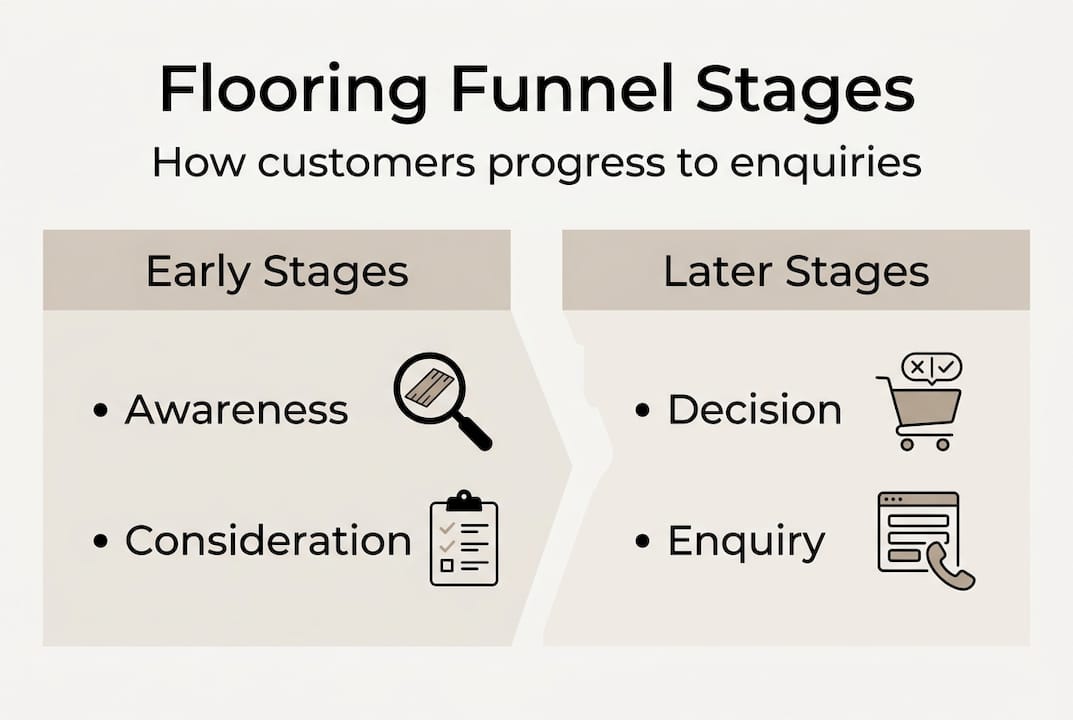
For flooring retailers and manufacturers, the funnel typically has three core stages:
- Awareness: The customer realises they need new flooring and starts searching online or sees an ad.
- Consideration: They explore options, compare suppliers, look at galleries, and read reviews.
- Decision: They choose a supplier and make contact, whether by phone, form, or showroom visit.
Understanding this journey matters because digital enquiry rates across flooring and home improvement sectors typically range from 2% to 11%, depending on the channel and how well the funnel is set up. That’s a wide gap. The businesses sitting at the top end aren’t lucky. They’ve built funnels that match how their customers actually behave.
Offline showroom conversion rates tend to be higher because the customer is already committed enough to visit. Online, you’re competing for attention at a much earlier stage. That’s why the funnel structure matters more in digital digital marketing for flooring than in traditional retail.
The funnel also changes how you think about your marketing budget. Without one, you’re spending money to drive traffic that bounces. With one, every pound you invest has a defined purpose at a specific stage.
Pro Tip: A funnel isn’t about chasing instant sales. It’s about nurturing interest so that when a customer is ready to buy, your business is the obvious choice.
Flooring is a considered purchase. Customers often spend weeks or months researching before they enquire. A funnel respects that process and keeps your brand visible throughout it.
The stages of the flooring marketing funnel explained
Now that we know what a funnel is, let’s break down each stage using real flooring scenarios.
Each stage has a different objective, a different audience mindset, and different tools that work best.

| Funnel stage | Customer mindset | Key objective | Flooring example |
|---|---|---|---|
| Awareness | “I need new flooring” | Get seen | Google Ads, social media posts, local SEO |
| Consideration | “What are my options?” | Build trust | Galleries, testimonials, comparison guides |
| Decision | “Who should I contact?” | Drive enquiry | Clear CTAs, contact forms, limited-time offers |
At the awareness stage, your goal is reach. Customers are searching broadly. They might type “wood flooring ideas” or “best carpet for stairs” into Google. Successful flooring ads at this stage focus on visibility, not conversion. You’re planting the seed.
At the consideration stage, the customer is comparing. They want to see your product range, read reviews, and understand why you’re better than the competitor down the road. This is where galleries, case studies, and detailed product pages earn their keep. Weak content here causes significant drop-off.
At the decision stage, friction is your enemy. Common flooring site mistakes like buried contact forms, slow page loads, or unclear pricing all kill conversions at this final step.
Key drop-off points to watch:
- Awareness to consideration: High drop-off if landing pages are generic or slow.
- Consideration to decision: Drop-off increases when trust signals are missing.
- Decision to enquiry: Lost if the contact process is complicated or unclear.
Industry conversion data for home improvement digital channels shows the average sits at around 2.9%. Flooring businesses with well-structured funnels consistently outperform this benchmark. The difference is almost always in the consideration and decision stages, not the awareness stage.
How to build an effective marketing funnel for flooring
With each stage clarified, let’s see how you can build your own funnel to guide customers from interest to enquiry.
Building a funnel isn’t a one-day job, but it’s not complicated either. Follow these steps:
- Map your customer touchpoints. List every place a customer encounters your brand, from Google search results to your Instagram page to your showroom sign.
- Assign content to each stage. Awareness needs attention-grabbing content. Consideration needs educational and trust-building material. Decision needs clear calls to action.
- Set measurable goals for each stage. Traffic targets for awareness, time-on-site for consideration, and enquiry volume for decision.
- Choose your channels. Not every channel suits every stage. Match them deliberately.
- Build and connect the pieces. Your website, ads, social profiles, and email sequences should all point customers in the same direction.
| Channel | Best funnel stage | Pros | Cons |
|---|---|---|---|
| Google Ads | Awareness, Decision | Fast results, targeted | Ongoing cost |
| SEO | Awareness, Consideration | Long-term visibility | Slower to build |
| Consideration, Decision | Personalised, low cost | Needs a list | |
| Social media | Awareness, Consideration | Visual, brand-building | Low direct conversion |
| Showroom | Decision | High conversion rate | Limited reach |
Understanding digital touchpoints for flooring is essential before you invest in any single channel. Multi-channel approaches consistently outperform single-channel strategies. Multi-channel conversion data shows businesses using three or more channels see significantly higher enquiry rates than those relying on one.
Your website is the hub. Everything else feeds into it. Make sure your SERPs for flooring visibility is strong so customers can find you when they’re actively searching.
Pro Tip: A high-quality photo gallery and a simple, prominent enquiry form are two of the fastest ways to improve mid and lower funnel performance. Don’t underestimate either. Review your enquiry handling process too. Speed of response matters enormously at the decision stage.
Measuring and improving your flooring marketing funnel
Building is just half the battle. Success depends on understanding where prospects drop off and continually improving your funnel.
You can’t improve what you don’t measure. Here are the key metrics to track at each funnel stage:
- Awareness: Website sessions, impressions, ad reach, organic search rankings.
- Consideration: Pages per session, time on site, gallery views, return visits.
- Decision: Enquiry form submissions, phone calls, click-to-call actions, live chat starts.
The industry average digital conversion benchmark sits at approximately 2.9% across home improvement sectors. If your flooring website is below this, your funnel has a weakness worth finding. If you’re above it, there’s still room to grow.
Tools that work well for flooring businesses:
- Google Analytics: Track traffic sources, page performance, and goal completions.
- Call tracking platforms: Attribute phone enquiries to specific campaigns or pages.
- CRM systems: Record every lead, track follow-up, and measure close rates.
Pro Tip: Quick wins often come from mid-funnel content. Update your gallery with recent projects, add a few customer testimonials, and shorten your contact form to three fields. These changes alone can lift enquiry rates noticeably.
Once you have data, iterate. Test different page headlines. Try a new enquiry form layout. Update your flooring photo galleries with fresh images. Small changes compound over time.
The biggest mistake is setting up tracking and then ignoring it. Review your funnel metrics monthly. Look for the stage where customers are dropping off and fix that first before spending more on driving traffic.
Why most flooring companies struggle with funnels (and how to get ahead)
Having understood how to measure and improve your funnel, let’s challenge some conventional wisdom with practical experience.
Most generic funnel advice treats every industry the same. Flooring is different. Customers want to touch samples, see how colours look in natural light, and trust the person fitting their floors. A generic checklist ignores all of that.
We’ve seen flooring businesses automate their entire follow-up sequence and wonder why enquiries go cold. The answer is simple. Flooring is a personal purchase. An automated email chain can’t replace a quick, knowledgeable phone call from someone who knows their products.
The real advantage comes from blending digital efficiency with genuine human touchpoints. Use digital to get found and build initial trust. Use personal follow-up and showroom experience to close.
Local trust signals matter more in flooring than in almost any other retail sector. Reviews from recognisable local areas, photos of real local projects, and clear information about your team all outperform generic brand messaging.
Our flooring-specific marketing expertise is built on this understanding. Never automate away what should be personal. That’s where flooring businesses consistently win or lose.
Ready to optimise your flooring marketing funnel?
Armed with a better approach to funnels, here’s how to put these lessons into action with expert support.
We work exclusively with flooring businesses across the UK, so we understand the buyer journey, the competitive landscape, and what actually generates enquiries in this sector.
Whether you need stronger SEO for flooring to build awareness, better-performing Google Ads for flooring to drive decision-stage traffic, or a website that converts visitors into real enquiries, we can help. Browse our website success stories to see what’s possible for a flooring business like yours. Get in touch and let’s talk about where your funnel needs the most attention.
Frequently asked questions
What are the typical conversion rates for flooring marketing online?
Digital enquiry rates for flooring services typically range from 2% to 11%, depending on the channel and how well the funnel is structured. Businesses with optimised funnels consistently sit above the 2.9% industry average.
How long does it take to see results from a new flooring marketing funnel?
Paid campaigns like Google Ads can generate enquiries within days of launching, but SEO and email-based funnel improvements typically take two to three months to show sustained, measurable growth.
Which funnel stage is most important for increasing flooring showrooms’ enquiries?
The consideration and decision stages are most critical. This is where customers are actively comparing suppliers and deciding who to contact, so strong trust signals and clear calls to action are essential.
What tools help track the funnel for flooring retailers?
Google Analytics, call tracking platforms, and CRM systems are the most practical tools for flooring retailers to measure performance at each funnel stage and identify where improvements are needed.