


TL;DR:
- Many flooring businesses mistake multi-platform presence for effective cross-channel marketing, which actually requires coordinated customer journeys. Implementing integrated messaging, tracking, and internal alignment across channels significantly increases enquiries and conversions. Proper attribution, website fundamentals, and internal sales processes are essential for maximizing marketing results.
Many flooring businesses assume that showing up on Google, Instagram, and Houzz at the same time means they’re doing cross-channel marketing. They’re not. Being present on multiple platforms is easy. Getting those platforms to work together, sharing signals, reinforcing the same message, and guiding a customer from first search to booked appointment, is an entirely different discipline. According to the Cyncly Flooring Industry Outlook Report, flooring buyers conduct substantial digital research before ever making contact. That means the journey matters just as much as the destination. This guide walks you through what coordinated cross-channel marketing actually looks like, how to measure it properly, and the practical steps to get more enquiries from it.
Key Takeaways
| Point | Details |
|---|---|
| Join up your channels | Orchestrating all marketing touchpoints works better than isolated campaigns for flooring enquiries. |
| Measure what matters | Use attribution models and call tracking to see the real impact of your combined efforts. |
| Support internal readiness | Internal sales and alignment are as critical as marketing spend for turning traffic into leads. |
| Tailor for local customers | Prioritise local SEO, Google Ads, and direct contact paths for maximum impact. |
What is cross-channel marketing and why does it matter for flooring?
Cross-channel marketing is not about being everywhere. It’s about making every touchpoint reinforce the last one. A customer sees your Instagram reel, searches your business name on Google, lands on your website, reads your reviews, and then calls you. That’s a cross-channel journey. The question is whether you designed it, or whether it happened by accident.
As Amazon Advertising puts it, cross-channel effectiveness depends on coordinated customer-journey mechanics, not separate campaigns with independent reporting. Running a Google Ads campaign with one message and posting on Facebook with a completely different one isn’t coordination. It’s noise.
For flooring businesses, this distinction matters more than most. Your market is local and enquiry-driven. You’re not selling to millions of people online. You’re selling to homeowners in a 20-mile radius who want to speak to someone before they commit to spending thousands of pounds on new floors. Every channel you use should be moving that person closer to picking up the phone or filling in a form.
Here’s what a coordinated channel mix typically looks like for a UK flooring retailer:
- Local SEO to appear in Google Maps and organic search for flooring searches in your area
- Google Ads to capture high-intent searches like “carpet fitting Leeds” or “LVT flooring near me”
- Social media to build familiarity and showcase finished installations
- Email marketing to re-engage past customers and warm up prospects
- Offline activity such as showroom events, local networking, or partnerships with builders
The key is that these channels talk to each other. Your Google Ads landing pages reflect your social content. Your email follow-ups reference the search terms people used. Your showroom team knows what campaigns are running. Understanding organic search for flooring is a strong starting point. And being aware of flooring website mistakes that break the customer journey is equally critical.
The goal is not more activity. It’s more coherent activity. Every channel should serve the same customer journey, not compete for a separate budget.
Key building blocks: The flooring customer journey across channels
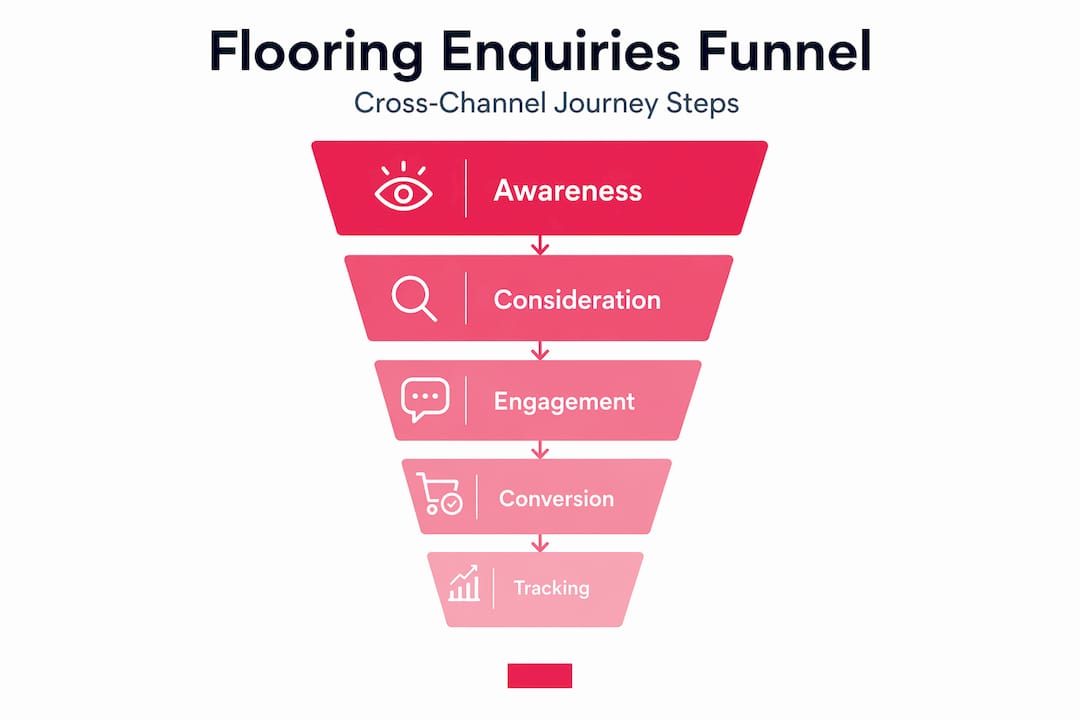
Most flooring customers don’t find you and immediately book. They search, compare, forget, come back, and then eventually enquire. Understanding that journey is what lets you design a marketing system rather than a collection of campaigns.
Here’s a typical pathway for a UK homeowner looking for new wood flooring:
- They search “engineered wood flooring [town]” on Google and see both organic results and ads.
- They click through to two or three websites, including yours.
- They browse your gallery and read a few product pages.
- They leave without enquiring because they’re not ready.
- They see a retargeting ad on Instagram showing a project similar to their own home.
- They return to your website a few days later and this time, they call.
The problem for many flooring businesses is step six. The phone rings, the job is quoted, and no one tracks which channel started that journey. As the Cyncly report makes clear, digital research before contact is the norm in flooring. That means phone-call attribution isn’t optional. It’s essential.
Here’s a summary of common channel roles in a flooring enquiry journey:
| Channel | Role in journey | Typical conversion action |
|---|---|---|
| Google organic search | Awareness and consideration | Website visit |
| Google Ads | High-intent capture | Form fill or phone call |
| Social media | Familiarity and inspiration | Return website visit |
| Email marketing | Nurture and re-engagement | Enquiry or showroom booking |
| Retargeting ads | Re-engagement after drop-off | Return visit or direct enquiry |
| Phone call | Final conversion | Booked appointment |

Pro Tip: Set up call tracking for flooring to link every inbound call back to the channel and keyword that triggered it. Without this, you’re flying blind on at least half your conversions.
When you map the journey clearly, you can also see where it breaks. Are people finding you on Google but bouncing from a slow website? Are they engaging on social but never receiving a follow-up email? The journey map highlights the weak points. And fixing them, rather than just spending more on ads, is usually where the real gains come from.
Understanding flooring marketing funnels is the natural next step once you’ve mapped the journey. A well-built funnel connects each stage deliberately, so no prospect falls through the gaps.
Measuring what matters: Attribution models for cross-channel flooring marketing
Attribution is the process of assigning credit to the channels that contributed to a conversion. It sounds technical but the core question is simple: which marketing activity deserves the credit for that enquiry?
As Media Performance explains, multi-touch attribution acknowledges multiple touchpoints, and models differ significantly in how they allocate credit. Here are the main ones and what they mean for flooring:
| Attribution model | How it works | Best suited for |
|---|---|---|
| Last click | 100% credit to the final touchpoint | Simple tracking, short journeys |
| First click | 100% credit to the first touchpoint | Brand awareness focus |
| Linear | Equal credit to all touchpoints | Multi-stage nurture journeys |
| Time decay | More credit to recent touchpoints | Longer sales cycles like flooring |
| Position-based | More credit to first and last touch | Balanced view of journey |
For flooring businesses, time decay and linear models tend to reflect reality more accurately. The journey is rarely instant. A customer might touch five channels over two weeks before calling. Giving all the credit to the last Google Ad they clicked ignores the Instagram reel, the organic visit, and the email that kept you front of mind throughout.
The bigger problem, though, is offline conversion gaps. Purely digital tracking misses or misattributes value in phone-heavy markets. If your analytics only tracks form fills, you’re likely under-reporting enquiries by a significant margin. Flooring is a phone-call business. Always has been.
The fix is to integrate call tracking with your CRM and ad platforms. Tools like this assign unique phone numbers to each marketing channel, so when someone calls after clicking a Google Ad, that call is recorded as a conversion from that campaign. The same applies to organic search, social traffic, and email links.
Once you’ve connected the dots, your SERP visibility data becomes meaningful. You can see which search positions generate not just clicks but actual phone calls.
Pro Tip: Don’t trust any single attribution model as the final word. Run two models side by side, such as linear and time decay, and look for patterns rather than precise numbers. Attribution is a guide, not a ledger.
From theory to practice: Actionable cross-channel marketing strategies
Knowing the theory is useful. Applying it to a real flooring business is where most firms get stuck. Here’s how to make cross-channel marketing work in practice.
Start with sequencing. Not every channel should be launched at the same time. A common and effective sequence for flooring businesses looks like this:
- Fix your website first. It’s the hub of every channel. If it’s slow, unclear, or hard to navigate, every other investment is undermined.
- Launch local SEO. Build organic visibility for your core service and location combinations. This is a long-term asset.
- Add Google Ads once SEO is running. Use ads to capture high-intent searches immediately while organic rankings build.
- Layer in social media for retargeting and brand familiarity. Don’t try to post everything everywhere from day one.
- Build an email sequence for new leads and past customers. Even a simple three-step follow-up makes a measurable difference.
Retargeting deserves its own mention. Showing ads to people who have already visited your website is one of the highest-return tactics available. These are warm prospects. They already know you exist. A retargeting ad featuring a project similar to what they browsed on your website can bring them back and convert them. This is practical cross-channel lead generation in action: unifying journey mapping, behavioural lead scoring, and follow-up tailored to earlier interactions.
Here are the most important practical steps to unify your channels:
- Use consistent messaging and imagery across every channel so the customer experience feels joined-up.
- Set up UTM parameters on all your links so you can track traffic sources in Google Analytics.
- Integrate call tracking with your CRM and ad accounts.
- Create a simple email sequence for every new enquiry, whether they came from ads, organic, or social.
- Align your sales team with your marketing campaigns so they know what offers or products are being promoted.
That last point is where most businesses underinvest. Internal readiness is framed as essential so that externally generated traffic actually converts. If your marketing drives 50 new enquiries but your team isn’t prepared to follow up quickly, you’ve wasted the spend.
Drip marketing for flooring is one of the most underused tools in the sector. Automated email sequences keep prospects warm without any manual effort. And a digital marketing strategy that ties all of this together is far more valuable than any single tactic run in isolation.
Pro Tip: Budget for both external demand generation (ads, SEO, social) and internal enablement (CRM setup, sales training, follow-up processes). Spending 100% on ads while ignoring your conversion process is one of the most common and costly mistakes in flooring marketing.
Why most flooring firms waste money with fragmented marketing (and what actually works)
We see it constantly. A flooring business spends money on Google Ads, posts sporadically on Facebook, occasionally sends a promotional email, and wonders why the results are inconsistent. Each channel is running, but none of them are connected. There’s no shared data. No consistent message. No system for following up.
The honest truth is that fragmented marketing creates fragmented results. When your channels don’t share data or messaging, you end up bidding against your own organic listings, retargeting people who already converted, and crediting the wrong channel for enquiries. You make decisions based on incomplete information.
The businesses that see the strongest results do things differently. They start by fixing their website fundamentals before scaling ad spend. They set up proper tracking before drawing any conclusions. And critically, they treat their sales and customer service team as part of the marketing system, not a separate function.
The internal marketing reality for flooring is this: sales team alignment is what separates businesses that grow from those that plateau. You can have perfect ad targeting and a beautiful website. But if the person answering the phone doesn’t know what promotion is running, or if no one follows up on a web enquiry within 24 hours, you lose the job.
The businesses we’ve worked with that rebuilt their internal process before scaling up multi-channel campaigns consistently outperform those that just increase their ad budgets. It’s not glamorous advice. But it works.
Unlock your next step in flooring marketing success
If you’re serious about getting more from your marketing, it starts with having the right systems in place. The guide above gives you the framework. What you need next is execution.
At Truth Digital, we work exclusively with UK flooring businesses. We build the websites, run the SEO, manage the Google Ads, and set up the email marketing sequences that tie it all together. We don’t work with other industries. That means everything we do is built specifically for the flooring sector, including how customers search, what drives them to enquire, and what turns an enquiry into a sale. If you want to stop guessing and start growing, let’s talk.
Frequently asked questions
What is the difference between cross-channel and multichannel marketing for flooring?
Multichannel marketing uses several platforms independently, while cross-channel coordination connects every touchpoint so the customer experiences a single, coherent journey rather than separate, unrelated messages.
How can I measure phone enquiries alongside website leads?
Use call tracking software linked to your CRM and ad platforms. As Delacon’s research shows, integrating call attribution with your digital tools gives you full visibility of both online and offline enquiry sources.
Which attribution model is best for flooring marketing?
There’s no single right answer. No one model is universally best; the right choice depends on your conversion volume, sales cycle length, and channel mix. Testing two models together gives you a more reliable picture.
What is the most common mistake in cross-channel marketing for flooring firms?
Running campaigns on separate channels without aligning messaging, tracking, or sales readiness. Internal alignment is just as important as external activity if you want enquiries to convert into actual jobs.
How soon should I expect results from cross-channel marketing?
Google Ads can generate enquiries within days of launching. Organic SEO typically takes three to six months to build momentum. The strongest long-term results come from running both together and refining the system over time.