


TL;DR:
- Drip marketing involves automated, sequenced messages that nurture leads over time in flooring sales.
- It aligns with the long decision cycle of flooring buyers, increasing engagement and conversions.
- Effective campaigns use segmentation, personalization, and multi-channel strategies to improve results.
Drip marketing is not drip pricing. That confusion trips up a lot of flooring businesses before they even get started. Drip pricing is a consumer law issue, where costs are added incrementally at checkout. Drip marketing is something entirely different and far more useful. It is a method of sending automated, sequenced messages to leads and customers at the right time, based on where they are in their buying journey. For UK flooring retailers and manufacturers, it is one of the most effective tools available for turning cold enquiries into booked jobs and loyal customers.
Key Takeaways
| Point | Details |
|---|---|
| Drip marketing explained | Drip marketing is a series of automated communications that nurture flooring leads and encourage sales. |
| Strategy over volume | Success comes from segmenting and personalising campaigns, not sending more emails. |
| Multi-channel works best | Combining email, ads, and SEO drives higher conversions than using email alone. |
| Measure what matters | Focus on engagement and conversion rates, not just open rates, to judge campaign success. |
What is drip marketing in flooring?
Drip marketing uses automated, scheduled communications to nurture leads over time. Instead of sending one email blast and hoping for the best, you build a sequence. Each message arrives at a specific point in the prospect’s journey, triggered by their behaviour or a set time interval.
This is not a new concept. But it is especially well-suited to flooring. Here is why.
Buying decisions in flooring are rarely instant. Customers spend weeks, sometimes months, researching products, requesting samples, comparing quotes, and consulting partners or colleagues. That long decision cycle means a single touchpoint rarely converts. You need multiple, well-timed messages to stay front of mind.
The same applies to trade buyers. Contractors and commercial fit-out teams have their own procurement processes. They need different information, different timing, and a different tone compared to retail customers.
“Drip marketing is about meeting your audience where they are, at the right moment, with the right message.”
Drip marketing for flooring enhances engagement and sales precisely because it mirrors how flooring decisions are actually made, gradually and with consideration.
A typical flooring drip programme is built around four core sequence types:
- Welcome sequences that introduce your brand and build immediate trust
- Education sequences that inform prospects about products, installation, and quality differences
- Offer sequences that present promotions or consultations at the right moment
- Re-engagement sequences that win back leads who have gone quiet
This structure keeps your business visible throughout a buying cycle that might last 30 to 90 days. Without it, you are relying on luck. With it, you are running digital marketing for UK flooring businesses in a way that is measurable and repeatable.
Drip marketing also differs from one-off campaigns in accountability. Each sequence can be tested, refined, and improved based on real engagement data. That is a significant advantage over traditional advertising, where results are often unclear.
Key components of an effective flooring drip campaign
Knowing what drip marketing is and actually running a campaign are two different things. Here is how a flooring business puts it into action.
- Start with a welcome series. Send three emails within the first two weeks of a lead opting in. Introduce your brand, share what makes you different, and set expectations for what comes next.
- Segment your list immediately. Trade buyers and retail customers should never receive the same messages. The language, offers, and timing need to reflect their specific needs.
- Use automation tools. Platforms like Mailchimp and Klaviyo handle sequencing, timing, and A/B testing automatically. Connect them to your CRM so every interaction is tracked.
- Follow up based on behaviour. If someone opens three emails but never clicks, that tells you something. Adjust the sequence to serve them a different offer or format.
- Layer in monthly promotions. These sit alongside your evergreen nurture sequences and give engaged subscribers a timely reason to act.
Pro Tip: Focus your reporting on Click-to-Open Rate (CTOR) rather than open rates. Open rates are increasingly unreliable due to email privacy protections. CTOR tells you how compelling your actual content is, which is what matters.
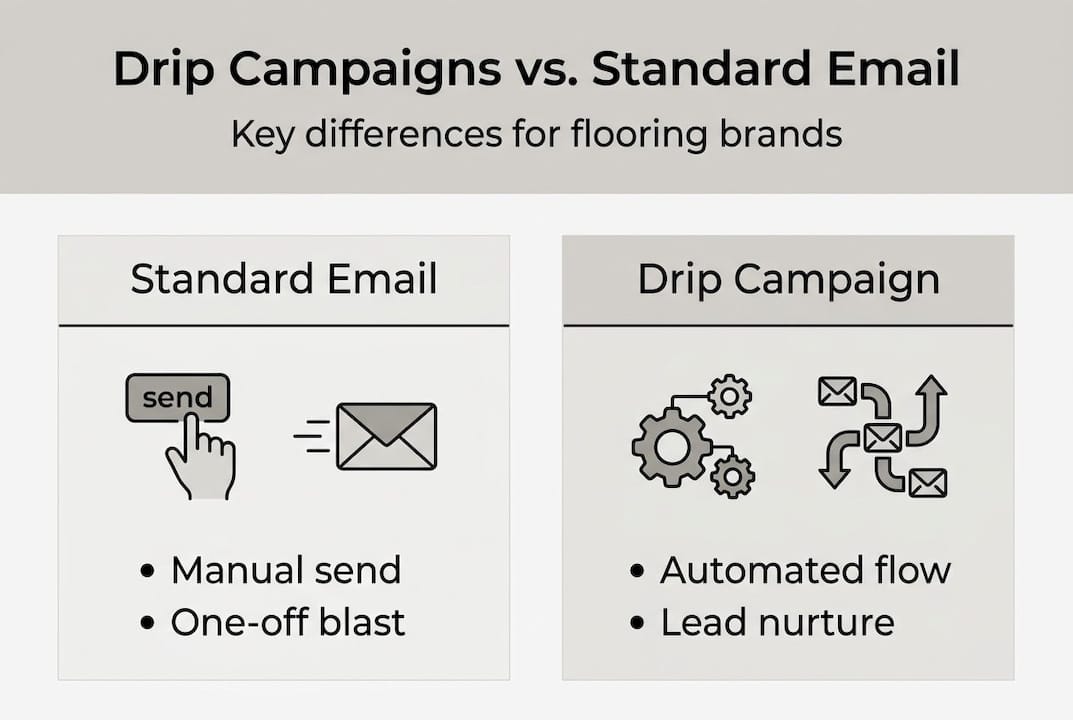
Here is a simple comparison to show how drip campaigns differ from standard email marketing:
| Feature | Standard email campaign | Drip campaign |
|---|---|---|
| Timing | Sent once, manually | Automated and sequenced |
| Targeting | Whole list | Segmented by behaviour |
| Personalisation | Limited | High |
| Measurement | Open rate, clicks | CTOR, conversions, funnel stage |
| Effort over time | High, repeated | Low after initial setup |
For flooring businesses with limited marketing resource, the automation element is particularly valuable. You build the sequences once and they run continuously, nurturing leads even when your team is on the floor or in the showroom. Explore multi-channel digital tactics to layer email into a broader strategy, or review our free flooring growth pack to benchmark where your current marketing stands.

Tailoring your approach: segmentation, personalisation, and multi-channel
Having covered the campaign structure, it is time to focus on refining your approach for maximum relevance and impact.
Segmentation is the single biggest lever in drip marketing. A retail customer browsing carpets for a living room needs different messaging to a commercial contractor specifying LVT for a hotel refurbishment. Sending the same content to both reduces relevance and increases unsubscribes.
For UK flooring businesses, the most useful segmentation criteria are:
- Trade versus retail buyer
- Product interest, such as wood flooring, carpet, or LVT
- Stage in the buying cycle, whether awareness, consideration, or decision
- Geography, especially relevant for showroom-based retailers
- B2B versus B2C intent
Personalisation goes beyond using someone’s first name. It means timing your offer sequence to match when a prospect is most likely to convert. A lead who requested samples three weeks ago is probably ready for a follow-up quote conversation. A new subscriber is not.
Marketing funnels for flooring brands work best when email is placed at the consideration and decision stages, not just used as a broadcast tool. Email works alongside display ads, Google Ads, and SEO to create multiple touchpoints that move a prospect through your funnel. Multi-channel combinations consistently outperform single-channel approaches for UK flooring businesses.
Pro Tip: Set up a CRM tag that flags leads who have visited your website more than twice. Trigger a specific email sequence for those leads offering a showroom visit or a free consultation. Warm traffic converts at a much higher rate than cold.
Here is a look at how channel combinations perform for UK flooring businesses:
| Channel combination | Expected conversion rate |
|---|---|
| Email only | 2 to 4% |
| Email plus SEO traffic | 5 to 8% |
| Email plus paid ads plus SEO | 8 to 11% |
The takeaway is clear. Email drip campaigns perform best as part of a joined-up digital strategy, not in isolation.
Common pitfalls and metrics that matter in flooring drip marketing
Once you are optimising campaigns, it is vital to avoid the mistakes that cause most flooring drip programmes to fail.
The most common error is over-emailing. Sending too frequently signals desperation and erodes trust. 33% of buyers disengage from brands they feel contact them too often. Start conservatively, one or two emails per week at most, and scale based on engagement data.
Early campaign volatility is also normal. When you first launch an automated sequence, platform learning periods mean your results will fluctuate. Do not make drastic changes in the first four weeks. Give the system time to optimise.
Here are the pitfalls flooring businesses run into most often:
- Sending the same sequence to every subscriber regardless of segment
- Writing subject lines that focus on the product rather than the customer’s problem
- Ignoring unsubscribe trends, which are an early warning sign of poor relevance
- Setting up a campaign and never reviewing it again
- Measuring open rates instead of CTOR
The metrics that actually matter for flooring drip campaigns are:
- CTOR: Measures genuine content engagement, not just whether the email was received
- Conversion rate: Tracks how many email recipients take a desired action, such as booking a consultation
- Unsubscribe rate: Anything above 0.5% per email is worth investigating
- Funnel progression: How many leads move from one stage to the next within your CRM
Realistic expectations matter here. UK flooring businesses using email marketing for flooring typically see 2 to 11% conversion rates from digital campaigns, depending on channel mix and campaign maturity. Do not expect 20% overnight.
Pro Tip: Review your unsubscribe data monthly. If specific emails in your sequence have above-average drop-off, rework the subject line and content before looking at timing.
A flooring expert’s perspective: less volume, more relevance
Most drip marketing guides focus heavily on tactics. Which tools to use, how many emails to send, what subject line format to follow. That is useful. But it misses the bigger point.
The flooring businesses we see generating consistent results from drip marketing are not the ones sending the most emails. They are the ones who understand their audience best.
A local flooring retailer running custom sequences for residential buyers, local trade contacts, and commercial clients will outperform a competitor blasting the same campaign to everyone. Every time. The specificity is what creates the feeling of relevance. And relevance is what drives action.
The best performers also treat email as one layer, not the whole strategy. They connect their email nurture approach to SEO, paid ads, and marketing funnels that guide prospects from first search to confirmed order. That integration is where the real revenue comes from. Not the volume of messages sent, but the depth of understanding behind them.
Level up your flooring marketing with expert support
If you are running drip campaigns that are not converting, or you have not started yet, we can help. Truth Digital works exclusively with flooring retailers and manufacturers across the UK.
We build and manage expert email marketing services tailored for flooring businesses, from welcome sequences to full CRM integration. We also support flooring brands with SEO for flooring companies and marketing funnels for flooring that align your digital channels for better results. Get in touch and let us look at what your current strategy needs.
Frequently asked questions
How is drip marketing different from regular email campaigns in the flooring sector?
Drip marketing uses automated, sequenced emails to nurture leads over time, while regular campaigns are typically one-off messages sent to the whole list at once.
What tools do UK flooring companies use for automated drip campaigns?
Popular tools are Mailchimp and Klaviyo, both of which support automation, A/B testing, and CRM integration for flooring businesses.
What is the average digital conversion rate for UK flooring drip marketing?
UK flooring businesses typically see 2 to 11% conversion rates from digital drip marketing strategies, depending on channel mix and campaign maturity.
What is the biggest mistake to avoid in flooring drip marketing?
Over-emailing is the most damaging error. 33% of buyers disengage from brands they feel contact them too frequently, so always prioritise relevance over volume.

