


TL;DR:
- Using precise flooring terminology improves SEO, customer trust, and lead quality.
- Clear communication about installation methods reduces unsuitable enquiries and enhances reputation.
- Incorporating advanced specs like wear layer and AC ratings boosts professionalism and pricing power.
Flooring retailers and installers who use the right digital keywords see a measurable uplift in website enquiries. Yet many UK flooring businesses are still uncertain about the terminology that drives online visibility. Phrases like SPC, LVT, wear layer, and click-lock appear constantly in customer searches, yet they are often missing from service pages and product listings. That gap costs you leads. This guide breaks down the essential flooring terms you need to know, explains how to apply them in your digital content, and shows you exactly where each term has the most marketing impact. If you want more enquiries and better-quality customers, start here.
Key Takeaways
| Point | Details |
|---|---|
| Precise terms build trust | Using correct industry language online reassures customers and helps you rank higher in local searches. |
| Product and install clarity | Clear explanation of product types and installation methods increases enquiries and reduces costly misunderstandings. |
| Specs matter for margins | Highlighting durability specs like wear layer or AC rating helps justify value and attracts quality leads. |
| Digital content edge | Smart keyword use and adaptation to seasonal trends boost visibility against competitors. |
Why digital flooring terminology matters for retailers and installers
Clarity builds trust. When a potential customer lands on your website and sees precise, confident language around products and installation, they feel reassured. Vague descriptions do the opposite. They create doubt, and doubtful buyers move on.
The same applies to Google. Search engines reward content that uses specific, relevant language. If your competitors are using terms like ‘engineered wood flooring for underfloor heating’ and you are simply writing ‘wood floors available,’ you will lose ground in the rankings. The connection between keyword clarity and Google ranking is direct and well established.
Here is what terminology does for your digital presence:
- Builds credibility with customers who already know what they want
- Signals expertise to search engines, improving your organic visibility
- Reduces enquiries from customers who are not a good fit
- Supports more accurate Google Ads targeting
- Strengthens your flooring branding essentials across every channel
Using glossaries and product specs in content builds trust and aids SEO by giving search engines clear signals about your expertise. It also helps customers make faster decisions, which shortens the sales cycle.
Misusing or ignoring terms causes real damage. A retailer who describes SPC as ‘just vinyl’ may attract customers expecting a budget product, only for those customers to be surprised by the price. Mismatched expectations lead to abandoned enquiries or negative reviews.
‘Retailers push waterproof SPC and LVT heavily in their marketing, but experts consistently stress that subfloor preparation and durability specs are the real failure points in retail claims.’
Your digital branding guide should reflect your technical knowledge, not just your product range. Customers who find a flooring business that speaks their language are far more likely to convert.
Pro Tip: Include key flooring terms in your FAQs, service pages, and blog posts. This improves both your professional credibility and your conversion rate by answering buyer questions before they even ask.
For a broader view of how this fits into your overall strategy, the practical digital marketing guide for UK flooring businesses is worth your time.
Essential product terminology: What every UK digital flooring pro should know
Knowing what to call your products is step one. Using those names correctly in your digital content is step two. The table below covers the terms that appear most frequently in customer searches and buying conversations.
| Term | What it means | Why it matters digitally |
|---|---|---|
| Engineered wood | Multi-layer board with a real wood top layer | High search volume; appeals to premium buyers |
| LVT (Luxury Vinyl Tile) | Resilient vinyl flooring mimicking natural materials | Extremely popular search term across the UK |
| SPC (Stone Plastic Composite) | Rigid-core vinyl with limestone powder base | Growing in search; great for kitchens and bathrooms |
| Laminate | Synthetic layered flooring with photographic surface | Budget-conscious audience; high search competition |
| Click-lock | Planks or tiles that lock together without adhesive | DIY search queries; strong for instructional content |
| Floating floor | Installation that sits over the subfloor without fixing | Appears in ‘how to install’ searches regularly |
These flooring term definitions are the foundation of your product content. Get them right, and your service descriptions, landing pages, and ads become far more effective.
Here is where these terms commonly appear in your digital channels:
- Website product category pages and navigation labels
- Landing pages for specific flooring types or rooms
- Google Ads headlines and descriptions
- Google My Business product listings
- Blog posts answering ‘which flooring is best for’ type queries
Using precise terms in service descriptions also helps when you add products to flooring sites within a structured catalogue. Properly labelled products rank better in on-site search and attract more relevant traffic from Google.
The benefit is cumulative. Every page that uses accurate terminology adds to your site’s authority in the eyes of search engines. Over time, that authority translates to higher rankings and more organic enquiries.
Decoding installation methods: What retailers and installers must communicate online
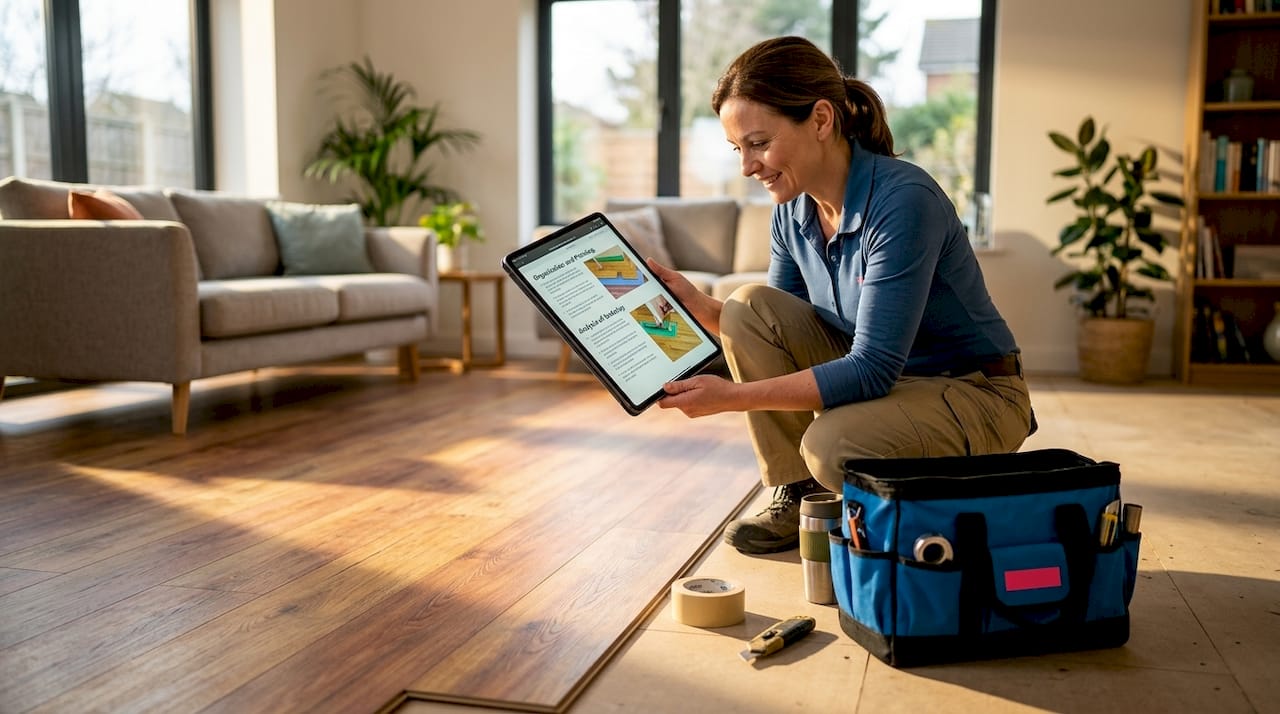
Installation is where confusion often costs businesses real money. A customer who misunderstands the installation method may choose the wrong product, leading to call-backs, complaints, and negative reviews. Clear online communication about methods prevents all of that.
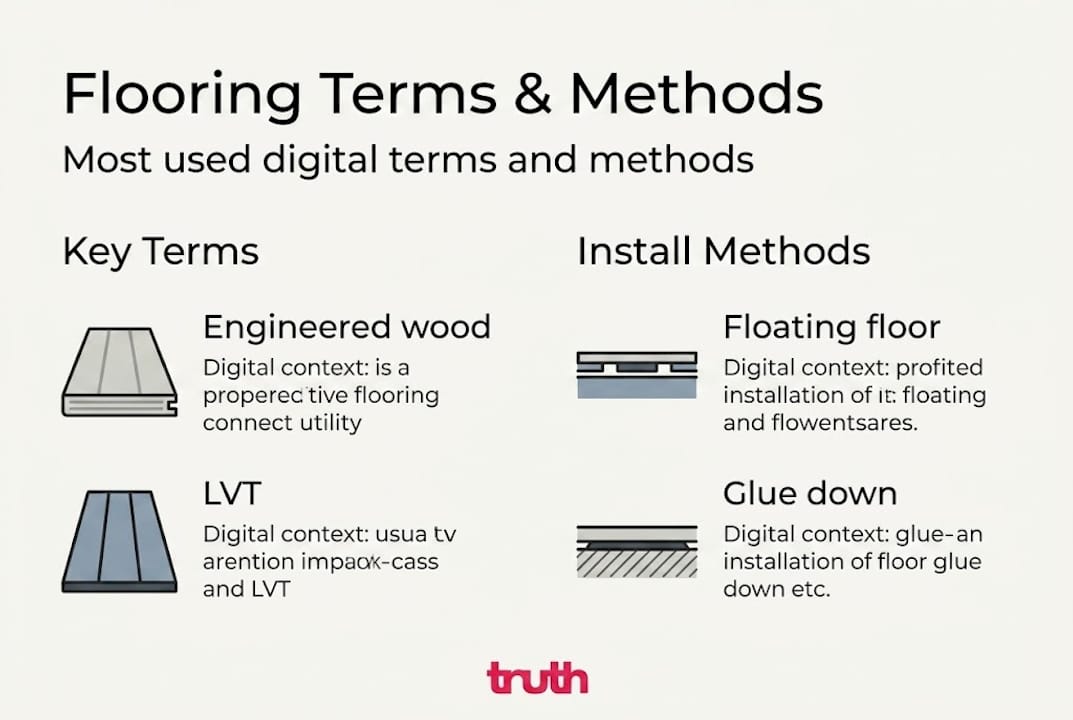
Here is a comparison of the three most common installation approaches:
| Method | How it works | Best for | Key consideration |
|---|---|---|---|
| Floating floor | Planks lay over the subfloor, not fixed down | Most residential settings | Requires expansion gaps at walls |
| Click-lock | Planks interlock along edges without adhesive | DIY-friendly installs | Fast to fit; suits many subfloor types |
| Glue down | Flooring adhered directly to the subfloor | Commercial and premium installs | Subfloor must be smooth, level, and dry |
The key installation method differences including expansion gaps and subfloor requirements are not just technical details. They are marketing assets. Customers searching for ‘best flooring for kitchens’ or ‘DIY flooring install’ are ready to buy. If your content addresses their exact concern, you win the click.
SPC rigid core suits uneven subfloors better than glue-down LVT, which is premium but demands a near-perfect base. That single distinction, communicated clearly on a product page, can pre-qualify your customers and save your team hours of wasted quoting time.
SEO-rich queries you should be answering in your content:
- ‘Can I install LVT over existing tiles?’
- ‘What is a floating floor installation?’
- ‘Do I need underlay with click-lock flooring?’
- ‘Best flooring for uneven subfloor UK’
- ‘Professional vs DIY wood floor fitting’
Each of these represents a buyer who is close to making a decision. Your Google Ads for flooring campaigns can target these queries directly, and your organic search for flooring strategy can build pages around them.
Pro Tip: Always specify subfloor requirements and installation method in your web copy. It filters out non-ideal customers before they call, which means fewer wasted enquiries and more productive conversations.
Advanced terminology: Durability specs, benchmarks, and digital search impact
Once your product and installation basics are in order, advanced terminology becomes your competitive advantage. These are the terms that separate professional flooring businesses from general home improvement retailers in the eyes of informed buyers.
Key terms to understand and use:
- Wear layer: The protective top surface of LVT or SPC, measured in millimetres. Thicker wear layers command higher prices and justify them.
- AC rating (Abrasion Class): A standardised durability score from AC1 to AC6, used mainly for laminate. AC3 suits most domestic use; AC4 and above for commercial.
- Subfloor: The structural base beneath your finished floor. Its condition determines which products and methods are viable.
- Waste factor: The additional material ordered to account for cuts and offcuts. A standard waste factor of 10% is typical for most installations.
- UFH compatibility: Whether a product can be used over underfloor heating. Engineered wood is better suited to UFH than solid wood due to its dimensional stability.
These specs belong in multiple places across your digital channels:
- Product specification tables on individual product pages
- FAQ sections addressing durability and longevity
- Blog posts comparing flooring types for specific rooms or use cases
- Google Shopping product data feeds
- Email marketing to trade customers and specifiers
Using advanced specs also helps you defend higher price points. A customer questioning why your LVT costs more than a competitor’s will feel reassured when you point to a 0.55mm wear layer versus a 0.3mm alternative. That is a conversation you can have through your website before the customer ever calls.
‘Experts consistently emphasise subfloor preparation and durability specs as the most common failure points in retail flooring claims. Getting these terms right is not pedantry. It is professional responsibility.’
Think about digital touchpoints for flooring as the full journey a buyer takes before making contact. Advanced terminology makes each touchpoint more convincing. For search visibility, these terms also influence how your pages appear in SERPs for flooring, especially for long-tail queries from buyers who know exactly what they want.
An honest perspective: Why flooring terminology will define digital winners
Here is what we observe working with flooring businesses across the UK. Most retailers focus almost entirely on price-led language online. ‘Cheap laminate.’ ‘Best value LVT.’ ‘Affordable wood floors.’ That approach attracts the most price-sensitive customers, which are also the most demanding and least profitable.
The businesses winning online in 2026 are the ones who treat their websites as education platforms. They explain wear layers. They clarify subfloor requirements. They compare installation methods honestly. And because they do that, they attract buyers who already understand the value of quality.
The irony is that most flooring businesses already have this knowledge. The gap is in communicating it online. A fitter who can explain the difference between glue-down LVT and SPC rigid core on-site should be able to do the same on a product page or FAQ.
‘Digital education is the most underused asset in UK flooring retail. The businesses that teach online are the ones customers trust enough to buy from.’
Pro Tip: Rewrite your service pages and product descriptions as if you were advising a knowledgeable friend. Be specific, be honest, and explain the why behind your recommendations.
We work with flooring businesses who make this shift and the results are consistent. Better leads, fewer time-wasting enquiries, and stronger close rates. If you want to understand how we approach this, our digital flooring expertise page explains it plainly.
Take the next step: Elevate your digital presence with expert support
You now have a clear picture of the terminology that drives flooring search traffic and customer trust. The next move is putting it to work consistently across your website, your ads, and your content.
We help flooring retailers and installers do exactly that. From building pages that rank for the right terms to managing SEO for flooring companies that attract high-intent buyers, our work is focused entirely on the flooring sector. No generalist approaches. No guesswork. If you are ready to turn your technical knowledge into real digital results, speak to our team of digital marketing experts who understand your industry inside out. Let’s make your website work as hard as you do.
Frequently asked questions
What does SPC flooring stand for and why is it popular in digital content?
SPC stands for Stone Plastic Composite, a rigid-core vinyl that is waterproof and stable for uneven subfloors. It performs well in search for kitchens and bathrooms because buyers actively search for waterproof options in those rooms.
How should I use keywords like ‘LVT flooring fitters’ to boost my website?
Pair product keywords with local modifiers such as ‘LVT fitters Leeds’ and place them in headings, service pages, and your Google Business Profile. Long-tail local keywords consistently outperform broad terms when it comes to converting visitors into enquiries.
What are the main installation methods retail customers ask about?
Customers most commonly ask about Floating Floor, Click-Lock, and Glue Down methods. Each suits different products and subfloor conditions, so explaining the distinctions on your website reduces confusion before customers call.
Why do product specifications like wear layer and AC rating matter online?
Wear layer and AC rating are the durability specs buyers use to compare products. Including them on your pages builds trust and attracts informed buyers rather than price-shoppers who are unlikely to convert at your margins.