TL;DR:
- Visual identity extends beyond logos to include all touchpoints like website, signage, and social media.
- Consistency in branding elements builds trust, recognition, and increases online enquiries.
- Focusing on detailed digital and offline experiences is crucial for effective flooring branding.
Your logo is not your brand. That is one of the most common misconceptions we see among UK flooring businesses. Many owners invest in a professional logo, then assume the job is done. But your customers are forming opinions about your business based on every visual element they encounter, from your website and social media to your van livery and showroom signage. Visual identity for flooring includes all of it. Get it right, and you build instant trust, stronger recognition, and more online enquiries. This guide breaks down exactly what that looks like in practice.
Key Takeaways
| Point | Details |
|---|---|
| Visual identity basics | Every flooring business needs a clear, unified look across all digital and physical channels to build trust. |
| Consistency delivers results | Staying visually consistent boosts brand recognition, website conversions, and lowers customer acquisition costs. |
| Digital-first branding | Optimised visuals for web, mobile, and AR tools are essential for generating more flooring leads online. |
| Avoiding pitfalls | Steer clear of inconsistent branding and generic images to maintain customer trust and stand out. |
What defines visual identity for flooring businesses?
Now you know visual identity is more than just a logo, let’s break down what defines a visual identity fit for your flooring business.
At its core, visual identity for flooring encompasses the consistent visual elements that define and communicate your brand across all touchpoints, including logo, colour palette, typography, imagery, and digital assets, all tailored to evoke quality, style, durability, and trust. Every element needs to work together, not just sit in isolation on a business card.
Here are the core components your flooring business needs to define:
- Logo and its approved variants (primary, stacked, monochrome)
- Colour palette, typically two to four colours that reflect your product range and target market
- Typography, meaning the specific fonts used for headings, body copy, and signage
- Imagery style, including whether you use authentic project photos or a curated stock style
- Digital assets such as social media templates, email headers, and website banners
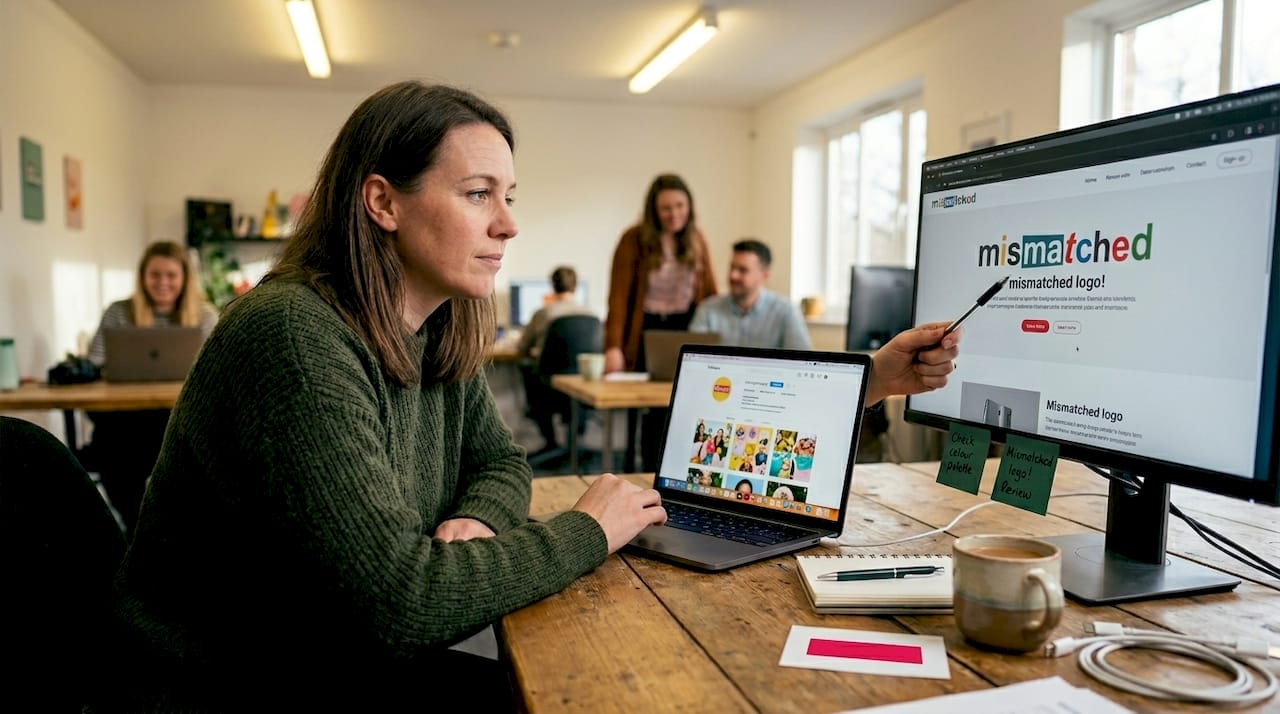
For flooring businesses, colour choices carry particular weight. Earth tones, warm neutrals, and stone-inspired palettes communicate material authenticity. They tell a customer, before a single word is read, that your business understands quality surfaces. Contrast that with a flooring company using bold, mismatched colours that bear no relation to their product range. The disconnect erodes confidence.
Consistency is where most businesses fall down. Your branding on Instagram looks nothing like your website, which looks nothing like your quote document. That inconsistency signals disorganisation to potential customers.
Here is a quick comparison of strong versus weak visual identity in the flooring sector:
| Feature | Strong visual identity | Weak visual identity |
|---|---|---|
| Colour palette | Defined, consistent, material-led | Random, changes per platform |
| Logo usage | Consistent sizing and placement | Stretched, cropped, or varied |
| Imagery | Authentic project photography | Generic stock photos |
| Typography | One or two defined fonts | Multiple mismatched fonts |
| Digital assets | Branded templates used consistently | Created ad hoc each time |
The design elements for trust you build into your brand now will pay dividends every time a prospect lands on your website or sees your van.
“Your visual identity is not decoration. It is the first judgement your customer makes about whether you are worth trusting with their home.”
Building consistent brand visuals: Best practices for UK flooring
Understanding the ingredients is a start, but consistency across channels is the real key. Here is how to build and maintain impeccable visual branding.
The branding essentials for a flooring business start with clear definitions. Your brand guide should specify logo clear space, approved colour codes, and typography rules. Without this document, every new piece of marketing becomes a guessing game.
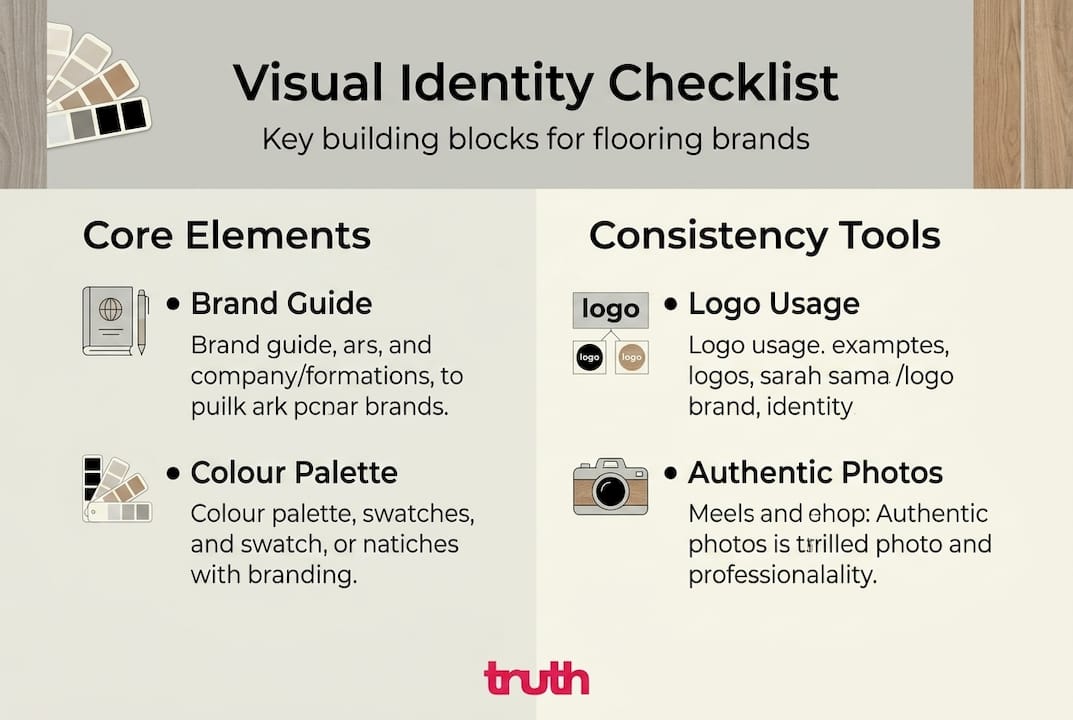
Core mechanics include defining your logo with clear space and variants, selecting colour palettes inspired by your materials, using modern sans-serif typography, and applying these consistently across all touchpoints.
Here is a step-by-step process for building and auditing your visual consistency:
- Define your brand assets in a single document, logo files, hex codes, fonts, and image guidelines.
- Audit every customer touchpoint: website, social profiles, van livery, uniforms, email signatures, printed literature.
- Identify where inconsistencies exist. Note every place your colours, logo, or fonts differ from your brand guide.
- Prioritise fixes starting with your website and Google Business Profile, as these have the highest customer visibility.
- Create templated assets for ongoing use, social post templates, email headers, quote document covers.
- Review quarterly. Branding drifts over time, especially when multiple people produce marketing materials.
Pro Tip: Avoid literal flooring icons such as planks or tiles in your logo or marketing materials. They read as generic and instantly forgettable. Abstract symbols that evoke precision, quality, or elevation give your brand far more distinction and staying power.
Data consistently backs up the value of this work. The impact is tangible when you look at conversion rates. Businesses with consistent visual branding report significantly stronger conversion rates compared to those with fragmented or inconsistent presentation. Customers make trust decisions fast, often within seconds of landing on a page.
| Branding consistency level | Impact on conversion rate | Impact on brand recall |
|---|---|---|
| Fully consistent across channels | High positive impact | Strong recognition |
| Partially consistent | Neutral to moderate impact | Moderate recall |
| Inconsistent or fragmented | Negative impact, trust erosion | Poor recall |
Every website must-have for your flooring site should reflect your brand standards. That means branded photography, correct colours in every button and heading, and a consistent voice throughout.
Digital presence and omnichannel experience: Visual identity in action
Once your visual assets are developed, their effectiveness depends on real-world execution, especially online. Here is how visual identity works in digital and omnichannel experiences.
For UK flooring owners, omnichannel consistency across website, social, SEO, and AR visualisers reinforces brand recognition at every stage of the customer journey. A prospect might discover you on Instagram, visit your site on mobile, then search your name on Google before calling. Each of those touchpoints must feel like the same business.
Here is where digital visual identity has the greatest impact:
- Website: Your most important branded asset. Colour, typography, and imagery must all align perfectly.
- Social media: Use branded templates so every post looks intentional, not improvised.
- Mobile experience: Over half of flooring searches happen on mobile. Your brand must translate without compromise.
- AR visualisers: Tools that let customers see flooring in their own home. Branded overlays and interfaces reinforce trust during this critical decision stage.
- Local SEO: Consistent name, address, and branding across Google Business Profile, directories, and your site strengthens visibility in local search results.
Authentic project photography is one of the highest-impact investments you can make. Authentic imagery doubles engagement compared to stock photos, while location targeting reduces cost per click by 60% and optimised landing pages boost conversions by over 42%. Real photos of real installs in real UK homes resonate far more with local customers than anything generic.
Pro Tip: If you use an AR visualiser tool, ensure it reflects your brand colours and interface style. An unbranded or poorly styled visualiser feels disconnected from your business and can undermine the trust you have worked to build everywhere else.
Strong website gallery tips and sound UX improvements compound the effect. When your visuals are polished and your user experience is smooth, lower ad costs and higher enquiry rates follow naturally.
Avoiding common pitfalls in flooring visual identity
Bringing your brand to life visually is powerful, unless common mistakes creep in. Here is what to avoid.
Many flooring businesses invest in a website or social presence and then let standards slip. The result is a fragmented identity that chips away at customer confidence. Inconsistency erodes trust, over-literal designs fail to inspire, and neglecting mobile and SEO limits your digital reach.
Here are the top five visual identity mistakes to watch for:
- Inconsistent logo use: Different versions of your logo appearing across platforms, some stretched, some outdated, some in wrong colours.
- Ignoring mobile display: Your branding may look great on desktop but break apart on a phone. With most searches happening on mobile, this is a serious trust issue.
- Overuse of cliché imagery: Stock photos of generic rooms, or literal tile and plank icons, make your business look the same as every competitor.
- No brand guide in place: Without a documented set of rules, every team member and supplier makes their own decisions, leading to drift and inconsistency over time.
- Skipping regular audits: Branding evolves and platforms change. A visual identity that was consistent two years ago may now be misrepresented across multiple channels.
When you avoid common website mistakes, your overall brand experience improves significantly. The same discipline applies to offline materials too. Consider this: even basic rug cleaning mistakes can undermine how customers perceive a flooring professional’s expertise. Perception is built in the details.
“Inconsistency in visual branding does not just look untidy. It tells your customer that your business lacks attention to detail, which is exactly the opposite of what a flooring professional needs to communicate.”
The remedy is straightforward. Conduct a visual audit every six months. Brief every supplier and contractor who produces marketing materials. And know when to flex your style guide for a good reason, for example, a seasonal campaign or a new product launch may warrant a controlled departure that still feels intentional and on-brand.
The uncomfortable truth about flooring visual identity that most overlook
Here is something most branding conversations miss entirely. Flooring businesses often focus on surface-level updates: a new logo, a fresh colour, a redesigned brochure. These feel productive. But they rarely fix the real problem.
The moments where trust is won or lost are far more granular. It is the blurry project photo on your gallery page. The mobile menu that does not load properly. The AR visualiser that looks unbranded and cheap. These micro-experiences are where customers make real decisions about whether to contact you or move on to a competitor.
A logo refresh will not fix a gallery full of dark, low-quality images. A new colour palette will not compensate for a mobile experience that frustrates users. We see this pattern regularly with flooring businesses who feel their rebrand did not deliver results. The issue was never the logo.
True website structure for trust means investing in the unglamorous details: sharp, well-lit project photos, fast-loading pages, clean navigation on every device, and local authenticity throughout. These are the things that convert browsers into enquiries. Surface design matters, but only when the foundations are solid.
Enhance your flooring brand’s visual identity with expert support
If your business is ready to move beyond basics and build a visual identity that genuinely drives enquiries, we can help.
At Truth Digital, we work exclusively with flooring businesses across the UK. We understand your market, your customers, and what it takes to stand out online. From bespoke flooring websites built to convert, to flooring SEO support that puts your business in front of local customers, our focus is on results you can measure. We also offer full website development for flooring businesses ready to take their digital presence seriously. Get in touch and let us show you what a properly executed visual identity strategy looks like in practice.
Frequently asked questions
What are the key elements of a flooring company’s visual identity?
The key elements include a distinct logo, colour palette, consistent typography, authentic imagery, and digital assets applied seamlessly across all brand touchpoints. Visual identity for flooring covers everything a customer sees, not just your logo.
Should I use literal flooring icons in my brand materials?
No, it is best to choose abstract symbols that evoke quality and elevation rather than using literal icons, which appear cliché and uninspired. Abstract symbols give your brand far more distinction and longevity.
How does visual identity affect online lead generation for flooring companies?
Consistent, authentic visual identity increases trust and recognition, which in turn boosts website engagement and leads. Consistent visuals increase recognition and authentic imagery doubles engagement compared to stock photography.
What mistake do most flooring brands make with visual identity?
Most often, they are inconsistent across different platforms or use generic, overly literal visuals that do not differentiate their business. Inconsistency across touchpoints erodes trust and over-literal designs fail to inspire confidence in potential customers.