


TL;DR:
- Strategic graphic design builds trust, showcases quality, and drives customer conversions in flooring marketing.
- Authentic project visuals outperform generic images, significantly increasing credibility and enquiry rates.
- Consistent, compliant visuals across digital and physical channels are vital for brand effectiveness and safety.
Graphic design is not just about making things look nice. That belief is one of the most expensive misconceptions flooring retailers and manufacturers hold. The real power of graphic design in flooring marketing sits in its ability to communicate trust, showcase quality, and convert browsers into buyers. When done strategically, it shapes every step of your customer journey, from the first Google search to a showroom visit. This article covers what graphic design actually means for flooring businesses, why authentic visuals outperform generic ones, and how to build a process that delivers measurable results.
Key Takeaways
| Point | Details |
|---|---|
| Trust comes from authenticity | Real project visuals inspire more confidence and enquiries than stock images. |
| Design impacts sales | Strategic graphic design can boost buyer conversion rates by up to 45%. |
| Compliance is critical | Floor graphics must meet slip resistance standards and digital assets should load quickly for the best results. |
| Consistency wins | Aligning your visuals across all platforms, both digital and physical, solidifies your brand identity. |
Defining graphic design in the flooring market context
The word ‘design’ gets thrown around loosely. For flooring businesses, it needs a precise definition. In this context, graphic design is the visual system you use to communicate brand and product benefits across all channels. That is a strategic function, not a decorative one.
This covers far more ground than most flooring businesses realise. On the digital side, it includes your website layout, product photography, social media graphics, paid ad creatives, and your project gallery presentation. On the physical side, it includes your showroom signage, printed brochures, product labels, and something increasingly popular: branded floor graphics.
Printed floor graphics are a genuine tool in the flooring marketer’s kit. They support wayfinding, highlight promotional offers at the point of footfall, and reinforce your brand identity right on the surface your customers are walking across. That is a powerful touchpoint many retailers overlook.
Here is a breakdown of where graphic design appears across the typical flooring customer journey:
- Google ad creative: First impression for paid traffic
- Website homepage: Communicates credibility within seconds
- Project gallery: Proves capability with real evidence
- Social media posts: Keeps the brand visible and trusted
- In-store signage and floor graphics: Guides and converts in-person visitors
- Email templates: Maintains relationship and drives repeat business
The table below shows the key graphic design assets flooring businesses use and their primary marketing purpose:
| Asset | Channel | Primary purpose |
|---|---|---|
| Website hero image | Digital | Build instant trust |
| Project photo gallery | Digital | Prove capability |
| Google ad banner | Digital | Drive traffic |
| Floor graphic | Physical | Wayfinding and promotion |
| Showroom signage | Physical | Reinforce brand identity |
| Product brochure | Physical | Support sales conversations |
“Graphic design in flooring marketing is the connective tissue between your product quality and your customer’s perception of it. Without consistency, even the best flooring goes unnoticed.”
Exploring digital marketing for flooring businesses shows how these visual assets work together as part of a wider marketing system. None of them work effectively in isolation. Consistency across channels is what builds brand recognition and, ultimately, buyer confidence.
How authentic visuals convert more flooring buyers
Once you understand what graphic design covers, the next question is: what kind of visuals actually work? The answer is clear. Authentic, project-specific imagery consistently outperforms generic stock photography for flooring businesses.
Using high-quality, authentic visual proof, such as before and after images and real project galleries, rather than generic imagery, is one of the most effective methods for boosting trust and enquiry rates. Project galleries that showcase actual installations, with real rooms and real customers, can lift credibility and conversions by up to 45%.

Here is a direct comparison between the two approaches:
| Factor | Authentic project visuals | Generic stock images |
|---|---|---|
| Trust level | High: real proof of results | Low: looks manufactured |
| Conversion impact | Significant increase in enquiries | Minimal impact |
| SEO value | Unique images improve rankings | Duplicate content risk |
| Buyer relevance | Matches real buying scenarios | Disconnected from real life |
| Brand differentiation | Shows your actual work | Same images as competitors |
The case for authentic imagery is strong. So how do you build it?
- Start with your best completed projects. Ask satisfied customers for permission to photograph their finished floors.
- Capture before and after shots wherever possible. This shows transformation and adds narrative value.
- Organise images by product type, room, or style. Buyers searching for LVT in a kitchen want to see exactly that.
- Publish the gallery on your website with descriptive file names and alt text to support your SEO.
- Use the same images across your social channels and ad campaigns to maintain consistency.
Pro Tip: Tag and filter your gallery by product category, room type, and budget range. A buyer looking for a hardwood floor in a period property needs to find relevant examples fast. The easier you make that, the more enquiries you generate. You can see practical examples in our guide to improving flooring photo galleries and in flooring ad visual examples that have driven real results for UK retailers.
The conversion loop: From customer insight to measurable results
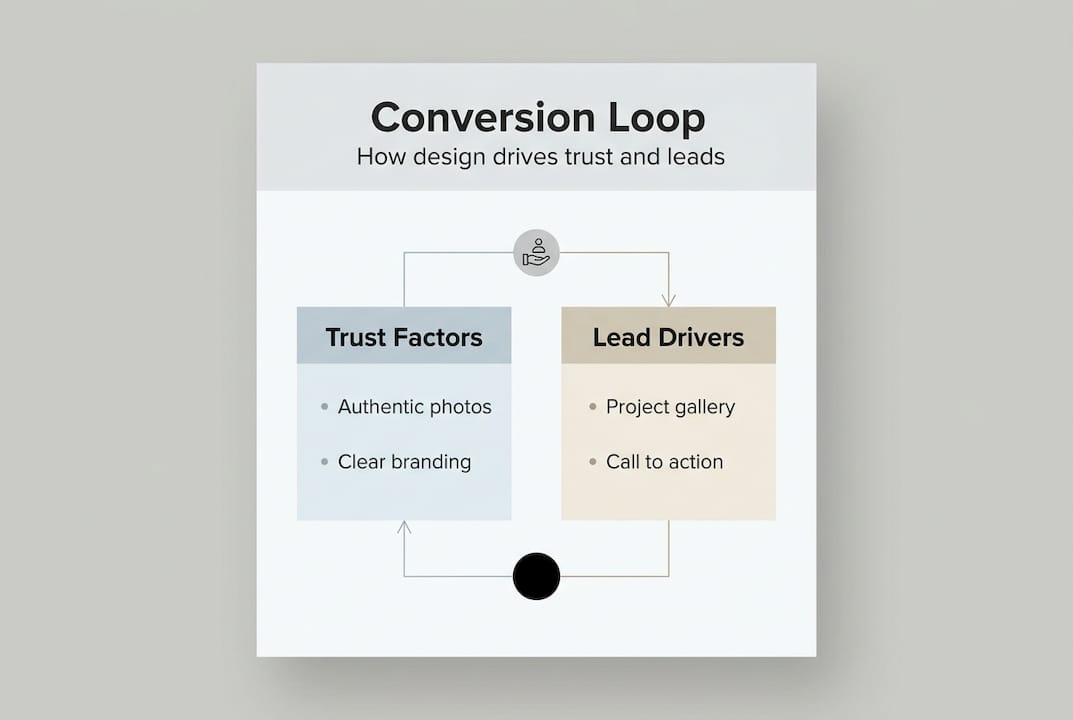
Knowing why authentic visuals work is one thing. Building a repeatable process to make graphic design drive actual business results is another. We call this the conversion loop.
Effective graphic design in flooring marketing follows a clear cycle: research, create, deploy, measure, and iterate. Skip any step and results become inconsistent.
Here is how each stage works in practice:
- Research buyer context: What are your customers searching for? What rooms, products, and price points matter most to them? Use Google Analytics, search data, and sales conversations to find out.
- Create proof visuals: Build your asset library using real project photography, testimonials, and product shots that match what buyers are actually looking for.
- Deploy with matching calls to action: Your visuals and your calls to action must work together. A stunning LVT gallery page with no clear next step wastes traffic.
- Measure results: Track gallery interactions, time on page, enquiry form completions, and call tracking data. Know which visuals generate leads.
- Iterate and improve: Swap underperforming images, test different gallery layouts, and refresh creatives in your ads regularly.
Consistency is critical across this loop. Your flooring website must-haves and your paid ads should use the same visual language. A buyer who sees your ad on Google and then lands on a page that feels visually different loses confidence instantly.
Websites with strong UX for flooring businesses show that visual consistency, clear navigation, and fast loading work together to keep buyers engaged and moving towards an enquiry.
Pro Tip: Test the order of your project gallery. Putting your most dramatic transformations first, rather than your most recent projects, can significantly improve engagement and lead quality.
Statistic to note: Websites that load in under 3 seconds retain significantly more visitors than slower sites. Your visual assets must be optimised for speed, not just impact.
Usability and compliance: Meeting digital and physical standards
Quality graphic design is not only about looking good or driving clicks. It also means meeting safety and usability standards. This is an area many flooring businesses do not think about until something goes wrong.
On the physical side, flooring visuals must be designed for usability and compliance, including slip resistance for physical floor graphics and mobile performance for online assets. A branded floor graphic in a busy retail environment or public space must carry the appropriate slip resistance rating.
Slip-resistance ratings for printed floor graphics typically range from R9 to R13. For example, PrismaFloor Solo is rated R10, making it suitable for moderate-traffic environments. Choosing the wrong rating for your application risks injury and liability.
On the digital side, the compliance requirements are about performance and accessibility:
- Mobile-first design: Over 60% of flooring website traffic now comes from mobile devices. Your visuals must load cleanly on smaller screens.
- Page load speed: Aim for under 3 seconds. Large, uncompressed images kill load times and bounce rates increase.
- Clear navigation: Buyers should find your gallery, product pages, and contact details within two clicks.
- Accessible contrast ratios: Text over images must meet readability standards to serve all users.
Here is a standards overview for flooring marketing assets:
| Standard | Type | Requirement |
|---|---|---|
| R9 slip rating | Physical floor graphic | Low-risk, dry indoor areas |
| R10 slip rating | Physical floor graphic | Moderate-traffic retail spaces |
| R13 slip rating | Physical floor graphic | High-risk or wet environments |
| Under 3 sec load | Digital website | Retain mobile visitors |
| Mobile-first layout | Digital website | Serve majority of traffic |
| WCAG contrast ratio | Digital assets | Meet accessibility standards |
“A floor graphic that causes a trip, or a website that crashes on mobile, both do the same damage to your brand. Compliance is not optional, it is part of good design.”
You can explore both the UX improvements for leads and our broader flooring compliance guide for detailed guidance on meeting these standards.
Why focusing only on aesthetics will limit your flooring brand’s growth
Here is the uncomfortable truth we see repeatedly when working with UK flooring businesses. The ones who invest heavily in a beautiful website, with stunning hero images, elegant typography, and polished branding, but neglect the conversion mechanics, consistently underperform against competitors with simpler but better-organised sites.
Aesthetics without strategy is expensive decoration. We have seen flooring retailers spend thousands on a glossy website redesign and generate fewer enquiries than before, because the gallery was hard to filter, the calls to action were vague, and the mobile experience was broken.
What actually drives growth in the UK flooring market is not a beautiful brand. It is trust, proof, and usability. Real project photos beat expensive lifestyle photography. A clear ‘request a quote’ button beats a subtle, elegant design choice. A fast-loading mobile page beats a visually impressive desktop experience that takes six seconds to render.
Our perspective, built from working across flooring industry marketing insights, is this: balance your brand vision with measurable impact. Design should earn its place by contributing to enquiries, not just compliments.
Elevate your flooring business with expert graphic design
If this article has shifted how you think about graphic design in your flooring marketing, the next step is putting these ideas into action.
At Truth Digital, we work exclusively with flooring retailers and manufacturers across the UK. We build visual systems that connect brand identity to real results. Whether you need a new website, a sharper ad creative, or a full digital marketing strategy, our design services for flooring brands are built specifically for this industry. Browse our website success stories to see what is possible, or explore our full range of digital marketing for flooring brands to find the right starting point for your business. Let’s build something that actually works.
Frequently asked questions
How does graphic design increase flooring sales?
By using authentic project visuals and clear calls to action, graphic design builds trust with prospects and turns website visitors into enquiries. Project galleries and authentic visuals can boost credibility and conversions by up to 45%.
What makes a good flooring photo gallery?
High-quality, filterable images showing real projects, with before and after shots, help buyers see genuine results and inspire confidence. Authentic project galleries are the strongest trust and conversion driver for flooring buyers.
Do physical floor graphics need to meet safety standards?
Yes, printed floor graphics require slip resistance ratings to ensure safety in public or commercial spaces. Slip-resistance ratings for printed floor graphics typically range from R9 to R13.
What website performance features should flooring visuals support?
Flooring websites should display visuals optimised for mobile, with fast loading and clear calls to action. Flooring websites need a fast, mobile-first experience, ideally loading under 3 seconds.