


TL;DR:
- Geo-targeting in flooring campaigns extends beyond basic settings, focusing on location signals that improve response rates and profitability. Implementing precise, area-specific strategies and combining paid ads with local SEO maximizes local trust, reduces wasted spend, and boosts conversion. Regularly reviewing regional metrics and tailoring creative to local environmental conditions enhance overall campaign effectiveness and business growth.
Most flooring businesses treat geo-targeting as a basic campaign setting. Tick a box, choose a city, move on. But the role of geo-targeting in flooring campaigns goes far deeper than that. 46% of all Google searches carry local intent, and flooring is one of the most location-dependent purchases a consumer makes. Get the geography right and you spend less, convert more, and build a local reputation that national chains simply cannot replicate. Get it wrong and you waste budget on enquiries you cannot service.
The role of geo-targeting in flooring campaigns
Geo-targeting is location-based advertising. It lets you show ads, content, or offers to people based on where they are, where they have been, or where they are likely to go. For flooring businesses, this is not optional. It is fundamental.
There are several targeting mechanisms worth knowing:
- Radius targeting: Show ads to anyone within a set distance of your showroom or service area.
- Postal code targeting: Focus spend on specific postcodes, ideal for affluent neighbourhoods with higher flooring budgets.
- DMA (Designated Market Area) targeting: Broader regional targeting used in larger campaigns to cover city-wide audiences.
- Geofencing: Trigger ads when a user enters a defined physical zone, such as a competitor’s showroom or a new-build housing development.
Geography matters to flooring in ways it simply does not matter for digital products. You need a fitter on the ground. You need to physically transport heavy materials. Your profit margins depend on how far your team travels. A carpet enquiry from 80 miles away is often unprofitable before it even starts.
Unlike demographic targeting, which focuses on who someone is, geo-targeting focuses on where they are. Both matter. But location signals are superior intent indicators because they combine intent with proximity, the two factors that actually drive a flooring booking.
Data sources for geo-targeting signals include IP addresses, GPS data from mobile devices, Wi-Fi triangulation, and search query location modifiers like “wood flooring installer near me.” Each one tells you something different, and combining them gives you a far sharper picture of who is actually ready to buy.
Geo-targeting benefits for flooring businesses
The numbers behind location-based advertising in flooring are hard to ignore.
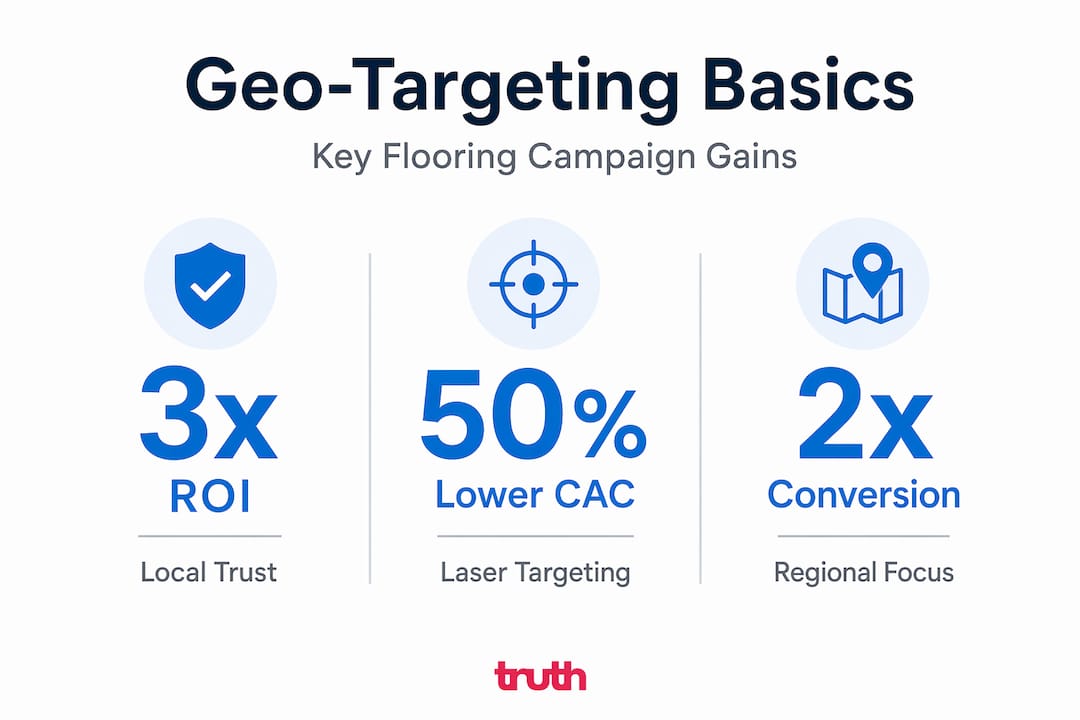
78% of marketers report that location targeting increases response rates, and 84% confirm it generates higher engagement. More critically for flooring, 76% of local smartphone searchers visit a related business within a day of searching.
Here is what that means in practice for a flooring retailer or installer:
- Higher conversion rates: Someone searching “LVT flooring fitter Leeds” and seeing your ad is already in buying mode. You are not educating them. You are closing them.
- Lower wasted spend: Excluding postcodes outside your service area stops budget going to enquiries you cannot fulfil.
- Better customer experience: An ad that speaks directly to someone’s location feels relevant. Generic ads do not.
- Improved cost efficiency: Targeting specific affluent postcodes can yield 20 to 100 leads per month at a cost per lead of £50 to £85, a range that keeps profitable jobs coming in without overspending.
Regional flooring campaigns also benefit from local trust signals. A business that mentions the specific town or area in its ad copy outperforms a generic city-wide ad almost every time. People want to know you are local, accessible, and familiar with their area.
The cost efficiency argument is particularly strong for independent flooring retailers competing against national chains. You do not need to match their overall spend. You just need to dominate the postcodes that matter to you. That is a winnable fight.
Advanced geo-targeting strategies for flooring marketers
This is where most campaigns either pull ahead or plateau. Moving from basic radius targeting to a proper geo-targeting operating model is the difference between a decent campaign and one that genuinely drives business growth.
Geo-targeting should function as a repeatable operating model, not a one-off tactic. That means building consistent processes around your geographic data, reviewing them regularly, and linking location signals to actual business outcomes.
Metrics that matter by territory
Stop looking at blended campaign averages. They hide the truth. Instead, track:
| Metric | What it measures | Why it matters for flooring |
|---|---|---|
| Geo-CAC | Cost to acquire a customer per region | Reveals which territories are expensive or underpriced |
| Territory LTV | Lifetime value of customers in each area | Shows where to invest more, not just where to spend less |
| Spatial conversion rate | Conversions relative to local impressions | Identifies high-intent areas being underserved by current spend |
Tracking geo-CAC and territory LTV independently per region allows you to allocate budget with real precision. A postcode that looks expensive on cost-per-click may actually deliver the highest-value jobs. You would never know that from blended data.
Microclimate and product alignment
Here is something most flooring campaigns miss completely. Local environmental conditions affect which flooring products are appropriate for a given area. Coastal humidity can cause cupping or swelling in certain wood floors, increasing warranty claims and damaging customer trust. If you are running ads in a coastal region, geo-targeted creative that acknowledges this and promotes moisture-resistant alternatives is not just smarter marketing. It is better service.

Omnichannel geo-targeting
Advanced geo-targeting now integrates across connected TV (CTV), digital out-of-home (DOOH), and mobile to create a consistent local presence across multiple touchpoints. A potential customer might see your brand on a digital billboard near a new housing development, then encounter your Google Ad when they search that evening. That kind of coordinated local presence builds recognition quickly.
Pro Tip: Build geo-specific audience lists in Google Ads by saving high-performing postcodes as custom location groups. Review and update these quarterly based on actual job profitability data, not just campaign metrics.
Practical implementation for geo-targeted flooring ads
Getting this right takes planning. Here is a no-nonsense process for flooring businesses and their marketers.
-
Define your realistic service area. Be honest about how far your fitters can travel profitably. Map it out. Use that boundary as your hard targeting limit. Do not let Google’s “near this location” setting expand beyond what you can actually service.
-
Prioritise high-value postcodes. Use your CRM or job data to identify where your best customers come from. Cross-reference with local household income data or property values. These are your top-priority targeting zones.
-
Create location-specific ad creative. “Carpets fitted in Harrogate” outperforms “Carpets fitted across Yorkshire” for a Harrogate searcher. Mention the town. Reference local landmarks if relevant. Make it feel hyper-local.
-
Use Google Local Services Ads alongside standard Google Ads. LSAs appear at the very top of mobile search results and show verified business information. They capture high-intent, ready-to-book searchers within your defined service area. Pairing them with standard Search campaigns covers both immediate bookers and those still in research mode.
-
Set up offline conversion tracking. If you use a CRM or booking system, connect it to your Google Ads account. This lets you track which geo-targeted clicks actually turned into booked jobs, not just form fills.
-
Review performance by location monthly. Do not let campaigns run on autopilot. Look at postcode-level data. Pause areas that consistently underperform. Increase bids in areas where jobs are profitable and plentiful.
Common mistakes to avoid include targeting entire counties when you only cover two towns, ignoring negative location exclusions, and treating all enquiries as equal regardless of where they came from. An enquiry from the next street is worth more than one from 60 miles away if your fitters are local.
Pro Tip: Run a separate campaign for new-build housing developments in your area. Target the postcodes of active developments directly. New homeowners need flooring fast and they are actively searching. This is one of the highest-converting audiences in local flooring campaigns.
Local SEO and geo-targeting working together
Paid geo-targeted campaigns work best when they are backed by a strong organic local presence. The two reinforce each other.
Local flooring businesses that combine geo-targeted ads with Map Pack optimisation consistently outperform those relying on either tactic alone. When someone searches “flooring fitter near me,” Google shows a Map Pack at the top of the results. If your paid ad appears below it but your organic listing is absent, you are losing visibility you have already earned through your reputation.
Here is how to keep both working together:
- Maintain consistent NAP data (Name, Address, Phone number) across Google Business Profile, your website, and all directories. Inconsistency damages both paid and organic performance.
- Generate reviews actively. Reviews are a direct ranking signal for the Map Pack and a trust signal for anyone who sees your geo-targeted ad. Someone clicking your ad will often check your reviews before booking.
- Publish locally relevant content. A page titled “Wood flooring installation in Edinburgh” does more for your local organic visibility than a generic “Wood flooring installation” page. It also supports your paid campaigns by improving Quality Score for location-specific queries.
- Optimise your local listings thoroughly. Add photos, service areas, opening hours, and product categories. A complete listing ranks better and converts better.
Local SEO tactics that improve ranking directly support your geo-targeted paid campaigns by reducing your cost-per-click through higher Quality Scores and improving the landing page experience. They are not separate strategies. They are the same strategy viewed from different angles.
My take on geo-targeting in flooring
I have worked with flooring businesses across the UK and the pattern I see most often is this: businesses set up geo-targeting once, point it at a county or a city, and then wonder why their campaign is underperforming. They have ticked the box but missed the point.
What I have learned is that the postcodes you exclude matter just as much as the ones you target. A tight, well-defined service area with strong local creative will consistently outperform a broad campaign with vague geography. Every time.
The other thing I would challenge is the assumption that geo-targeting is purely a paid media concern. In my experience, the flooring businesses that generate the most reliable enquiries treat location as a thread running through everything. Their website pages are localised. Their Google Business Profile is properly maintained. Their ad copy mentions specific towns. All of it works together.
The privacy changes coming through in 2026 will make precise location data harder to access. Cookie deprecation and tighter mobile data restrictions are already affecting signal quality. The businesses that build first-party data now, through CRM systems, booking forms, and customer postcodes, will be in a much stronger position when third-party signals degrade further. That is not a distant concern. It is worth acting on today.
— John
Let’s get your flooring business in front of the right people
If you are running flooring ads without a clear geo-targeting strategy, you are almost certainly spending more than you need to and converting less than you could.

At Truthdigital, we specialise in digital marketing for flooring businesses. That means Google Ads campaigns built around your actual service area, your best postcodes, and the products that drive your highest-value jobs. We also provide flooring SEO services that support your paid campaigns with strong organic local visibility. No generic strategies. No wasted spend on areas you cannot service. Just results-driven campaigns designed specifically for flooring businesses across the UK. Get in touch and let’s talk about what the right geo-targeting setup looks like for you.
FAQ
What is geo-targeting in flooring advertising?
Geo-targeting in flooring advertising means showing your ads only to people in specific locations, such as your service area or high-value postcodes. It keeps your budget focused on enquiries you can actually convert and service profitably.
Why does geo-targeting matter for local flooring campaigns?
Geography provides a stronger intent signal than keywords alone, often delivering 2 to 3 times higher conversion rates in focused locations. For flooring businesses tied to a physical service area, targeting the right postcodes is directly linked to campaign profitability.
How do I measure geo-targeting performance for my flooring campaigns?
Track geo-CAC and territory LTV independently for each region rather than relying on blended averages. These geo-specific metrics reveal which areas deliver the most profitable jobs and where to increase or reduce spend.
Can geo-targeting work alongside local SEO for flooring?
Yes, and it works best when the two are aligned. Combining geo-targeted ads with Map Pack optimisation gives flooring businesses visibility in both paid and organic local search results, reducing cost-per-click and improving conversion rates across both channels.
What are the biggest geo-targeting mistakes flooring businesses make?
The most common mistakes are targeting areas too broadly, ignoring negative location exclusions, and not reviewing postcode-level performance regularly. Treating all enquiries as equal regardless of location is also a significant issue, since jobs far outside your core area are often unprofitable to fulfil.