TL;DR:
- Most flooring businesses lack clear understanding of their conversion funnel, causing missed leads and revenue. Separating lead generation from sales funnels improves accountability, data accuracy, and decision-making. Tracking defined stages and key metrics across multiple channels enables businesses to optimize their entire customer journey effectively.
Most flooring businesses have a funnel. Few can actually describe it. That gap, between having one and understanding it, is where leads go quiet, enquiries stall, and revenue gets left on the table. Defining a flooring business conversion funnel properly is not just a marketing exercise. It is the foundation for every decision you make about where to spend budget, where to improve your website, and how to convert more browsers into buyers. This article breaks it down clearly, practically, and specifically for flooring.
Lead generation funnels vs sales funnels in flooring
This is where most flooring businesses get confused. They treat “the funnel” as one thing. It is actually two things working together.
A lead generation funnel covers everything that happens before a lead is qualified. It pulls people in at the top (TOFU), warms them up in the middle (MOFU), and qualifies them at the bottom (BOFU). The job of this funnel is to fill your pipeline with the right people. Lead funnels focus on attracting and qualifying leads before any selling begins.
A sales funnel starts the moment a lead is qualified. It covers the process of converting that person into a paying customer. For a flooring business, that typically means the journey from first enquiry through sample selection, survey, quote, and finally purchase. Lead generation funnels end at qualification; sales funnels pick up from there.
Why does the distinction matter? Because it clarifies who owns what. Your marketing team or agency owns the lead generation funnel. Your sales team owns the conversion side. When both funnels are poorly defined, nobody is accountable for where leads drop off. Separating lead gen and sales funnels gives you cleaner data, clearer ownership, and better decisions.
For a flooring retailer, your lead funnel might include Google search, paid ads, social media content, and your website. Your sales funnel starts when someone fills in a contact form, calls the showroom, or books a consultation. Both need to be documented, measured, and actively managed.
- TOFU (top of funnel): People searching for “wood flooring ideas” or “best LVT for kitchens.” They are not ready to buy yet.
- MOFU (middle of funnel): People comparing your brand to others, reading reviews, visiting your website multiple times.
- BOFU (bottom of funnel): People requesting a quote, asking about fitting costs, or booking a home survey.
- Sales funnel: The sequence from enquiry to signed order. Quote sent, survey booked, sample dropped off, purchase confirmed.
Pro Tip: Use lead scoring with behavioural signals to decide when a lead moves from the marketing funnel to the sales team. This stops salespeople chasing cold contacts and keeps your pipeline quality high.
Funnel stages and entry/exit criteria
Knowing the stages of your funnel is useful. Knowing exactly when a lead enters and exits each stage is what makes your data reliable.

Without explicit rules, two people on your team will describe the same lead differently. One says it’s a warm prospect. The other says it’s still in awareness. Your CRM data becomes meaningless, and funnel data without agreed criteria breaks down quickly.
Here is a practical framework for a flooring business conversion funnel:
-
Awareness. Entry: first website visit, social media impression, or ad click. Exit: second visit, form fill, or any direct contact. The person knows you exist.
-
Interest. Entry: engages with product pages, views samples section, opens email. Exit: requests a brochure, calls the showroom, or submits an online enquiry. This stage filters out passive traffic.
-
Consideration. Entry: enquiry received and logged. Exit: quote or proposal sent. This is where your sales process formally begins. At this point, lead ownership shifts from marketing to sales.
-
Intent. Entry: quote sent and confirmed received. Exit: survey booked or sample left at property. The lead has moved from interested to actively evaluating your offer.
-
Purchase. Entry: verbal or written agreement to proceed. Exit: deposit paid and order placed. This is your conversion event. Everything in your funnel should be traced back to this moment.
For each stage, write down the specific action that confirms entry and the specific action that confirms exit. Not opinions. Not gut feelings. Specific, logged actions in your CRM.
Pro Tip: Build a local business sales funnel document that lists each stage, its entry trigger, its exit trigger, and who is responsible for moving the lead forward. One page. Shared with everyone. Update it quarterly.
Key metrics for flooring funnel performance
Once your stages are defined, you need numbers. Without them, you cannot tell the difference between a funnel that is working and one that is slowly leaking revenue.
Essential funnel metrics include conversion rates between stages, lead-to-opportunity qualification rate, average deal size, sales cycle length, and pipeline velocity. Each one tells you something specific about where your funnel is healthy and where it is not.
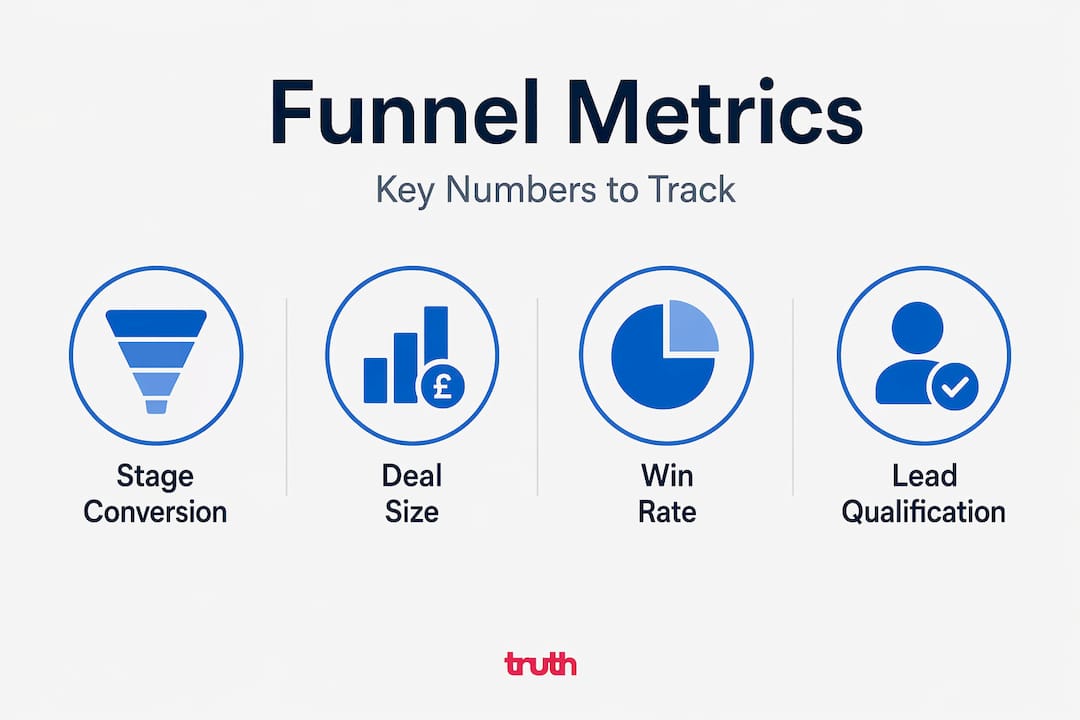
| Metric | What it tells you |
|---|---|
| Stage conversion rate | The percentage of leads moving from one stage to the next |
| Lead-to-opportunity rate | How many raw enquiries qualify as genuine sales opportunities |
| Sales win rate | The percentage of qualified opportunities that become customers |
| Average deal size | Your typical order value per customer |
| Sales cycle length | How many days from first enquiry to purchase |
| Pipeline velocity | How fast revenue moves through your funnel overall |
These metrics are not just numbers for a spreadsheet. They are diagnostic tools. If your lead-to-opportunity rate is low, your marketing funnel is not qualifying people well enough. If your win rate drops, something in the sales process is failing. Maybe your quotes are too slow, your samples are not arriving promptly, or a competitor is undercutting you.
Sales funnel analysis turns pipeline data into a clear picture of where to act. Most CRM tools, including HubSpot and Monday, offer visual dashboards that show exactly where leads are piling up or dropping out.
- Track your stage conversion rates weekly, not monthly. Problems compound fast.
- Measure average time in each stage. If leads sit in “quote sent” for three weeks without movement, that is a bottleneck worth fixing.
- Segment metrics by source. Do leads from Google Ads convert at a different rate than referrals? Knowing that shapes where you invest.
Tracking multi-channel engagement
The flooring purchase decision process is rarely a straight line. A customer might find you on Google, visit your website, follow you on Instagram, call the showroom, and then come back two weeks later to fill in a quote form. Flooring buyers follow non-linear journeys, using self-service research before ever engaging with a salesperson.
That means your funnel tracking needs to cover every touchpoint, not just the last click. Modern flooring funnels require tracking across ten or more sales channels to build accurate attribution models tied to revenue.
Here is how to approach this practically:
- Organic search (SEO): Track which pages bring in visitors who later convert. A flooring website guide on LVT fitting costs might attract buyers who convert days later. Look at assisted conversions, not just last-click data.
- Google Ads: Track which campaigns generate actual enquiries, not just clicks. Connect your ad account to your CRM or use call tracking to see which ads led to phone calls that became customers.
- Email: Measure open rates and click rates, but focus on what happens after the click. Did someone book a consultation? Request a sample? That is the metric that matters.
- Referrals: Log where phone enquiries come from. Ask every caller how they found you. It sounds basic, but most flooring businesses do not do this consistently.
- Showroom visits: If you have a physical location, track how many visitors came from a specific campaign or piece of content. A simple form at the door or a staff prompt goes a long way.
For attribution to work, you need a single conversion event to anchor everything to. For most flooring businesses, that is the enquiry form submission, phone call, or showroom booking. Define that event clearly, then track buyer journeys across channels back to it.
Managing this across channels does get complex. Our guide on cross-channel flooring marketing covers how to bring these data streams together without needing a full-time analyst.
My honest take on flooring funnels
I have worked with flooring businesses at very different stages. Some are tightly run operations with a CRM, clear stages, and weekly pipeline reviews. Most are not. And the honest truth is that the gap between those two types of business is almost always funnel clarity.
What I see most often is this: a business invests in a new website or a Google Ads campaign, sees some enquiries come in, and assumes the funnel is working. But they cannot tell you their lead-to-opportunity rate. They cannot tell you how long a typical sale takes. They do not know which channel produces the highest-value customers. So when results dip, they blame the ads or the website, when the real issue is that nobody defined the funnel properly in the first place.
The counterintuitive lesson here is that documenting your funnel stages before you spend on marketing is not admin overhead. It is the thing that makes every pound you spend more traceable and more accountable.
I have also seen flooring businesses waste months chasing volume at the top of the funnel when the bottleneck was actually at the quote stage. More traffic will not fix a slow quote process. You have to measure the whole funnel to know where to act.
If you want to go deeper on the structural side, our article on flooring marketing funnels covers the full stage-by-stage setup in more detail.
— John
How Truthdigital helps flooring businesses grow
If you are ready to put this into practice, Truthdigital builds and manages the digital infrastructure that powers flooring funnels at every stage.
We design flooring websites that are built to convert, with clear calls to action, fast load times, and the kind of trust signals that turn browsers into enquiries. Our SEO for flooring companies drives qualified traffic to the top of your funnel, targeting buyers who are actively searching for what you sell. We also manage Google Ads for flooring businesses with a focus on actual lead volume and cost per enquiry, not just clicks. Everything we do is built around your funnel, measured by the metrics that tie directly to revenue. Browse our flooring website success stories to see what this looks like in practice.
FAQ
What is a flooring business conversion funnel?
A flooring business conversion funnel is the defined sequence of stages a potential customer moves through from first awareness of your brand through to completing a purchase. It typically covers awareness, interest, consideration, intent, and purchase.
How is a lead generation funnel different from a sales funnel?
A lead generation funnel attracts and qualifies prospects before passing them to sales. Lead generation funnels end at qualification; a sales funnel then takes over and drives the qualified lead towards closing the deal.
What metrics should I track in my flooring sales funnel?
The core metrics to track are stage-to-stage conversion rates, lead-to-opportunity rate, win rate, average deal size, and sales cycle length. Together, these show where your funnel is performing and where leads are dropping off.
Why do flooring businesses struggle with funnel measurement?
Most struggle because funnel stages are not clearly defined with explicit entry and exit criteria. Without agreed stage rules, CRM data becomes inconsistent and it is impossible to diagnose where the funnel is breaking down.
How do I track leads across multiple channels in a flooring funnel?
Define a single primary conversion event, such as a form submission or phone call, and use tools like Google Analytics, call tracking software, and your CRM to trace leads back to their source. Buyers engage across multiple channels, so attribution must cover every touchpoint, not just the last one.