Most flooring retailers lose potential customers every day without realising why. Your website might look professional, but if the content hasn’t been refreshed in months, you’re invisible to shoppers searching for carpets, LVT, or wood flooring services. Search engines reward fresh, relevant content with higher rankings, whilst outdated sites slip down the results. This guide reveals how regular content updates transform your online visibility, attract more qualified leads, and directly increase sales for your flooring business in 2026.
Key takeaways
| Point | Details |
|---|---|
| SEO freshness signals | Updated content boosts search rankings by signalling relevance to Google and matching evolving customer search behaviour. |
| Competitive advantage | Regular content reviews prevent traffic loss as competitors improve their sites and capture your potential customers. |
| Conversion impact | Accurate, current information about products, pricing, and services builds trust and drives more enquiries from qualified buyers. |
| Proven results | UK flooring businesses report traffic increases of 37% and conversion improvements of 80% after strategic content updates. |
| Sustainable growth | Scheduled content maintenance creates consistent visibility improvements without requiring constant technical overhauls. |
How updated website content boosts SEO for flooring businesses
Search engines prioritise websites that demonstrate freshness and relevance. When you update your website content regularly, you send powerful signals to Google that your flooring business is active, current, and worthy of higher rankings. This isn’t about gaming the system. It’s about maintaining accuracy as your business evolves and customer needs shift.
Think about how flooring trends change. Luxury vinyl tile dominated searches five years ago, but today’s customers want sustainable options, hybrid products, and specific installation methods. If your content still focuses on outdated product categories or uses search terms nobody types anymore, you’re invisible to potential customers. Your competitors who refresh their content to match current search trends will appear instead.
Content updates matter most when they reflect real business changes. Added a new showroom location? Launched a commercial flooring service? Changed your pricing structure? Every business evolution that isn’t reflected online creates a disconnect between what customers find and what you actually offer. This confusion costs you enquiries.
Fresh content doesn’t just help search engines find you. It helps the right customers find exactly what they need, exactly when they need it.
The competitive element cannot be ignored. When a rival flooring retailer publishes detailed guides about underfloor heating compatibility or creates location-specific pages for every town they serve, they capture search visibility you once owned. Standing still means falling behind. Many flooring businesses make common website mistakes by assuming their site is “done” after launch.
Consider these specific SEO benefits from regular content updates:
- Improved rankings for product and service keywords as Google recognises your content matches current search intent
- Higher click-through rates when searchers see recent information and relevant details in search results
- Better user engagement metrics as visitors find accurate, helpful content that answers their questions
- Increased internal linking opportunities that distribute SEO value across your entire site
- Enhanced local search visibility when you add location-specific content and service area details
The mechanism is straightforward. Google’s algorithms assess hundreds of ranking factors, but freshness and relevance consistently influence where flooring businesses appear in search results. When you maintain current, detailed content that addresses real customer questions, you outperform competitors who let their sites stagnate.
Signs your flooring website content needs updating
How do you know when your content has gone stale? The most obvious indicator is competitor activity. Visit the websites of other flooring retailers in your area. If their product pages contain more detail, better imagery, and clearer service descriptions than yours, you have a problem. Competitors with modern, comprehensive content will capture customers who might have chosen you.
Traffic and conversion drops tell a clear story. You check your analytics and notice fewer visitors despite no technical issues with your site. Or visitor numbers stay steady, but enquiry forms and phone calls decline. These patterns often indicate content that no longer resonates with what customers search for or need. The disconnect between your messaging and market demand grows until it becomes a revenue problem.

Business evolution creates another urgent update trigger. You’ve expanded into luxury vinyl tile installation, but your homepage still emphasises carpet fitting. You’ve opened a second showroom in a neighbouring town, but your contact page lists only the original location. You’ve changed suppliers and now offer premium brands, but product pages mention discontinued ranges. Every mismatch between your actual business and your online presence costs you credibility and sales.
Pro Tip: Set calendar reminders to review competitor websites quarterly and check your own analytics monthly. Early detection of content gaps prevents significant traffic and revenue loss.
Use this checklist to evaluate whether your flooring site needs immediate attention:
- Product pages lack detail compared to competitor sites or don’t reflect your current inventory
- Service descriptions use generic language instead of specific processes, materials, and outcomes
- Pricing information is vague, outdated, or missing entirely
- Location and service area content doesn’t match where you actually operate
- Blog or news sections haven’t been updated in over six months
- Customer questions you answer daily aren’t addressed anywhere on your site
- Images show old showroom layouts, discontinued products, or outdated branding
- Contact information includes former staff members or old phone numbers
The website refresh case study from The Flooring Outlet demonstrates how addressing these issues transforms business performance. They recognised their content had fallen behind market expectations and took action. The result was measurable growth in both traffic and conversions.
Don’t wait for a crisis. Regular content audits help you spot problems before they impact your bottom line. When you notice any of these warning signs, prioritise updates immediately.
Best practices for updating flooring website content in 2026
Successful content updates follow a systematic approach. Start by reviewing core service pages every 6-12 months as a baseline. Your carpet fitting, wood flooring installation, and LVT supply pages form the foundation of your online presence. These pages must reflect current services, accurate pricing guidance, and detailed process explanations that build customer confidence.
Timing matters more than most flooring retailers realise. Annual reviews work for stable service offerings, but product inventory and pricing often change quarterly. Create a schedule that matches your business rhythm. If you rotate featured products seasonally or adjust pricing twice yearly, align content updates with those cycles. Consistency beats perfection.
Focus your update efforts on these critical content elements:
- Assess current performance using analytics to identify underperforming pages and content gaps
- Plan updates based on business changes, competitor analysis, and customer feedback
- Refresh copy to improve clarity, add detail, and incorporate current search terms naturally
- Add or update images, videos, and other media that showcase your work and products
- Optimise SEO elements including title tags, meta descriptions, headings, and internal links
- Test all changes on mobile devices to ensure excellent user experience across platforms
Remove outdated information ruthlessly. Old pricing that no longer applies confuses customers. Discontinued product ranges waste their time. Former service areas you no longer cover generate enquiries you must turn away. Every piece of inaccurate content damages trust and wastes marketing budget driving traffic to irrelevant pages.
Pro Tip: Schedule automated calendar reminders for content reviews so updates become routine rather than reactive. Set quarterly alerts for high-priority pages and annual reminders for stable content.
Add frequently asked questions based on real customer enquiries. You answer the same questions about underfloor heating compatibility, installation timeframes, and product warranties every week. Turn those conversations into valuable website content that serves customers 24/7 and captures long-tail search traffic. This approach supports your digital marketing for flooring strategy by addressing customer needs at every stage.
| Content Type | Update Frequency | Priority Elements |
|---|---|---|
| Product pages | Every 3-6 months | Pricing, availability, specifications, images |
| Service pages | Every 6-12 months | Process details, service areas, team credentials |
| Location pages | Every 12 months | Operating hours, contact details, directions |
| Blog content | Monthly additions | Industry trends, customer questions, case studies |
| Homepage | Every 6 months | Featured services, promotions, key messaging |
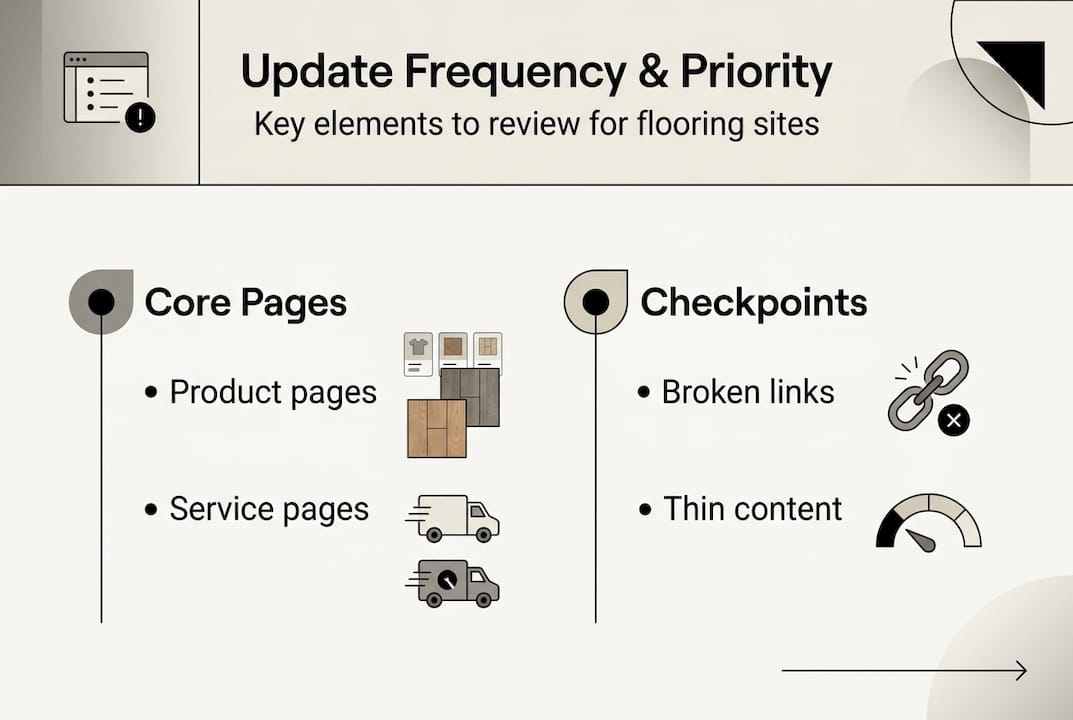
Fix broken links during every content review. Links to discontinued products, moved pages, or external sites that no longer exist create frustration and signal poor site maintenance to search engines. Use free tools to scan for broken links quarterly and repair them immediately.
Improve thin content that doesn’t match competitor depth. If your carpet cleaning page contains 200 words whilst competitors publish 800-word guides with process details, pricing factors, and care tips, you lose rankings and credibility. Match or exceed the detail level of top-ranking competitors in your market.
Impact of updating website content: real-world flooring business examples
Data from actual UK flooring businesses proves content updates deliver measurable growth. These aren’t theoretical benefits. They’re documented results from companies that prioritised regular content maintenance and strategic improvements.
| Business | Key Updates | Traffic Impact | Conversion Impact | Revenue Impact |
|---|---|---|---|---|
| Factory Direct Flooring | Site rebuild, content refresh, UX improvements | Sustained growth | Improved engagement | +20.73% YoY revenue |
| Greg Stone Flooring | Product pages, geo-targeted content, portfolio updates | +37% traffic increase | +80% conversion boost | Significant revenue growth |
| Grimley Flooring | WordPress rebuild enabling easy content updates | Improved maintainability | Better user experience | Supported business growth |
| Newland Floors | Category page optimisation, unique product content | Enhanced SEO performance | Supported paid ads strategy | E-commerce growth |
Factory Direct Flooring’s transformation illustrates comprehensive content strategy impact. Their site rebuild and refresh combined technical improvements with substantive content updates. The result was over 20% revenue growth year-on-year, demonstrating how content quality directly influences commercial performance.
Greg Stone Flooring achieved even more dramatic results through targeted content expansion. By creating geo-targeted pages and refreshing product content, they increased traffic by 37% and conversions by 80%. These numbers represent real customers finding their site, engaging with content, and submitting enquiries at much higher rates.
The improvements these businesses implemented included:
- Enhanced user experience through clearer navigation and faster page loading
- Comprehensive content refresh addressing customer questions and search intent
- Geo-targeted pages for specific service areas and local search visibility
- Detailed FAQ sections answering common customer concerns
- Updated portfolio showcasing recent projects with high-quality imagery
- Product specifications and comparison content helping customers make decisions
Grimley Flooring took a different approach by rebuilding their site on WordPress specifically to enable easier content updates. This strategic decision recognised that content maintenance matters as much as initial design. The platform change empowered their team to keep information current without developer dependency.
Newland Floors focused on e-commerce content optimisation, creating unique category page content with detailed specifications to support both SEO and paid advertising. This integrated approach shows how content updates amplify other marketing investments.
These examples share common threads. Each business recognised content stagnation as a growth barrier. Each committed to systematic updates aligned with customer needs and search behaviour. Each measured results and continued refining their approach. You can achieve similar outcomes by applying the same principles to your flooring business. Explore the flooring growth pack to identify your specific opportunities, or review flooring ads examples showing how content supports broader marketing efforts.
Help your flooring business grow with expert website content updates
You’ve seen how content updates transform flooring business performance. Truth Digital specialises in helping UK flooring retailers and manufacturers achieve exactly these results. Our flooring SEO services combine strategic content updates with technical optimisation to improve your search visibility and drive qualified enquiries.
We understand the flooring industry because we work exclusively with businesses like yours. Our flooring website design services create platforms built for easy content maintenance and ongoing growth. Every project focuses on measurable outcomes, not vanity metrics. Explore our website success stories to see the traffic increases, conversion improvements, and revenue growth we’ve delivered for flooring companies across the United Kingdom.
FAQ
How often should I update my flooring website content?
Review core service and product pages every 6-12 months at minimum. Update pricing, service areas, and product availability quarterly if these change frequently. Add new blog content or customer questions monthly to maintain freshness signals and capture emerging search trends.
What type of content changes improve SEO the most?
Adding detailed product specifications, creating location-specific service pages, and publishing answers to customer questions deliver the strongest SEO impact. These updates target specific search queries, demonstrate expertise, and provide value that keeps visitors engaged. Focus on substance over superficial changes.
Can updating website content increase my local search rankings?
Absolutely. Adding location-specific content, updating service area descriptions, and creating pages for individual towns you serve directly improves local SEO performance. Include local landmarks, specific postcodes, and area-specific customer needs to strengthen relevance signals.
How do I balance content updates with running my flooring business?
Schedule updates during quieter business periods and batch similar tasks together. Dedicate two hours monthly to review analytics, identify priority pages, and make focused improvements. Alternatively, partner with specialists who handle content updates whilst you focus on installations and customer service.
What common mistakes should I avoid when updating my site?
Avoid making superficial changes that don’t add value, such as minor wording tweaks without improving clarity or detail. Don’t remove old content without redirects, as this breaks links and loses SEO value. Never copy competitor content directly, as duplicate content harms rankings rather than helping them.