
Every week you’re not reviewing competitor flooring websites, you’re potentially losing customers to businesses that are. Shoppers compare multiple flooring retailers online before making a decision, and if a rival’s site is faster, clearer, or more persuasive than yours, they’ll get the enquiry. The good news is that a structured competitor review gives you a clear picture of where you stand and exactly what to fix. This guide walks you through the full process, from gathering the right tools to turning insights into real improvements that boost your online presence and customer engagement.
Key Takeaways
| Point | Details |
|---|---|
| Benchmark for growth | Continual competitor reviews identify new tactics that can boost your digital performance. |
| Use a structured process | Following a five-step benchmarking framework ensures thorough and actionable reviews. |
| Focus on key metrics | Analyse pricing, galleries, content, and customer journeys to reveal improvement opportunities. |
| Regular reviews matter | Check competitor sites at least twice a year to stay competitive and spot new trends early. |
| Turn insights into action | Implement findings systematically for ongoing website growth and improved engagement. |
Why review competitor flooring websites?
With the stakes established, let’s explore why reviewing competitor sites delivers a real digital edge.
Competitor website reviews are one of the most practical things a flooring business can do to sharpen its digital marketing. They show you what’s working in your market right now, not in theory. You can spot which businesses are running effective ad campaigns, how they present their product galleries, whether they display pricing, and how easy they make it for customers to get in touch.
The benefits go beyond copying tactics. You start to see genuine gaps in your own site. Maybe your competitors all have clear call-to-action buttons on every page and yours don’t. Maybe they’re all ranking for “LVT flooring [your town]” and you’re nowhere to be seen. Competitor benchmarking enables regular improvement and prevents stagnation.
Here’s what a competitor review helps you identify:
- Pages and content that attract organic traffic
- Promotional offers and seasonal messaging
- Trust signals such as reviews, accreditations, and guarantees
- How competitors handle website content updates and blog activity
- Gaps in their offering that you can fill
“Knowing what your competitors are doing online isn’t about imitation. It’s about making informed decisions that move your business forward.”
What you need before you start
Armed with motivation, set yourself up for success by collecting everything you need for a meaningful review.
Rushing into a competitor review without preparation wastes time and produces patchy results. A structured approach covering goals, competitor lists, metrics, and regular review yields the most useful insights. Before you open a single competitor website, get organised.
Here are the tools and resources you’ll need:
- SEMrush or Ahrefs for keyword rankings and backlink data
- Panoramata for tracking competitor ads and email campaigns
- Google Search for manual SERP checks
- A spreadsheet to log findings consistently
- Your own flooring growth pack metrics as a baseline
- Sign up to competitor email lists to monitor their offers
Here’s a quick reference for what each tool covers:
| Tool | Primary use | Cost |
|---|---|---|
| SEMrush | SEO rankings, traffic estimates | Paid |
| Ahrefs | Backlinks, keyword gaps | Paid |
| Panoramata | Ad and email tracking | Paid |
| Google Search | Manual SERP checks | Free |
| Spreadsheet | Data logging and comparison | Free |
| PageSpeed Insights | Site speed testing | Free |
Also check your website hosting essentials before you start. Understanding your own technical baseline makes comparisons far more meaningful.
Pro Tip: Define two or three specific goals before you begin. For example: “I want to understand how competitors present pricing” or “I want to see which pages rank for carpet fitting in my area.” Vague reviews produce vague results.
Step-by-step: How to review competitor flooring sites
With all tools and goals in place, follow this structured method for an efficient competitor site analysis.
The five-step process of setting goals, selecting competitors, choosing metrics, collecting data, and analysing regularly is the industry gold standard. Here’s how to apply it to your flooring business.
-
Set clear, measurable goals. Decide what you want to improve. More organic traffic? Better conversion rates? Stronger local visibility? Your goals shape everything that follows.
-
Build your competitor list. Include three types: direct local competitors, online-only flooring retailers, and aspirational brands you’d like to match. Aim for five to ten businesses total.
-
Choose your metrics. Focus on what matters most to flooring buyers. Key areas include search rankings for flooring terms, mobile usability, page load speed, product page quality, pricing transparency, and enquiry process simplicity.
-
Collect your data. Use your tools for quantitative data and manual browsing for qualitative observations. Note what feels easy or frustrating as a user. Check their flooring ad examples via Google Ads transparency tools.
-
Analyse and act. Compare findings against your own site. Group observations into strengths, weaknesses, and opportunities. Assign each action item a priority level.
Here’s a comparison of what to assess across competitor sites:
| Area | What to check | Why it matters |
|---|---|---|
| Homepage | Navigation, trust signals, CTA | First impressions drive bounce rate |
| Product pages | Photo quality, descriptions, pricing | Directly influences purchase decisions |
| Mobile experience | Speed, layout, tap targets | Over 60% of searches are on mobile |
| Local SEO | Google Business, local keywords | Drives footfall and local enquiries |
| Enquiry process | Forms, phone visibility, chat | Reduces friction for potential customers |
Pro Tip: Use an incognito browser window when manually reviewing competitor sites. This prevents personalised results from skewing what you see in search and on their pages.
Analysing the key areas: what to look for on competitor sites
This framework helps structure your review. Here’s how to dig deeper into what truly matters on rival flooring sites.
Comprehensive benchmarking covers ads, emails, pricing structures, and page content. Each area tells a different story about how a competitor attracts and converts customers.
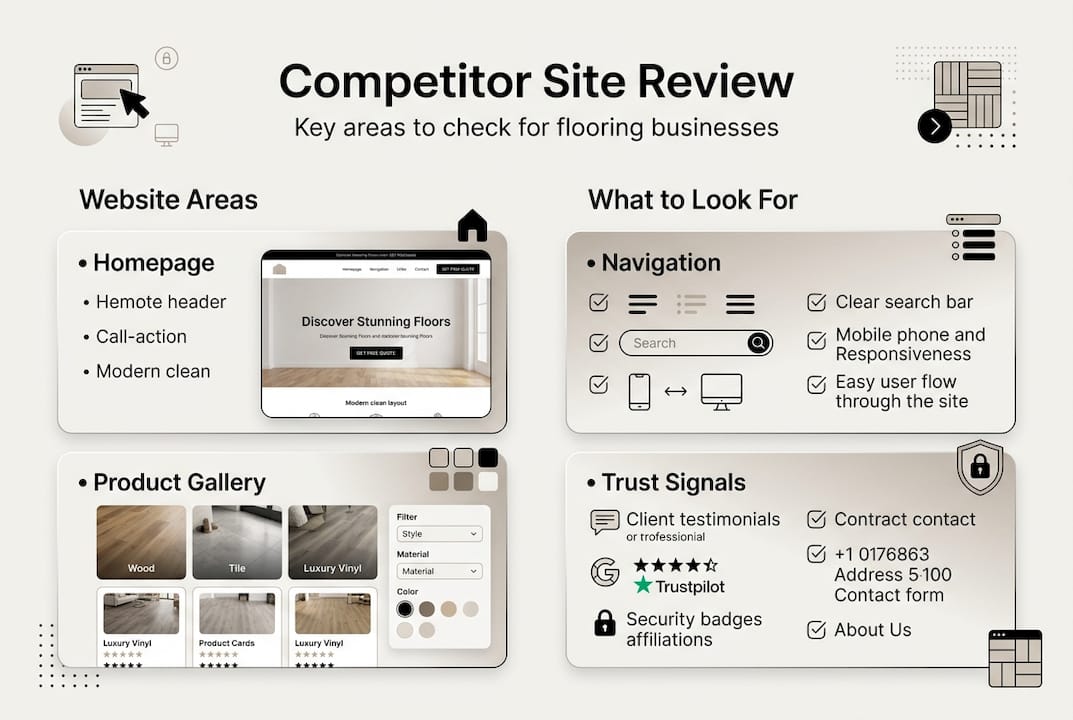
Start with the homepage. Is the navigation clear? Can you find a phone number within three seconds? Are there trust signals such as customer reviews, trade body logos, or years in business? These details build confidence fast.

Move on to product galleries. Photo gallery quality is one of the biggest differentiators in flooring. Are competitors using professional room-set photography or blurry supplier images? Do they show the product installed in real homes? Customers buy with their eyes, and gallery quality directly affects enquiry rates.
Check pricing and promotional messaging. Many flooring retailers avoid showing prices online, but some competitors do. If they’re getting traction with transparent pricing or finance options, that’s worth noting. Look at seasonal promotions and how they’re communicated across the site.
Assess the user journey. How many clicks does it take to request a quote? Is there a live chat option? Are contact details visible on every page? Friction in the enquiry process costs sales.
Finally, review their email signup process and ad placement. Sign up to their newsletter and track what they send over the following weeks. This reveals their retention strategy and promotional calendar. Also check for common flooring site mistakes that competitors are making, because those are opportunities for you.
Over 60% of UK consumers say they research flooring online before visiting a showroom. If your site doesn’t impress during that research phase, you lose the visit entirely.
Turning insights into action: improving your flooring website
After analysing competitor strengths and gaps, it’s time to implement what you’ve learned for real-world results.
Regularly benchmarking and implementing changes leads to consistent digital improvements. The key word is implementing. A review that sits in a spreadsheet does nothing.
Here’s how to move from insight to action:
-
Sort your findings into quick wins and longer-term projects. Quick wins might include adding a phone number to your header or improving a product page title. Longer-term projects might involve a full gallery redesign or a new enquiry form.
-
Set measurable benchmarks. If a competitor ranks on page one for “engineered wood flooring [your city]” and you don’t, set a target to reach page two within three months. Tie every action to a metric.
-
Make changes and test. Don’t overhaul everything at once. Change one element, monitor the impact, then move to the next. This keeps results clear and avoids confusion about what’s working.
-
Schedule your next review. Build competitor monitoring into your regular routine. Set a calendar reminder for quarterly or bi-annual reviews. Markets shift, competitors update their sites, and new players enter the space.
Use your findings to update website content regularly and stay on top of website maintenance basics so your site remains technically competitive.
Pro Tip: Create a simple scoring sheet for each competitor. Rate them out of five on each key area. This makes it easy to spot patterns and track changes over time without re-reading pages of notes.
Take your flooring website further with digital expertise
Reviewing competitors is a powerful starting point. But turning those insights into a high-performing flooring website takes the right expertise and tools.
At Truth Digital, we work exclusively with flooring businesses across the UK. We handle everything from specialist flooring SEO and Google Ads to full dedicated flooring website development built to convert visitors into enquiries. We know what works in this sector because it’s all we do. If you want a clear picture of where your site stands against competitors, start with our free Flooring Growth Pack. It gives you a structured baseline and highlights the areas with the biggest impact on your growth. Let’s talk about what’s possible for your business.
Frequently asked questions
Which benchmarking tools work best for flooring sites?
SEMrush, Ahrefs, and Panoramata are highly effective for structured competitor analysis across SEO, ads, and email marketing. Each covers different data points, so using a combination gives the most complete picture.
How often should I review competitor flooring websites?
Quarterly reviews are ideal for most flooring businesses, though bi-annual checks are a solid minimum. Regular benchmarking ensures you adapt quickly to digital trends and competitor changes before they affect your enquiry levels.
What is the biggest mistake when analysing competitor sites?
The most common pitfall is gathering observations without acting on them. Benchmarking only benefits your business when findings are translated into specific, prioritised improvements on your own site.
Can reviewing competitors help with local SEO?
Absolutely. Analysing how competitors rank for local search terms and structure their Google Business profiles gives you a direct roadmap for improving your own local SEO results and visibility in your area.
Should I focus more on direct or aspirational competitor sites in reviews?
Both matter. Direct competitors show you what’s winning in your immediate market right now. Aspirational competitor sites set the benchmark for premium user experience and content quality that you can work towards over time.