

TL;DR:
- Data privacy builds trust essential for high-value flooring purchases and long decision cycles.
- UK regulations require transparency, secure data practices, and clear customer rights handling.
- Proper privacy strategies can enhance brand reputation and competitive advantage beyond legal compliance.
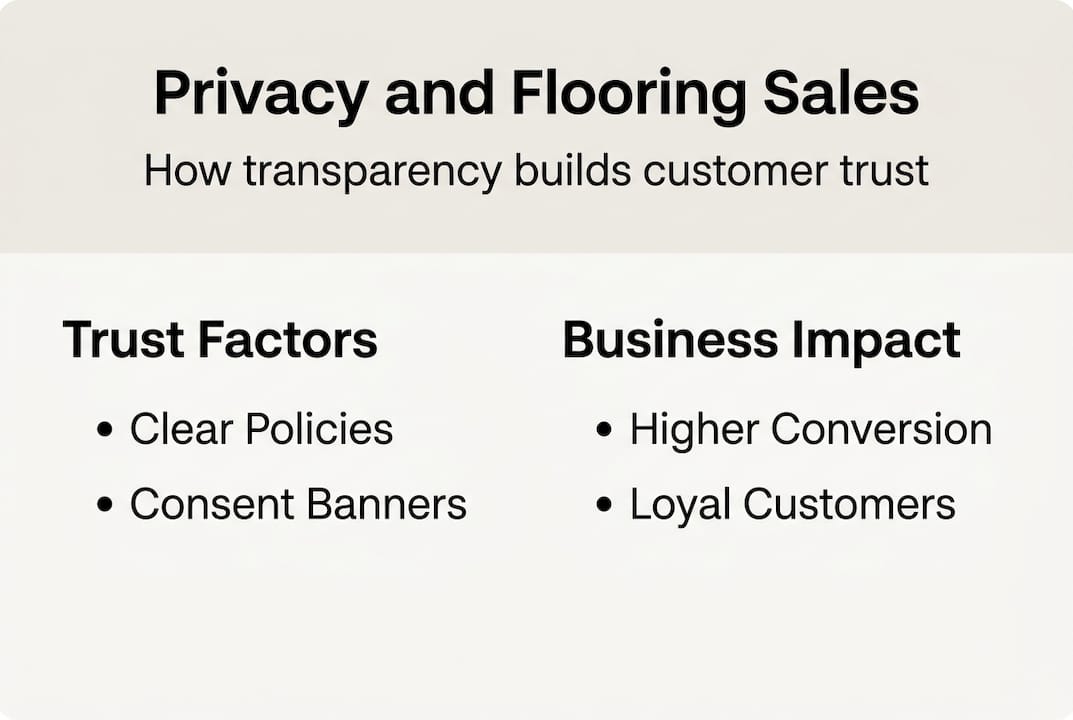
Data privacy is not a box-ticking exercise. For UK flooring retailers and manufacturers, it is one of the most powerful trust signals you can put in front of a potential customer. Flooring purchases are high-value decisions. Customers spend weeks researching, comparing, and deliberating before they commit. At every stage, they are asking: can I trust this business with my money and my personal details? Data privacy directly influences trust in high-value online purchases like flooring. This guide will show you exactly how to get privacy right, what most retailers miss, and how solid data practices translate into real competitive gains.
Key Takeaways
| Point | Details |
|---|---|
| Privacy drives trust | Effective data privacy directly boosts consumer confidence and online conversions. |
| Compliance is essential | UK flooring websites must follow GDPR, offering clear privacy notices and consent options. |
| Security and transparency matter | Minimising data collection, strong security, and visible trust signals protect both brand and customer. |
| Future-proofing protects your brand | Preparing for biometric data and new regulations mitigates risks and positions flooring brands for long-term success. |
Why data privacy matters for UK flooring retailers
Flooring is not an impulse buy. Customers might spend £2,000 or more on a single order, visit your site multiple times, and compare several competitors before they pick up the phone or fill in your enquiry form. That long decision cycle means trust is everything. If your website feels insecure or your data practices look sloppy, customers will simply go elsewhere.
The numbers back this up. 33% of consumers cut ties with a business after a data breach. In a high-consideration market like flooring, losing a third of your customers over a single incident is not a recoverable situation for most independent retailers.
Customers today expect transparency. They want to know:
- What data you collect and why
- How you store and protect it
- Whether you share it with third parties
- How they can request its deletion
These are not unreasonable expectations. They are the baseline. And meeting them is not just about avoiding fines. It is about building a flooring website that converts browsers into buyers.
“Trust is the single most important factor in converting a flooring enquiry into a sale. Privacy is now central to that trust.”
The competitive angle is real. Most small and mid-sized flooring retailers still treat privacy as an afterthought. A copied policy buried in the footer. No visible trust signals. No clear cookie consent. That creates an opportunity. If you get UX and privacy right while your competitors do not, you stand out immediately.
Brand reputation risk is also significant. A data breach does not just cost you in fines. It generates negative press, bad reviews, and a lasting dent in your reputation. The digital touchpoints in flooring have multiplied. Every form, every chat widget, every Google Ads landing page is a potential exposure point. Protecting customer data across all of them is now a core business responsibility, not a technical nicety. GDPR guidance for retail makes clear that the obligation sits with the business, not the developer.
With an understanding of how privacy underpins trust, it is critical to clarify what doing privacy right looks like in practice for UK flooring businesses.
Understanding UK regulations for flooring websites
The legal framework is not complicated once you break it down. UK flooring websites must comply with UK GDPR and the Data Protection Act 2018. These two pieces of legislation work together to govern how you collect, store, use, and share personal data.
Here are the core legal requirements every flooring website needs to address:
- A clear and accessible privacy policy
- A compliant cookie consent mechanism
- A defined lawful basis for each type of data you collect
- Documented data minimisation practices
- A process for handling data subject access requests
- Security measures including SSL certificates and access controls
- A Data Protection Impact Assessment (DPIA) for higher-risk processing
A DPIA is a formal assessment you carry out when processing data is likely to result in a high risk to individuals. For most flooring retailers, this applies if you use profiling, biometric data, or large-scale tracking tools.
The lawful bases most relevant to flooring businesses are consent, contract, and legal obligation. When a customer places an order, you process their data under contract. When you send marketing emails, you need explicit consent. When you retain financial records, you do so under legal obligation to HMRC.
| Data type | Lawful basis | Retention period |
|---|---|---|
| Order details | Contract | 6 years (HMRC) |
| Marketing opt-ins | Consent | Until withdrawn |
| Enquiry forms | Legitimate interest | 12 months |
| Payment data | Legal obligation | 6 years |
A GDPR eCommerce guide outlines how these bases apply in practice for online retail businesses, including flooring.
Pro Tip: Do not copy a privacy policy from another website. Policies must reflect your actual data practices. A generic template that does not match what your site actually does is a compliance risk, not a solution.
Once the legal landscape is clear, the next step is understanding the specific mechanics that turn regulation into real-life website practice.
Making data privacy work on your flooring website
Compliance on paper is not the same as compliance in practice. Here is how to make privacy work across your actual website.

Start with your cookie banner. Granular consent, privacy-by-design, and notice at collection points are all required under UK GDPR. Your cookie banner must allow users to accept or reject different categories of cookies separately. Analytics cookies, marketing cookies, and functional cookies each need their own toggle. A single “Accept all” button with no opt-out is not compliant.
Data minimisation is equally important. Only collect what you actually need. For a flooring enquiry form, that is typically a name, email address, postcode, and a brief description of the project. You do not need a phone number if you are not going to call. You do not need a date of birth. Collecting unnecessary data increases your risk and undermines customer trust.
When it comes to third-party processors, your privacy policy must name them. If you use a payment gateway, a delivery partner, or a CRM tool, customers have a right to know. This includes platforms like WooCommerce, Stripe, or any marketing automation tool.
Here is a practical checklist for your flooring website:
- SSL certificate active and visible (padlock in browser bar)
- Cookie consent tool configured with granular options
- Privacy policy updated to reflect current data practices
- Contact and enquiry forms collect only essential fields
- Third-party processors listed in your privacy policy
- Data deletion request process documented and accessible
- Staff with access to customer data trained on handling it
Data subject rights matter too. Under UK GDPR, any customer can request access to their data, ask for corrections, or request deletion. You need a clear process to handle these requests within 30 days. Avoid common website mistakes like burying the contact details for data requests or failing to respond within the legal timeframe.
Pro Tip: Use our free flooring growth pack to audit your current website setup, including privacy and trust signal gaps that could be costing you enquiries.
But privacy strategy can have blind spots and grey areas, so it is vital to spot the edge cases and emerging risks, particularly as technology changes.
Edge cases, enforcement and preparing for the future
Most flooring retailers will not face the most complex data privacy scenarios. But some edge cases are becoming more common, and it pays to know about them.
Biometric data is one. Some larger flooring showrooms have trialled facial recognition for customer analytics. The retail biometrics debate is ongoing, but the legal position is clear: biometric data is a special category under UK GDPR and requires explicit consent and a DPIA before you can use it.
Pseudonymised data is another grey area. Pseudonymisation means replacing identifying information with a code or alias. It reduces risk but does not remove the obligation to protect the data. UK courts have ruled that the duty to safeguard personal data extends to pseudonymised data, even when it has been hacked.
International data transfers are relevant if you use US-based software tools. If customer data is processed on servers outside the UK, you need appropriate safeguards in place. Check the terms of service for every tool you use.
Enforcement is real. Fines can reach 4% of annual turnover, and criminal prosecution can arise from serious non-compliance. The ICO has been increasingly active in pursuing retail businesses.
Here is what to watch going forward:
- Regular privacy policy reviews, at least annually
- Monitoring ICO guidance updates on cookies and tracking
- Considering ISO 27701 certification for data privacy management
- Ensuring your web hosting and data protection arrangements are documented and compliant
- Staying ahead of AI-driven personalisation tools that may introduce new data risks
“The businesses that treat privacy as a living practice rather than a one-time task are the ones that avoid the costly mistakes.”
Having mapped the practical steps for compliance and innovation, let us consider how flooring retailers can leverage privacy for real-world business growth, not just to avoid fines.
Why getting privacy right will shape the winners in flooring
Here is our honest take. Most flooring retailers treat data privacy as a legal obligation they want to get off their to-do list as quickly as possible. Copy a policy from a competitor. Stick a cookie banner on the site. Move on. That approach is not just risky. It is a missed opportunity.
Privacy is now a visible trust signal. Google’s E-E-A-T framework rewards websites that demonstrate expertise, authority, and trustworthiness. A well-structured privacy policy, clear consent mechanisms, and visible trust signals on your flooring website all contribute to that. They tell both Google and your customers that you are a legitimate, professional business.
Flooring firms that treat privacy as a brand value, not just risk management, win more long-term business. They earn better reviews. They retain customers through repeat purchases. They build a reputation that is hard for competitors to replicate.
Privacy fatigue is real. Hidden notices, confusing consent flows, and copy-paste policies all signal to customers that you do not really care. That matters in a market where trust drives conversion. Get it right and it shows.
Take the next step to build trust with your online flooring business
You have seen how data privacy connects directly to customer trust, conversion rates, and long-term reputation. The next step is making sure your website reflects that.

At Truth Digital, we work exclusively with flooring businesses across the UK. We build websites that are fast, compliant, and designed to generate enquiries. Our SEO for flooring brands integrates trust signals and privacy best practice from the ground up. We also audit existing sites to identify gaps in privacy compliance, UX, and lead generation. Explore the must-haves for flooring sites or see what we have delivered in our flooring website success stories. Let’s talk about what your site needs to compete.
Frequently asked questions
What data do flooring websites typically collect in the UK?
UK flooring sites collect names, email addresses, delivery addresses, order details, and reviews, and may share details with payment and delivery partners to fulfil orders.
How long should flooring businesses keep customer data?
Order-related data should be retained for six years to meet HMRC compliance requirements. Marketing data should be deleted once consent is withdrawn.
Is it necessary to get consent for cookies on a flooring website?
Yes. Consent must be freely given, specific, granular, and as easy to withdraw as it is to give. A simple “Accept all” button without a reject option does not meet the standard.
What are the risks of not complying with data privacy laws?
Fines can reach 4% of turnover and 33% of customers will leave after a breach. Reputational damage in a trust-driven market like flooring can be long-lasting.
Does displaying reviews help with trust and data collection?
Yes. Reviews drive 67% of users to check a business before sharing personal data, and platforms like Trustpilot have been shown to increase conversion rates for flooring retailers directly.

