TL;DR:
- Proper digital readiness, including website speed and trust signals, is essential before marketing.
- Local SEO and Google Ads are the most effective channels for flooring businesses.
- Continuous testing and refinement are key to successful digital marketing campaigns.
Getting traffic to your flooring website is one thing. Turning that traffic into actual customer enquiries is another challenge entirely. Many UK flooring businesses invest time and money into their online presence but still struggle to generate consistent leads. The good news is that digital marketing, when done correctly, can change that quickly. This guide covers everything from assessing your digital readiness to running campaigns and measuring results. It is built on real data and practical steps that work specifically for flooring retailers, installers, and sanding specialists across the UK.
Key Takeaways
| Point | Details |
|---|---|
| Local SEO delivers results | Optimising your local presence drives a dramatic increase in organic traffic and qualified leads. |
| Google Ads boosts enquiries | Location-based targeting saves costs and attracts more UK flooring customers quickly. |
| Foundation is key | A fast, trusted website and strong branding are essential before launching digital campaigns. |
| Measure and improve | Tracking results and correcting mistakes ensures every pound invested in digital marketing counts. |
Assessing your flooring business’s digital readiness
Before spending a penny on ads or SEO, you need to know whether your website and online presence can actually convert visitors into enquiries. Many businesses skip this step and wonder why their campaigns underperform.
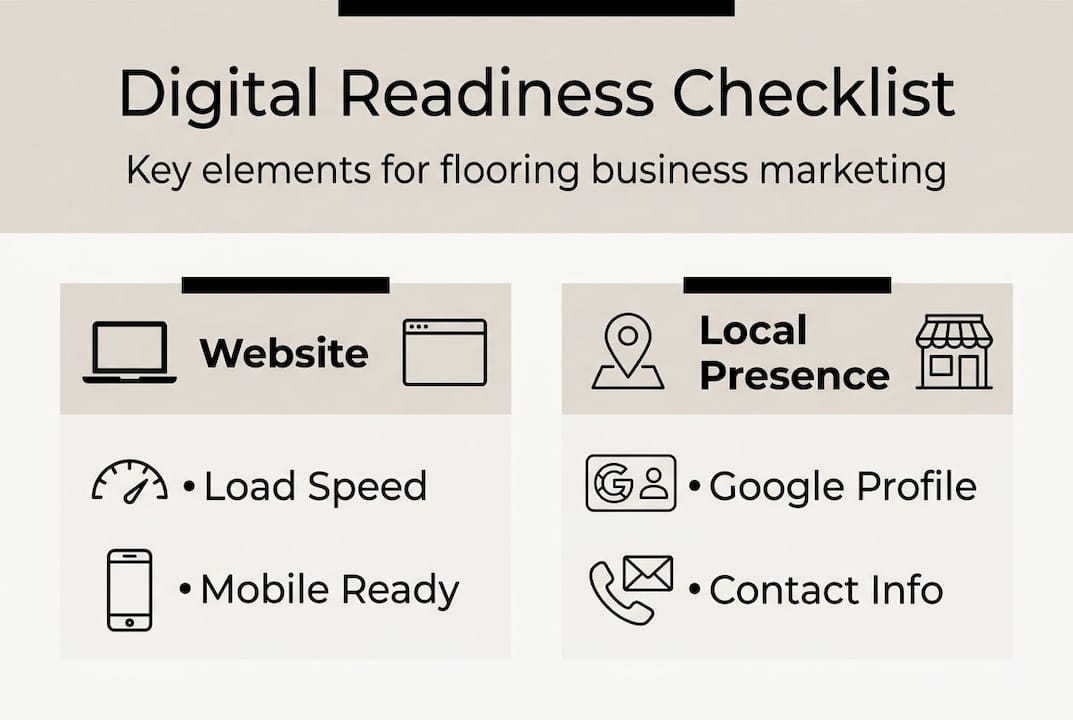
Start with your website. Ask yourself these questions:
- Does your site load in under three seconds on mobile?
- Is it easy to navigate on a smartphone?
- Do you display customer testimonials and reviews prominently?
- Is your contact form visible without scrolling?
- Do you have clear trust signals such as accreditations, guarantees, or trade memberships?
If you answered no to any of these, fixing them first will make every other marketing effort more effective. Reviewing common flooring website mistakes is a smart starting point before investing in paid channels.
Next, look at your brand positioning. Can a visitor understand within five seconds what you offer, where you operate, and why they should choose you over a competitor? If not, your value proposition needs work. A clear local identity, such as referencing the towns or regions you serve, builds immediate trust with local customers.
Local SEO is the third pillar. This means claiming and optimising your Google Business Profile, ensuring your business name, address, and phone number are consistent across all directories, and actively collecting reviews. Proper local SEO strategies deliver over 214% organic traffic increase and 3x more qualified leads for flooring companies. That is not a marginal gain. That is a business-changing result.
Pro Tip: Check your Google Business Profile right now. Make sure your opening hours, service areas, and photos are up to date. An incomplete profile loses you leads every single day.
Here is a quick readiness checklist to benchmark where you stand:
| Area | What to check | Priority |
|---|---|---|
| Website speed | Under 3 seconds load time | High |
| Mobile usability | Easy navigation on phones | High |
| Trust signals | Reviews, accreditations shown | High |
| Google Business Profile | Complete and verified | High |
| Brand positioning | Clear value proposition | Medium |
| Directory citations | Consistent NAP across listings | Medium |
Once these foundations are solid, you are ready to build on them. The flooring website must-haves guide covers the technical and content elements in more detail. Understanding digital branding for flooring brands also helps you communicate your offer more effectively online.
Choosing proven digital marketing strategies
Once your digital foundations are in place, it is time to decide where to focus your marketing efforts for immediate and sustainable results. Not all channels deliver equally for flooring businesses.
Here is a comparison of the three main channels:
| Channel | Speed of results | Cost | Lead quality | Best for |
|---|---|---|---|---|
| Local SEO | 3 to 6 months | Low ongoing | Very high | Long-term growth |
| Google Ads | Immediate | Medium to high | High | Quick enquiries |
| Paid social | 1 to 4 weeks | Medium | Medium | Brand awareness |
SEO builds long-term value. When you rank for searches like “carpet fitter in Leeds” or “LVT flooring supplier Manchester,” you attract people who are actively looking to buy. These leads convert at a much higher rate than cold traffic. Local SEO strategies can deliver over 214% organic traffic increase and 3x more qualified leads for flooring companies over time.
Google Ads delivers speed. You can appear at the top of search results today, not in six months. Location-based targeting in Google Ads reduces cost per click by 60% and increases leads by 35% for UK flooring businesses. That is a significant efficiency gain when budgets are tight.
Paid social, primarily Facebook and Instagram, works well for flooring because the product is visual. Showcasing a stunning herringbone wood floor or a plush carpet installation grabs attention. Remarketing to people who visited your website but did not enquire is particularly effective.
Here is a numbered priority order we recommend for most flooring businesses:
- Fix your website and Google Business Profile first.
- Launch Google Ads for immediate enquiries.
- Build SEO in parallel for long-term organic growth.
- Add paid social once your core channels are performing.
Looking at flooring ads that boost sales gives you real creative examples to draw from. Understanding flooring marketing funnels helps you see how customers move from awareness to enquiry. And mapping out digital touchpoints for flooring sales shows you where to engage them at each stage.
Implementing and optimising campaigns
After selecting strategies, it is essential to execute your campaigns correctly and continually refine them for the best results. Poor execution wastes budget fast.
Follow these steps to launch a Google Ads campaign for your flooring business:
- Define your target area. Use postcode or radius targeting to focus spend on areas you actually serve.
- Choose the right keywords. Focus on high-intent terms like “carpet fitting quote” or “LVT floor installation near me.”
- Write clear, benefit-led ad copy. Mention your location, a key benefit, and a call to action.
- Send traffic to a dedicated landing page, not your homepage. The page should match the ad’s promise.
- Set up conversion tracking so you know exactly which clicks become enquiries.
Location-based targeting in Google Ads reduces CPC by 60% and increases leads by 35% for UK flooring businesses. Getting this targeting right from day one is critical.
Pro Tip: Never send Google Ads traffic to your homepage. Build a simple landing page that matches exactly what the ad promises. Conversion rates improve dramatically when there is no disconnect between ad and page.
Once campaigns are live, the optimisation cycle begins. Check performance weekly in the early stages. Look at:
- Which keywords are generating clicks but no enquiries (add these as negatives)
- Which ads have the highest click-through rate (use these as templates)
- Which landing page elements are causing drop-off (test different headlines and forms)
Common mistakes to avoid:
- Broad match keywords that drain budget on irrelevant searches
- Sending all traffic to a slow or cluttered website
- Not tracking phone calls as conversions
- Setting campaigns live and ignoring them for weeks
For a full breakdown of campaign setup, the Google Ads for flooring guide covers every step in detail. The digital marketing guide for flooring also provides a broader strategic framework to work from.
Measuring results and troubleshooting
With campaigns running, monitoring and improving your results ensures ongoing success rather than wasted effort. You need to know what is working and what is not.
Here are the key metrics to track:
| Metric | What it tells you | Target benchmark |
|---|---|---|
| Enquiries (leads) | Total campaign output | Increasing month on month |
| Website traffic | Volume of visitors | Steady growth |
| Conversion rate | Visitors who enquire | 2% to 5% for flooring |
| Cost per lead | Efficiency of spend | Decreasing over time |
| Return on ad spend | Revenue vs. cost | Positive and growing |
Interpret your analytics with context. A spike in traffic that does not produce enquiries usually points to a website problem, not a campaign problem. A drop in leads with steady traffic suggests your landing page or offer needs attention.
“The flooring businesses that grow consistently online are not the ones with the biggest budgets. They are the ones that review their data regularly and act on it quickly.”
Troubleshooting checklist if results fall short:
- Low enquiry volume: Check your landing page for clarity, speed, and a visible contact form.
- Weak targeting: Review your keyword match types and geographic settings.
- Poor website experience: Test your site on a mobile device and time the load speed.
- Low ad visibility: Check your quality score and bid strategy in Google Ads.
- No review growth: Ask every satisfied customer for a Google review immediately after job completion.
Local SEO strategies consistently deliver over 214% organic traffic increases and 3x more qualified leads. If your organic traffic is flat, your SEO foundations need attention. Use the flooring growth pack to benchmark your current performance and identify gaps. The website essentials for flooring businesses resource helps you address technical issues that block conversions.
Why most digital marketing for flooring fails (and how to do better)
Here is something we see constantly. Flooring businesses follow generic digital marketing advice written for any industry and wonder why it does not produce results. The problem is not effort. It is specificity.
Most flooring campaigns fail because they use broad targeting, generic ad copy, and a website that was not built to convert. They treat digital marketing as a one-time task rather than an ongoing process. They set up a Google Ads campaign, leave it running for three months, and conclude that ads do not work.
What actually works is relentless local focus. Your ads, your website, your SEO, all of it should speak directly to the towns and regions you serve. Customers want to know you are local, reliable, and experienced in their area.
The other failure point is the absence of a review and refinement cycle. Winning campaigns adapt. They test new headlines, adjust bids, cut underperforming keywords, and improve landing pages based on real data. This is not complicated. It just requires consistency.
We have seen flooring businesses double their enquiry volume not by spending more but by fixing the basics and staying disciplined with their data. That is the real edge. Our perspective on what separates the best flooring marketing agencies from the rest comes down to exactly this: specificity, consistency, and genuine industry knowledge.
Next steps: Get professional help for flooring growth
You now have a clear picture of what effective digital marketing looks like for a UK flooring business. The next step is putting it into action.
We work exclusively with flooring businesses across the UK, so everything we do is built around your industry. Whether you need flooring SEO services to build long-term organic visibility, Google Ads management for flooring to generate enquiries fast, or simply a clear plan to follow, we can help. Start by downloading the free flooring growth pack to see exactly where your business stands and what to prioritise first. No fluff. Just practical next steps built for flooring businesses like yours.
Frequently asked questions
What is the most effective digital marketing channel for flooring companies?
Local SEO and Google Ads deliver the strongest results. Local SEO strategies produce over 214% organic traffic increases and 3x more qualified leads, while location-based Google Ads targeting increases leads by 35% and cuts cost per click by 60%.
How can I reduce digital marketing costs for my flooring business?
Using location-based targeting in Google Ads reduces cost per click by up to 60% compared to generic national targeting, making your budget work significantly harder.
How soon can I expect results from digital marketing?
Google Ads can deliver enquiries within days of launch, while SEO and local optimisation typically produce measurable organic results within three to six months of consistent effort.
How do I know if my website is hurting enquiries?
If your traffic is steady but enquiries are low, your site is likely the problem. Fixing load speed, mobile usability, and trust signals can unlock a 214% traffic increase and up to triple the qualified leads.