TL;DR:
- Onsite SEO optimizes website structure and content to improve search engine visibility for flooring retailers.
- Core elements include clear metadata, internal linking, trust signals, and technical health checks.
- Implementing basic SEO practices can significantly boost organic inquiries and outrank competitors.
Your flooring website might look great. Professional photography, clean layout, a full product range. But if search engines cannot properly read your pages, none of that matters. Onsite SEO is the practice of structuring and optimising your own website so Google and AI search engines can understand what you offer, who you serve, and why you are the right choice. For flooring retailers across the UK, getting this right is the difference between a steady flow of enquiries and a site that simply sits there, invisible.
Key Takeaways
| Point | Details |
|---|---|
| Onsite SEO demystified | Optimising your website’s structure and content helps search engines and AI answer engines understand and promote your flooring business. |
| Trust and expertise matter | Visible expertise—like bios and reviews—increases your chances of being chosen in both Google and AI results. |
| Technical SEO can make or break success | Common unseen errors, like generic metadata or client-side rendering mishaps, can wipe out all your content’s benefits. |
| Practical improvements drive enquiries | Regular onsite SEO checks and small tweaks to trust signals and speed can quickly boost online leads for flooring retailers. |
What is onsite SEO and why does it matter for flooring retailers?
On-page SEO is the practice of optimising content, structure, and HTML elements on individual pages so search engines and AI answer engines understand what each page is about and can surface it for relevant queries. It is not a one-off task. It is an ongoing discipline that shapes how visible your business is every single day.
For flooring retailers, this matters enormously. When someone searches “LVT flooring installer Bristol” or “best carpet shop near me,” Google is scanning thousands of pages in milliseconds. It favours pages that are clearly structured, relevant, and trustworthy. If your pages lack that clarity, you will not appear in those results, regardless of how good your products are.
Many flooring business owners assume poor visibility is a budget problem. In reality, it is often a configuration problem. Understanding SERP rankings for flooring and how search engine results pages work is the first step.
It is also worth understanding what onsite SEO is not. It is not keyword stuffing. It is not just filling in meta tags. Those are outdated tactics. Modern onsite SEO is about clarity, structure, and trust.
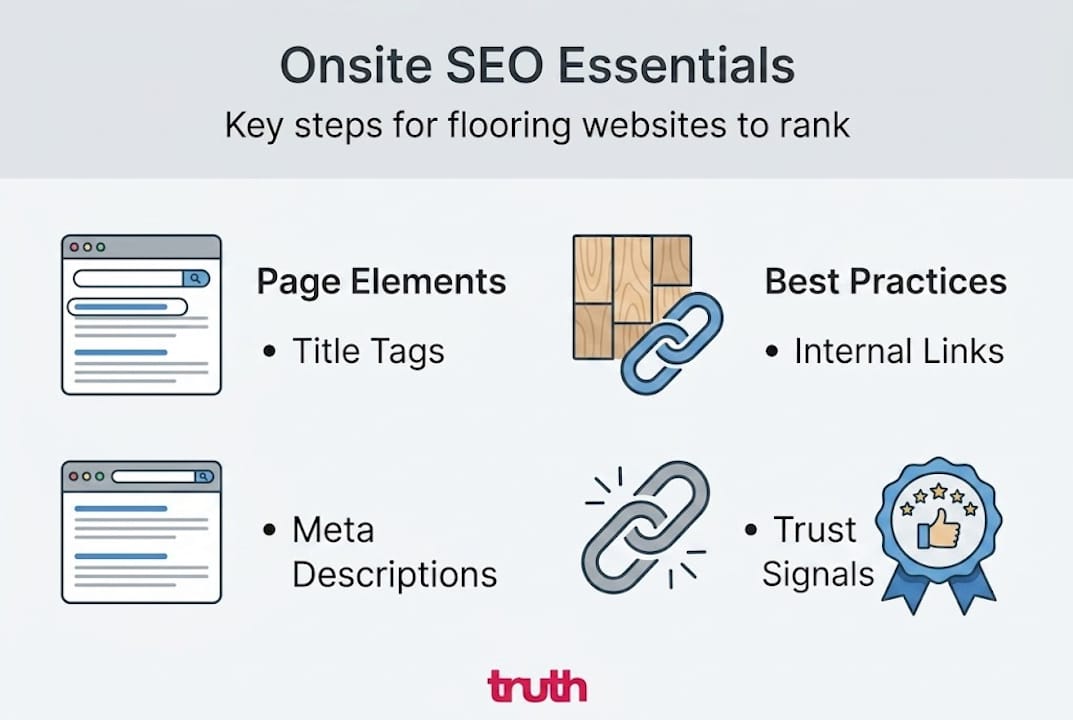
| Factor | Onsite SEO | Offsite SEO |
|---|---|---|
| Where it happens | Your own website | External sites and platforms |
| What you control | Fully | Partially |
| Key actions | Content, titles, structure, speed | Backlinks, citations, reviews |
| Impact timeline | Weeks to months | Months to years |
| Priority for new sites | High | Secondary |
Common mistakes flooring businesses make include:
- Duplicate page titles across product categories
- Missing or generic meta descriptions
- No clear H1 heading on key service pages
- Slow image loading on mobile
- Ignoring common flooring website mistakes that quietly suppress rankings
“Most flooring websites are not failing because of a lack of content. They are failing because the content they have is invisible to search engines.”
Core onsite SEO elements: Getting your flooring pages found
Having set the context for onsite SEO, let us break down the individual elements that make the biggest difference for flooring professionals.
On-page SEO extends beyond traditional keywords and title tags into semantic clarity, internal linking logic, machine-readable formatting, and page performance signals. That means every element of your page contributes to how well it ranks.
Here is a before and after example of metadata improvements for a flooring retailer:
| Page element | Before | After |
|---|---|---|
| Page title | "Products | FloorCo" |
| Meta description | “Welcome to our website.” | “Browse our range of engineered wood floors. Free fitting quotes available across Manchester.” |
| H1 heading | “Welcome” | “Engineered wood flooring in Manchester” |
| URL | /products/page2 | /engineered-wood-flooring-manchester |
| Image alt text | “img001.jpg” | “Engineered oak flooring in a Manchester living room” |
The difference is significant. The “after” version tells Google exactly what the page is about, where it serves, and what action a visitor can take.
Here is a step-by-step audit process you can apply to your own pages:
- Open each key service or product page and check the page title in the browser tab. Does it include your product type and location?
- Use a free tool like Screaming Frog or Google Search Console to pull all meta descriptions. Flag any that are missing or duplicated.
- Check every page has a single, clear H1 heading that matches what the page is about.
- Review your URL structure. Remove unnecessary parameters or generic slugs.
- Run your site through Google PageSpeed Insights. Address any mobile speed issues flagged.
- Check that images have descriptive alt text, not file names.
- Confirm your internal links connect related pages logically. For example, your LVT category page should link to individual LVT product pages and your fitting service page.
These website essentials are not optional. They are the foundation every flooring site needs.
Pro Tip: Build your internal linking around customer intent. A visitor on your “carpet fitting” page is likely interested in your “carpet ranges” and “pricing guide” pages too. Link them deliberately. This keeps visitors on your site longer and signals relevance to Google. If you are unsure where to start, SEO support for small businesses can help you prioritise.
Modern SEO priorities: E-E-A-T, authorship, and trust signals
Now that the core elements are clear, it is time to look at the new rules for standing out in AI-enhanced search results by fostering trust.
E-E-A-T is a framework used in Google’s Search Quality Rater Guidelines. Adding visible authorship and bios with relevant experience boosts trust and discoverability, including for AI answer engines. E-E-A-T stands for Experience, Expertise, Authoritativeness, and Trustworthiness. Google uses these signals to assess whether your content deserves to rank.
For flooring businesses, this is very practical. You do not need to be a published academic. You need to demonstrate that you know your trade and that customers can trust you.
Here is what E-E-A-T looks like in a flooring context:
- Named author or business owner on blog posts and guides, with a short bio mentioning years of experience
- Credentials and memberships displayed clearly, such as Checkatrade, Which? Trusted Trader, or the Contract Flooring Association
- Customer testimonials on service pages, ideally with full names and locations
- A clear returns policy, fitting guarantee, and contact details on every page
- Third-party review platforms linked from your site, such as Google Reviews or Trustpilot
- Case studies or project galleries showing real completed work
AI answer engines, including Google’s AI Overviews, are increasingly selective about which sources they pull from. They favour pages that demonstrate clear expertise and transparency. If your site has no author information, no credentials, and no social proof, it is less likely to be cited in AI-generated answers.
Research consistently shows that trust signals influence purchasing decisions significantly. Studies suggest that over 80% of consumers research a business online before making contact. If your site does not convey credibility quickly, visitors leave.
Pro Tip: Add a short author bio to every blog post or guide you publish. Even a two-sentence bio that mentions your years in the flooring trade and your service area will strengthen your E-E-A-T signals considerably. Do the same for your About page. Name the people behind the business. It builds trust fast.
Technical pitfalls: Avoid common traps in modern website builds
Trust and expertise need a solid technical foundation. Even the best content can be wasted if configuration goes wrong. Let us look at hidden pitfalls.
Incorrect or inconsistent onsite configuration in interactive front-ends, such as client-side rendering, can prevent search engines from seeing unique metadata per route. Fixing this requires meaningful, crawlable meta tags and distinct titles and metadata for each page. This is a growing issue as more flooring businesses adopt modern website builders or JavaScript-heavy platforms.
Here is a practical checklist to assess your site’s technical SEO health:
- Verify your site in Google Search Console and check for crawl errors or pages marked as “not indexed.”
- Confirm that every page has a unique title tag. Use Search Console’s “Pages” report to identify duplicates.
- Check that your site loads over HTTPS. An insecure site is penalised in rankings.
- Test your site on a mobile device. Google uses mobile-first indexing, meaning it ranks the mobile version of your site.
- Check your robots.txt file is not accidentally blocking key pages from being crawled.
- If your site uses a JavaScript framework, confirm that pages are server-side rendered or pre-rendered so search engines can read the content.
- Review your sitemap. It should be submitted to Google Search Console and include all key pages.
“We have seen flooring websites built on modern platforms where every product page had the same title and meta description. Google had no way to distinguish between them. The fix was straightforward, but the traffic loss in the meantime was significant.”
This is not a rare scenario. It happens regularly with sites built quickly on platforms that do not handle metadata per page by default.
Pro Tip: Use Screaming Frog’s free version to crawl up to 500 URLs on your site. It will flag duplicate titles, missing meta descriptions, broken links, and pages returning errors. Run this audit every quarter. Our advanced SEO for flooring service covers this as part of ongoing management, and you can see the kind of results this approach delivers in our SEO success stories.
From principles to practice: Quick wins for UK flooring sites
Armed with strategy and awareness of pitfalls, flooring professionals can turn knowledge into results with these actionable quick wins.
Optimising onsite elements, verifying technical SEO, and visibly demonstrating trust are key to surfacing your flooring business for relevant queries and boosting quality enquiries. Here is where to start today.
Immediate actions you can take right now:
- Check your homepage title tag. Does it include your main product type and your location?
- Read your meta descriptions out loud. Do they sound like something a real customer would want to click on?
- Add at least three genuine customer testimonials to your most visited service page.
- Compress all images on your site using a free tool like Squoosh or TinyPNG. Large images are one of the biggest causes of slow mobile load times.
- Log into Google Search Console and check the “Coverage” report. Fix any pages marked as errors or excluded.
- Review your local SEO for flooring setup. Ensure your Google Business Profile is complete and consistent with your website.
- Update any local landing pages to include your town or city name in the H1, title tag, and first paragraph.
What you can improve in under 60 minutes:
- Rewrite your homepage title and meta description (10 minutes)
- Add alt text to your top 20 product images (15 minutes)
- Add a customer testimonials section to your main service page (20 minutes)
- Submit an updated sitemap in Google Search Console (5 minutes)
- Fix one broken internal link flagged in Search Console (10 minutes)
Pro Tip: Google Search Console’s “Search Results” report shows you exactly which queries are bringing visitors to your site. If you are ranking on page two for a key term like “vinyl flooring Leeds,” that page is a priority for onsite improvement. A small uplift in ranking can double your click-through rate.
Why most flooring websites miss out on onsite SEO’s real potential
Here is an uncomfortable truth we see regularly. Most flooring businesses assume that onsite SEO requires deep technical knowledge or expensive developers. So they either ignore it or hand it off to someone who applies generic fixes without understanding the flooring sector.
Neither approach works.
The businesses that get the best results are not the ones with the most complex setups. They are the ones that treat every page as a clear, well-structured answer to a specific customer question. “What LVT flooring is available in Sheffield?” “Who fits carpets in Edinburgh?” “How much does engineered wood flooring cost?” Each of those questions deserves its own page, with a clear title, honest content, and visible trust signals.
Copying competitors is another trap. If the top-ranking flooring site in your area has weak onsite SEO, copying their structure will not get you ahead. It will just put you in the same position. The opportunity is to do the basics consistently and correctly, not to copy what is already there.
Why SEO matters is not just a philosophical question. It is a commercial one. Every week your pages are unclear or misconfigured is a week your competitors are picking up enquiries that should be coming to you. The good news is that the bar is not high. Most flooring websites are not doing this well. That means the opportunity is real and available right now.
The mindset shift is simple. Stop thinking of your website as a brochure. Start thinking of it as your best salesperson, one that needs to be well-briefed, clearly structured, and trusted by the customer before they even pick up the phone.
Ready to transform your flooring website’s visibility?
At Truth Digital, we work exclusively with flooring businesses across the UK. We know the sector, the search terms, and the technical pitfalls that hold flooring sites back.
Whether you need a full site audit, ongoing flooring SEO services, or a new website built for flooring from the ground up, we can help. Every project starts with a clear picture of where you are and what needs to change. No jargon. No generic advice. Just practical work that generates real enquiries. Explore our digital marketing strategies for flooring businesses and see what a focused approach can do for your visibility. Let’s talk.
Frequently asked questions
What’s the difference between onsite and offsite SEO for flooring companies?
On-page SEO focuses on changes to your own website’s structure, content, and coding, while offsite SEO is about generating authority signals like backlinks from other sites. Both matter, but onsite SEO is where most flooring businesses should start.
How can I check if my flooring website has technical SEO issues?
Use Google Search Console to spot crawling and indexing errors, and look for duplicate or missing meta tags. Incorrect onsite configuration can prevent search engines from seeing your content entirely, so this check is essential.
Is E-E-A-T really necessary for small or local flooring retailers?
Yes. E-E-A-T signals make your business stand out in both Google and AI search results, and local businesses benefit significantly from displaying trust credentials, testimonials, and clear expertise on their pages.
How often should I update onsite SEO on my flooring website?
Aim to review and refresh onsite SEO basics at least once a quarter or after any major website change, such as adding new product categories or redesigning pages.
Can I do onsite SEO myself or do I need an expert?
You can handle basic onsite SEO with the right guidance, covering titles, meta descriptions, and image alt text. Technical issues or complex site builds, particularly JavaScript-heavy platforms, will benefit from expert support.