TL;DR:
- Having an excellent showroom and craftsmanship is not enough if your online reputation is weak, as you will lose inquiries to competitors. Effective reputation management involves monitoring key channels like Google, social media, and review sites, and requesting authentic reviews ethically within 24-48 hours after service. Consistent responses, operational improvements, and regular reputation assessment are essential for long-term brand strength and increased customer trust.
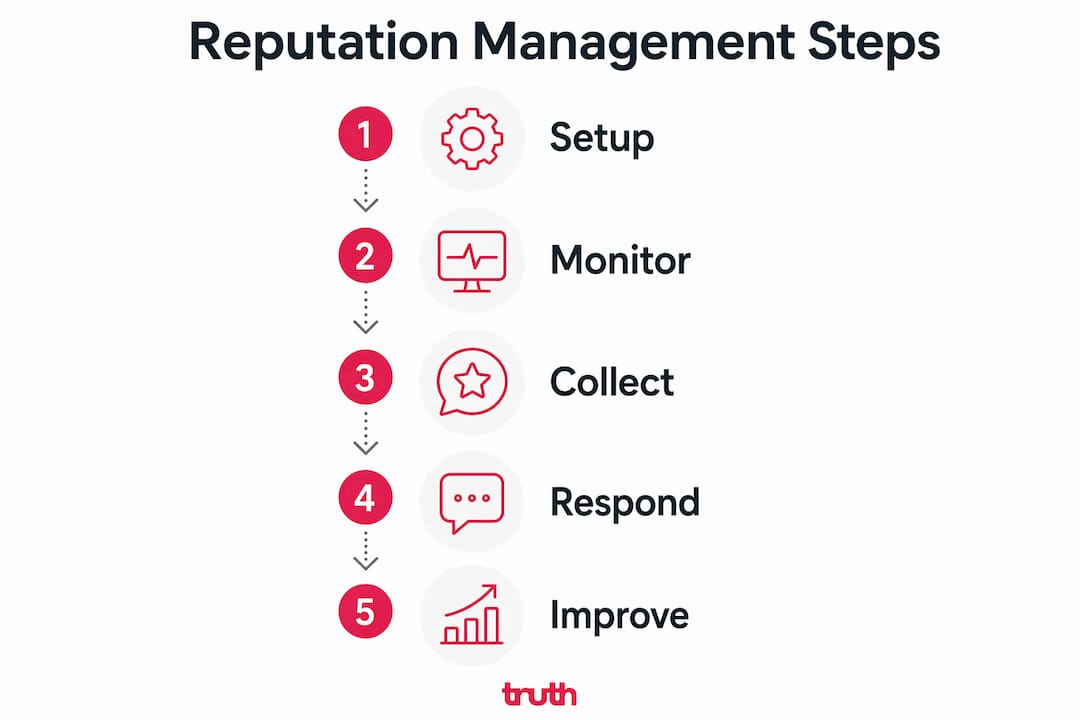
Your flooring business could have excellent craftsmanship and a brilliant showroom, but if your online reputation is weak, you will lose enquiries to competitors before a single conversation takes place. This flooring reputation management guide covers the practical steps you need: from setting up monitoring tools and collecting genuine reviews, to handling public complaints and tracking long-term brand health. Online reputation management (ORM) is the recognised industry term for this discipline, and ORM spans search results, social media, review sites, and forums to build positive presence and address problems early. Let’s get into it.
The flooring reputation management guide: foundations first

Before you respond to a single review or send a single review request, you need the right setup. Most flooring businesses skip this stage and end up firefighting. Getting the basics right saves you time and protects you from compliance problems further down the line.
The channels that actually matter
For flooring businesses, the priority channels are Google Business Profile, Checkatrade, Trustpilot, Houzz, and Facebook. Google is the most consequential. 98% of consumers read online reviews for local businesses, and a one-star improvement correlates with a 5 to 9% revenue increase. That is not a marginal gain. That is the difference between a quiet quarter and a full installation calendar.
Social media matters too, particularly Facebook and Instagram, where unhappy customers sometimes post publicly before contacting you directly. Trade forums and local community groups on Facebook are worth monitoring as well.
Monitoring tools to set up today
You do not need expensive enterprise software. Here is a practical starting point:
- Google Alerts: Free. Set up alerts for your business name, your trading name, and common misspellings.
- Google Business Profile notifications: Turn on email alerts for every new review.
- Mention or Brand24: Paid tools that track mentions across social, news, and forums in near real time.
- Trustpilot dashboard: If you use Trustpilot, the built-in dashboard shows sentiment trends over time.
- CRM flags: If your CRM supports it, tag customers who have flagged issues so you can follow up proactively.
| Tool | Cost | Best for |
|---|---|---|
| Google Alerts | Free | Name mentions across the web |
| Google Business Profile | Free | Review notifications |
| Brand24 | Paid | Social and forum monitoring |
| Mention | Paid | Multi-channel brand tracking |
| Trustpilot dashboard | Included | Review sentiment trends |
Legal and platform compliance
This is where businesses get themselves into trouble. Google prohibits offering any incentive in exchange for a review. That includes discounts, free products, or entry into a prize draw. Violating this policy risks having your reviews removed or your Google Business Profile suspended.
The same principle applies across platforms. Any automation in review outreach must facilitate honest interactions. It must never attempt to game the system.
Pro Tip: Never add a review request to a loyalty scheme or discount email. Keep your review requests completely separate from any promotional communication to stay clearly within platform guidelines.
Collecting and responding to reviews properly
Getting reviews is not about volume alone. It is about authenticity, timing, and professional follow-through. Here is how to build an ethical review programme that actually works.
How to ask without crossing the line
The right message is simple and direct. After a job is completed, send a short follow-up by text or email. Something like: “Thanks for choosing us for your flooring. We hope you are pleased with the result. If you have a moment, we would genuinely appreciate a Google review.” No pressure. No reward. Just a clear, neutral review request with a direct link.
Timing beats incentives every time. The best window is within 24 to 48 hours of installation completion, when the experience is fresh and the customer is satisfied. If there was an issue that you resolved, send the request after confirming the resolution, not before.
Steps to implement an ethical review programme
- Create a standard follow-up message template for post-installation and post-resolution scenarios.
- Add a direct Google review link to your template so customers do not have to search.
- Set a reminder in your CRM or job management software to trigger the message within 24 to 48 hours of job completion.
- Train your fitters and office team to mention the review request verbally at handover. Consistent messaging reinforces the written follow-up.
- Log every review request in your CRM, including the date and method, so you can track response rates.
- Review your response rate monthly and adjust your messaging or timing if you are seeing low conversion.
Responding to reviews: positive and negative
Responding to positive reviews is easy and often skipped. Do not skip it. A brief, personalised reply signals to future customers that you are attentive and genuine. Avoid copy-pasting the same response to every five-star review. It reads as automated.
Negative reviews require a different approach. Respond publicly within 24 hours. Keep it calm and professional. Acknowledge the concern, apologise where appropriate, and invite the customer to contact you directly to resolve it. Do not argue. Do not get defensive. Linking responses to actual operational fixes is what separates businesses that recover from negative reviews from those that stay damaged by them.
Pro Tip: Your response to a negative review is read by future customers, not just the person who left it. Write your reply for the audience of potential buyers reading it six months from now.
Handling reputation crises in flooring
A spike in negative sentiment can happen to any business. A botched installation, a delay on a major contract, a dispute that goes public on social media. The businesses that come through these situations are the ones that prepared in advance.
Early detection saves everything
Real-time monitoring tools provide early warnings before a single complaint becomes a chorus. Set your Brand24 or Mention alerts to notify you immediately if your business name appears alongside words like “complaint,” “avoid,” or “terrible.” Speed matters here.
Build a response playbook before you need it
Setting up a response playbook with assigned owners and escalation thresholds is vital before any crisis arises. Your playbook should cover:
- Who is responsible for monitoring and initial response (typically your office manager or marketing lead).
- What the escalation threshold is: for example, three or more negative reviews within 48 hours triggers a director-level response.
- Approved response templates for common scenarios: installation delays, product defects, and billing disputes.
- A clear policy on when to take the conversation offline versus continuing publicly.
- Contact details for any third parties involved in the job, such as suppliers, so you can gather facts quickly.
“Advance preparation avoids scrambling during crises and ensures a consistent message and timely reaction.” Brandwatch
Connect your response to real operational change
This is the part most businesses get wrong. Responding professionally to a crisis is necessary. But if the underlying problem does not change, the reviews will keep coming. If three customers in a row complained about your fitters not cleaning up after themselves, the response is not just a good public reply. The response is retraining your fitters and updating your end-of-job checklist.
Reputation management for flooring companies works best when it feeds back into operations. The impact of unresolved service issues on long-term brand health is significant. Treat every negative review as a data point, not just a PR problem.
Measuring reputation health over time
Getting set up and collecting reviews is stage one. Maintaining positive brand signals over the long term requires consistent measurement and regular engagement.
What to track and why
| Metric | What it tells you | Suggested frequency |
|---|---|---|
| Average star rating | Overall sentiment trend | Weekly |
| Review volume per month | Whether outreach is working | Monthly |
| Response rate | How consistently you engage | Monthly |
| Sentiment in review text | Recurring praise or problems | Monthly |
| Local search ranking | Whether ORM supports SEO | Quarterly |
Your Google Business Profile Insights tab shows how often your listing appears in search and what actions people take. Cross-reference this with your review activity. Businesses that respond to reviews consistently tend to see better local SEO performance over time.
ORM as a long-term brand signal
ORM works best when systematic and ongoing rather than reactive. A flooring business with a steady stream of recent, genuine reviews and consistent responses sends a strong signal to both customers and search engines. A business with 40 reviews from three years ago and no responses sends the opposite.
Set a monthly calendar reminder to audit your review profiles. Check your average rating, flag any unanswered reviews, and look for patterns in the language customers use. This is also a good time to update your online brand consistency across directories and social profiles.
Pro Tip: Do not chase a perfect 5.0 star rating. A rating of 4.6 to 4.8 with a healthy volume of recent reviews is more credible to buyers than 5.0 with fewer than 20 reviews. Authenticity reads better than perfection.
My take: what actually moves the needle
I have worked with flooring businesses across the UK, and the same pattern shows up repeatedly. Owners focus on collecting more reviews when their real problem is not review volume. It is review recency and response consistency.
A business with 80 reviews but no responses in the past year looks abandoned. A business with 30 reviews and a thoughtful reply to every single one looks professional, attentive, and trustworthy. That second business wins the enquiry.
The other thing I see is businesses treating reputation management as a separate task from their actual operations. It is not. The best reputation improvements I have seen came from operational fixes: better job handover procedures, clearer communication about delays, and fitters who actually clean up at the end of a day. Those changes generate better reviews without asking anyone for anything.
What I tell every flooring business we work with: the review is a symptom. Focus on the experience, and the reviews follow. You cannot manage your way out of a consistently poor service. But you absolutely can build a strong reputation on top of a consistently good one with the right system in place.
Transparency matters more than spin. When something goes wrong, own it publicly and fix it visibly. Customers are surprisingly forgiving when they see genuine accountability. What they do not forgive is silence or deflection.
If you want to understand how your online reviews drive enquiries, start by reading what your last ten reviews actually say. Not the star rating. The words.
— John
How Truthdigital helps flooring businesses grow online
Managing your reputation takes time, consistency, and the right tools in place. At Truthdigital, we work exclusively with flooring businesses across the UK and we understand the specific challenges you face: seasonal demand, installation complaints, showroom trust signals, and the need to stand out in competitive local markets.
We offer digital marketing for flooring businesses that covers reputation strategy, SEO, Google Ads, and website development in one joined-up service. If your website is not supporting your reputation efforts, our flooring website development service builds platforms designed to convert enquiries and showcase your reviews prominently. We also run email marketing for flooring businesses that keeps past customers engaged and encourages repeat business. Want to see where your business stands right now? Grab your free flooring growth pack and we will show you exactly where the opportunities are.
FAQ
What is reputation management for flooring businesses?
Reputation management for flooring businesses is the process of monitoring, responding to, and improving how your company appears across Google, social media, review sites, and forums. The goal is to build customer trust and protect your brand from negative sentiment.
Can I offer a discount to get more Google reviews?
No. Google prohibits incentivising reviews with discounts, gifts, or rewards. Doing so risks having your reviews removed or your Google Business Profile suspended. Always ask for reviews neutrally and without any offer attached.
When is the best time to ask a customer for a review?
The best time is within 24 to 48 hours of job completion, while the experience is fresh. If there was a complaint that you resolved, ask after confirming the resolution is satisfactory.
How do negative reviews affect my flooring business?
Negative reviews reduce customer trust and can lower your local search ranking. However, a professional and timely public response can limit the damage significantly. Linking your response to a genuine operational fix improves long-term brand health.
How often should I audit my online reputation?
Monthly audits are a practical minimum. Check your average rating, review volume, unanswered reviews, and any patterns in customer feedback. A quarterly review of your local search ranking shows whether your ORM activity is supporting your flooring SEO performance.