

TL;DR:
- Consistent, long-term effort in branding and marketing builds stronger visibility than quick campaigns.
- Clear USPs and targeted local SEO are foundational for generating qualified flooring leads online.
- Regular engagement like reviews, social posting, and website updates sustain and grow brand recognition.
Getting noticed online as a UK flooring business is genuinely hard. There are thousands of flooring retailers, installers, and specialists competing for the same searches, the same clicks, and the same customers. Without a clear strategy, even businesses with exceptional workmanship and strong reputations can find themselves invisible online. This guide walks you through everything: from the foundational assets you need, to the tactics that drive real visibility, through to measuring what’s actually working. Practical, specific, and built for flooring businesses.
Key Takeaways
| Point | Details |
|---|---|
| Preparation matters | Start with clear branding, defined USPs, and the right digital assets to succeed. |
| Digital channels drive growth | Leverage SEO, ads, content, and reviews to maximise your flooring brand’s visibility. |
| Avoid common pitfalls | Stay consistent across all platforms, focus on quality, and engage users post-service. |
| Measure your impact | Use analytics and customer feedback to track brand awareness and guide improvements. |
Preparation: What you need before building brand awareness
With the problem clear, let’s focus on the essentials you’ll need before taking action.
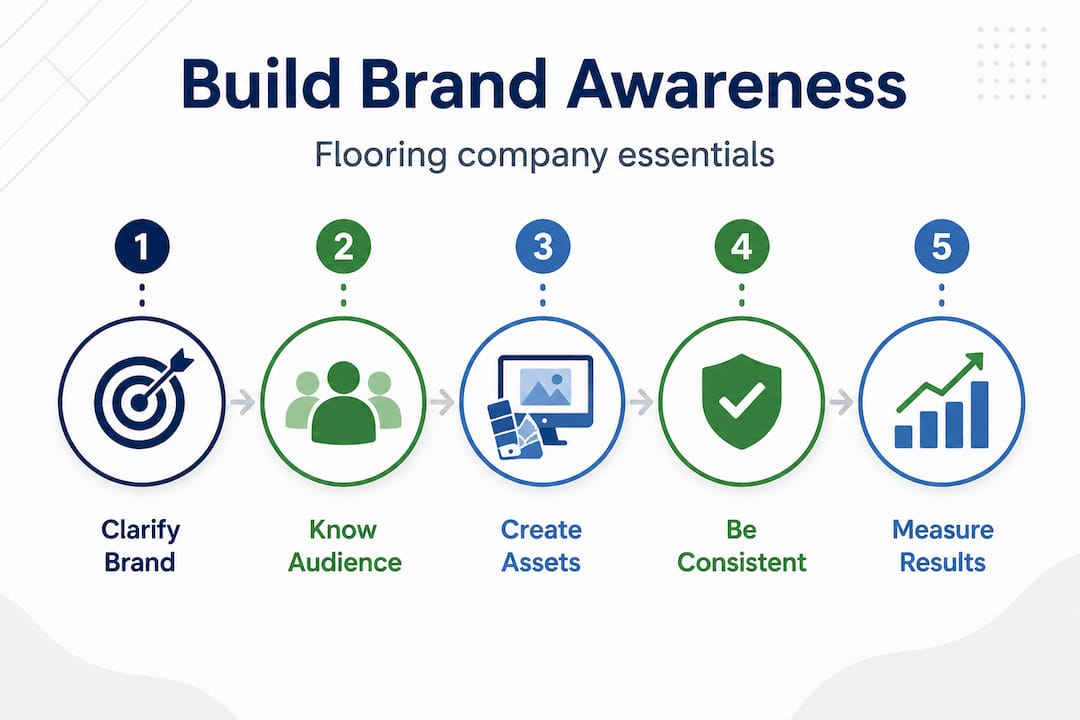
Brand awareness does not start with an ad campaign. It starts with clarity. If you cannot clearly explain what makes your flooring business different from the one down the road, neither can your potential customers. Defining your unique selling points (USPs) is the first step. Are you the fastest installer in your county? Do you specialise exclusively in engineered oak? Do you offer a five-year fitting guarantee? These answers shape everything that follows, from your website copy to your social posts to your Google Ads.
Alongside your USPs, you need a solid understanding of your target audience. Are your customers primarily homeowners renovating a living room? Commercial property managers fitting out offices? Interior designers specifying materials for clients? Each audience has different questions, different concerns, and different ways of finding a flooring business. The branding essentials for flooring covers this in detail, but the key point is this: know who you are talking to before you say anything.
Once you have that clarity, you need the right assets in place.
Essential digital assets checklist:
- A professional logo that works across web, social, and print
- A business website that is fast, mobile-friendly, and easy to navigate
- Consistent brand guidelines covering colours, fonts, and tone of voice
- Active profiles on Google Business, Facebook, Instagram, and Houzz where relevant
- A library of high-quality project photos (before and after where possible)
- Clear, accurate contact information everywhere your business appears
These are not optional extras. They are the baseline. Without them, any marketing spend is working against itself.
| Asset | Why it matters | Priority |
|---|---|---|
| Professional website | First impression for most prospects | High |
| Google Business Profile | Drives local search visibility | High |
| Brand guidelines | Ensures consistent recognition | Medium |
| Social profiles | Supports discovery and trust-building | Medium |
| Project photography | Converts visitors into enquiries | High |
| Email marketing setup | Enables ongoing nurture and retention | Medium |
Common pitfalls at this stage include using different logo versions across platforms, having out-of-date contact details on old listings, and neglecting to claim and verify your Google Business Profile. These inconsistencies confuse potential customers and weaken trust before you have even spoken to them.
Pro Tip: Set up Google Analytics and Google Search Console on your website from day one. Even if you are not ready to act on the data immediately, having historical data from the start gives you a genuine performance baseline to measure against later.
Step-by-step: Digital marketing strategies for flooring brand awareness
Having covered the foundations, the next step is to put your awareness strategy into action.
There is no shortage of channels available to flooring businesses. The real skill is knowing where to focus. We see too many businesses spread themselves thin across every platform simultaneously and get weak results everywhere. A more effective approach is to build one channel properly, establish results, then expand. Here is a practical sequence that works.
-
Optimise your website for local search. Start with your Google Business Profile and your website together. Make sure your site has dedicated pages for each core service, for example carpets, LVT (luxury vinyl tile), engineered wood, commercial fitting. Each page needs clear headings, useful content, and location-specific language. “Carpet fitter in Leeds” performs far better than a generic page for “flooring services.” The right digital marketing strategies for flooring businesses all begin with SEO as the foundation.
-
Run Google Ads campaigns targeting local, niche searches. Broad keywords like “flooring” are expensive and often irrelevant. Targeted searches like “LVT installer Birmingham” or “engineered wood floor sanding Manchester” attract people who are ready to buy, not just browsing. Study flooring ad examples that convert well, and pay close attention to the messaging, most high-performing ads lead with a specific benefit or offer rather than a company name.
-
Build a consistent content presence. Before-and-after photos are among the most powerful content assets a flooring business can produce. Post them to your Google Business Profile, your website gallery, and social media. Add brief descriptions explaining the product, the location type (kitchen, commercial space, staircase), and why the customer chose that option. This type of content builds trust and answers real questions buyers have.
-
Set up email marketing sequences. Do not let enquiries go cold. Once a prospect has made contact, a simple email follow-up sequence keeps your business front of mind while they decide. Drip marketing strategies specifically designed for flooring businesses show how automated email sequences can re-engage cold leads and recover sales that would otherwise be lost. Even a three-email sequence covering project examples, an FAQ, and a clear next step can meaningfully improve conversion rates.
-
Actively build your review profile. Positive reviews on Google are arguably the most cost-effective brand awareness tool available to a flooring business. A page with 50 reviews averaging 4.8 stars builds instant credibility with every visitor. Ask for reviews at the point of project completion, ideally while the customer is still delighted with the result. Make it easy by sending a direct link.
Research consistently shows that local search visibility drives the majority of enquiries for service businesses. Flooring companies that actively invest in both organic SEO and paid search regularly report a significant increase in qualified leads within the first six months.
Pro Tip: When setting up Google Ads, exclude broad match keywords and use phrase or exact match to control spend. Focus budget on searches that include a location and a specific flooring type. This approach consistently delivers a lower cost per enquiry and attracts buyers rather than browsers.
Troubleshooting: Common mistakes and how to avoid them
Effective tactics are crucial, but steering clear of common errors prevents wasted effort.
Even businesses with strong products and good intentions can undermine their brand awareness efforts through avoidable mistakes. Here are the most common ones we see, and how to fix them.
Inconsistent branding across platforms is a persistent problem. When your website uses one logo, your Facebook page uses an older version, and your van signage uses a different font altogether, customers struggle to build a coherent impression of your business. Consistency is what makes a brand recognisable. Create a single set of brand guidelines and apply them everywhere.
Neglecting mobile optimisation is surprisingly common even in 2026. The majority of local searches happen on mobile devices. If your website takes more than three seconds to load on a phone, or if the contact form is difficult to use on a small screen, you are losing enquiries daily. A review of website mistakes for flooring brands reveals that slow load speeds and poor mobile layouts are among the top reasons visitors leave without enquiring.
Running generic, unfocused adverts is another common issue. An advert that simply says “Quality Flooring Available” tells a potential customer nothing. It does not explain what type of flooring, where you operate, what makes you different, or what they should do next. Every advert needs a clear offer, a specific audience, and a direct call to action.
Not requesting reviews after completing a project is a missed opportunity that compounds over time. Every completed job is a chance to build your reputation, and most satisfied customers are happy to leave a review if you make it simple. The ones who are not asked rarely volunteer.
“A single negative review can undo months of good work if not addressed. Responding to every review, positive or negative, shows prospective customers that you are professional and that you care.”
Here are the key pitfalls to watch for:
- Using different brand assets across platforms
- Ignoring your Google Business Profile after setting it up
- Failing to respond to reviews, especially negative ones
- Running adverts without geo-targeting to your service area
- Not tracking where your enquiries actually come from
- Letting your website go without updates for more than six months
Pro Tip: Set up an automated email that goes out to every customer two weeks after project completion. Keep it brief, thank them for their business, and include a direct link to your Google review page. This simple step can double the number of reviews you collect without requiring any manual effort.
Verification: How to measure your brand awareness impact
After implementation and fine-tuning, it is vital to assess the impact of your brand-building efforts.
Brand awareness can feel intangible, but it is absolutely measurable. The key is knowing which metrics matter for each type of activity you are running.
Start by setting clear, measurable goals. For example: increase website traffic from organic search by 30% over six months, grow branded search volume (people searching for your company name directly) by 20%, and collect 20 new Google reviews in the next quarter. These are concrete targets you can track and report on.
Here are four numbered steps to link your marketing activity to real business outcomes:
-
Connect Google Analytics to your website and set up conversion tracking. Every form submission, phone number click, and live chat enquiry should be tracked as a goal. This tells you which pages and channels are actually generating enquiries.
-
Monitor branded search volume in Google Search Console. If more people are searching for your business name specifically over time, that is a clear signal your brand awareness is growing. It is also a strong indicator of word-of-mouth referrals.
-
Track your Google Business Profile insights monthly. The profile dashboard shows you how many people viewed your listing, clicked for directions, or called you directly. These numbers are a direct measure of local brand visibility.
-
Use the flooring growth pack to audit your current performance across all key areas. It gives you a structured starting point for identifying gaps and prioritising where to focus next.
| Goal | Metric to track | Recommended tool |
|---|---|---|
| Website visibility | Organic search traffic | Google Analytics |
| Brand recognition | Branded search volume | Google Search Console |
| Local discovery | Profile views and calls | Google Business Profile |
| Campaign performance | Click-through rate, cost per enquiry | Google Ads dashboard |
| Reputation growth | Review count and average rating | Google, Trustpilot |
| Social reach | Follower growth, post engagement | Platform native analytics |
The most important habit is regular review. Set aside time once a month to check your key numbers. Look for trends over time, not just month-to-month fluctuations. Brand awareness builds gradually, and the data will reflect that if you are consistent.
What most flooring brands miss about brand awareness
Here is an uncomfortable truth we see repeatedly. Flooring businesses often invest in a burst of marketing activity, see some results, then ease off. A few months later, they restart from close to zero. This stop-start approach is one of the most costly patterns in the industry.
Brand awareness is not a campaign. It is a consistent presence over time. The businesses that dominate their local markets are not necessarily running the cleverest adverts or spending the most money. They are simply the most consistently visible. They post regularly. They respond to every review. They update their website. They send emails. They show up, week after week.
The other thing most flooring brands miss is the cumulative value of everyday touchpoints. Every customer who walks away satisfied and tells a neighbour is a brand awareness event. Every van on the road with clear, professional signage is a brand awareness event. Every helpful response to a query on social media is a brand awareness event. Marketing campaigns amplify this, but they do not replace it.
“The brands that win long-term are the ones that treat every single customer interaction as part of their marketing strategy. Not just the paid stuff.”
We work with flooring businesses across the UK, and the ones who grow most consistently share one characteristic: they understand that brand is built daily. They do not treat digital marketing expertise for flooring as a quick fix. They treat it as an ongoing investment in their reputation.
The businesses chasing quick wins often miss the compound effect of sustained, coherent brand-building. Six months of consistent effort creates a level of recognition that no single campaign can achieve. That is the foundation your paid activity should sit on, not replace.
Next steps: Accelerate your flooring brand’s growth
With actionable steps and context in place, take the next leap with professional support tailored for the UK flooring sector.
Building brand awareness takes the right strategy, the right tools, and consistent execution. We work exclusively with flooring businesses, which means every service we offer is built around the specific challenges and opportunities in this industry.
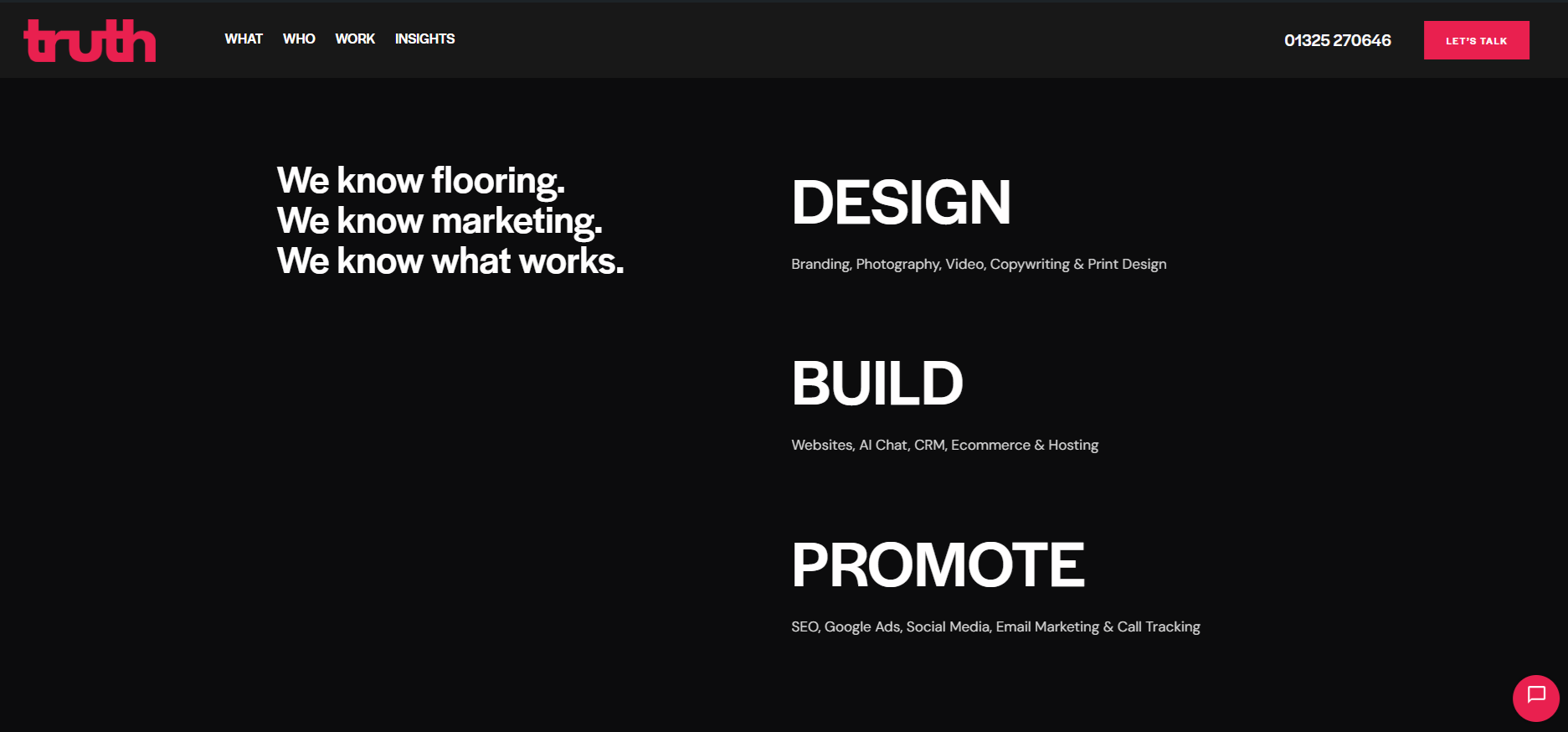
Whether you need SEO for flooring companies to build long-term organic visibility, Google Ads management for flooring to generate immediate enquiries, or flooring design services to ensure your brand makes the right first impression, we can help. Start by auditing your current visibility or book a strategy call to talk through where you are and where you want to be. No jargon, no pressure. Just practical next steps.
Frequently asked questions
How long does it take to see results from flooring brand awareness campaigns?
Tangible improvements can be seen in as little as three months, but sustained activity over six to twelve months is required for lasting, compounding growth.
Do I need a large marketing budget to increase flooring brand awareness?
No. Strategic use of digital channels such as Google Business Profile, organic SEO, and targeted social content enables even modest budgets to raise brand visibility effectively.
Which digital channels are most effective for UK flooring brands?
SEO, Google Ads, and social are consistently the highest-impact channels for flooring brands, delivering both discovery and qualified enquiries when managed correctly.
How important are online reviews for flooring companies?
Online reviews are crucial. Positive feedback builds immediate trust with new visitors and directly influences buying decisions, particularly for higher-value flooring projects.