


TL;DR:
- Effective web copywriting persuades visitors to take immediate actions, boosting flooring business enquiries.
- Striking the right balance between persuasive copy and SEO enhances website visibility and conversion rates.
- Prioritizing clear, benefit-focused language over jargon and generic content significantly improves website performance.
Most flooring businesses invest heavily in a new website, then wait for the enquiries to roll in. They rarely do. The design looks great, the photos are sharp, and the navigation is clean. But the phone stays quiet. The reason, more often than not, is the copy. Web copywriting is the strategic writing of persuasive text for websites, aimed at driving specific user actions such as enquiries, purchases, or sign-ups. It is distinct from general content writing, which focuses on education or entertainment. Get it right, and your website starts working as a genuine sales tool. Get it wrong, and even the best-looking flooring site will underperform.
Key Takeaways
| Point | Details |
|---|---|
| Copywriting drives enquiries | Persuasive website copy is critical for turning visitors into real flooring business leads. |
| Balance copy and content | Combining action-focused copy with authority-building content creates trust and wins quick enquiries. |
| SEO and copywriting work together | Aligning your website’s messaging with search best practices helps attract and convert more local customers. |
| Practical improvements matter | Updating landing pages, CTAs, and headlines based on web copywriting frameworks can boost conversions. |
| Prioritise copy with design | Prioritising persuasive copywriting alongside visual design leads to greater online success for flooring firms. |
What is web copywriting and why does it matter?
To understand why web copywriting is so effective, we need to define exactly what it is and how it differs from the content you may already have on your site.
Web copywriting is the strategic writing of persuasive text for websites, aimed at driving specific user actions such as enquiries, purchases, or sign-ups. It is not about filling pages with words. It is about choosing the right words to move a visitor from curious browser to confirmed lead.
Content writing, by contrast, is about building trust over time. A blog post explaining the difference between LVT and engineered wood is content writing. The headline and call-to-action on your LVT product page is copywriting. Both have value, but they serve very different purposes.
Here is a quick comparison to make this clearer:
| Feature | Web copywriting | Content writing |
|---|---|---|
| Primary goal | Drive immediate action | Build trust and authority |
| Tone | Persuasive and direct | Informative and educational |
| Typical formats | Landing pages, CTAs, service pages | Blog posts, guides, FAQs |
| Measurement | Enquiry rate, conversions | Traffic, time on page |
| Flooring example | “Get a free measure today” | “How to choose the right underlay” |
For flooring businesses, the stakes are high. A homeowner searching for “carpet fitters in Manchester” is ready to act. If your homepage copy does not immediately communicate what you offer, where you operate, and why you are the right choice, they will click away to a competitor.
“The words on your website are your best salesperson. They are working 24 hours a day, seven days a week, even when your showroom is closed.”
This is why copywriting matters so much for flooring firms seeking local or commercial work. You are not just competing on price or product range. You are competing on first impressions, and those impressions are shaped by words.
The impact of web copywriting on flooring business success
Having defined web copywriting, let us explore why its impact is especially tangible for flooring businesses aiming to fuel growth.

Consider a flooring retailer whose homepage opens with: “Welcome to our website. We sell carpets, wood flooring, and LVT.” That is not copy. That is a description. Now compare it to: “Transforming homes across Leeds with carpets, wood floors, and LVT. Free home measure. Fast installation. Call us today.” The second version tells the visitor what they get, where you operate, and what to do next. That is copywriting doing its job.
The difference in results can be significant. Persuasive copy drives immediate action such as a quote request, while content builds long-term authority. Both are essential for flooring sites balancing quick leads with trust-building guides. But if your website only has one of the two, prioritise the copy that converts first.
Here is a summary of how copy changes can affect performance:
| Page element | Weak copy | Strong copy | Typical impact |
|---|---|---|---|
| Homepage headline | “Welcome to our site” | “Expert flooring in Bristol. Free quotes.” | Higher time on page |
| CTA button | “Submit” | “Get my free quote” | Increased form submissions |
| Service page intro | “We offer LVT flooring” | “Durable, stylish LVT for busy family homes” | More enquiries per visit |
| About page | “We have been trading since 2005” | “20 years fitting floors families love” | Stronger trust signal |
Real flooring businesses we work with have seen enquiry rates improve significantly after revising their homepage headlines, rewriting service page introductions, and replacing generic CTAs with action-focused alternatives. The design did not change. The photos did not change. Only the words changed.
One common issue we see is flooring businesses using trade jargon that homeowners simply do not understand. Terms like “herringbone parquet overlay installation” mean nothing to someone who just wants a nice wood floor in their hallway. Avoid jargon. Write as you would speak to a local homeowner or contractor sitting across from you in your showroom.
Pro Tip: Review your homepage copy out loud. If it sounds like a brochure rather than a conversation, rewrite it. Plain, direct language almost always outperforms formal, corporate-sounding text for local flooring businesses.
Avoiding common flooring website mistakes is one of the fastest ways to improve your enquiry rate without spending more on advertising.
Web copywriting versus content writing: Finding the right balance
Some business owners confuse copywriting with content creation. Let us demystify the difference so you can make informed decisions on your website investment.
Copywriting is built for quick wins. It is the text that greets a visitor, guides them through your services, and pushes them to make contact. Content writing is built for the long game. It earns trust, improves your search rankings over time, and positions you as a knowledgeable flooring expert in your area.
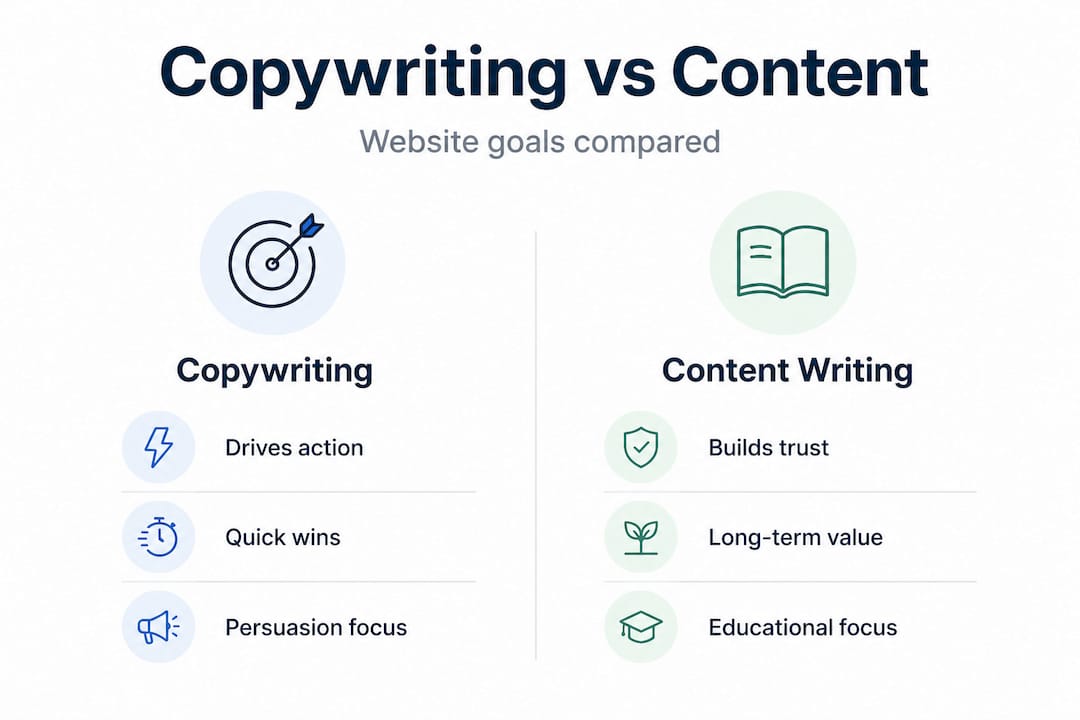
Both approaches are essential for flooring sites balancing quick leads with trust-building guides. The mistake most businesses make is investing in one while ignoring the other.
Here is a practical breakdown of each:
Web copywriting use cases for flooring businesses:
- Homepage headline and sub-headline
- Service page descriptions for carpets, LVT, wood, and commercial flooring
- Call-to-action buttons and form introductions
- Contact page messaging
- Google Ads landing page copy
- Quote request page text
Content writing use cases for flooring businesses:
- Blog posts comparing flooring types
- Guides on flooring care and maintenance
- Case studies from completed projects
- FAQs for homeowners and commercial clients
- Area-specific pages targeting local search terms
“A flooring business that only publishes blog posts but has weak homepage copy will attract visitors and lose them. A business with strong copy but no content will convert well but struggle to grow organic traffic. You need both.”
The good news is that you do not need to tackle both at once. Start with your core service pages and homepage. Get the copy working to convert visitors into enquiries. Then layer in content marketing to build authority and attract more traffic over time.
Exploring content marketing strategies for small businesses can help you plan this second phase effectively.
Practical web copywriting tactics for flooring websites
Now that you know the theory, here is how to apply web copywriting to your actual flooring business website.
Structuring your pages well is the foundation. Here is a proven approach for the three most important page types:
-
Homepage: Lead with a clear headline that states what you do and where. Follow with a short sub-headline that adds a key benefit, such as speed, quality, or a free service. Include a prominent CTA above the fold. Add social proof, such as a review count or years of experience, within the first scroll.
-
Service pages: Open with a benefit-led sentence, not a product description. For example, “Our LVT flooring is built for busy households that need durability without sacrificing style” outperforms “We supply and fit LVT flooring.” Describe the process briefly, address common concerns, and close with a specific CTA relevant to that service.
-
About page: This is not a CV. It is a trust-building opportunity. Focus on why you started the business, what you care about, and what makes your approach different. Include a photo of your team or showroom. End with a CTA that invites the visitor to get in touch.
CTAs deserve special attention. The words you use on a button or link matter more than most people realise. “Submit” is passive and uninspiring. “Get my free quote” is active and benefit-focused. “Book a free measure” tells the visitor exactly what will happen next and what they will gain. Always write CTAs from the visitor’s perspective, not your own.
Flooring-specific headline frameworks that work well include:
- “[Service] in [Location]. Free [Offer].”
- “Trusted [flooring type] fitters for [audience] across [area].”
- “Quality [product] installed by local experts. No fuss, no hidden costs.”
These frameworks are simple, but they work because they answer the three questions every visitor has: What do you do? Where do you do it? Why should I choose you?
Web copywriting is the strategic writing of persuasive text for websites, aimed at driving specific user actions. Every page on your site should have one clear action you want the visitor to take. Do not give them five options. Give them one.
Pro Tip: Rather than rewriting your entire site at once, pick your single highest-traffic page and test a revised headline and CTA for 30 days. Track enquiries from that page specifically. This focused approach gives you clear data on what resonates with your local audience before you roll out changes across the site.
Reviewing the website must-haves for flooring businesses will help you ensure your copy has the right structural support to perform.
SEO and web copywriting: A partnership for visibility and conversion
With persuasive messaging in place, flooring firms can supercharge results by merging sound copywriting with good SEO fundamentals.
SEO (search engine optimisation) is the process of improving your website so it appears higher in Google search results. Copywriting and SEO are not in conflict. They are complementary. The key is knowing how to balance them.
Web copywriting is the strategic writing of persuasive text for websites, aimed at driving specific user actions such as enquiries, purchases, or sign-ups, distinct from general content writing which focuses on education or entertainment. When you add keyword intent to that framework, you get copy that ranks and converts.
Here are practical ways to blend SEO with your web copy:
- Use your primary keyword naturally in the page headline, first paragraph, and at least one subheading. For example, “carpet fitters in Sheffield” should appear in these locations on your relevant service page.
- Write meta descriptions as mini-CTAs. They appear in Google search results and influence whether someone clicks through to your site.
- Structure service pages with clear H2 and H3 headings that include location and service terms. This helps Google understand the page topic.
- Avoid keyword stuffing. If a phrase appears so often that it reads unnaturally, Google will notice and so will your visitors.
- Focus on high-intent search terms. Phrases like “LVT flooring installers near me” or “wood floor sanding Bristol” signal a visitor who is ready to buy, not just browse.
The synergy here is powerful. A page that ranks well for “commercial carpet fitters in Birmingham” but fails to convert visitors is wasting your SEO investment. A page with brilliant copy but no keyword structure will never be found. You need both working together.
Explore our flooring SEO strategies to understand how we approach this for flooring businesses specifically. If you are new to local search, our local SEO guide is a strong starting point.
What most flooring firms get wrong about web copywriting
Here is an honest reflection from our experience working with flooring businesses across the UK.
Most flooring business owners treat their website copy as an afterthought. They spend weeks choosing the right photos, debating colour schemes, and reviewing page layouts. Then they write the copy in an afternoon, or worse, they copy it from a competitor’s site and change the business name.
We have seen this pattern repeatedly. A flooring retailer invests £5,000 in a new website. The design is excellent. The photos are professional. But the homepage still says “Welcome to our website” and the service pages read like a product catalogue. Six months later, the owner wonders why the site is not generating enquiries.
The uncomfortable truth is that design attracts attention, but copy drives action. A visitor who lands on your site decides within seconds whether to stay or leave. That decision is shaped almost entirely by what they read, not what they see.
We also see flooring businesses over-investing in SEO traffic without fixing their copy first. They rank on page one for competitive local terms, drive hundreds of visitors to their site each month, and convert almost none of them because the copy does not give visitors a reason to act.
Fixing your copy is almost always the highest-return activity you can do on an existing website. It costs less than a redesign, takes less time than an SEO campaign, and the results are visible within weeks. Addressing avoiding website mistakes should sit alongside copywriting as a priority, not an optional extra.
Elevate copywriting to the same level of importance as design and SEO. Treat it as a core business asset, not a box to tick.
Boost your flooring business with expert copy and digital marketing
If you are ready to bridge the gap between traffic and tangible enquiries, here is how our team can help.
At Truth Digital, we specialise in web copywriting, website design, and digital marketing for UK flooring businesses. We know the flooring sector inside out, which means we write copy that speaks directly to your customers, whether they are homeowners choosing a new carpet or commercial clients sourcing LVT for an office fit-out. Our flooring websites are built to convert from day one, with copy and design working together. Pair that with our flooring SEO service and you have a system that attracts the right visitors and turns them into enquiries. Let us talk about what is possible for your business.
Frequently asked questions
What is the difference between web copywriting and normal website content?
Web copywriting aims to persuade visitors to take a specific action such as requesting a quote, while normal website content focuses on informing or educating the reader. Both serve important roles, but copywriting is what directly drives enquiries.
Does web copywriting improve SEO results for flooring businesses?
Yes. Copywriting and SEO work together to boost both search visibility and on-site conversions when the copy is structured around high-intent keywords and written to persuade as well as inform.
How often should I update web copy on my flooring website?
Review and update your main service and landing page copy every 6 to 12 months to keep messaging relevant, reflect any changes to your services, and respond to shifts in how your customers search online.
What makes good web copy for flooring businesses?
Effective web copy is clear, benefit-focused, and written for the specific customer you want to attract, whether that is a homeowner renovating a kitchen or a contractor sourcing commercial flooring for a large project.
Do I need a specialist to write my web copy?
A web copywriting specialist will ensure your content persuasively drives enquiries and is structured for SEO, but clear and direct DIY copy is always better than leaving pages with weak or generic text that fails to convert visitors.

