Most flooring business owners pour money into SEO expecting enquiries to flood in, yet see minimal results. The problem isn’t effort, it’s understanding. Search engine results pages (SERPs) have evolved dramatically, and the old playbook of keyword stuffing and generic optimisation no longer works for flooring companies. Today’s SERPs present a complex mix of local packs, paid ads, image results, and organic listings that require strategic navigation. For UK flooring businesses, mastering these elements isn’t optional, it’s essential for capturing customer attention and converting searches into profitable enquiries.
Key Takeaways
| Point | Details |
|---|---|
| Local packs dominate | For UK flooring businesses, the Google Local Pack often appears above organic results and drives valuable enquiries. |
| GBP optimised for clicks | An optimised Google Business Profile with complete information and positive reviews often delivers more clicks than a higher ranking website. |
| Hybrid paid and organic | A balanced mix of paid ads and strong organic content helps capture attention across different SERP features. |
| Visual search drives decisions | Image packs and visual content are pivotal for flooring buyers researching textures and finishes before contacting suppliers. |
| Local focus over national | Local intent dominates flooring enquiries, so prioritising local optimisation and proximity signals yields more profitable enquiries than broad national rankings. |
Understanding search engine results pages (SERPs) for flooring businesses
Search engine results pages are the screens customers see after typing queries into Google. For flooring businesses, these pages contain multiple elements competing for attention. Understanding each component helps you position your business where potential customers actually look.
Typical SERP elements for flooring searches include:
- Paid advertisements appearing at the top and bottom of results
- Google Local Pack showing three nearby businesses with maps
- Organic listings from websites ranking naturally
- Image packs displaying product photos and room installations
- People Also Ask boxes with common flooring questions
- Shopping results for product-focused searches
When someone searches “oak flooring installer Manchester” or “carpet shops near me”, Google prioritises local results. Local searches such as carpet shops near me trigger Google Local Pack, vital for UK flooring owners. This local pack appears prominently, often above traditional organic results, making your Google Business Profile (GBP) more valuable than your website ranking in many cases.
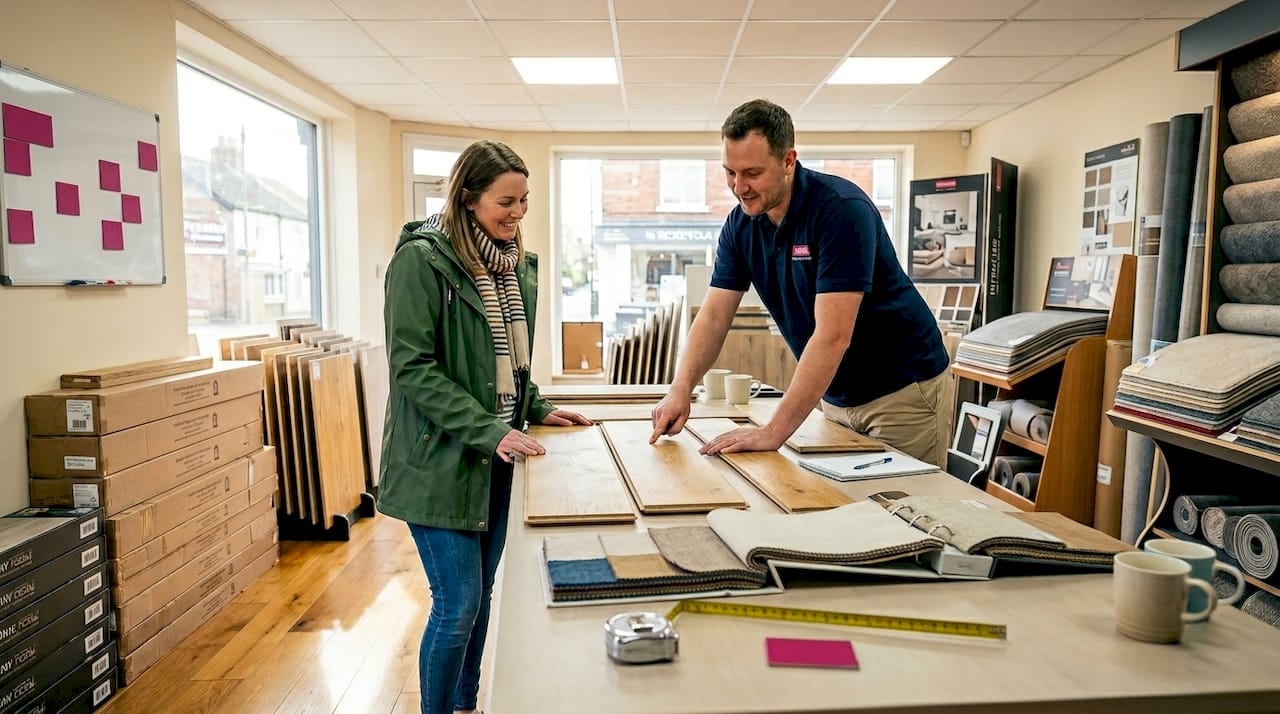
The visual nature of flooring products means image packs play an outsized role. Customers want to see finished installations, product textures, and room transformations before making contact. Businesses that neglect visual optimisation miss opportunities to capture attention during the crucial research phase.
SERP layouts vary based on search intent. Product searches like “luxury vinyl tile prices” generate different results than service searches like “floor sanding London”. Understanding these patterns lets you tailor content and advertising to match how customers actually search for flooring solutions.
Google Business Profiles dominate local flooring searches because customers prioritise proximity, reviews, and immediate contact options. A well optimised GBP with complete information, regular updates, and positive reviews outperforms websites that rank organically but lack local signals.
The shifting landscape: why traditional SEO alone no longer suffices for flooring companies
The flooring buyer journey has fundamentally changed. Customers no longer follow linear paths from awareness to purchase. They research sporadically, compare locally, and make decisions based on immediate availability and trust signals visible directly in SERPs.
Traditional SEO is broken for flooring due to buyer journey shifts; local intent is more critical than national keyword focus. This shift means ranking on page one for broad terms like “carpet installation” delivers minimal value if you’re not visible in local results where purchase intent concentrates.
Here’s why old SEO methods fail flooring businesses:
- Keyword stuffing damages credibility and Google penalises unnatural content that prioritises search engines over readers
- National ranking efforts waste resources when 90% of flooring enquiries come from local searches within 10 miles
- Generic content fails to address specific customer concerns about installation timeframes, product suitability, and local availability
- Ignoring paid advertising leaves SERP real estate to competitors who capture attention before organic results appear
- Incomplete Google Business Profiles eliminate you from the local pack where most clicks occur
Intent-driven content now determines success. When someone searches “best flooring for kitchens”, they want practical advice, not sales pitches. When they search “vinyl flooring installers Leeds”, they’re ready to book. Your content and optimisation must match these distinct intents.
Pro Tip: Focus on local search terms that reflect purchase intent like “book carpet fitting” or “emergency floor repair” rather than generic terms like “flooring services” to improve conversion rates dramatically.
The rise of local SEO for flooring reflects this reality. Businesses investing in local signals, reviews, citations, and GBP optimisation see better returns than those chasing national rankings. Cost per click volatility in paid advertising also demands hybrid strategies that balance organic presence with targeted ads.
Customers trust visual proof. They want to see your work, read recent reviews, and confirm you operate nearby before making contact. Traditional SEO focused on text and links can’t deliver these trust signals. Modern SERP optimisation integrates visual content, local data, and social proof to meet customer expectations at every search stage.
Successful flooring businesses now view SERPs holistically. They optimise for local pack inclusion, run targeted paid campaigns, maintain active GBP profiles, and create flooring ads examples that capture attention across multiple SERP features simultaneously.
Key SERP features UK flooring businesses must optimise for increased enquiries
Google Local Pack remains the most valuable SERP feature for flooring companies. This section displays three businesses with contact details, reviews, and maps. Appearing here generates more enquiries than ranking first organically because customers see immediate trust signals and contact options without clicking through.
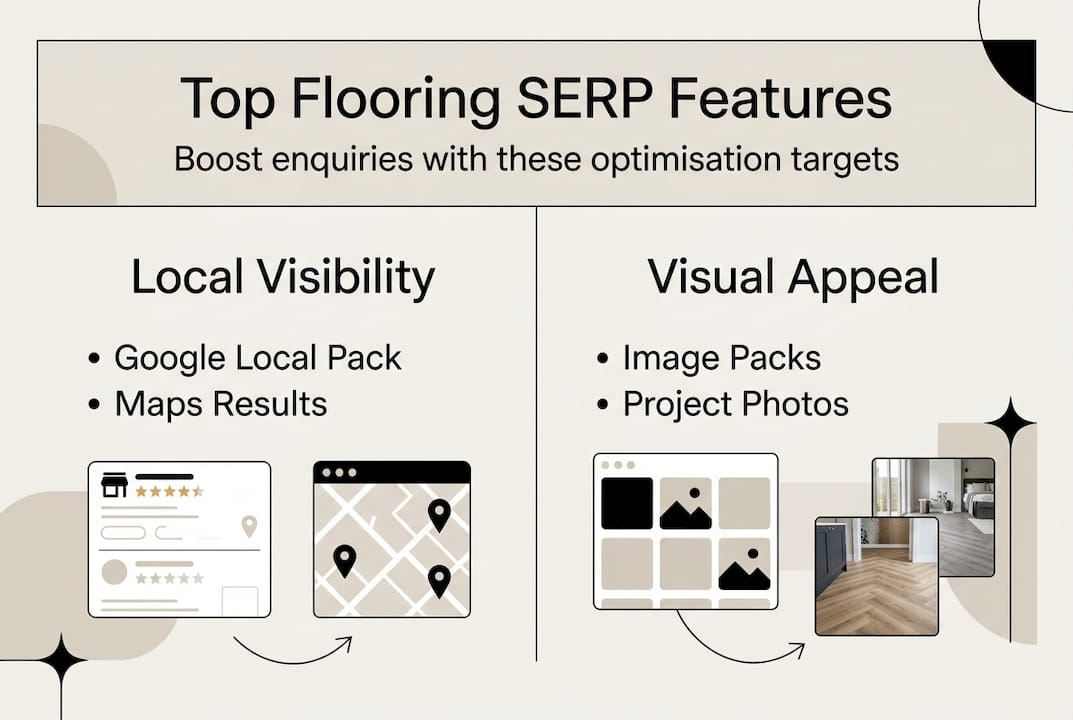
Optimised Google Business Profiles get 7x more clicks; incomplete profiles cause great losses. Yet many flooring businesses leave GBP profiles incomplete, missing crucial fields like service areas, business hours, and product categories. This single oversight eliminates you from consideration before customers even see your website.
| SERP feature | Optimisation priority | Expected impact |
|---|---|---|
| Google Local Pack | Critical | 60-70% of local search clicks |
| Paid search ads | High | 20-30% of total clicks, immediate visibility |
| Organic listings | Medium | 10-15% of clicks, long term value |
| Image pack | Medium | 15-25% engagement for product searches |
| People Also Ask | Low | 5-10% engagement, authority building |
Paid advertisements complement organic efforts by capturing attention at the top of SERPs. For competitive terms like “carpet fitters near me”, paid ads ensure visibility even while you build organic rankings. The key is targeting purchase-intent keywords that convert rather than broad awareness terms that drain budgets.
Image packs appear for product-focused searches like “herringbone wood flooring” or “grey carpet living room”. Optimising your website images with descriptive filenames, alt text, and structured data increases chances of appearing here. High quality installation photos showcasing finished projects attract clicks from visually motivated buyers.
Pro Tip: Upload at least 20 high quality photos to your Google Business Profile showing different flooring types, installation processes, and completed projects to increase engagement by up to 40%.
Common GBP optimisation errors include:
- Inconsistent business names across citations and directories
- Missing or incorrect service area definitions
- Incomplete business categories and attributes
- Ignoring customer reviews or failing to respond promptly
- Outdated business hours and contact information
- Lack of regular posts and updates showing business activity
Quick optimisation checklist for immediate results:
- Verify and claim your Google Business Profile completely
- Add all relevant flooring categories and services
- Upload minimum 20 professional photos of completed work
- Collect and respond to customer reviews weekly
- Post updates about promotions, new products, and projects monthly
- Ensure NAP (name, address, phone) consistency across all online listings
- Enable messaging and booking features for direct customer contact
The local seo benefits extend beyond immediate visibility. Consistent optimisation builds authority signals that improve rankings across all SERP features over time. Businesses that maintain active, complete profiles with fresh content and regular engagement outperform competitors who treat GBP as a one-time setup task.
Paid advertising works best when coordinated with organic efforts. Running ads for terms where you already rank organically might seem redundant, but it captures additional clicks from users who prefer ads or miss organic listings. Conversely, advertising for terms where you rank poorly ensures visibility while building organic presence.
How to integrate SERP insights into your flooring business marketing strategy
Applying SERP knowledge requires systematic implementation across multiple channels. Start with your Google Business Profile as the foundation for local visibility.
Step-by-step GBP optimisation approach:
- Audit your current profile for completeness, checking every field and category option available
- Photograph your best recent projects, ensuring variety across flooring types and room settings
- Research competitor profiles to identify gaps and opportunities in your market
- Set up a review collection system to gather feedback from every completed job
- Create a content calendar for monthly GBP posts about projects, tips, and promotions
- Monitor insights weekly to understand how customers find and interact with your profile
Planning paid ad campaigns requires understanding customer search patterns. Hybrid paid/organic strategies handle CPC volatility and maximise visibility across SERP features. Focus budgets on high-intent keywords during peak seasons when customers actively seek installation services.
Local SEO tools help identify opportunities competitors miss. Use keyword research platforms to find location-specific terms customers actually use. “Carpet fitters Nottingham” might have lower competition than “carpet installation Nottingham” despite similar intent. Small targeting adjustments create significant visibility improvements.
Monitoring SERP performance means tracking rankings, but also measuring practical outcomes. Which keywords generate enquiries? What percentage of GBP views convert to website visits or phone calls? How do paid ad click-through rates compare to organic results? These metrics reveal where to invest effort.
Common pitfalls to avoid:
- Neglecting mobile optimisation when 75% of local searches occur on phones
- Targeting keywords with search volume but no purchase intent
- Running paid campaigns without conversion tracking to measure actual ROI
- Ignoring negative reviews or responding defensively instead of professionally
- Copying competitor strategies without understanding your unique market position
- Expecting immediate results from SEO when meaningful rankings require 3-6 months
Successful integration means aligning website content with SERP opportunities. If image packs drive traffic for “luxury vinyl tile bathroom”, create detailed gallery pages showcasing LVT installations in various bathroom styles. If local pack dominates “floor sanding” searches, ensure your GBP highlights this service prominently with before-and-after photos.
Running flooring Google ads effectively requires testing ad copy that speaks to specific customer concerns. “Fast carpet fitting, next day slots available” outperforms “professional carpet installation services” because it addresses the urgency customers feel when searching.
Regular strategy reviews keep efforts aligned with changing SERP features. Google continuously tests new formats and adjusts algorithms. Quarterly audits of your SERP presence across key terms reveal emerging opportunities and threats. The flooring growth pack provides structured frameworks for systematic improvement.
Integration succeeds when every marketing activity considers SERP impact. Blog posts should target featured snippet opportunities. Product pages need optimisation for image pack inclusion. Service pages must align with local pack ranking factors. This holistic approach compounds results across all SERP features simultaneously.
Boost your flooring business online with expert support
Navigating SERP complexity whilst running a flooring business stretches resources thin. Professional digital marketing support accelerates results by applying proven strategies tailored to flooring sector dynamics.
Truth Digital specialises exclusively in helping UK flooring businesses improve online visibility and generate quality enquiries. Our flooring SEO services focus on local pack optimisation, technical website improvements, and content strategies that capture customers at every search stage. We understand the unique challenges flooring companies face, from seasonal demand fluctuations to competitive local markets.
Our flooring Google Ads guide demonstrates how targeted paid campaigns complement organic efforts, ensuring visibility during the critical research and decision phases. Review our SEO success stories to see measurable results other flooring businesses achieved through strategic SERP optimisation.
Frequently asked questions about SERPs for flooring businesses
What are SERPs and why are they important for my flooring company?
SERPs are the pages Google displays after someone searches for flooring services or products. They determine whether potential customers see your business, contact you, or choose competitors. Optimising for SERP features like local packs and paid ads directly impacts enquiry volume and revenue.
How can I improve my Google Business Profile effectively?
Complete every profile field, upload 20+ high quality project photos, collect reviews from satisfied customers, post monthly updates, and respond to all reviews within 48 hours. Consistency and activity signal credibility to both Google and potential customers browsing local results.
Do I need to use paid ads alongside SEO for best results?
Yes, hybrid strategies perform best for flooring businesses. Paid ads provide immediate visibility whilst building organic rankings, capture additional clicks on competitive terms, and let you test messaging before investing in content creation. The combination maximises total SERP presence.
What types of keywords should I target for flooring searches?
Focus on local, high-intent terms like “carpet fitters [your city]” or “vinyl flooring installation near me” rather than broad terms like “flooring”. Include product-specific phrases customers use such as “herringbone wood flooring” or “luxury vinyl tile bathroom” to capture purchase-ready searchers.
How quickly can I expect to see enquiries increase after optimising for SERPs?
Google Business Profile optimisation and paid ads generate results within days to weeks. Organic SEO improvements typically show meaningful ranking changes within 3-6 months. The local SEO explained guide details realistic timelines for different optimisation strategies.
Why do some flooring businesses rank well but get few enquiries?
Ranking for wrong keywords, poor website conversion design, incomplete Google Business Profiles, or targeting broad terms without purchase intent cause this disconnect. Visibility means nothing without relevance to customer needs and clear paths to contact you.