TL;DR:
- Authentic project galleries with filters significantly boost credibility and conversions.
- Fast, mobile-responsive websites under three seconds retain more potential customers.
- Optimizing local SEO and maintaining accessibility and content updates drive sustainable growth.
The flooring market in the UK is competitive. Customers search online, compare several businesses in minutes, and make quick judgements based on what they see. If your website is slow, hard to navigate, or lacks real project images, you lose that customer before they ever pick up the phone. The gap between flooring businesses that generate steady enquiries online and those that struggle often comes down to a handful of specific website features. This guide covers every must-have, backed by data, so you can prioritise what actually drives growth.
Key Takeaways
| Point | Details |
|---|---|
| Professional project galleries | Authentic images and before-and-after photos are the biggest online trust factors. |
| Fast and mobile-first experience | Speed and mobile responsiveness can halve bounce rates and reach the majority of clients. |
| Simple navigation, strong CTAs | Easy menus and contact info on every page capture more customer enquiries. |
| Local search optimisation | A complete Google Business Profile can multiply high-value local clicks and organic traffic. |
| Mandatory compliance measures | HTTPS security, accessibility, and regular content updates protect your reputation and boost rankings. |
Showcase your work with compelling visual galleries
Customers buying flooring are making a visual decision. They want to see real results before they trust you with their home or commercial space. A gallery of authentic, high-resolution project photos does more for your credibility than any amount of text.
Authentic galleries with filters boost credibility and conversions by up to 45%. That is a significant number. It reflects the reality that people buy with their eyes, especially for a product as visible as flooring.
Before-and-after photos are particularly powerful. They show transformation. They answer the question every customer has: “What will this actually look like in my space?” Pair those images with a short description of the project, the product used, and the location. That context builds trust fast.
Organise your gallery by category. Separate sections for carpet, wood flooring, LVT, and commercial projects help visitors find what is relevant to them quickly. Filtering tools let users self-select, which keeps them on your site longer and increases the chance they enquire.
Here is what to focus on:
- Use only real project photos, not stock imagery
- Include before-and-after pairs wherever possible
- Add short captions with product type, room, and location
- Organise by flooring category and room type
- Compress images for speed without losing quality
- Update the gallery regularly with recent work
Pro Tip: After completing a job, ask the client for a short testimonial and permission to use the photo. Pair the testimonial with the project image on your gallery page. This combination of social proof and visual evidence is extremely persuasive.
Avoid using outdated projects or images that no longer represent your current standard of work. Old photos can undermine trust rather than build it. To boost gallery impact, treat your gallery as a live portfolio that evolves with your business.
Once you understand the make-or-break role of visual credibility, it is time to ensure your website performance matches client expectations.

Fast, mobile-first performance keeps visitors engaged
A beautiful website that loads slowly is a liability. Visitors are impatient. If your pages take more than three seconds to load, a large proportion of potential customers will leave before seeing anything.
Image optimisation reduces load times by 50 to 70 percent, directly improving your Google rankings and the number of enquiries you receive. That is not a minor tweak. It is one of the highest-impact technical improvements you can make.
Mobile performance is equally critical. Over 60% of searches are carried out on mobile devices. If your site is not fully responsive, you are excluding the majority of your potential customers before they even see your work.
“User impatience is the silent killer of flooring enquiries. A one-second delay in page response can reduce conversions by 7%. Most flooring businesses have no idea how much revenue they are losing to a slow website.”
Here is a quick comparison of performance benchmarks:
| Performance factor | Good standard | Poor standard |
|---|---|---|
| Page load time | Under 3 seconds | Over 5 seconds |
| Mobile responsiveness | Fully responsive | Desktop only |
| Image file size | Under 150KB per image | Over 500KB per image |
| Core Web Vitals score | 90 or above | Below 50 |
To avoid slow sites costing you leads, compress every image before uploading, use a content delivery network, and choose a fast hosting provider. Avoid autoplay videos on landing pages as they dramatically increase load time.
Pro Tip: Use Google PageSpeed Insights once a month to check your scores. It is free, takes two minutes, and flags exactly what needs fixing. Make it a routine.
Optimising your site’s visuals and speed sets the foundation, but seamless navigation is what turns browsers into leads.
Clear navigation and calls-to-action convert interest to leads
You can have the best-looking flooring website in your area. If visitors cannot find what they need in two clicks, they will leave. Clear navigation and prominent calls-to-action are non-negotiable.
Clear navigation with prominent CTAs and contact forms on every page reduces friction and increases conversions significantly. This is about removing every possible barrier between a visitor and an enquiry.
Here is how to streamline your flooring site menu:
- Limit your main navigation to five or six items maximum
- Use plain labels: Services, Gallery, About, Contact
- Group related services under a single dropdown if needed
- Place your phone number and a “Get a quote” button in the header
- Add a contact form or click-to-call button in the footer of every page
Comparison of navigation approaches:
| Navigation type | User experience | Conversion impact |
|---|---|---|
| Simple, labelled menu | Easy to scan, low friction | High |
| Overcrowded menu with jargon | Confusing, high bounce rate | Low |
| Sticky header with CTA | Always visible, accessible | Very high |
| No clear CTA on homepage | Visitor unsure what to do | Very low |
Your calls-to-action need to be visible without scrolling. Place them above the fold on every key page. Use direct language: “Request a free quote”, “Call us today”, “Book a home visit”. Avoid vague phrases like “Learn more” or “Find out more”.
For enquiry handling strategies that convert, make sure every form is short. Name, phone number, and a brief message is enough to start a conversation. Long forms kill conversions.
Now that visitors can easily navigate and get in touch, the next essential is making your website discoverable to local customers.
Master local SEO to attract high-intent customers
Ranking on Google for flooring searches in your area is one of the most valuable things your website can do. Local SEO is how you get there.
An optimised Google Business Profile yields 7 times more clicks, and comprehensive local SEO strategies can increase organic traffic by 214 percent. Those numbers represent real enquiries from people actively looking for flooring in your area.
On-page local SEO essentials for flooring websites:
- Include your business name, address, and phone number (NAP) consistently on every page
- Add location-specific pages if you serve multiple towns or cities
- Use local schema markup so Google understands your business details
- Embed a Google Map on your contact page
- Display Google reviews prominently on your homepage and service pages
- Publish fresh content regularly, including project updates and local news
Here is how different local SEO tactics compare for traffic and leads:
| Local SEO tactic | Traffic impact | Lead impact |
|---|---|---|
| Optimised Google Business Profile | Very high | Very high |
| Location pages on website | High | High |
| Schema markup | Medium | Medium |
| Regular review responses | Medium | High |
| Fresh blog or project content | Medium | Medium |
To improve your SERP visibility, focus on your Google Business Profile first. Add photos weekly, respond to every review, and keep your opening hours accurate. This single action has an outsized impact on local rankings.
Pro Tip: Set a weekly reminder to post an update on your Google Business Profile. Share a completed project photo, a product highlight, or a seasonal offer. Consistency signals activity to Google and keeps your listing visible.
For faster results, consider combining Google Ads with your organic local SEO to dominate the search results page while your rankings build.
With these four digital must-haves in place, there are two final essentials that secure trust, compliance, and long-term results.
Don’t overlook accessibility, security, and content freshness
These three areas are the ones most flooring businesses ignore. That is a mistake. They affect your legal standing, your Google rankings, and the trust visitors place in your business.
Accessibility standards and HTTPS are mandatory for trust, SEO, and legal compliance in the UK. Accessibility means your site must be usable by people with visual impairments or disabilities. That includes sufficient colour contrast (a minimum ratio of 4.5:1), readable font sizes, and descriptive alt text on every image.
Accessibility, security, and freshness checklist:
- Run your site over HTTPS with a valid SSL certificate
- Check colour contrast ratios meet the 4.5:1 minimum standard
- Add descriptive alt text to every image, including gallery photos
- Use font sizes of at least 16px for body text
- Audit for broken links and outdated information quarterly
- Update project galleries monthly with new completed work
“Google rewards websites that are secure, accessible, and regularly updated. These are not optional extras. They are the baseline for any business that wants to compete in local search in 2026.”
Regular updates signal freshness to both users and search engines. A static website that has not changed in six months sends a negative signal. Fresh content, new project photos, and updated service information all contribute to better rankings and more trust.
Pro Tip: Schedule a monthly content review in your calendar. Add one new project to your gallery, check your contact details are correct, and review any pricing or service information. It takes 30 minutes and keeps your site competitive.
For ongoing site maintenance essentials and the content update benefits that drive flooring sales, consistency is what separates the businesses that grow from those that plateau.
Now you have seen every critical must-have, let us put them in perspective with expert opinion from those who deliver flooring web success every day.
Our perspective: Don’t be dazzled, focus on what converts
We work with flooring businesses across the UK every week. The pattern we see repeatedly is this: businesses invest in a visually impressive website, then wonder why the enquiries are not coming in.
The truth is that flashy design without proven UX improvements is just an expensive brochure. Traffic without clear CTAs, fast load times, and accessible design converts at a fraction of its potential. We have seen businesses with modest-looking sites outperform competitors with far more expensive ones, simply because the basics were done properly.
True growth is boring, repeatable, and measurable. It comes from fixing your gallery, compressing your images, adding a contact form to every page, and updating your Google Business Profile every week. Not from chasing the latest design trend.
Small, consistent improvements compound over time. A site that loads in 2.5 seconds, has a clear quote button, and adds two new project photos every month will outperform a slow, beautiful site within six months. Every time.
Focus your budget on the must-haves. The content freshness insights and UX fundamentals covered in this guide are where the real wins are. Do not let anyone convince you otherwise.
Next steps: Build a flooring website that grows your business
With a checklist of must-haves in hand, you can now turn knowledge into new leads and real growth with the right specialist support.
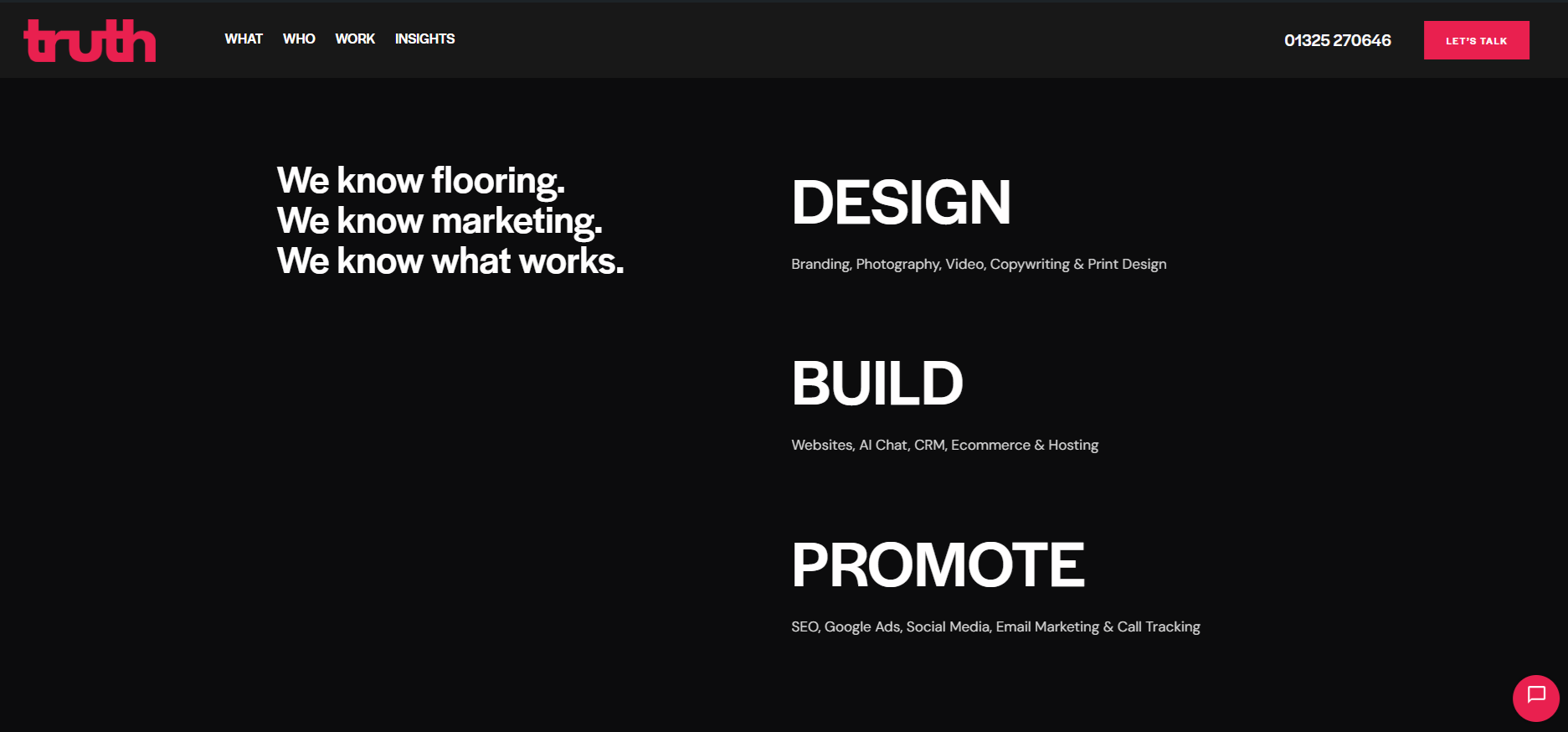
At Truth Digital, we build and optimise websites exclusively for flooring businesses across the UK. We handle everything covered in this guide: fast, mobile-first website development for flooring, specialist flooring SEO to improve your local rankings, and secure web hosting to keep your site protected and performing.
If you are ready to stop guessing and start generating consistent enquiries, we would love to talk. Book a free consultation with our team and we will assess your current site against every must-have in this guide. No jargon, no pressure. Just clear, practical advice on what will move the needle for your flooring business.
Frequently asked questions
What is the most important feature for a flooring website?
High-quality visual galleries featuring real projects are the most powerful trust and conversion driver for flooring websites. Authentic galleries with filters boost credibility and conversions by up to 45 percent.
How can I get my flooring website to rank higher locally?
Optimise your Google Business Profile and implement on-page local SEO. A fully optimised profile yields 7 times more clicks and can increase organic traffic by 214 percent.
Why does mobile-friendly design matter for flooring websites?
Over 60% of flooring searches in the UK take place on mobile devices, meaning non-responsive sites lose the majority of potential clients before they even see your work.
What legal protections do I need on my flooring site?
You must apply accessibility standards and HTTPS for legal compliance and customer trust. This includes a 4.5:1 colour contrast ratio, descriptive alt text, and a valid SSL certificate.
How often should I update my flooring website content?
Update project galleries monthly and your Google Business Profile weekly. Regular updates signal freshness to search engines and keep your rankings and enquiries consistently high.