
TL;DR:
- A sitemap is essential for flooring websites to accurately signal valuable pages and improve search engine rankings. Proper structure, regular updates, and technical setup directly enhance local SEO and site visibility. Treat your sitemap as a strategic reflection of your business priorities to maximize indexing and attract relevant inquiries.
Most flooring website developers and digital marketers overlook one of the most foundational technical SEO elements on their sites. Understanding what is sitemap flooring website means goes well beyond knowing it exists. A sitemap tells search engines which pages matter, where they live, and how often they change. Get it wrong and Google misses your best service pages entirely. Get it right and your hardwood installation, LVT, and carpet pages start ranking for the local queries that drive real enquiries. This guide covers everything: types, structure, technical setup, and local SEO impact.
What is a sitemap on a flooring website?
A sitemap is a structured file or page that lists all the URLs on your website. Think of it as a directory that tells search engines exactly what content exists and how it is organised. For flooring websites, that means your service pages, location pages, product galleries, and blog content are all clearly signposted for crawlers.
There are two distinct types worth understanding:
- XML sitemaps are built for search engines. They are machine-readable files submitted directly to Google Search Console and Bing Webmaster Tools. They include metadata such as when a page was last modified, how frequently it changes, and its priority relative to other pages.
- HTML sitemaps are built for users. They appear as a navigable page on your site, listing key sections and pages so visitors can find what they need quickly.
For flooring businesses specifically, an XML sitemap acts as a blueprint that helps Google discover and index your service, location, and product pages, which directly improves local search rankings.
The metadata fields in an XML sitemap carry real weight. The "lastmodtag tells crawlers when you last updated a page, which signals freshness. Thechangefreqfield indicates how often content shifts. Thepriority` attribute (scored 0.0 to 1.0) guides crawlers on which pages deserve attention first.

Pro Tip: Set priority 1.0 on your homepage and core service pages such as carpet fitting or hardwood installation. Drop location pages to 0.8 and blog posts to 0.5. This steers crawl budget to pages that generate enquiries.
Structuring your flooring sitemap for maximum SEO impact
Getting the structure right separates a sitemap that performs from one that just exists. Flooring contractors should explicitly include service pages, service area pages, and portfolio galleries for both user navigation and search engine discovery. Here is how to build that structure properly:
- Homepage — Always priority 1.0. Your brand anchor.
- Service pages — One page per service: carpet fitting, LVT installation, hardwood flooring, floor sanding, commercial flooring. Never lump them together.
- Location or service area pages — One page per city or region you serve. A URL like
/hardwood-floor-installation-manchesteroutperforms/services1every time. Keyword-rich URLs that reflect page content clearly improve both SEO performance and user trust. - Product or portfolio galleries — Showcase past work by floor type. These pages keep users engaged and support conversion.
- About, contact, and FAQs — Supporting pages that build trust and assist navigation.
- Blog or resource content — Lower priority, but still indexed for topical authority.
The table below compares how a well-structured flooring sitemap differs from a common poorly structured one:
| Feature | Well-structured sitemap | Poorly structured sitemap |
|---|---|---|
| URL naming | Descriptive and keyword-rich | Generic: /page1, /services2 |
| Location pages | Separate page per area served | Single generic contact page |
| Service pages | Individual page per service type | One combined services page |
| Priority settings | Tiered by business importance | All set to 1.0 or left blank |
| Multimedia | Images and videos included | Text pages only |
Grouping pages logically matters too. Services sit under a /services parent. Location pages live under /service-areas. This hierarchy mirrors how users navigate and how search engines interpret site architecture. Good website structure for flooring businesses directly feeds into how well your sitemap performs.
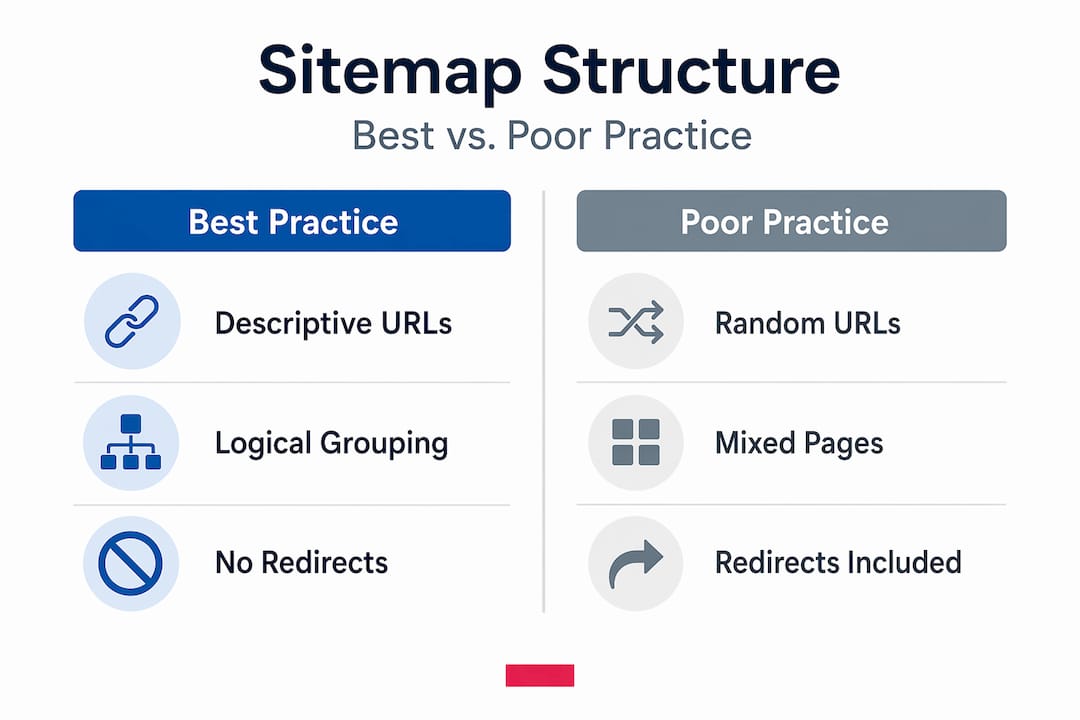
Pro Tip: Audit your sitemap every quarter. Remove redirect chains, noindex pages, and thin content from the file. Pruning oversized sitemaps to high-value hub pages improves crawl efficiency and indexing speed significantly.
Technical setup and maintenance for flooring sitemaps
Generating a sitemap does not need to be complex. Most modern CMS platforms handle it automatically, but understanding the technical layer helps you make better decisions and catch problems before they hurt rankings.
Key technical considerations for flooring developers include:
- Generation tools — CMS plugins handle basic XML sitemaps well. For bespoke builds, PHP 8.1+ libraries produce clean, standards-compliant XML. Modern sitemap tools now support image and video indexing, hreflang tags, gzip compression, and per-URL metadata like last modified dates and change frequency.
- Image and video sitemaps — Flooring websites are visual. Your portfolio and product images should appear in an image sitemap extension so Google can index them for image search. If you have installation videos, include a video sitemap too.
- Hreflang tags — If your flooring business serves Welsh or Scottish markets in multiple languages, hreflang tags in your sitemap signal the correct language version to search engines.
- Sitemap size limits — A single sitemap file supports a maximum of 50,000 URLs and must stay under 50MB uncompressed. Large flooring retailers with extensive product catalogues or many location pages should use a sitemap index file that references multiple child sitemaps.
- Submission and resubmission — Submit your sitemap through Google Search Console. For sites with frequent product or inventory updates, manual resubmission is not enough. Programmatic resubmission via the Search Console API triggers fresh crawls within 24 hours. This matters because Google deprecated the old manual ping endpoint in 2023.
The table below summarises the key technical settings for a flooring website sitemap:
| Setting | Recommended value | Notes |
|---|---|---|
| Sitemap format | XML | Standard for search engines |
| Max URLs per file | 50,000 | Use sitemap index for larger sites |
| Compression | Gzip recommended | Reduces file size for faster crawling |
| Submission method | Search Console API | Replaces deprecated ping endpoint |
| Update frequency | Automated on publish | Critical for product and location updates |
Local SEO and sitemaps for flooring businesses
This is where sitemaps move from technical necessity to genuine competitive advantage. Over 75% of local flooring buyers use search engines to find contractors. That makes local search visibility a core business function, not a nice-to-have.
Your sitemap plays a direct role in capturing that traffic. Here is how:
- Location-specific service pages in your sitemap signal to Google exactly where you operate and what you offer. A page titled “LVT flooring installation in Leeds” and submitted via sitemap gives Google a concrete reason to show your site when someone in Leeds searches for that service.
- Sitemaps support Google Business Profile verification. Including location-based services in sitemaps strengthens local SEO and helps confirm service area relevance during the verification process.
- Crawlability of localised content improves with a well-maintained sitemap. Without it, Google may miss newer location pages entirely, particularly on sites with weak internal linking.
- Crawl budget management is critical for flooring businesses covering multiple towns. Every URL Google crawls costs a fraction of your crawl budget. Prioritise your highest-value location and service pages in the sitemap and remove low-value pages from the file.
Pairing your sitemap with a properly optimised Google Business Profile creates a compounding effect. As combining sitemaps with optimised Business Profiles creates a powerful local SEO foundation, you are reinforcing your service areas from two directions simultaneously. Your website pages rank organically. Your Business Profile appears in the map pack. Both signals point to the same locations.
For practical guidance on home services SEO strategies that work alongside sitemaps, the approach applies directly to flooring businesses targeting local queries.
“Sitemap importance goes beyond listing pages; it is about structuring content that aligns with user search intent and business priorities.” — The Ideal Website Sitemap for Flooring Contractors
The onsite SEO factors for UK flooring businesses connect directly to sitemap strategy. A sitemap without strong on-page signals on those indexed pages will still underperform.
My take on flooring sitemaps after years of seeing what breaks
I have reviewed dozens of flooring websites where sitemaps were either completely absent, automatically generated without any thought, or bloated with hundreds of thin pages that were never going to rank.
The most common mistake I see is treating the sitemap as an afterthought. Developers launch the site, let the plugin generate whatever it generates, submit it once, and move on. Six months later the client is asking why their Manchester carpet fitting page is not showing up in Google. Nine times out of ten, the page either was not in the sitemap or was buried under dozens of low-value URLs diluting the crawl.
What actually works is treating the sitemap as a reflection of your business priorities. New domains in particular benefit from prioritising hub pages, such as service categories and city areas, for efficient indexing and strong internal linking. Start lean. Add pages as you build authority.
I have also seen flooring businesses with fast-changing stock or seasonal promotions lose rankings because their sitemap was not being resubmitted programmatically. Automating that process is one of the highest-return technical tasks you can do. It costs very little to set up and the payoff in timely indexing is real.
Avoid common flooring website mistakes that undermine even a well-built sitemap. Technical SEO and on-page quality have to work together.
— John
How Truth Digital can help with your flooring website
At Truthdigital, we build and optimise websites exclusively for flooring businesses. Sitemaps are one part of a broader technical and SEO strategy we put in place for every client.

When we build a flooring company website, the sitemap is planned from day one alongside the page architecture, URL structure, and local SEO targeting. We do not generate it as an afterthought. We structure it to reflect your services, your locations, and your business goals.
Our flooring SEO services include ongoing sitemap maintenance, crawl budget analysis, and programmatic resubmission for sites with regular content updates. And for businesses looking to stay front of mind with previous enquirers, our email marketing for flooring businesses complements the organic traffic your sitemap helps generate.
Get in touch with Truthdigital to talk through what your flooring website actually needs.
FAQ
What is a sitemap on a flooring website?
A sitemap is a file that lists all the pages on your flooring website so search engines can find and index them. XML sitemaps are submitted to Google Search Console and help search engines prioritise your service, location, and product pages.
Which pages should a flooring website include in its sitemap?
Flooring websites should include service pages, individual location or service area pages, portfolio galleries, and core supporting pages such as About and Contact. Each service type and each location served should have its own URL.
How do I create a sitemap for my flooring website?
Most CMS platforms generate XML sitemaps automatically through plugins. For bespoke builds, PHP libraries or dedicated sitemap tools produce standards-compliant files. Submit the sitemap through Google Search Console and automate resubmission for sites with frequent updates.
How does a sitemap improve local SEO for flooring businesses?
A sitemap helps Google discover location-specific service pages such as “carpet fitting in Birmingham,” which directly supports local search rankings. Location pages in sitemaps also strengthen Google Business Profile signals for your service areas.
How often should a flooring website sitemap be updated?
Update your sitemap every time you add or significantly change a page. For flooring sites with regular product or service updates, automate sitemap resubmission via the Google Search Console API so Google crawls new content within 24 hours.