

TL;DR:
- Online reviews are a crucial trust factor influencing over 97% of consumers’ decisions to choose local flooring businesses before direct contact. Maintaining recent, authentic reviews of at least 20 with high ratings and positive sentiment significantly boosts competitiveness and search rankings. Consistent, compliant review generation and prompt responses build credibility, enhance discoverability, and turn reviews into a powerful lead-generation tool.
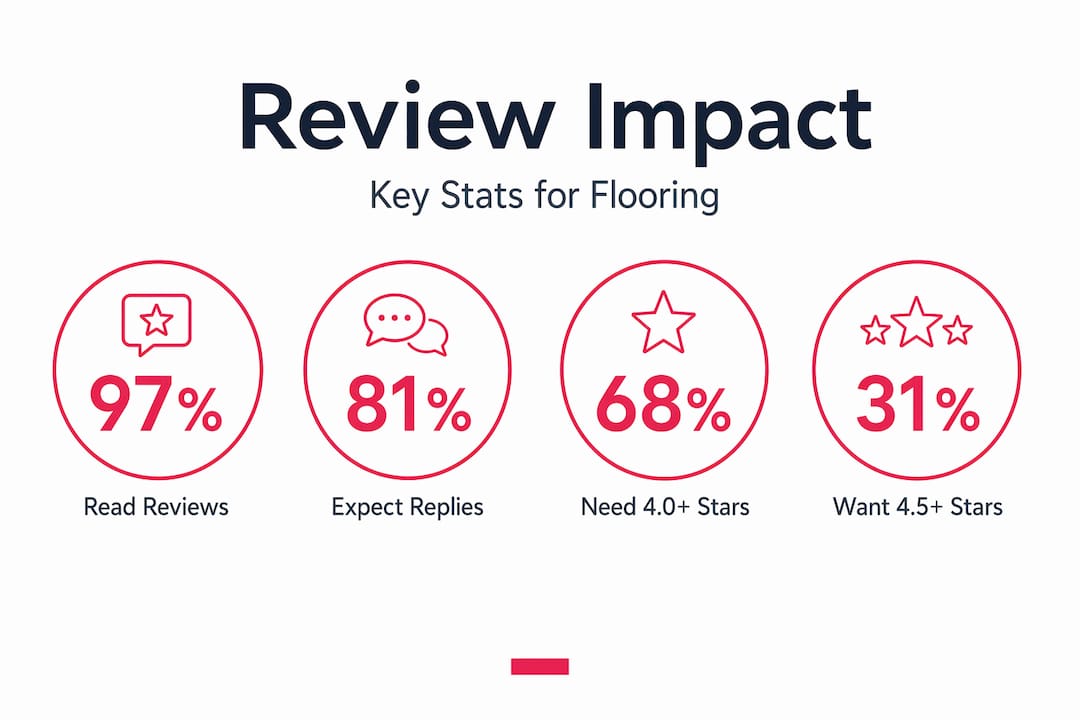
The role of online reviews in flooring is more decisive than most business owners realise. Price matters. Word of mouth matters. But before a potential customer picks up the phone or fills in an enquiry form, they check your reviews. 97% of consumers read online reviews for local businesses before deciding whether to use them. That stat should stop you in your tracks. This guide explains exactly how reviews shape buying decisions, what metrics you need to hit, how to generate them compliantly, and how to turn them into a steady stream of enquiries.
Key Takeaways
| Point | Details |
|---|---|
| Reviews are essential | Nearly all flooring customers read online reviews before choosing a business in the UK. |
| Quantity and recency matter | Aim for at least 20 fresh reviews posted within three months to build trust. |
| High ratings required | Most customers expect at least a 4.0 star rating, preferably 4.5+, with consistent positive sentiment. |
| Respond promptly | Reply publicly to every review, positive or negative, within a week to boost customer confidence. |
| Avoid incentives | Never offer discounts or gifts in exchange for reviews to comply with Google policies and protect reputation. |
How online reviews influence flooring customers’ decisions
Reviews are not background noise. They are the primary trust signal your potential customers rely on before they ever speak to you.
Think about the typical flooring buyer journey. A homeowner wants new LVT throughout their ground floor. They search Google, find three or four local businesses, and then what? They read reviews. Every single time. 97% of consumers read reviews before choosing a local business, and 41% say they always do so.
That behaviour reshapes how you should think about your marketing. Advertising and a well-designed website get you found. Reviews get you chosen.
Here is what customers actually care about when they read your reviews:
- Whether you show up on time and communicate well
- Whether the finish quality matches what was promised
- How you handled problems when things did not go to plan
- Whether recent customers had a good experience
That last point is critical. 47% of consumers will not use a business with fewer than 20 reviews, and 74% only care about reviews from the last three months. An impressive haul of reviews from 2022 does very little for you in 2026.
“Recency matters as much as quantity. A flooring business with 10 fresh reviews from the last eight weeks will often outperform one sitting on 80 reviews from three years ago in the minds of prospective customers.”
Understanding how to build online trust in a digital environment makes it clear why this is the case. Buyers use recency as a proxy for reliability. If nobody has reviewed you lately, they wonder whether you are still trading, still good, still the right choice.
Your review profile is, in effect, a living reference check. You need it to look active, positive, and genuine.
Key metrics for online reviews that flooring businesses must meet
Knowing reviews matter is one thing. Knowing exactly what you need to compete is another. Let us get specific.

31% of consumers only use businesses with 4.5 stars or higher, and 68% demand at least 4.0 stars. Drop below that threshold and you are handing enquiries to your competitors before a customer has even seen your showroom.
Here is a simple comparison to show where different businesses typically stand:
| Star rating | Consumer willingness to enquire | Risk level |
|---|---|---|
| 4.5 and above | High, preferred by 31% of buyers | Low |
| 4.0 to 4.4 | Acceptable to most buyers | Moderate |
| 3.5 to 3.9 | Significant drop-off in trust | High |
| Below 3.5 | Most buyers will not contact you | Very high |
A 4.2 average might feel safe. It is not. You are still losing the segment of buyers who will only consider 4.5-plus businesses. In a competitive local market, that segment is sizeable.
What separates strong review profiles from weak ones is not just the average score. It is sentiment consistency. A business with a 4.6 average built from a mix of detailed, authentic reviews will outperform a 4.8 average built from a sudden burst of vague five-star posts. Customers notice patterns. So does Google. Social proof works precisely because it reflects genuine, repeated experience rather than one-off praise.
Pro Tip: Use our free scorecard tool to check your current review score against competitor benchmarks and identify exactly where you are losing ground.
Benchmarking is something most flooring businesses skip entirely. Do not skip it. Spend 20 minutes looking at your nearest competitors’ review profiles on Google. Note their volume, their average score, and how recently they have collected reviews. That gap analysis tells you exactly what you need to close to compete. You can find a structured approach to this through competitive review benchmarking for flooring businesses.
Effective and compliant strategies to generate and respond to flooring reviews
Now for the practical side. Knowing the benchmarks means nothing if you do not have a clear system for getting reviews and managing them properly.
Getting more reviews
The best time to ask for a review is immediately after a successful job. Not a week later. Not when you send the invoice. Right when the customer is standing in their newly fitted room, pleased with the result. That moment of satisfaction is when you are most likely to get a detailed, genuine response.
Here is a simple, compliant review request process:
- Complete the job and carry out a final walkthrough with the customer.
- Ask verbally whether they are happy with the result.
- Follow up within 24 hours via text or email with a direct link to your Google review page.
- Use neutral wording such as: “If you have a moment, we would really appreciate your honest feedback on Google.”
- Do not ask again after one follow-up.
That last point matters. Pestering customers for reviews damages the relationship you just built.
Google prohibits incentives like discounts or gift cards in exchange for reviews. It is against their policy and risks your listing being penalised or removed. Do not offer vouchers, freebies, or loyalty points tied to leaving a review. It is not worth it.
- Always request reviews after positive interactions, not just completed jobs
- Never gate reviews by only sending requests to customers you expect will rate you highly
- Assign one person internally to manage your review inbox and response schedule
- Keep all review request templates neutral and free from any language that guides the rating
Responding to reviews
80% of consumers prefer businesses that respond to every review, and 81% expect a reply within a week. That applies to five-star reviews and one-star reviews alike.
For positive reviews, keep responses brief, personal, and genuine. Reference something specific from the review. “Glad the oak engineered boards look as good as you hoped” beats “Thank you for your kind words” every time.
For negative reviews, stay calm and factual. Acknowledge the concern. Offer to resolve it offline. Never get defensive in public. A measured, professional response to a poor review often reassures prospective customers more than a string of five-star ratings.
You can find a more detailed breakdown of how to handle enquiries and responses effectively, including review replies, in our step-by-step guide.
Pro Tip: Set a weekly calendar reminder to check and respond to all new reviews. Consistency is what builds your reputation over time. Not one great response, but dozens.
Pair your review strategy with well-managed local listings to make sure your Google Business Profile is accurate, complete, and working for you across every local search.
How online reviews improve flooring businesses’ discoverability and sales leads
The role of reviews in digital flooring goes well beyond trust signals. Reviews directly affect where you appear in local search results and how many enquiries you actually receive.
Google uses review signals, including volume, recency, and response rate, as ranking factors in local search. A flooring business with 60 recent reviews, a 4.6 average, and consistent responses will rank above a competitor with 10 stale reviews and no responses, even if the competitor has a better website.
Here is what the data tells us about changing buyer behaviour:
| Enquiry method | Trend in 2026 | Implication for flooring businesses |
|---|---|---|
| Online form submissions | Declining less sharply than calls | Digital presence and reviews are more important |
| Phone calls | Steeper decline | Buyers research fully before contacting |
| Showroom walk-ins | Gradually recovering | Still driven by prior digital research |
| Live chat / messaging | Growing | Reviews influence willingness to initiate contact |
According to the Cyncly Q1 2026 Flooring Industry Outlook Report, online form submissions for flooring retailers declined less sharply than phone calls, which points to one clear conclusion: buyers are doing more digital research before they ever make contact. Reviews are central to that research.
What does this mean for your business?
- Your review profile needs to be strong before buyers reach your website, because many will check Google before they click your link
- Fresh, specific reviews work as content. They tell the story of your workmanship and customer service in a way no webpage can replicate
- Combining educational content on your website with a strong review profile captures high-intent customers at the point they are ready to decide
Understanding how SERPs work for flooring businesses helps you see exactly how review signals feed into your overall search visibility. It is not a standalone activity. It is part of a wider set of digital marketing strategies that work together to drive enquiries.
A flooring marketing expert’s perspective on mastering online reviews for growth
Most flooring businesses treat reviews as a passive by-product of doing good work. They are not. They are an active part of your marketing, and the businesses that treat them that way are consistently outperforming those that do not.
Here is what we see repeatedly when working with flooring businesses across the UK. The ones struggling for enquiries often have decent reviews, sometimes even good ones, but they are inconsistent. A flurry of reviews in January, nothing for five months, three more in June. That pattern signals neglect, not quality. Consistent review velocity is more influential than chasing a handful of five-star posts in a single push.
The other mistake we see constantly is the generic response. “Thank you for your review, we hope to work with you again.” That tells prospective customers nothing. A response that says “Delighted the herringbone pattern came together so well in your hallway, it’s a real statement floor” tells them you pay attention, you care, and you know your craft.
On the subject of negative reviews: do not hide from them. A flooring business with 4.6 stars and two thoughtfully answered one-star reviews looks more credible than one with a suspicious 5.0 from 15 reviews. Buyers know that imperfection is real. How you handle it is what they are actually judging.
Timing and authenticity beat incentives every time. Review gating, where you only send review requests to customers you expect will rate you highly, and incentive schemes both carry real risk of penalties and reputational harm. Beyond policy compliance, they produce hollow profiles. Buyers can sense when something feels manufactured.
Our advice: build review generation into your post-job process as a non-negotiable step. Assign it. Track it. Review your competitor profiles quarterly to stay aware of where you stand. And respond to every single review within a week, no exceptions.
That is not a complex strategy. It is consistent execution of a simple one.
How Truth Digital helps UK flooring businesses leverage online reviews
Online reviews are one of the highest-impact areas we work on with flooring businesses, and it is almost always an area where there is room to improve.
We help flooring retailers, installers, and specialists build review generation workflows that are compliant, practical, and sustainable. Our SEO services for flooring businesses incorporate review signals directly into local search strategies, so your reviews do real ranking work. Our website design services integrate testimonials and review feeds in ways that build credibility the moment a visitor lands on your site. And if you are not sure where you currently stand, our free flooring growth pack gives you a clear picture of your review gaps, competitor benchmarks, and the quick wins available to you right now. Let us help you turn your reviews into a genuine lead generation tool.
Frequently asked questions
Why are online reviews critical for flooring businesses in the UK?
Reviews are the primary trust factor in local buying decisions. 97% of consumers consult reviews before choosing a flooring service, making them more influential than advertising or word of mouth alone.
How many reviews should a flooring business aim to have?
Aim for a minimum of 20 recent reviews as a starting point. 47% of consumers will not use a business with fewer than 20 reviews, so hitting that threshold is essential for credibility.
Can flooring businesses offer discounts in exchange for Google reviews?
No. Google explicitly prohibits offering discounts, gifts, or any incentive in exchange for reviews. Doing so risks penalties to your Google Business Profile and undermines the authenticity buyers rely on.
How quickly should a flooring business respond to online reviews?
Respond within one week. 81% of consumers expect a reply within that timeframe, and timely responses signal that your business is active, attentive, and trustworthy.
Do online reviews help flooring businesses get found on Google?
Yes. Reviews are a confirmed local ranking factor, and with digital research now driving more enquiries than ever, a strong review profile directly improves both your search visibility and your conversion rate.