
TL;DR:
- Audience targeting focuses marketing on people most likely to buy flooring products or services.
- Precise targeting reduces wasted ad spend and improves lead quality and conversion rates.
- Regular testing and refinement of targeting strategies are essential for sustained marketing success.
Spending money on digital ads that attract the wrong people is one of the most common and costly mistakes flooring businesses make. You could be getting hundreds of clicks from users who will never buy a carpet or lay a plank of wood flooring in their lives. That wasted spend adds up fast. Audience targeting fixes this by focusing your marketing on people who are genuinely likely to enquire and buy. This guide breaks down exactly what audience targeting means for UK flooring retailers and installers, how it works in practice, and how you can start using it to generate better quality leads right now.
Key Takeaways
| Point | Details |
|---|---|
| Precise targeting matters | Focusing on the right audience directly increases flooring enquiries and reduces wasted ad spend. |
| Tools power results | Digital platforms like Google Ads and email deliver stronger marketing when targeting features are fully used. |
| Segmentation drives ROI | Breaking down audiences lets you tailor offers and boosts conversion rates for your business. |
| Real-world success | Case studies prove that better targeting improves sales, not just traffic numbers. |
| Continuous improvement wins | Regularly testing and refining your targeting delivers the best long-term value for UK flooring companies. |
What is audience targeting for flooring?
Audience targeting means directing your marketing efforts towards specific groups of people who are most likely to want and buy your flooring products or services. Instead of showing your ads to everyone in the country and hoping someone bites, you narrow the focus to people who fit the profile of your ideal customer. That might be homeowners in your local area, landlords renovating buy-to-let properties, or commercial property managers looking for contract flooring solutions.
The problem with being too broad is straightforward. If your ads appear to anyone and everyone, you spend budget on clicks that will never convert. A student scrolling Instagram in Manchester is probably not looking to re-floor a three-bedroom detached house in Cheshire. Yet without targeting, your ads might reach that student. Every irrelevant click costs money. Irrelevant traffic also skews your analytics, making it harder to understand what is and is not working.
The core benefits of audience targeting are significant. First, you attract better leads. People who actually need flooring, in your area, with your budget range, are far more likely to call or fill in a contact form. Second, your conversion rate improves because your messaging speaks directly to the right person. Third, you reduce wasted ad spend, which means your cost per enquiry falls. All of this improves your overall return on marketing investment.
Targeted campaigns yield higher quality leads compared to unfocused ones, making every pound of ad spend work harder for your flooring business.
The core targeting options available to flooring businesses include:
- Location targeting, focusing on postcodes, towns, or regions where you operate
- Demographic targeting, based on age, household income, or homeowner status
- Interest and behaviour targeting, reaching people actively researching home improvements
- In-market audiences, people who are currently searching for flooring products online
- Keyword targeting, serving ads when people search terms like “wood flooring installer near me”
Understanding the types of flooring customers you serve is the first step to knowing who to target. Different customers have very different needs, budgets, and buying timelines. Getting that clarity before you set up any campaign saves you considerable time and money.
Look at flooring ad examples that have performed well, and you will notice one consistent factor. They speak to a very specific audience rather than trying to appeal to everyone. That specificity is what drives results.
How audience targeting works in digital marketing
Now that you know what audience targeting is, let’s look at the tools and methods flooring companies use to reach their ideal customers.

The three primary channels for flooring audience targeting are Google Ads, Facebook and Meta advertising, and email marketing. Each platform offers different strengths, and the best campaigns typically combine at least two of these. Google Ads allows for targeting by keywords, location, and demographics, making ads more relevant and significantly reducing wasted spend.
Here is how the main channels compare for flooring audience targeting:
| Platform | Key targeting features | Flooring example |
|---|---|---|
| Google Ads | Keywords, location, device, demographics, in-market | “LVT flooring installer Bristol” search ads |
| Facebook/Meta | Age, interests, homeowner status, lookalike audiences | Ad targeting homeowners aged 35-55 in Surrey |
| Email marketing | Segmented lists, purchase history, location | Follow-up campaign for bathroom flooring enquiries |
| YouTube/Display | Interest-based, retargeting, custom intent audiences | Video ad retargeting website visitors |
Setting up targeted ads for your flooring business follows a clear process. Here are the core steps:
- Define your ideal customer. Who is most likely to buy from you? Think about property type, location, budget, and project type.
- Choose the right platform. Google Ads suits people actively searching. Facebook works well for building awareness and reaching people before they start searching.
- Set your location parameters. Always restrict your targeting to the areas you can actually serve. There is no point in a flooring installer based in Leeds attracting leads from London.
- Select your audience signals. Use keywords, interests, or demographic filters that match your ideal customer profile.
- Write ad copy that speaks to that specific audience. A message aimed at buy-to-let landlords should look very different from one aimed at a family doing a home renovation.
- Set your budget and monitor performance. Review click-through rates and conversion rates weekly, especially in the first month.
Pro Tip: Use location radius targeting on Google Ads to focus exclusively on your service areas. Set a radius around your business premises or the postcodes where your best customers live. This alone can dramatically reduce irrelevant clicks.
Beyond basic targeting, there are two advanced options worth knowing about. Retargeting means showing ads to people who have already visited your website but did not enquire. These people already know who you are, so your cost per conversion is typically much lower. Lookalike audiences work by finding new users who share similar characteristics with your existing customers. Facebook and Google both offer these, and they can be extremely powerful for scaling a campaign that is already working.
Understanding flooring marketing funnels helps you match the right targeting to the right stage of the buying journey. Someone at the awareness stage needs different messaging from someone who has already visited your website three times. If you want a fuller picture of how these channels fit together, the practical digital marketing guide for UK flooring businesses covers the broader strategy in depth.
Audience segmentation: identifying your best flooring customers
Once you know how targeting works, it is time to get granular by segmenting your audience for even more powerful marketing.
Audience segmentation means splitting your potential customers into distinct groups based on shared characteristics. For flooring businesses, useful segments might include first-time buyers renovating a new home, landlords looking for durable, low-cost flooring options, high-end residential clients wanting bespoke wood or stone flooring, or commercial clients outfitting offices and retail spaces.
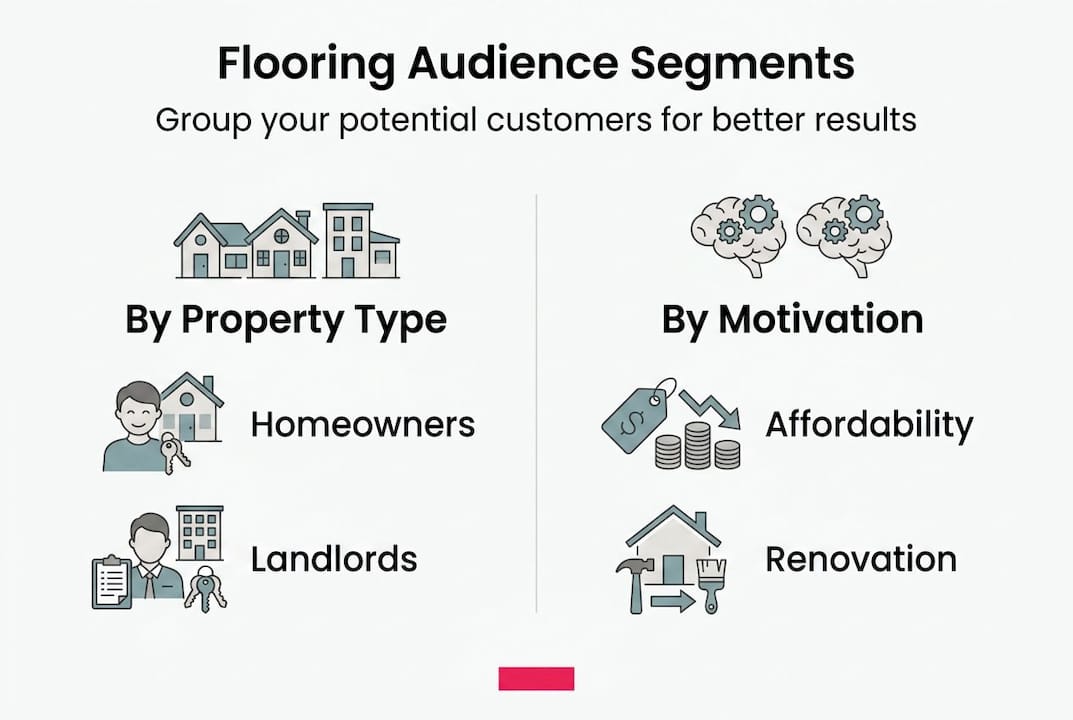
Segmenting audiences allows flooring companies to tailor offers and messaging for higher conversion rates, because each group has specific motivations and concerns that a generic message simply cannot address.
Here is a quick comparison of common flooring customer segments and the marketing approach that works best for each:
| Customer segment | Key motivation | Recommended message |
|---|---|---|
| First-time homeowner | Affordability, style | “Transform your home with quality flooring from £X” |
| Buy-to-let landlord | Durability, low maintenance | “Hard-wearing LVT perfect for rental properties” |
| High-end residential | Premium quality, aesthetics | “Bespoke wood flooring fitted by expert craftsmen” |
| Commercial client | Cost efficiency, speed | “Trade flooring solutions for offices and retail” |
| Developer/builder | Volume, consistent supply | “Flooring supply packages for new build projects” |
Segmentation also makes your email marketing far more effective. Rather than sending one newsletter to your entire database, you can send tailored messages. A landlord does not want to read about the latest luxury carpet ranges. They want to know which LVT options are most resistant to tenant wear and tear. Sending them relevant content dramatically increases open rates, click-throughs, and enquiries. Combining this with drip marketing strategies lets you nurture leads over time with messages that align to where each customer is in their buying process.
The key data points to collect for effective segmentation include:
- Property type (residential, commercial, buy-to-let)
- Location and postcode
- Project size and estimated budget
- Flooring type of interest (carpet, LVT, wood, tile)
- Source of enquiry (Google search, social media, referral)
- Whether the enquiry was for supply only or supply and fit
One pitfall to avoid is over-segmentation. If you create too many narrow segments, you end up with groups too small to market to efficiently, and you spread your budget too thin. Start with three or four clear segments and refine from there as you gather more data on what is working.
Exploring the full range of flooring customer segments available to UK businesses helps you prioritise which groups deserve the most attention based on value and volume.
Examples of successful audience targeting for flooring
Now, to make these concepts concrete, let’s examine how UK flooring retailers and installers have achieved impressive results with targeted marketing.
Consider a carpet retailer based in the East Midlands who had been running Google Ads for two years with mediocre results. Their campaigns targeted the entire UK. After tightening their location targeting to a 25-mile radius around their showroom and adding in-market audience filters for home improvement, their enquiry rate increased significantly within the first 60 days. The budget did not increase. Only the targeting changed.
Well-targeted Google Ads campaigns greatly improve enquiry rates for flooring companies, and the difference between broad and precise targeting can be dramatic. Here are the types of improvements businesses typically see after refining their audience targeting:
- Cost per enquiry falls by 30-50% when irrelevant locations are excluded
- Click-through rates improve when ad copy matches the specific audience segment
- Conversion rates on landing pages rise when the message aligns with the visitor’s intent
- Return on ad spend increases because budget focuses only on likely buyers
- Time spent on unqualified calls drops, freeing up your team for real prospects
A wood flooring installer in Surrey used Facebook lookalike audiences to reach new homeowners in the area who matched the profile of their best existing customers. The campaign targeted people aged 35 to 55 with homeowner status and interests in interior design. Within three months, they had booked six new projects directly from the campaign, all from customers who had no prior awareness of the business.
Examples show that audience targeting leads to more sales from digital campaigns, particularly when the targeting is reviewed and refined regularly rather than set once and left alone.
Pro Tip: Review your campaigns monthly and run split tests on your targeting parameters. Try one variation with a narrow radius and one slightly wider, then compare enquiry quality not just volume. Volume is easy to chase. Quality is what pays the wages.
Looking at real campaign examples from the flooring sector gives you a clearer sense of what good targeting looks like in action. It also pays to ensure your website is ready to convert the traffic you attract, which is why updating website content regularly is just as important as refining your ad targeting.
What most flooring businesses miss about audience targeting
Most flooring businesses we speak to believe more traffic automatically means more sales. It does not. A hundred unqualified clicks costs you money and wastes your time. Ten highly targeted clicks from local homeowners actively looking for flooring installation? That builds a business.
The real issue is that many firms set up targeting once, perhaps when they first launch a campaign, and never revisit it. They repeat the same approach month after month without reviewing the data. The cost stays the same but the results plateau or decline.
The businesses that win are the ones running regular tests. They try tightening their location radius. They test one audience segment against another. They check which keywords bring in genuine enquiries versus which ones bring in tyre-kickers. Small adjustments, made consistently, deliver compounding improvements over time.
True long-term marketing ROI in flooring does not come from doubling your budget. It comes from getting smarter about who you are reaching and why. Invest time in understanding your advanced marketing funnels and you will see how better targeting at each stage of the buyer journey leads to sustainable growth rather than short-term spikes.
Boosting your flooring leads with expert audience targeting
If you are ready to turn audience targeting insight into real flooring enquiries, here is how experts can help. At Truth Digital, we work exclusively with flooring businesses across the UK, and we know which targeting approaches deliver results in this sector specifically.
Trial and error is expensive. Partnering with specialists who already understand the flooring market shortens the learning curve dramatically. We manage Google Ads for flooring businesses with a focus on lead quality, not just click volume. Our SEO for flooring companies builds sustainable organic visibility that compounds over time. And if your website is not converting the traffic you are generating, our flooring website development service ensures you have a fast, clear, and persuasive platform to send leads to. Let’s talk about what targeted marketing can do for your flooring business.
Frequently asked questions
What is audience targeting in digital marketing for flooring?
It means focusing your marketing efforts on the people most likely to want your flooring solutions, based on factors like location, property type, or buying habits. Targeted ads bring in better quality leads than generic ads that reach an untargeted audience.
How do I know which flooring customers to target?
Analyse your previous customer data to identify patterns and use segmentation tools to focus on repeating property types, budgets, or locations. Understanding customer segments improves marketing results and helps you prioritise the most profitable customer types.
Which channels are best for audience targeting in flooring?
Paid search via Google Ads, Facebook advertising, and targeted email campaigns are the most effective channels for flooring audience targeting. Google Ads allows detailed audience targeting, leading to more relevant enquiries from people actively searching for flooring solutions.
What is the main benefit of audience targeting?
You get more qualified enquiries from people likely to buy, reducing wasted spend and improving your return on marketing investment. Targeted campaigns yield higher quality leads, which means less time chasing dead-end enquiries.
How can I improve my audience targeting for flooring in 2026?
Refine your segments regularly, test new targeting options, and analyse which campaigns drive the most enquiries rather than just the most clicks. Regular optimisation of targeting delivers better long-term results and keeps your cost per enquiry moving in the right direction.