TL;DR:
- Choosing professional website development enhances your flooring business’s credibility, SEO performance, and scalability significantly more than DIY builders. A tailored, well-structured site attracts local customers, integrates essential tools, and supports long-term growth, reducing costly technical debt over time. Partnering with experienced developers ensures your online presence effectively generates enquiries, builds trust, and keeps pace with your expanding business.
Most flooring businesses have a website. Far fewer have one that actually works. There is a widespread assumption that a drag-and-drop builder or a cheap template is enough to get by online. For flooring business owners weighing up that decision, understanding why choose professional website development is not an abstract question. It directly affects how many enquiries you receive, how customers perceive your brand, and whether your site keeps pace as your business grows. This article cuts through the noise and explains the real differences, with specific relevance to flooring retailers, installers, and sanding specialists.
Why choose professional website development: the core benefits
The most obvious benefit people cite is design. A professionally built site looks better. That is true, but it undersells the case considerably.
Custom design builds trust in a way templates cannot replicate. When a customer lands on your flooring site, they are making a split-second judgement about your professionalism. A generic layout with stock imagery signals that you are one of many. A tailored site that reflects your specific brand, product range, and location signals that you are the specialist they are looking for.
Here is where professional development earns its money in practical terms:
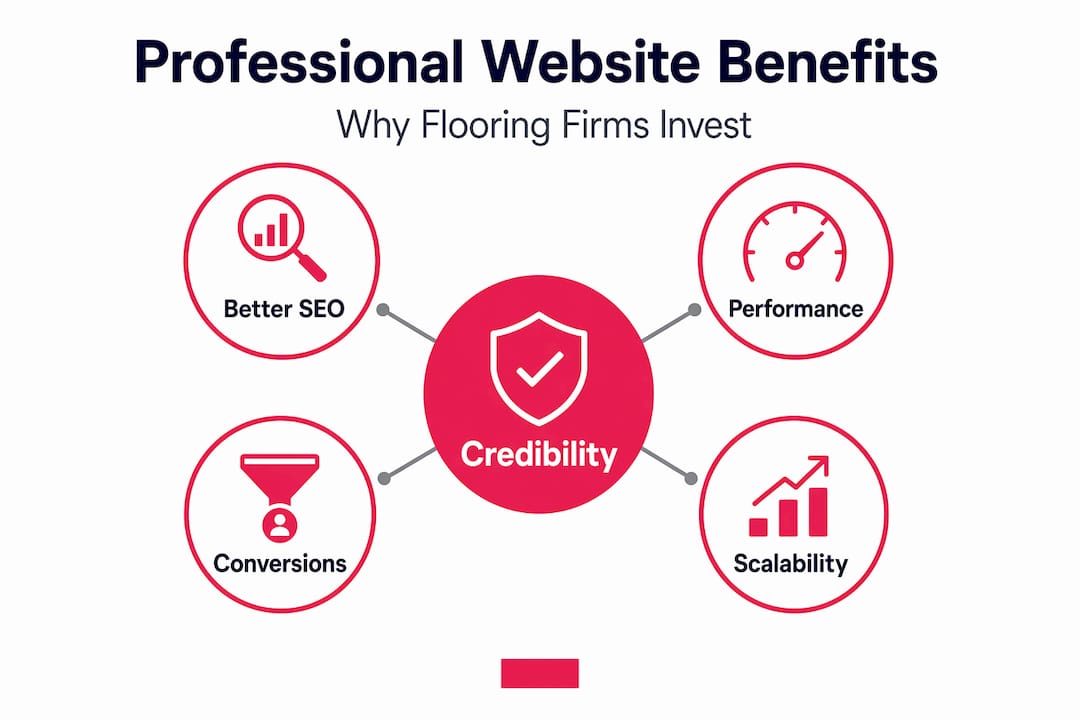
- SEO performance. Expert developers build sites with proper structure, fast load speeds, and clean code. Flooring businesses gain SEO advantage through expert site architecture targeting local searches, such as “LVT fitter in Leeds” or “carpet fitting Exeter.”
- Mobile-first design. Most flooring customers browse on a phone. Professional developers build for mobile as the primary experience, not as an afterthought.
- User experience (UX). Websites that perform poorly on UX lose potential customers and degrade brand perception. Professional UX design keeps visitors engaged and moves them toward making an enquiry.
- Security and reliability. Professional web development teams ensure website security with regular patches and audits, reducing the risk of data breaches and costly downtime.
- Scalability. Your business will grow. A professionally built site can accommodate e-commerce, appointment booking, or a product catalogue without requiring a complete rebuild.
- Ongoing technical support. You get a partner who keeps the site running, not a platform you are left to manage alone.
Pro Tip: Ask any web developer you speak to whether they have built flooring-specific integrations before. A developer with sector experience will already understand the difference between a product listing for carpet tiles and a service page for wood floor sanding. That context saves time and money.
The cumulative benefits here are significant. Expert web development builds stronger credibility, better performance, and improved customer loyalty over time.
DIY builders vs professional development
This is where a lot of flooring business owners get stung. The comparison appears simple on the surface: a DIY builder costs £20 a month, while a professional build costs several thousand pounds upfront. The maths looks obvious. It is not.
| Factor | DIY builder | Professional development |
|---|---|---|
| Upfront cost | Low (£15 to £40/month) | Higher (project fee) |
| Long-term cost | Ongoing fees, limitations, and workarounds | Lower maintenance cost over time |
| SEO performance | Limited, often penalised | Built-in best practices |
| Custom integrations | Restricted or unavailable | CRM, booking, inventory as needed |
| Design flexibility | Template constraints | Fully tailored to your brand |
| Scalability | Often requires platform migration | Built to grow with your business |
| Support | Community forums or generic chat | Dedicated technical partner |
Custom-built websites break even within 12 to 24 months due to better efficiency and scalability. That is a relatively short payback period when you consider the enquiries a properly optimised flooring site can generate.
The hidden trap with DIY builders is technical debt. Technical debt grows at 15 to 25% per year on poorly built sites. Every workaround, every plugin stacked on top of a template, every feature that does not quite fit adds cost and risk over time. For flooring businesses that want to list products, take room measurement requests, or integrate with a showroom booking system, these constraints become genuinely limiting.
There is also the issue of vendor lock-in. If you build your flooring business on a proprietary platform and that platform changes its pricing or shuts down a feature you rely on, your options are limited. A professionally built site on open standards gives you control.
DIY websites lack systematic cross-browser testing, which causes performance issues and SEO penalties. A customer visiting your site on an older Android browser and seeing a broken layout is not coming back.
Pro Tip: If budget is genuinely tight at launch, a hybrid approach is worth considering. Start with a professionally designed template-based site, but plan from day one for a custom build within 12 to 18 months. This approach offers faster market entry with a clear growth path, rather than an accidental migration forced by a failing DIY site.
Technical and marketing advantages that matter
Beyond aesthetics and cost, professional website development brings operational and marketing benefits that directly affect how your flooring business runs day to day.
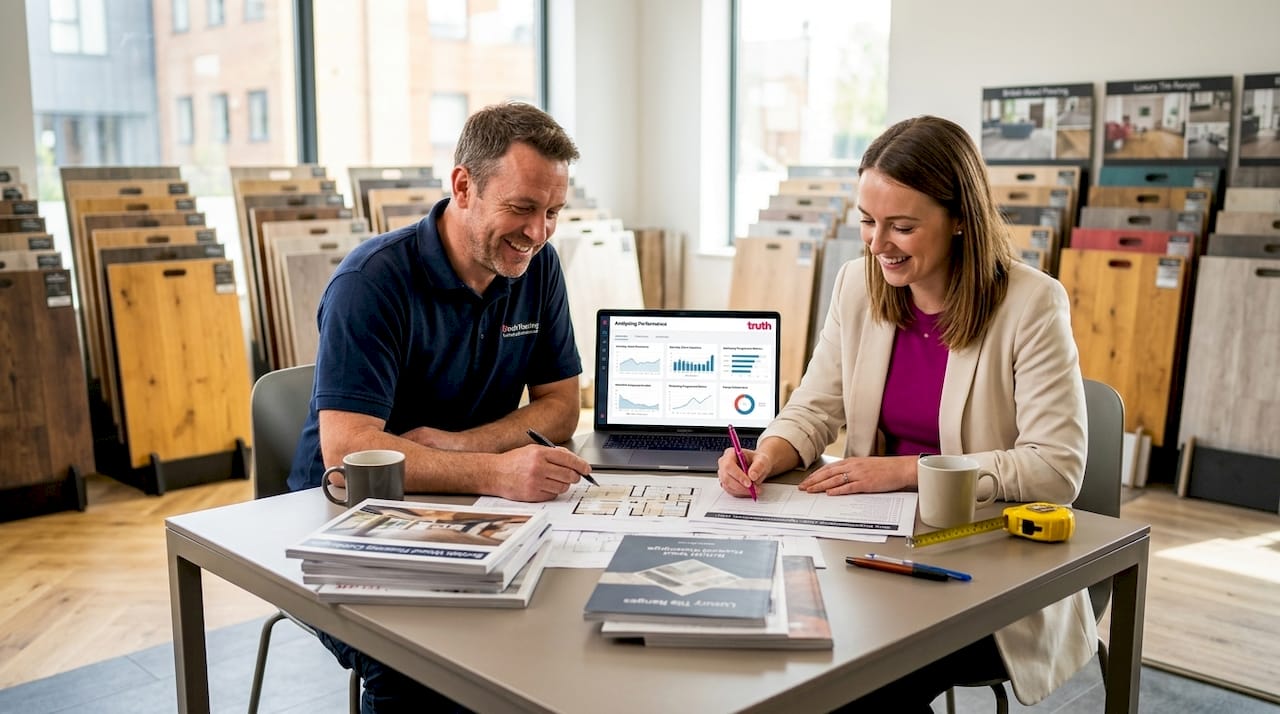
Consider what a properly structured website does for your local SEO. Expert site architecture improves visibility in competitive local searches for flooring services. This means dedicated service pages for carpet fitting, wood flooring, LVT, and sanding, each targeting specific locations. A professional developer builds this structure intentionally. A DIY builder leaves it to chance.
Here is what professional web development practically delivers on the technical and marketing side:
- Local SEO architecture. Properly structured pages, schema markup, and location targeting that helps your flooring business appear in the searches that matter.
- CRM and booking integrations. Whether you use a CRM to track leads, want customers to book a home visit, or need to manage stock, professional developers build those connections. Some flooring businesses are also exploring AI-powered call answering to handle enquiries outside business hours, which integrates far more cleanly with a professionally built site.
- Performance monitoring. Professional developers set up analytics properly. You can see where your visitors come from, what pages they engage with, and where you lose them before they enquire.
- Security and uptime. Secure, reliable hosting with ongoing monitoring means your site stays up and customer data stays protected.
- Brand consistency. Every page, every image, every call to action reflects your business in a coherent way. This matters when customers compare you to a competitor.
- E-commerce capability. Selling flooring samples, accessories, or even full products online is a growing channel. Expert developers build this properly rather than bolting on a generic shop.
A professionally developed website acts as a scalable virtual headquarters for your branding, sales activity, and customer engagement. That is not a luxury. It is an operational asset.
How to choose the right web development partner
Once you have decided that professional development is the right move, the next question is who to trust with it. This is where many flooring businesses make a costly mistake by choosing on price alone.
Here is a practical process for evaluating potential partners:
Check sector experience. An agency that has built sites for flooring businesses, or at least for home services trades, will already understand your customer journey. They will know why a room visualiser matters, why local service area pages are critical, and how to present product ranges effectively.
Understand the full team. You need design, development, SEO, content, and ongoing maintenance. Ask who handles each. A one-person freelancer may be excellent but cannot realistically cover every discipline without gaps.
Get a clear scope and timeline. Vague proposals lead to scope creep and budget overruns. A good partner will give you a detailed specification before work begins, with clear milestones and delivery dates.
Assess their communication. Are they responsive? Do they explain things in plain language? You will be working with these people for months, possibly years. Communication style matters as much as technical ability.
Read case studies and testimonials. Ask specifically for examples from flooring or trade businesses. Generic portfolio pieces do not tell you much about how they handle product listings, local SEO, or service-based conversion pages.
Plan for growth from day one. The right partner will ask about your three-year plan, not just your immediate needs. Avoiding common flooring website mistakes starts with choosing a developer who thinks ahead.
The goal is not to find the cheapest option. The goal is to find a partner who understands your industry, builds with your long-term growth in mind, and is genuinely invested in your results.
My take: what I have actually seen
I have worked with flooring businesses at various stages of their digital journey. What I have seen consistently is this: the ones who delay investing in a proper website always reach a point where they wish they had done it sooner. By that stage, they are dealing with a site that cannot be updated without breaking something, a Google ranking that has slipped, and a competitor who invested earlier and is now capturing the enquiries that should have been theirs.
The hidden cost of a poor website is not the maintenance bill. It is the lost revenue from customers who landed on the site, saw something unconvincing, and called someone else. That number is invisible on a spreadsheet, but it is real.
What I have also seen is that flooring businesses with professionally built, well-structured sites carry a genuine authority online. They rank better. They convert more visitors into enquiries. And because their site is built properly, they spend less time firefighting technical problems and more time running their business.
Viewing your website as a cost to be minimised is the wrong frame. It is a sales asset. Treat it like one.
— John
Work with a team that knows flooring
At Truthdigital, we build websites exclusively for flooring businesses. That means we already understand your services, your customer journey, and the local SEO structure your site needs to compete.
Our clients have seen real, measurable results from investing in professional web development. Take a look at how we helped The Flooring Outlet grow their online presence and generate more enquiries through a professionally built site and targeted SEO.
We also offer ongoing SEO for flooring companies, Google Ads management, and digital marketing strategy, all tailored to the flooring sector. Whether you are starting from scratch or looking to upgrade an underperforming site, we can build you a clear plan.
Get in touch with us at truthdigital.co.uk to talk through your requirements. No pressure, no jargon. Just a straight conversation about where your website is now and what it could be doing for your business.
FAQ
What are the main benefits of professional web design?
Professional web design delivers better SEO performance, faster load times, mobile-friendly layouts, and a brand-consistent experience that builds customer trust. For flooring businesses, it also supports local search visibility and lead generation.
Why hire web developers instead of using a template?
Templates carry hidden long-term costs including limited integrations, poor SEO foundations, and technical debt that grows over time. Professional developers build sites that scale with your business and perform consistently across devices and browsers.
How does professional website development help flooring businesses?
A professionally built flooring website can include dedicated service and location pages, product listings, booking integrations, and proper local SEO architecture. These features directly drive enquiries from customers searching for flooring services in your area.
How long does it take to see a return on a professional website?
Custom-built websites typically break even within 12 to 24 months through improved conversions, lower maintenance costs, and better organic search performance compared to DIY alternatives.
What should I look for when choosing a web development agency?
Prioritise agencies with experience in flooring or home services, a full team covering design, development, and SEO, and a clear process for scoping, delivery, and ongoing support. Case studies from similar businesses are a strong indicator of relevant expertise.