
TL;DR:
- Effective flooring product pages require high-quality images, accurate details, and structured data.
- Optimising for search visibility involves clear titles, benefits-focused descriptions, and Google Product schema.
- Thorough, well-presented listings increase customer confidence and drive online sales.
Getting customers to your flooring website is one challenge. Getting them to actually engage with your products is another entirely. Too many UK flooring retailers and manufacturers invest in driving traffic, only to lose potential buyers at the product page because listings are incomplete, confusing, or simply not compelling enough. Poor imagery, missing measurements, and unclear pricing all push customers away. This guide gives you a practical, no-nonsense walkthrough for setting up flooring product pages that attract search traffic, build trust, and convert browsers into enquiries.
Key Takeaways
| Point | Details |
|---|---|
| Prepare your assets | Gather detailed images, precise measurements, and pricing information before adding products. |
| Use structured data | Adding Product schema improves search visibility and merchant listing eligibility. |
| Optimise for sales | Write compelling product descriptions and include all variants for better online conversion. |
| Check for pitfalls | Common mistakes include unclear pricing and missing variant options; review each listing carefully. |
| Expert help | Specialist support can maximise your flooring site’s impact and streamline product listing management. |
What you need before adding flooring products
Rushing into uploading products without the right assets is one of the most common mistakes we see. Before you touch your CMS, get everything prepared. It saves time and avoids messy corrections later.
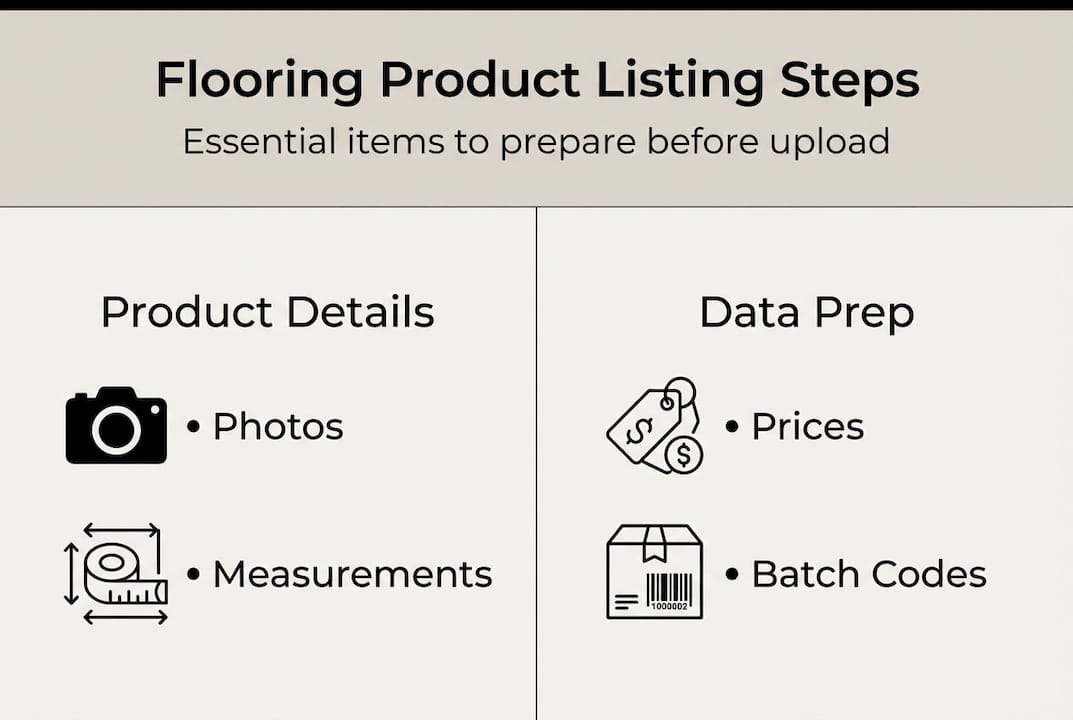
Here is what you need to gather:
- High-quality product images (minimum 1000px wide, multiple angles, lifestyle shots where possible)
- Accurate product dimensions and coverage per pack
- Pricing per square metre, not just per pack
- Colour and finish names, batch codes, and any variant information
- Product descriptions written with the buyer in mind
- Stock availability status
- Manufacturer data sheets or installation guides (PDF format works well)
Your platform also needs to be ready. Whether you are running WooCommerce, Shopify, or a custom CMS, confirm it supports variable products and unit pricing before you start. Check the flooring website essentials your site should already have in place.
Structured data is non-negotiable. Google recommends Product schema with properties including price, availability, images, and unit pricing for flooring sold by area, such as per square metre, to enable rich results and merchant listings. Without it, your products are invisible to Google Shopping and rich result features.
| Asset | Why it matters |
|---|---|
| High-res images | Builds trust, reduces returns |
| Price per m² | Reduces customer confusion |
| Batch codes | Avoids ordering mismatches |
| Product schema | Enables Google rich results |
| Variant data | Supports colour and size filtering |
Pro Tip: Create a simple spreadsheet with all product variants, batch codes, and pricing before you begin uploading. It makes bulk imports far quicker and reduces errors significantly.
Step-by-step: How to add a new flooring product
With your materials ready, follow these clear steps to get your flooring products live.
- Log in to your CMS and navigate to the products section.
- Select the correct category (for example, Engineered Wood, LVT, or Carpet).
- Add your product title. Keep it descriptive: include the product name, finish, and width.
- Upload images. Name each file clearly (for example, oak-herringbone-natural-angle.jpg). Properly named images support SEO and product gallery tips show they also improve click-through rates.
- Enter pricing per square metre as the primary price. Add pack price as secondary if needed.
- Write your product description. Focus on benefits, not just features.
- Add all variants: colours, widths, finishes, and batch codes.
- Implement Product schema. Most platforms have a plugin or built-in field for this. Include price, availability, images, and unit pricing as Google’s merchant listing guidance specifies.
- Preview the page before publishing. Check it on mobile as well as desktop.
- Publish and verify the listing appears correctly in search results using Google Search Console.
For larger catalogues, consider bulk importing via CSV. Here is a quick comparison:
| Method | Best for | Speed | Risk of errors |
|---|---|---|---|
| Manual upload | Small ranges (under 20 products) | Slow | Low |
| Bulk CSV import | Large catalogues | Fast | Medium |
| API integration | Manufacturer feeds | Very fast | Requires technical setup |
Well-implemented structured data increases product visibility in Google and can qualify your listings for rich results, including star ratings and price displays directly in search. That kind of visibility is hard to achieve any other way. To improve flooring site UX, make sure your product pages load quickly and display cleanly on all devices.

Optimise for discoverability and sales
Once your products are added, optimising for search and sales is a critical next step. A product page that nobody finds is a wasted opportunity.
Focus on these SEO fundamentals for every product:
- Title tag: Include the product name, key material, and a location or use case where relevant
- Meta description: Write a concise summary that includes the price per m² and a clear benefit
- Alt text for images: Describe the product accurately, include colour and material
- URL slug: Keep it short and descriptive (for example, /oak-engineered-flooring-natural-finish)
- Internal linking: Connect related products and buying guides to keep visitors on site longer
Structured data does more than help with indexing. Product schema markup can trigger rich results in Google Search, showing your price and availability directly in the results page. That means more clicks before a customer even reaches your site. To improve product SERPs, structured data is one of the most effective tools available.
Your product copy also needs to sell. Avoid listing only technical specifications. Lead with benefits: how the floor feels underfoot, how easy it is to maintain, how it works in busy family homes. Specific, relatable copy converts far better than generic descriptions.
Even the best flooring products will not sell themselves online. Clear, accessible, benefit-led listings are what turn a browser into a buyer.
Pro Tip: Add a sample request option or a product visualiser to your listings. Flooring is a tactile product and customers who cannot touch it in person need reassurance. Offering a free sample reduces hesitation and increases the chance of a sale. Keeping your site content updated with seasonal ranges and current stock also keeps listings relevant.
Avoid common pitfalls with flooring site products
After optimisation, double-check your listings with these critical verification steps and warnings.
The most common issues we see on flooring product pages are:
- Missing batch codes, causing customers to order mismatched stock
- Incorrect or absent price per square metre, leading to confusion and abandoned carts
- Unclear colour and size variants, forcing customers to contact you unnecessarily
- Images that are too small, too dark, or only show a single angle
- No stock availability indicator, leaving customers guessing
- Shipping information that does not account for the weight and size of flooring orders
As Google’s guidance on flooring product listings highlights, variable products with multiple colours and sizes, unit pricing per square metre, and heavy shipping logistics all need careful handling in your product data. Ignoring these edge cases creates friction at exactly the wrong moment in the buying journey.
To verify a listing is ready for customer traffic, run through this checklist:
- Does the page display correctly on mobile?
- Is the price per m² visible without scrolling?
- Are all variants clearly labelled with images?
- Is the batch code visible or available on request?
- Does the structured data validate in Google’s Rich Results Test?
- Is there a clear next step (add to basket, request a sample, get a quote)?
To avoid product page mistakes that cost you sales, and to boost online trust with buyers who are spending hundreds of pounds on flooring, every detail on your product page matters.
Pro Tip: Ask a member of staff who is unfamiliar with the product to try placing an order from scratch. If they get confused or cannot find key information, your customers will too.
The overlooked truth: Flooring product data is your silent salesman
Here is something we have seen time and again working with flooring retailers across the UK. Businesses with stunning showrooms and genuinely excellent products lose online sales not because of price, but because their product data is thin.
A competitor with average stock but thorough listings, clear pricing, good images, and proper structured data will consistently outperform a business with better products but poor pages. That is a hard truth, but it is an actionable one.
Structured, detailed product data reduces buyer hesitation. When a customer can see the price per m², the batch code, three angles of the product, a lifestyle image, and a sample request option, they feel confident. Confidence leads to enquiries. Enquiries lead to sales.
Many flooring businesses treat their website as a digital brochure. The ones growing fastest treat it as their best salesperson. Well-crafted product pages sell 24/7, even when your team is offline. Investing in photos, accurate spec sheets, and clear variant information pays off at every customer touchpoint. If you want to see how this translates into paid traffic too, look at effective flooring ads that pair strong product pages with targeted campaigns.
The businesses winning online are not necessarily the biggest. They are the most thorough.
Take your flooring site to the next level
Getting your product listings right is a strong start. But there is a lot more that goes into turning a flooring website into a consistent source of enquiries.
At Truth Digital, we work exclusively with flooring businesses across the UK. We build high-performing websites, implement structured data correctly from day one, and run SEO and Google Ads campaigns that bring the right customers to your product pages. Whether you need a full flooring website development project or ongoing SEO for flooring businesses, we can help. Explore what our flooring website specialists do differently, and get in touch to talk through what your site needs next.
Frequently asked questions
What is the best way to display price per square metre for flooring products?
Use structured data (Product schema) to specify unit pricing, and show the price per square metre clearly on the product page itself. Google recommends unit pricing for flooring sold by area to enable rich results and accurate merchant listings.
How do I make flooring products eligible for Google Merchant listings and rich results?
Add Product schema to every product page, including properties for price, availability, images, and unit pricing. Google’s merchant listing guidance covers exactly what properties are required to qualify.
What should I do if my flooring products have multiple colours or sizes?
List each variant with its own images and clear labelling, and ensure your schema includes all options. Handling variable products correctly in your structured data improves both search visibility and customer clarity.
How can I make my flooring products more attractive to online shoppers?
Use high-quality images from multiple angles, offer a sample request option, and write product descriptions that lead with benefits rather than technical specifications. Clear, benefit-led copy combined with strong visuals builds the confidence customers need to enquire.