TL;DR:
- A strong website structure helps customers find services quickly and improves search engine ranking.
- Effective site hierarchy includes clear navigation, internal links, descriptive URLs, and regular reviews.
- Ongoing structural optimization, including testing and fixing orphan pages, boosts inquiries and business growth.
Most flooring business owners put their energy into getting the design right. The colours, the imagery, the fonts. All of it matters, but none of it drives enquiries if your website structure is working against you. Website structure refers to the organisation, hierarchy, and connections between pages via navigation, URLs, and internal links. Get it wrong and customers leave. Search engines struggle. Leads dry up. Get it right and your website becomes your best salesperson. In this guide, we break down what structure means, how to build it well, and what to avoid.
Key Takeaways
| Point | Details |
|---|---|
| Structure is fundamental | A clear, logical site structure is the foundation for better customer experience and higher Google rankings. |
| Keep navigation simple | Limiting main menus to 5–7 items and grouping content helps visitors and search engines alike. |
| Regularly review your site | Quarterly checks help spot and fix common issues like orphaned or buried pages affecting leads. |
| Link images and services | Connecting galleries and service pages boosts engagement and conversions for flooring businesses. |
What is website structure and why does it matter?
Website structure is not about how your site looks. It is about how it is organised. Think of it as the backbone of your online presence. Every page, every link, every navigation item is part of that structure.
A strong structure does two important things. First, it helps your customers find what they need quickly. Second, it helps search engines crawl and index your pages efficiently. Both of those outcomes lead to more enquiries.
For flooring businesses, structure comes with unique challenges. You might offer carpets, LVT, wood flooring, and sanding services all under one roof. Each of those services needs its own dedicated page. Add local SEO into the mix and you also need location-specific content. Without a clear structure, these pages end up scattered and hard to find.
Here is what good structure covers:
- Clear navigation menus with logical categories
- A hierarchy that flows from homepage to service pages to supporting content
- Internal links that connect related pages
- Clean, descriptive URLs that reflect your content
- A sitemap that helps search engines understand your layout
Structure is not a design decision. It is a business decision. Every page you bury is a lead you are not capturing.
Many flooring websites we review have beautiful photography but poor page organisation. Customers land on the homepage and cannot find the carpet fitting service. They leave. That is a missed enquiry. Structure fixes that problem before it starts.

Key elements of effective website structure for flooring businesses
Now you know what structure is, let us look at what makes it work well for a flooring company.
Navigation menus are the first priority. Keep top-level items to five to seven maximum. More than that and customers feel overwhelmed. Use clear labels like “Carpets,” “Wood Flooring,” “LVT,” and “Contact Us.” Avoid vague labels like “Services” with no sub-items.
Hierarchical page structure is the second priority. Think of it in three layers. Your homepage sits at the top. Below that are your pillar pages, one for each major service or product category. Below those are your supporting or cluster pages, such as specific product ranges, room types, or location pages.
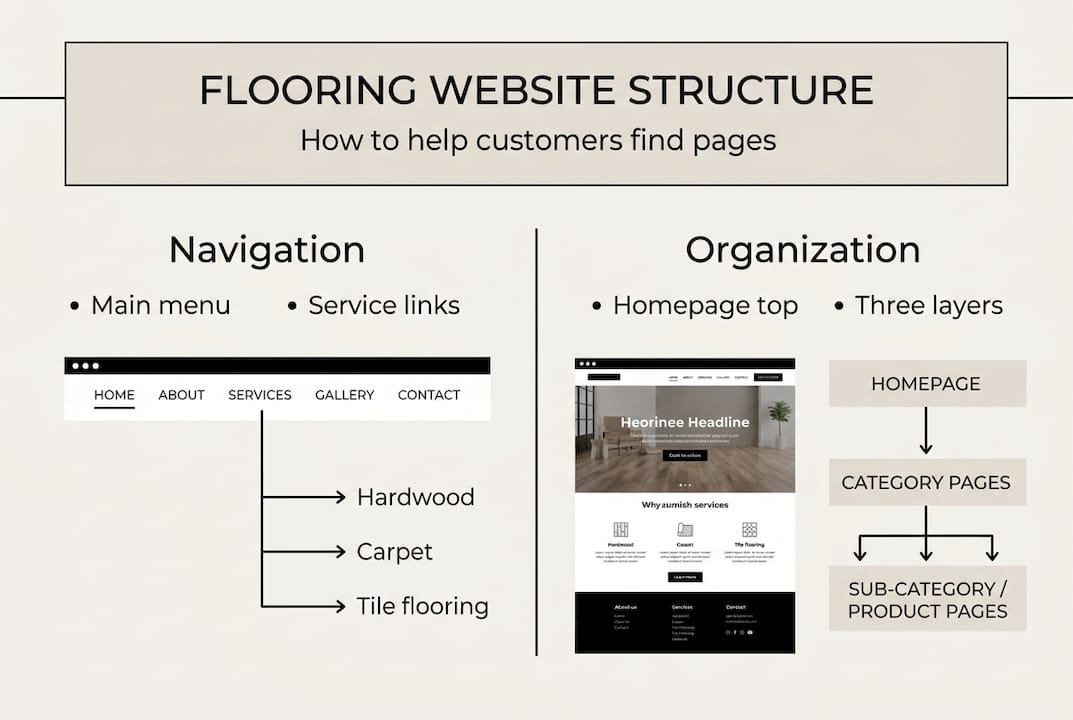
Internal linking connects everything together. Your LVT service page should link to your photo gallery, your reviews page, and a contact form. This keeps visitors on your site and signals relevance to search engines.
Here is a comparison of what well-structured and poorly structured flooring websites look like:
| Feature | Well-structured site | Poorly structured site |
|---|---|---|
| Navigation | 5 to 7 clear top-level items | 10+ vague or duplicated items |
| Service pages | One page per service type | All services on a single page |
| Internal links | Pages link to related content | Orphan pages with no links |
| URL structure | /carpets/bedroom-carpets | /page?id=42 |
| Gallery | Linked from each service page | Standalone with no connections |
Use content design methods such as card sorting and tree testing to validate your structure before you build. Card sorting asks real users to group your pages logically. Tree testing checks whether users can find content within your proposed structure.
- Map out every page you currently have
- Group pages into logical service categories
- Test the groupings with a small group of customers
- Build or adjust your navigation based on the results
- Link related pages together consistently
Pro Tip: When building your navigation, test it on a mobile device first. Most flooring customers browse on their phone. If your menu is hard to use on mobile, you are losing enquiries before they start.
For structure that drives enquiries, every layer of your site should lead towards a contact point. Never let a customer reach a dead end.
Proven steps to design or improve your site structure
Ready to take action? Here is a practical, step-by-step approach to building or fixing your flooring website structure.
- Conduct a content inventory. List every page on your website. Note the URL, the title, and its purpose. This gives you a full picture of what you have and what is missing.
- Group your content. Sort your pages into logical categories. Carpets, hard flooring, installation, about, and contact are natural groupings for most flooring businesses.
- Create a simple site map. Draw a visual diagram showing how pages connect. Your homepage links to main categories. Each category links to specific service or product pages.
- Test with tree testing. Use a tool like Treejack to run a tree testing exercise. Aim for over 80% success rate before you finalise your structure. This tells you whether real users can navigate your site without confusion.
- Monitor crawl depth quarterly. Use Screaming Frog to check how many clicks it takes to reach each page from your homepage. Pages buried more than three clicks deep are unlikely to rank well or receive enough traffic.
- Fix and repeat. Structure is not a one-time task. Review it every quarter and adjust as your business grows.
Here is a quick checklist you can use during a structure review:
| Check | Status |
|---|---|
| Every service has its own dedicated page | Done or to do |
| No page is more than 3 clicks from the homepage | Done or to do |
| All gallery pages link to relevant service pages | Done or to do |
| Navigation has no more than 7 top-level items | Done or to do |
| No orphan pages exist | Done or to do |
| URLs are descriptive and readable | Done or to do |
Avoiding common website mistakes at this stage saves a lot of costly rework later. Take the time to do this properly. It pays off in consistent organic traffic and enquiries.
Pro Tip: Run Screaming Frog on your site for free (up to 500 URLs). It reveals orphan pages, broken links, and crawl depth issues in one report. Fix those first before anything else.
For more on improving site UX, look at how your structure and user experience work together. They are closely connected.
Common pitfalls and advanced tips for UK flooring websites
Even well-intentioned flooring websites fall into predictable traps. Here is what to watch for.
Orphan pages are pages with no internal links pointing to them. Search engines rarely find them. Customers never see them. Every page you create needs at least one link from another page on your site. Orphan pages starve link equity and waste your content investment.
Overcrowded menus create confusion. When visitors see twelve navigation items, they often choose none. Simplify ruthlessly. Group related services under a single parent category with a clean dropdown.
Deep content is another common problem. If a page is five clicks from your homepage, it is effectively invisible. Both users and search engines deprioritise it. Keep your most important service pages within two to three clicks of your homepage.
Advanced tips for owners ready to go further:
- Use a hybrid structure combining a clear hierarchy with cluster content. Group carpet pages together, then cross-link to related blog posts and gallery images.
- Add breadcrumb navigation to every page. This helps users understand where they are and helps search engines understand your hierarchy.
- Link gallery images directly from service pages. A customer browsing your LVT page should be able to see real installation photos without leaving that section.
- Create location-specific pages if you serve multiple areas. Link them from your main service pages for local SEO benefit.
- Regularly update site content to keep pages fresh and relevant in search results.
The hybrid cluster-plus-hierarchy model consistently outperforms flat or overly deep structures for growing UK flooring businesses. It scales cleanly as you add new services or locations.
Pro Tip: Set up a simple spreadsheet to track every page, its parent category, and which pages link to it. Review this monthly. It takes ten minutes and prevents orphan pages from forming.
For solid enquiry handling practices, your structure needs to feed customers directly to your contact points. Every service page should end with a clear call to action.
Our experience: what actually makes a flooring website structure deliver results
We have worked with flooring businesses across the UK. Retailers, installers, sanding specialists. The pattern we see is consistent.
Most underestimate how much structure affects trust. A customer who cannot find your fitting service in two clicks assumes you do not offer it. They go elsewhere. It is not a design problem. It is a structure problem.
The flooring websites that generate the most enquiries share a common approach. Services are grouped logically. Each service page links to galleries, reviews, and a contact form. Navigation is simple. Nothing is buried.
What separates the best performers is that they treat structure as an ongoing asset. They review it quarterly. They add new pages as they add new services. They fix dead ends and broken paths as soon as they appear. A website redesign is not always necessary. Often a structural review and a round of fixes is enough to see measurable improvement in rankings and enquiries.
Our honest advice: do not build your structure once and forget it. Your business changes. Your website structure should change with it.
How to strengthen your flooring website structure with our help
If this guide has shown you that your current structure needs work, you are not alone. Most flooring websites we audit have at least three or four structural issues holding them back.
At Truth Digital, we specialise in exactly this. We work exclusively with flooring businesses across the UK. We audit your current structure, identify the gaps, and build or restructure your site to drive real enquiries. Our flooring SEO specialists understand the unique challenges of your industry. Our website development team builds sites that are fast, clear, and structured to convert. Whether you need a full rebuild or targeted improvements, we can help. Visit Truth Digital to find out how we support flooring businesses like yours.
Frequently asked questions
How does website structure affect SEO for flooring businesses?
A well-organised structure helps search engines crawl and index pages effectively, boosting visibility for your key services and generating more customer enquiries.
What is the best way to organise service pages for a flooring company?
Group services into clear main categories, link each service page to relevant gallery images, and keep your main menu simple. Service pages per type with gallery links consistently produce the best results.
How often should I review my website structure?
Review your structure at least every quarter. Use tools like Screaming Frog to monitor crawl depth and spot orphan or deeply buried pages before they affect your rankings.
What are orphan pages and why are they a problem?
Orphan pages have no internal links pointing to them. They starve link equity and remain invisible to both customers and search engines, meaning wasted content and lost leads.