

TL;DR:
- High-resolution flooring images are essential because they accurately display texture, color variation, and finish, influencing buyer confidence and sales. Low-quality images undermine trust and limit the effectiveness of AI visualisation tools, reducing commercial potential. Combining professional photography, AI previews, and lifestyle imagery with high-res files enhances marketing impact and conversion rates.
High-resolution flooring photography is defined as imagery captured at sufficient pixel density to render grain, texture, and colour variation accurately at full viewing size. For interior designers, architects, and renovation enthusiasts, this distinction is not academic. It is the difference between a client who orders confidently and one who second-guesses every choice. LVP and engineered hardwood yield an average ROI of 70% to 85%, and the ability to showcase those materials convincingly online directly affects whether that value is realised. AI visualisation tools like Roomvo and Home Narratives depend entirely on high-res input to generate previews buyers trust. Get the image quality wrong, and the entire digital sales process breaks down.
Why high-res images for flooring reveal what low-res images miss
The gap between a high-resolution and a low-resolution flooring image is not just visual. It is commercial. Low-res images flatten texture, muddy colour, and strip away the grain variation that tells a buyer whether a floor is premium oak or budget laminate. That ambiguity costs sales.
Here is what only high-resolution flooring photography communicates clearly:
- Texture and grain depth. The micro-bevelling on engineered hardwood, the embossed surface of Luxury Vinyl Plank, and the natural knot patterns in solid wood are invisible in compressed or low-resolution files. These details are what buyers use to assess quality before they ever visit a showroom.
- Colour accuracy and tonal variation. Flooring rarely reads as a single flat colour. Grey oak has warm undertones in certain light. Stone-effect LVT shifts between cool and neutral depending on the angle. High-res images capture that range. Low-res images collapse it into a single misleading tone.
- Scale and repeat pattern. Plank width, tile grout lines, and pattern repeat are spatial cues buyers use to imagine a floor in their own room. Blurred or pixelated images make that mental projection impossible.
- Finish type. Matt, satin, and high-gloss finishes behave completely differently underfoot and visually. A sharp, well-lit image communicates finish type instantly. A compressed image makes every floor look the same.
Flooring’s visual quality directly influences property valuation and buyer offers, which means the stakes for image clarity extend well beyond aesthetics. Buyers form first impressions from the floor up. If your images cannot communicate quality, your product cannot compete.
Pro Tip: When reviewing flooring images for a project, zoom to 100% in your browser or design software. If the grain or texture dissolves into pixels at that scale, the image will not perform well in AI visualisers or high-resolution print presentations.
How do high-res images improve customer confidence?
Flooring is a high-stakes, high-visibility purchase. Buyers know they will live with the result for years, and that awareness creates real anxiety. AI visualisation tools are described by experts as a critical way to reduce the cognitive burden of flooring decisions. But those tools only work when the source imagery is sharp enough to render accurately.
The confidence benefits follow a clear sequence:
- Clear expectations reduce post-purchase regret. When a buyer can see exactly how a floor will look, including its tonal variation, texture, and scale, they are far less likely to be surprised after installation. Surprise is the primary driver of returns and complaints.
- Side-by-side comparison becomes possible. High-res images allow designers and clients to place two or three flooring options next to each other digitally and make a genuinely informed choice. Blurry images make that comparison meaningless.
- AI visualisers produce accurate room previews. Tools like Roomvo and Home Narratives understand depth, scale, and lighting realistically when fed high-resolution input. Feed them a compressed image and the output looks unconvincing, which undermines trust rather than building it.
- Designers can present with authority. When you present a flooring recommendation to a client using sharp, detailed imagery, the proposal carries more weight. The image quality signals that you have done your homework.
“Flooring decisions are high-stakes and highly visible. Detailed, high-res visualisation tools build essential trust and reduce nerves for buyers.” — Roomvo
One practical example: a renovation client choosing between two herringbone oak options will struggle to decide from thumbnail-sized, compressed images. Show them the same options at full resolution, with visible grain and finish, and the decision often becomes obvious within minutes. That speed and certainty is the direct commercial benefit of image quality.
Traditional photography, AI visuals, and lifestyle images compared

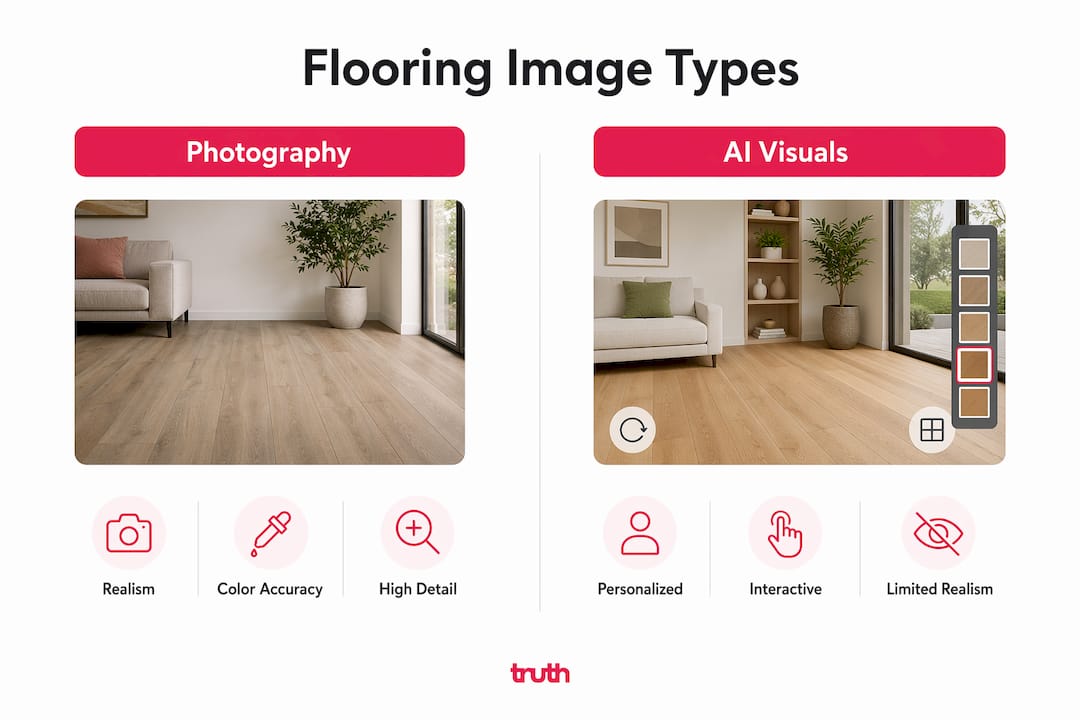
Not all flooring images serve the same purpose. Understanding the strengths and limitations of each type helps you choose the right approach for each stage of the design or sales process.
| Image type | Strengths | Limitations |
|---|---|---|
| Professional photography | Highest realism, accurate colour, full texture detail | Costly, time-consuming, static output |
| AI-generated visuals (Roomvo, Home Narratives) | Interactive, contextual, scalable across product ranges | Dependent on high-res input; cannot replace physical samples |
| Lifestyle photography | Sets aspirational context, shows flooring in real rooms | May not match exact product; lighting can mislead |
Professional photography remains the gold standard for product catalogues and high-end architectural presentations. A skilled photographer shooting engineered hardwood under controlled natural light will capture details that no other method replicates. The limitation is cost and flexibility. You cannot reshoot every product for every client brief.
AI visualisation tools fill the gap for interactive, personalised previews. Lifestyle imagery that is aspirational yet achievable, with authentic finishes and good lighting, enhances the visualisation experience by reflecting real living conditions. The key word is authentic. Overly styled showroom scenes can feel disconnected from how a buyer actually lives, which reduces rather than increases confidence.
The best approach combines all three. Use professional photography as your base product imagery. Deploy AI tools like Roomvo to let clients preview options in their own rooms. Use lifestyle images to set the emotional and aesthetic context. Each layer adds something the others cannot.
Pro Tip: When commissioning lifestyle photography for flooring, specify that the floor must be the focal point of at least 40% of the shots. Many photographers default to room composition, leaving the floor as background detail. That is the wrong priority for a flooring business.
How to capture or select optimal high-resolution flooring images
Whether you are photographing flooring yourself, briefing a photographer, or selecting images for a design presentation, the same principles apply. Image quality is not accidental. It is the result of specific, repeatable decisions.
- Shoot in natural daylight. Artificial lighting introduces colour casts that misrepresent flooring tones. North-facing rooms on an overcast day produce the most neutral, accurate light for flooring photography.
- Shoot from standing height. Photos taken in natural daylight from standing height, avoiding shadows or tight angles, produce the most accurate AI visualiser renderings. The same principle applies to standard photography. Low angles distort plank width and pattern repeat.
- Avoid shadows and obstructions. Furniture legs, rugs, and shadows from windows all obscure the floor surface. Clear the space before shooting.
- Capture texture close-ups separately. A full-room shot communicates scale. A macro close-up communicates material quality. You need both. For a flooring website photo gallery, pairing room shots with detail crops significantly increases engagement.
- Upload originals to AI tools. Compressed or resized images degrade AI visualiser output. Always upload the highest-resolution file available. High-res input images are what allow AI tools to capture colour, scale, and lighting realistically.
- Choose contextually relevant settings. A kitchen flooring image shot in a kitchen converts better than the same product shot in a generic white studio. Buyers visualise more easily when the context matches their own project. This is particularly relevant when choosing kitchen flooring, where material durability and visual tone both matter.
The practical implication is straightforward. If you are selecting images from a manufacturer’s catalogue for a client presentation, reject any image that fails these criteria. A poor image does more damage than no image at all.
What I have learned from watching flooring decisions up close
Working with flooring businesses across the UK, I have seen the same pattern repeat. A business invests in a beautiful product range, builds a website, and then populates it with compressed, poorly lit images pulled from a manufacturer’s PDF. The enquiry rate stays flat. The business assumes the problem is SEO or ad spend. It is almost always the images.
The uncomfortable truth is that buyers make quality judgements about the product and the business simultaneously from the same image. A blurry photo of premium engineered hardwood does not just fail to sell the floor. It actively signals that the business does not take quality seriously. That is a trust problem, and trust problems do not get fixed by Google Ads.
I have also seen the opposite. A flooring retailer we worked with replaced their entire image library with high-resolution photography and added Roomvo integration to their product pages. Enquiry rates increased within weeks. Not because the product changed, but because buyers could finally see what they were buying.
The one nuance I would add is this: physical samples remain irreplaceable for confirming texture, durability, and precise colour in the buyer’s environment. Digital tools shorten the decision process and reduce anxiety. They do not replace the moment a client holds a sample under their kitchen light. The goal is to get buyers to that moment faster and with more confidence. High-res imagery is what makes that possible.
The future direction is clear. As AI visualisation tools improve and screen resolutions increase, the minimum acceptable image quality will rise. Businesses that invest in high-resolution assets now will be ahead. Those that do not will find the gap increasingly difficult to close.
— John
How Truth Digital helps flooring businesses use imagery to win more enquiries
If you run a flooring business and your website is not converting visitors into enquiries, image quality is one of the first things we examine. At Truth Digital, we work exclusively with flooring retailers, installers, and manufacturers across the UK, and we know exactly how high-quality flooring visuals translate into leads.

We build websites designed to showcase flooring at its best, run SEO campaigns for flooring businesses that put your products in front of buyers actively searching, and manage Google Ads that convert clicks into showroom visits and direct enquiries. Our flooring website success stories show what is possible when strong imagery and smart digital marketing work together. If you want more enquiries from your website, let us talk.
FAQ
Why do high-res images matter for flooring sales?
High-resolution flooring images reveal texture, colour variation, and finish type accurately, giving buyers the visual information they need to purchase with confidence. Poor image quality creates ambiguity, which increases hesitation and reduces conversion rates.
Can AI visualisers work with standard-quality photos?
AI floor visualisers like Roomvo and Home Narratives produce significantly less accurate results with compressed or low-resolution input. Photos taken in natural daylight from standing height are the minimum requirement for reliable AI rendering quality.
Do digital images replace physical flooring samples?
No. Physical samples remain necessary for confirming colour accuracy under specific home lighting conditions and for assessing texture and durability directly. Digital tools shorten the selection process but do not replace hands-on evaluation.
What is the ROI impact of flooring image quality?
Flooring materials like LVP and engineered hardwood yield an ROI of 70% to 85%, but that value is only realised if buyers can see the quality clearly. Weak imagery undermines the perceived value of premium materials and reduces the likelihood of competitive offers.
What image types work best for flooring marketing?
A combination of professional product photography, AI-generated room previews, and aspirational lifestyle imagery produces the strongest results. Each type serves a different stage of the buyer’s decision process, and all three depend on high-resolution source files to perform effectively.