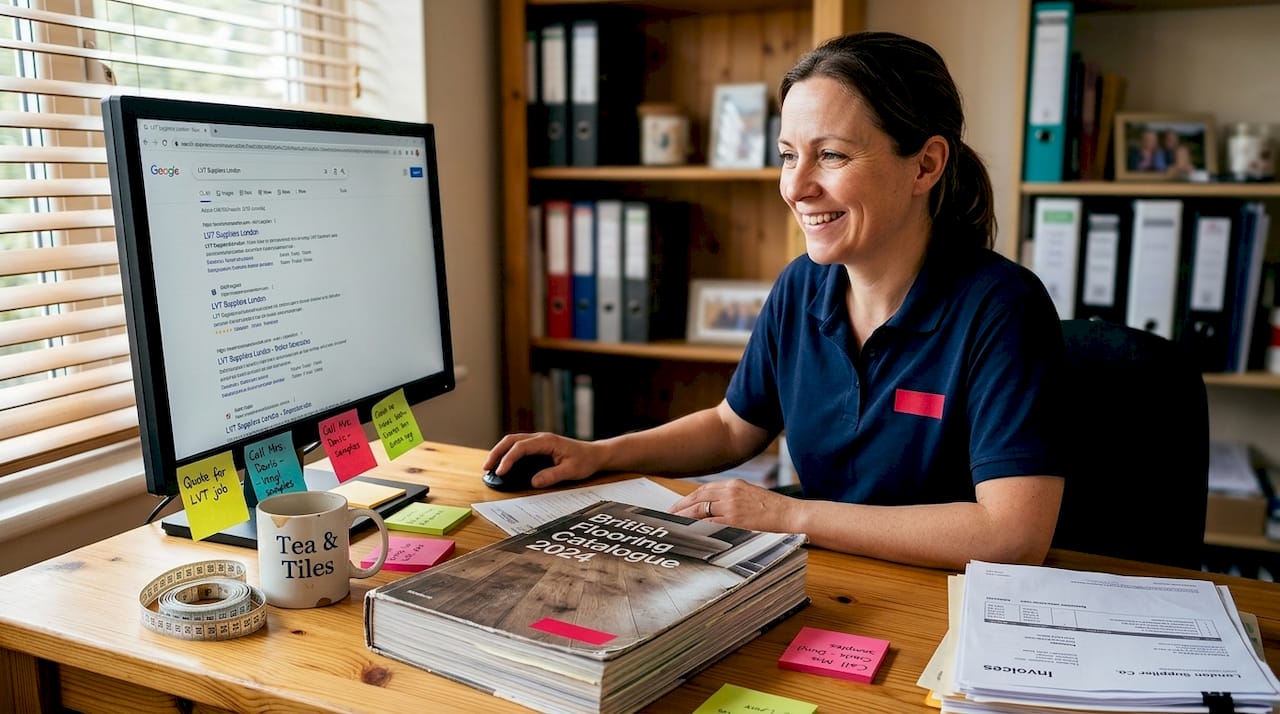
TL;DR:
- Effective keyword strategies focus on local, service-specific, buyer-intent terms for better leads.
- Most flooring businesses fail by targeting broad, competitive keywords instead of niche, localized phrases.
- Regularly review and optimize keywords to stay ahead of seasonal trends and evolving market competition.
Getting found on Google when someone searches for flooring in your area is harder than ever. Thousands of flooring businesses across the UK are competing for the same search terms, and most of them are guessing at which keywords to target. The right keyword strategy changes everything. It determines whether your website attracts ready-to-buy customers or sits invisible on page three. This article walks you through a clear, practical process for identifying, evaluating, and implementing the best keywords for your flooring business, so you can generate more enquiries and grow with confidence.
Key Takeaways
| Point | Details |
|---|---|
| Know your audience | Defining your customers’ needs underpins every keyword decision. |
| Keep research structured | Use the right tools and competitor insights for better keyword lists. |
| Focus on intent | Choose keywords with strong buying signals to attract more ready-to-buy clients. |
| Implement with care | Strategic keyword placement on your website directly boosts enquiry rates. |
Understand your audience and business goals
Before you type a single keyword into a research tool, you need to know who you are trying to reach. This is the step most flooring businesses skip, and it costs them dearly.

Start by defining your ideal customer. Are you targeting homeowners renovating their living rooms? Interior designers specifying flooring for new builds? Commercial contractors fitting out office spaces? Each of these groups searches differently, uses different language, and has different priorities.
Next, get clear on your core services and product specialisms. If you focus on LVT installation, your keyword strategy should reflect that. If you sell and fit carpets, wood flooring, and engineered boards, your keyword list will be broader. Clarity here prevents you from chasing irrelevant traffic.
Then define your business objectives. Do you want more volume, meaning lots of smaller residential jobs? Or are you targeting fewer, higher-value commercial contracts? Your goals shape which keywords are worth pursuing. A business chasing high-value kitchen flooring projects in Manchester needs very different terms than one doing volume carpet fitting across a whole county.
Once you know your audience and goals, think about the language your customers actually use. Most homeowners do not say “engineered hardwood flooring installation.” They say “wood floor fitters near me” or “best flooring for kitchen.” Defining your target audience is a critical step that directly shapes which search terms you pursue.
Businesses that define their target audience see higher ROI from marketing, and keyword strategy is no different. When your keywords match the real language of your ideal customer, you attract better quality visitors who are far more likely to convert.
Here is what to clarify before you start keyword research:
- Who are your ideal customers (homeowners, designers, contractors)?
- What services and products do you specialise in?
- What locations do you serve?
- Are you chasing volume or high-value jobs?
- What does a successful enquiry look like for your business?
This groundwork also helps with converting flooring enquiries once visitors land on your site, and informs any site improvements you make along the way.
Pro Tip: Write down five questions your customers typically ask before booking. Those questions are often your best keyword starting points.
Research keywords: Tools, trends, and techniques
Once you have mapped your audience and goals, it is time to uncover the search terms they actually use. Keyword research tools make this process far more reliable than guessing.
Here are the main tools worth using:
- Google Keyword Planner: Free and straightforward. Enter a service or product and it returns related terms with estimated monthly search volumes. Ideal for beginners.
- SEMrush: A paid platform that shows keyword difficulty, competitor rankings, and trend data. Excellent for spotting gaps in your competitors’ strategies.
- Moz Keyword Explorer: Strong for understanding keyword research basics and assessing how realistic it is to rank for a given term.
- Google Search Console: Free and often overlooked. It shows which terms your site already ranks for, so you can build on existing momentum.
- Google Autocomplete: Type a flooring term into Google and watch what it suggests. These suggestions reflect real searches happening right now.
Platforms like Google Keyword Planner and SEMrush make keyword discovery far more structured and evidence-based than relying on instinct alone.
Seasonal trends matter too. Flooring searches shift throughout the year. Carpet fitting enquiries often spike in autumn as homeowners prepare for winter. Hard flooring searches tend to rise in spring. Build these patterns into your content calendar and you will capture demand at exactly the right moment.
Competitor analysis is equally powerful. By analysing competitor sites, you can identify which keywords they rank for and, more usefully, which relevant terms they are missing. Those gaps are your opportunity.
Pro Tip: Use keyword analysis techniques to filter by intent, not just volume. A keyword with 200 monthly searches and strong buying intent will outperform a 2,000-search term where people are just browsing.
Here is a quick comparison of the main tools:
| Tool | Cost | Best for |
|---|---|---|
| Google Keyword Planner | Free | Volume data, beginner research |
| SEMrush | Paid | Competitor analysis, trend tracking |
| Moz Keyword Explorer | Paid | Difficulty scoring, niche terms |
| Google Search Console | Free | Existing rankings, quick wins |
| Google Autocomplete | Free | Real-time search suggestions |
Focus on building a balanced list. You want a mix of high-traffic broad terms and specific long-tail phrases. Long-tail keywords like “LVT flooring fitters in Leeds” may attract fewer visitors, but those visitors are far more likely to pick up the phone.
Evaluate and select your best keyword options
With a list of keyword options in hand, the next step is selecting the winners most likely to deliver strong results. Not all keywords are equal, and choosing poorly wastes time and budget.
Start by assessing search intent. Every keyword falls into one of three categories:
- Informational: The searcher wants to learn (“what is LVT flooring”).
- Navigational: They are looking for a specific business or brand.
- Transactional: They are ready to buy or book (“carpet fitters near me”).
For most flooring businesses, transactional and local keywords deliver the highest return. Informational terms can support your content strategy and build trust, but they rarely convert directly into enquiries.
Next, review keyword difficulty. This score, available in most research tools, indicates how hard it is to rank for a given term. A brand-new flooring website will struggle to rank for “wood flooring UK” against established national retailers. Start with lower-difficulty terms and build authority over time.
Local modifiers are one of the most effective tactics available to flooring businesses. Adding your city, town, or region to a keyword dramatically reduces competition and increases relevance. Targeting location-specific flooring keywords increases the likelihood of winning local business, and this is where many smaller flooring companies can genuinely outperform larger national brands.
Here is a simple framework for shortlisting keywords:
| Keyword | Monthly searches | Difficulty | Intent | Priority |
|---|---|---|---|---|
| Carpet fitters Birmingham | 320 | Low | Transactional | High |
| Wood flooring UK | 5,400 | Very high | Mixed | Low |
| LVT installation Manchester | 110 | Low | Transactional | High |
| What is engineered flooring | 880 | Medium | Informational | Medium |
Shortlist five to ten primary keywords that are realistic to rank for and directly tied to your core services. Then build a supporting list of fifteen to twenty long-tail alternatives. This gives you a focused strategy without spreading effort too thin.
Avoid the trap of chasing only the biggest search volumes. Many flooring businesses make this mistake, and it is one of the website mistakes that quietly costs them leads every month.
Pro Tip: Prioritise keywords that combine location plus service plus product. For example, “engineered oak flooring fitters Sheffield” is far more targeted than “flooring Sheffield” and far more likely to attract a buyer.
Implement keywords on your flooring website for maximum impact
Having handpicked your ideal keywords, the next step is powerful implementation across your website. Knowing the right terms is only half the job. Placing them correctly is what drives rankings.
Here is the order of priority for keyword placement:
- Page title tag: This is the clickable headline in Google search results. Include your primary keyword here, ideally near the start.
- Meta description: A brief summary shown under the title in search results. Include your keyword naturally and write it to encourage clicks.
- H1 heading: The main on-page heading. One per page, and it should include your primary keyword.
- H2 and H3 subheadings: Use supporting keywords and related terms here to reinforce relevance.
- Body copy: Weave keywords naturally throughout the page. Do not force them. Readability matters.
- Image alt text: Describe images accurately using relevant terms. This supports both SEO and accessibility.
Optimised placement of keywords in headings, meta descriptions, and page copy lifts search performance consistently across flooring websites we work with.
“Write for your customer first, then optimise for search engines second. Pages that read naturally and answer real questions will always outperform keyword-stuffed content.”
Each core service should have its own dedicated page. A carpet fitting page, an LVT installation page, a wood flooring page. Each one targets its own set of keywords. Do not cram everything onto one page and expect Google to figure it out.
Location pages work brilliantly for flooring businesses serving multiple areas. A page titled “Carpet fitters in Nottingham” targeting local search terms can rank independently and drive enquiries from that specific area.
Update your portfolio and gallery pages too. Adding descriptive captions and alt text with relevant terms helps these pages contribute to your overall SEO. Learn more about improving your site gallery to make every page work harder.
Finally, monitor performance. Use Google Search Console to track which keywords are driving impressions and clicks. Review this monthly. Rankings shift, and staying responsive keeps you ahead. Follow the keyword implementation guide from Yoast for a structured approach to on-page optimisation.
Why most flooring businesses get keyword strategy wrong—and how to stand out
Here is the honest truth: most flooring businesses either ignore keyword strategy entirely or focus obsessively on the same three or four obvious terms everyone else is chasing. Neither approach works.
We see it constantly. A business targets “flooring company” and wonders why they are invisible on Google. That term is dominated by national directories and aggregators with years of domain authority. You will not beat them by targeting the same phrase.
The flooring businesses that genuinely grow their enquiries through search do something different. They go granular. They target hyperlocal, service-specific, buyer-intent terms that their competitors have overlooked. We worked with one flooring company that tripled their monthly leads within six months simply by switching from broad terms to long-tail, location-specific queries. No new website. No paid ads. Just smarter keyword choices.
The other mistake is treating keyword strategy as a one-time task. Search behaviour evolves. New competitors enter the market. Seasonal patterns shift. Your keyword list needs to evolve too. Review it quarterly, test new terms, and retire ones that are not delivering.
Stay customer-obsessed. Use the language your clients use, not the jargon your industry uses. Check out real ad examples to see how the best flooring businesses frame their offer in plain, customer-focused language. That same thinking applies directly to keyword selection.
Supercharge your flooring business with expert help
You now have a clear, practical process for choosing keywords that drive real enquiries. But strategy and execution are two different things, and doing both well takes time.
At Truth Digital, we specialise exclusively in digital marketing for flooring businesses. We have a proven track record helping flooring companies dominate local search results through tailored SEO services for flooring companies, targeted Google Ads, and high-performing website builds. Whether you are starting from scratch or looking to sharpen an existing strategy, we can help. Explore why we are the No. 1 agency for flooring businesses in the UK, and learn more about understanding SERPs to see how search visibility translates into real growth. Get in touch today and let’s build a keyword strategy that actually works.
Frequently asked questions
What makes a keyword high value for flooring businesses?
Balancing search volume, intent, and competition is essential for keyword value. A high-value keyword combines realistic ranking potential with clear buying intent directly relevant to your core flooring services.
How often should I review my flooring website keywords?
Quarterly reviews are best practice for staying ahead of competitors and reacting to seasonal trends. Keyword refinement over time drives consistently improved search rankings for flooring businesses.
How do I find long-tail keywords for specialist flooring services?
Use keyword research tools, apply location or service modifiers, and study how competitors structure their content. Long-tail keywords increase relevance and conversion rates significantly for niche flooring services.
Should I use the same keywords for Google Ads and my website?
Overlap is fine for high-priority terms, but tailor each list carefully. Paid advertising and organic SEO keyword strategies have key differences in how they target, match, and convert searchers.