TL;DR:
- An outdated flooring website undermines trust, harms search rankings, and causes potential customers to choose competitors.
- A well-executed redesign enhances user experience, boosts organic traffic, and significantly increases enquiry conversions.
Your website is working against you right now. Not because your flooring work isn’t good enough, but because an outdated site quietly kills trust, buries your rankings, and sends potential customers to a competitor before they’ve even seen your showroom. The advantages of website redesign for flooring shops go far beyond a fresh coat of paint. A well-executed redesign increases organic traffic, generates more enquiries, and builds the credibility that converts browsers into buyers. This article walks you through exactly how and why it works.
Key Takeaways
| Point | Details |
|---|---|
| Conversion uplift | A well-planned website redesign typically increases conversion rates for flooring shops by 20 to 50 percent. |
| SEO growth | Redesigns improve organic traffic by enhancing mobile performance and technical SEO, often resulting in 30 to 60 percent growth within a year. |
| Enhanced trust | Modern website design instantly builds trust, as users judge credibility within seconds of visiting. |
| Reduced maintenance | Updating to modern platforms lowers long-term maintenance costs by mitigating security and compatibility issues. |
| Strategic investment | Flooring shops benefit most when redesigns are viewed as long-term digital growth strategies, not just cosmetic updates. |
How to evaluate your website’s need for redesign
Before committing to a redesign, you need to know whether your current site actually warrants one. Not every flooring website needs a full rebuild. But most do.
Here are the clearest warning signs:
- Pages take longer than 3 seconds to load on mobile
- Your site looks broken or cluttered on a smartphone
- The design hasn’t changed in more than three years
- Visitors leave quickly without contacting you (high bounce rate)
- You’re not appearing on the first page of Google for local flooring searches
- Your CMS (content management system) is outdated or unsupported
- You can’t easily add new product pages or update content yourself
If three or more of these apply, a redesign is overdue.
When it comes to metrics, look at your Google Analytics data. If your bounce rate is above 65% and your average session duration is under 60 seconds, visitors are not engaging. That’s a conversion problem rooted in design and performance.
The need for redesign is confirmed by poor mobile performance, slow speed, outdated visuals, low conversions, and unresolved technical SEO issues. These aren’t cosmetic problems. They cost you real enquiries every week.
Follow this process to assess your position:
- Run your site through Google PageSpeed Insights and note your mobile score
- Open your site on three different mobile devices and check for layout issues
- Review your Google Search Console for crawl errors and keyword drops
- Compare your site design to those of your top local competitors
- Check whether your site has an SSL certificate (https) and a clear privacy policy
Once you’ve done that, you’ll have an honest picture of where redesigning your flooring website sits on your priority list.
Key advantages of website redesign for flooring shops
With a clear picture of your current site’s weaknesses, the benefits of redesign become concrete rather than abstract.
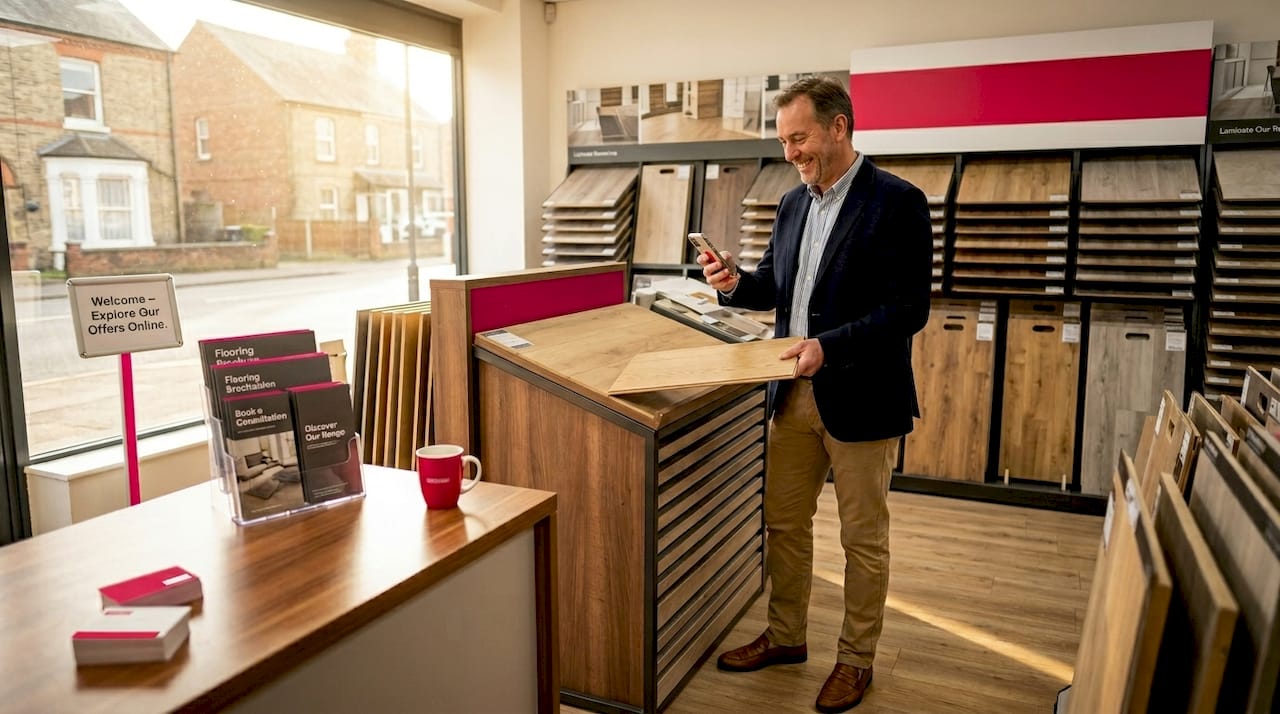
The headline numbers are significant. Website redesigns deliver a 20 to 50% uplift in conversion rates and reduce bounce rates by 15 to 30% through better user experience and mobile optimisation. For a flooring shop receiving 500 monthly visitors, even a modest 25% conversion improvement can mean the difference between 10 and 13 enquiries per month. Over a year, that’s meaningful revenue.
The advantages go beyond raw numbers:
- More enquiries from local customers already searching for flooring services
- Higher average session durations as visitors explore your product ranges
- Greater brand credibility, particularly for higher-value projects like wood flooring or LVT
- Improved visibility on Google for product-specific searches such as “engineered oak flooring Bristol”
- Consistent mobile experience that keeps users engaged rather than frustrated
Real flooring businesses are seeing real results. Carefree Carpets and Floors recorded a 373% increase in website traffic after their redesign. That’s not a marginal gain. That’s a business transformation.
Improving flooring shop websites also means addressing content structure. Clear product categories, visible pricing guidance, and easy-to-find contact details all contribute to lower friction and higher conversion. The essential features your flooring website needs are well-documented, and most outdated sites are missing several of them.
SEO and organic traffic growth benefits from redesign
Beyond conversion gains, a redesign’s SEO benefits power lasting organic traffic growth for flooring businesses.
Google’s ranking algorithm increasingly rewards sites that perform well technically. Core Web Vitals (the set of speed, interactivity, and visual stability metrics Google uses to assess user experience) directly influence where your site ranks. A redesign is the single most effective way to improve these scores across the board.
Here’s how to approach SEO during a redesign:
- Audit your existing pages before migrating. Identify which URLs are generating organic traffic and ensure they’re preserved with proper 301 redirects.
- Build in schema markup for your products and services. This helps Google understand what you sell and can unlock rich results in search.
- Optimise page titles and meta descriptions for local flooring searches during the build, not after.
- Ensure every page loads in under 2.5 seconds on mobile.
- Structure your site around your product categories, such as carpet, LVT, wood flooring, and tiles, each with its own landing page.
UK businesses see organic traffic increases of 30 to 60% within 6 to 12 months of a well-executed redesign. That’s sustained, free traffic from people actively searching for what you sell.
The flooring sector has its own evidence too. Marldon achieved 752% organic traffic growth and a 923% expansion in keyword rankings after launching an SEO-first redesign. These outcomes don’t happen by accident. They result from building the site correctly from the ground up.
| Redesign SEO action | Expected impact | Timeframe |
|---|---|---|
| Core Web Vitals improvement | Better rankings and reduced bounce | 1 to 3 months |
| Mobile-first design | Increased mobile traffic | Immediate post-launch |
| Schema markup implementation | Rich results and improved CTR | 2 to 4 months |
| URL structure and redirects | Preserved SEO equity | At launch |
| Content and keyword optimisation | Organic traffic growth | 6 to 12 months |
Pro Tip: Before your new site goes live, export a full list of your current indexed URLs from Google Search Console. Map every single one to its new equivalent URL. Missing even a handful of redirects can cost you rankings you’ve spent years building.
For flooring retailers specifically, pairing redesign with targeted onsite SEO for UK flooring businesses gives you the strongest possible starting position.
How redesign improves customer trust and engagement
Trust and engagement play vital roles in conversions. A redesign directly strengthens both.
Visitors form a judgement about your site in a fraction of a second. 78% of London SMEs are redesigning precisely because site design influences credibility, with trust formed within just 0.3 seconds of landing on a page. Your flooring expertise doesn’t get a chance to shine if the first impression is a cluttered, slow, or dated website.
A redesigned flooring site should include:
- A clickable phone number at the top of every page on mobile
- Clear calls to action such as “Get a free quote” or “Book a home visit”
- A gallery of completed projects with before and after photography
- Verified customer reviews displayed prominently, ideally pulled from Google
- A fast-loading homepage that communicates what you do and where you operate within five seconds
A flooring customer deciding between two local businesses will almost always choose the one whose website looks more professional. Your site is your first impression, and you don’t get a second one.
Interactive tools make a genuine difference too. Live chat on flooring websites triples conversion rates, with 44% of consumers prioritising it when choosing which business to contact. Room visualiser tools, which let visitors preview flooring in their own space, reduce hesitation significantly for higher-value purchases.
Pro Tip: Add your Google review score and total review count directly to your homepage header. Even a small number like “4.9 stars from 38 reviews” builds immediate social proof before a visitor has read a single word about your products.
The connection between trust and lead generation is direct. A well-designed flooring site converts curiosity into contact.
Long-term cost savings and maintenance advantages
Apart from immediate performance and trust improvements, redesigns offer genuine operational savings over time.
Older websites accumulate technical debt. Incompatible plugins, unsupported CMS versions, and security vulnerabilities don’t just create risk. They create cost. Older websites become expensive to maintain because of security issues and incompatible plugins, whereas modern redesigns reduce these ongoing costs substantially.
The financial case breaks down clearly:
- Legacy platforms often require specialist developers just to make basic updates
- Security patches for outdated CMS platforms become harder to find and more costly to apply
- Broken features and slow performance lead to lost enquiries that far exceed maintenance costs
- Modern platforms like WordPress with up-to-date themes allow your team to update content without developer involvement
Redesigning onto a supported, modern platform removes these friction points. Your site stays secure without emergency patch work. Updates take minutes, not days. Hosting performance stays consistent rather than degrading as old code accumulates.
Pro Tip: When planning your redesign, ask your web developer about the long-term support lifecycle of the platform they’re recommending. A site built on a well-supported CMS with regular updates will cost you far less over five years than one built on a proprietary or abandoned platform.
The long-term benefits of a flooring website redesign extend well beyond the launch date. Reduced maintenance costs, better security, and a more manageable site mean your team spends less time fire-fighting and more time focusing on customers.
Comparison of redesign strategies for flooring shops
Understanding the benefits, let’s compare the main approaches flooring shops typically take so you can choose what fits your situation.
Different redesign approaches suit different businesses depending on their current platform, budget, and goals. Here’s a straightforward comparison:
| Approach | What’s involved | SEO impact | Cost range | Timeframe |
|---|---|---|---|---|
| Partial refresh | Updated visuals, new fonts, improved CTAs | Low to medium | £500 to £2,000 | 2 to 4 weeks |
| Full redesign, same platform | New layout, improved UX, content overhaul | Medium to high | £2,000 to £5,000 | 4 to 8 weeks |
| Full rebuild, new platform | New CMS, new architecture, full SEO setup | High, with redirect risk | £4,000 to £12,000+ | 8 to 16 weeks |
| Template-based redesign | Pre-built theme applied to existing content | Low to medium | £1,000 to £3,000 | 2 to 6 weeks |
A full rebuild on a modern platform delivers the greatest long-term advantages but requires careful SEO preservation during migration. A partial refresh improves appearance but may not resolve underlying performance or technical issues.
Most established flooring businesses benefit most from a full redesign on a well-supported platform with a proper SEO migration plan built in from day one. Explore your flooring website redesign options with those priorities front of mind.
Why most flooring shops underestimate redesign’s impact
Here’s something we see consistently. Flooring retailers invest heavily in stock, staff, and showroom displays. Then they point potential customers to a website that looks like it was built in 2014. The disconnect is striking.
The honest truth is that redesigns enable visibility that craftsmanship alone no longer delivers. Thirty years of expertise won’t help you if a customer can’t find you on Google, or if they land on your site and leave within eight seconds because it looks untrustworthy on their phone.
We’ve also seen too many flooring shops treat a redesign as a one-off event. Launch the new site, tick the box, move on. That’s the wrong frame entirely. A website is a lead-generation system. It needs ongoing attention: fresh content, technical health checks, conversion testing, and SEO monitoring. The businesses we see generating consistent enquiry flow online treat their website as a living asset, not a static brochure.
The flooring businesses that pull ahead digitally are not necessarily the biggest or the best. They’re the ones who commit to avoiding common website mistakes and treat digital visibility as a genuine business priority.
If a competitor in your area has a fast, well-structured site with clear calls to action and strong Google rankings, they are winning enquiries that should be yours. A redesign is how you take them back.
How Truth Digital supports flooring website redesign success
We work exclusively with flooring businesses across the UK, and we know what converts on a flooring website because we’ve built and optimised them.
Our website development for flooring businesses is built around one goal: generating enquiries. Every site we build is fast, mobile-first, and structured for local SEO from the ground up. We pair that with SEO for flooring companies that targets the searches your customers are actually making, whether that’s “carpet fitter in Leeds” or “LVT flooring supply and fit Manchester.” We also provide secure web hosting for flooring websites to keep your site fast, protected, and performing consistently after launch. If you’re ready to stop losing enquiries to a website that isn’t working hard enough, let’s talk.
Frequently asked questions
What are the usual signs that a flooring shop’s website needs a redesign?
Common signs include slow load times, poor mobile usability, outdated design, high bounce rates, and declining search visibility. An outdated visual design and poor mobile performance are the clearest indicators that a redesign is needed.
How quickly can I expect to see SEO benefits after a website redesign?
SEO improvements typically become noticeable within 6 to 12 months following a well-executed redesign with technical and content optimisation. Organic traffic increases of 30 to 60% are common within that window for UK businesses.
Will redesigning my flooring website increase customer enquiries?
Yes. A redesign improves site speed, navigation, and trust signals, and website redesigns deliver a 20 to 50% uplift in conversion rates, which directly translates to more enquiries.
Can redesigning my website reduce long-term maintenance costs?
Yes. Redesigning onto a modern, supported platform reduces security risks and plugin compatibility issues. Older websites become expensive to maintain, and a redesign addresses the root cause rather than patching problems indefinitely.
Is live chat an effective feature to add during a flooring website redesign?
Absolutely. Live chat triples conversions on flooring websites because it engages visitors in real time and answers queries before they click away to a competitor.