TL;DR:
- High-converting flooring service pages focus on outcomes, customer needs, and trust signals to drive inquiries. Incorporating testimonials, visuals, transparent pricing, and clear calls to action significantly boosts conversions. Optimizing for mobile and highlighting local relevance further enhances lead generation.
Your service pages are doing the heavy lifting when a potential customer lands on your website. If they’re poorly written, vague, or missing the right signals, you’re losing enquiries before anyone picks up the phone. Home services conversion benchmarks show median rates sit around 6.7%, while top-performing pages reach 15 to 20%. That gap is real money. This article walks you through exactly what high-converting flooring service pages include, how to structure them, and what mistakes to fix right now.
Key Takeaways
| Point | Details |
|---|---|
| Focus on outcomes | Prioritise customer results and proof over technical features to boost trust and enquiries. |
| Use real social proof | Showcase genuine testimonials, images, and Google reviews to lift conversion rates by up to 20 percent. |
| Mobile-first design | Optimise for fast load speed and clear actions on mobile, as most users now search from their phones. |
| Keep it local | Highlight accredited status and service areas to increase credibility for UK flooring customers. |
| Simplify conversions | Short, visible forms and sticky calls to action make it easier for customers to get in touch and increase leads. |
What makes a high-converting flooring service page
Most flooring service pages look the same. A paragraph about the company, a list of products, and a contact form buried at the bottom. That approach does not convert visitors into enquiries.
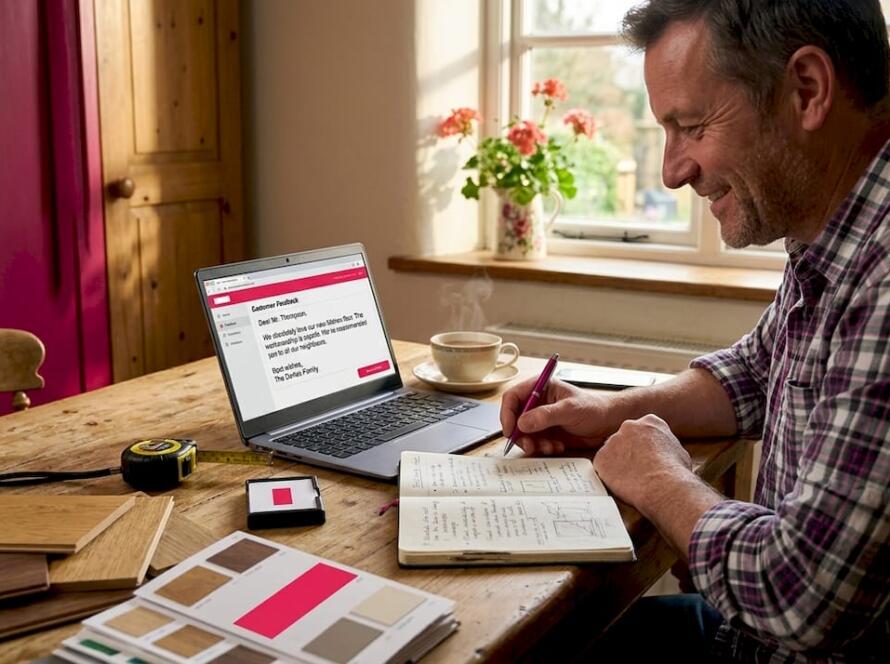
The pages that actually generate leads have a different structure entirely. They speak directly to what the customer wants to achieve, not just what the business offers. They prove capability before asking for anything.
Here is what the best flooring service pages consistently include:
- Real customer testimonials with names and locations
- Before-and-after photos showing the transformation
- Embedded Google reviews with star ratings visible on the page
- High-quality images and short video walkthroughs
- Clear service outcomes, not just a list of product features
- Mentions of local service areas in the UK
- Accreditations such as NICF displayed prominently
- Pricing ranges or transparent cost guidance
- A visible, mobile-friendly call to action
- FAQ section with structured schema markup for Google
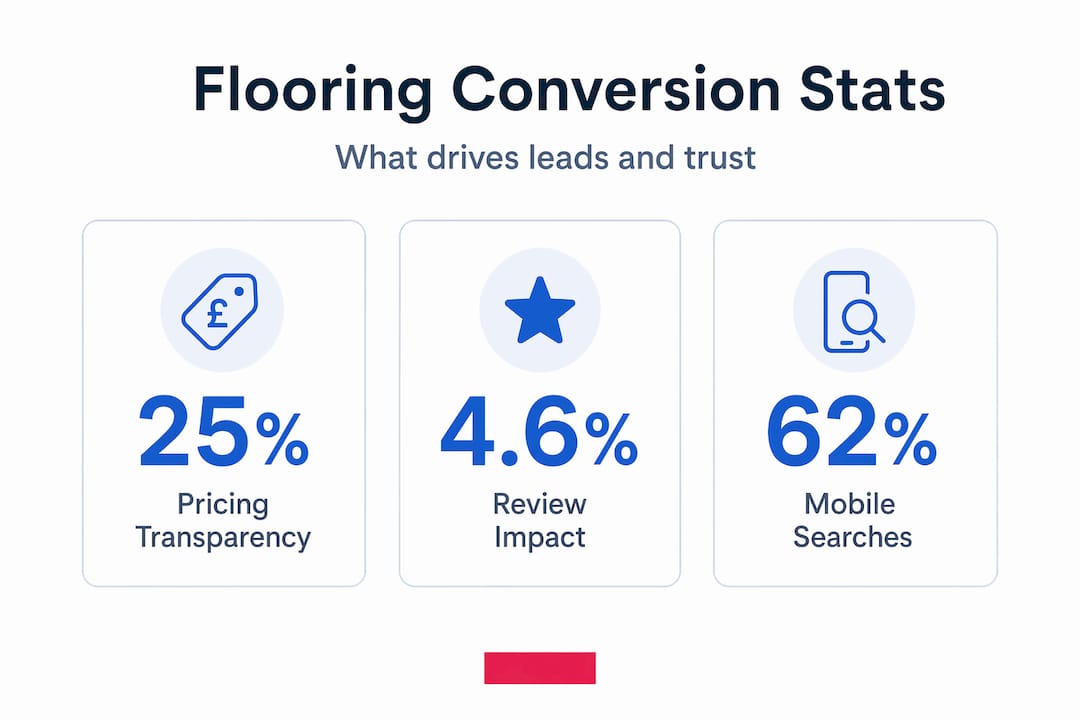
The data behind these choices is consistent. Transparent pricing lifts conversions by around 25%, pages with 50 or more reviews see conversion rates rise by 4.6%, and adding video increases conversions by up to 86%. These are not marginal gains. They are the difference between a busy enquiry pipeline and a quiet phone.
Good visuals matter more than most flooring businesses realise. Customers cannot touch the carpet or walk on the wood floor through a screen. Better flooring photos can do more to sell your service than paragraphs of text ever will. Show completed jobs in real homes. Include close-up shots of the finish. Show the team at work.
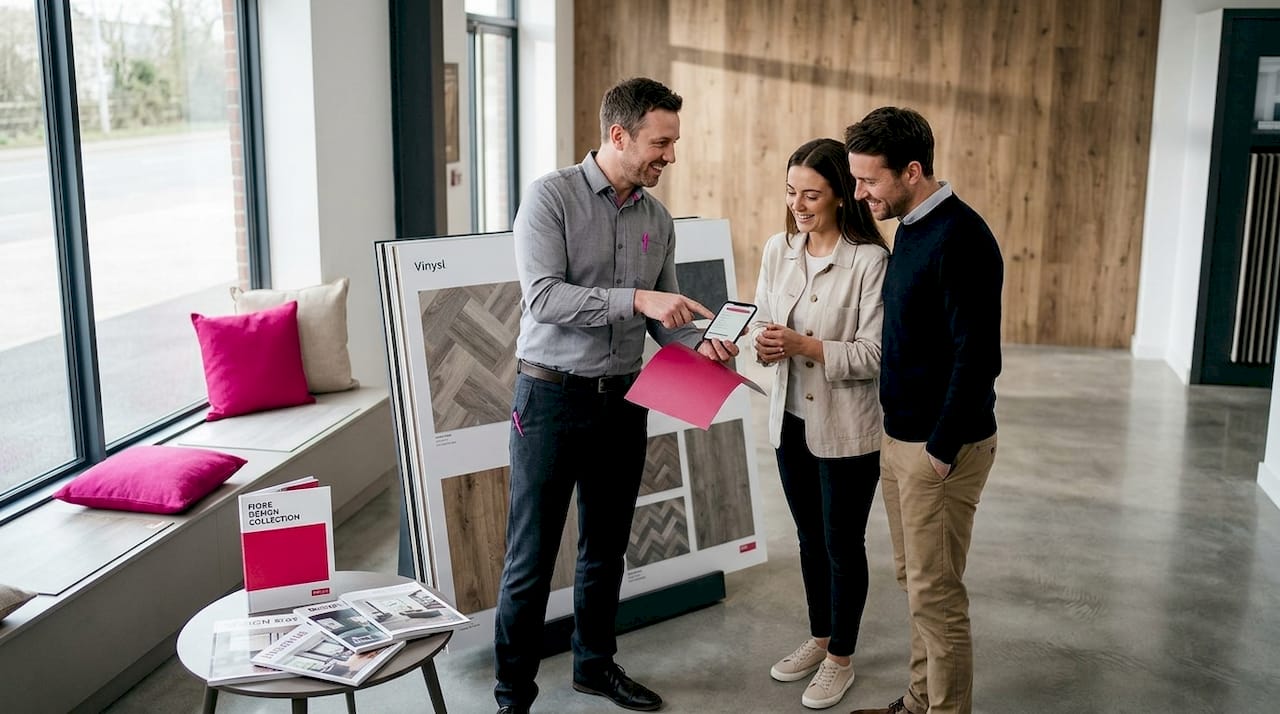
Local trust signals are especially powerful in the UK market. Naming the towns and cities you serve, displaying your NICF membership or other trade body accreditations, and including photos of actual customers (with their permission) tells visitors you are a real, established business in their area. Flooring website must-haves like these are not optional extras. They are core to building confidence and driving the enquiry.
| Element | Why it matters | Impact |
|---|---|---|
| Customer testimonials | Builds trust quickly | Reduces hesitation |
| Before-and-after images | Shows tangible outcomes | Increases time on page |
| Transparent pricing | Removes uncertainty | +25% conversions |
| Video walkthroughs | Demonstrates expertise | +86% conversions |
| 50+ Google reviews | Proves credibility | +4.6% conversions |
| Local area mentions | Confirms relevance | Reduces bounce rate |
| NICF or trade accreditations | Adds authority | Increases enquiry rate |
Pro Tip: Schema markup on your FAQ section helps Google display your answers as featured snippets. This drives more clicks even when you are not in the top organic position.
Step-by-step: How to structure and write your flooring service page
With a rough idea of what your page needs, let us break down each vital part and how to write it.
Think of each flooring service page as a short, persuasive conversation. You are guiding a visitor from “I have a problem” through to “this company can help me” and finally to “I want to get in touch.” The problem-solution-proof-action framework is the most reliable way to do that, and it works consistently in the UK flooring market.
Here is how to work through each stage:
-
Open with the customer’s problem or scenario. Do not start with your company name. Start with something your ideal customer is thinking. “Fed up with worn carpet that makes the whole room look tired?” or “Looking for a wood floor that will last 20 years and still look great?” This immediately signals relevance and keeps them reading.
-
Present your solution and approach. Explain what you do, how you do it, and what makes your approach different. Avoid generic claims like “high quality service.” Be specific. “We supply and fit engineered oak flooring, carry out a full subfloor assessment, and handle all furniture removal.” Specific details build confidence.
-
Prove your expertise. This is where your visuals, credentials, and reviews do the work. Include a gallery of completed jobs in your local area. Mention your NICF membership. Show your Google review score. A single genuine testimonial from a customer in the same town is worth more than a hundred generic phrases about being “dedicated to excellence.”
-
Give one clear call to action. Not three options. One. Whether it is a simple quote request form or a click-to-call button, make it obvious and make it easy. Visitors should never have to hunt for a way to reach you.
Your flooring website structure should make this flow feel natural on every service page. If it does not, it is worth reviewing how pages are laid out and whether they guide visitors through this progression.
| Page section | Purpose | Length guide |
|---|---|---|
| Headline | Hook with outcome or problem | 8 to 12 words |
| Opening paragraph | State the problem and solution | 30 to 60 words |
| Service details | Specific process, outcomes, products | 150 to 250 words |
| Proof section | Reviews, photos, credentials | Visual led |
| FAQ | Address objections, boost SEO | 4 to 6 questions |
| Call to action | Single, clear next step | One button or short form |
A page that lists every service your business offers but never tells the customer what life looks like after the work is done will consistently underperform. Write to outcomes, not features.
This approach is explained further in our flooring copywriting guide, which covers tone, structure, and word choice in more depth. If you are also building new pages from scratch, avoiding website mistakes from the start will save a significant amount of rework later.
Visuals, trust signals, and user experience: optimise for conversions
Once your words are in place, the right visual and UX choices turn visitors into leads. Here is how to maximise their impact.
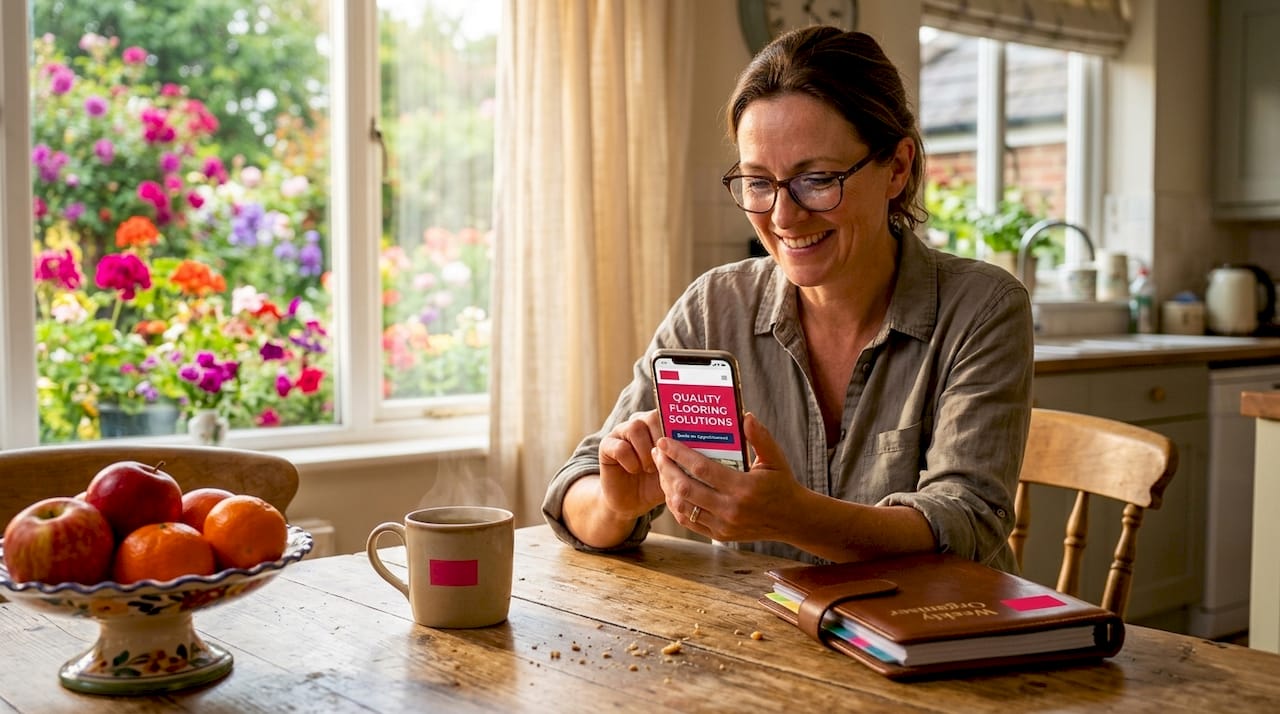
Over 62% of home services searches happen on mobile devices. If your service page is difficult to navigate on a phone, you are losing the majority of your potential enquiries before they even read a word of your copy.
Mobile load speed directly affects conversions. A page that loads in one second converts at roughly three times the rate of a page that takes five seconds. Compressing images, removing unnecessary scripts, and choosing a fast hosting provider are not technical luxuries. They are commercial necessities.
Here is what a well-optimised flooring service page looks like on mobile:
- Click-to-call phone number visible at the top of the page
- Sticky CTA button that stays on screen as the visitor scrolls
- Short enquiry form with no more than four fields (name, phone, email, and postcode or address)
- Fast-loading images under 200KB where possible
- Text that is readable without zooming in
Trust signals work in combination. A business address, a recognisable accreditation badge, a grid of five-star Google reviews, and real photos of completed jobs in local properties all reinforce each other. Remove any one of these and the overall credibility of the page drops. Local SEO for flooring is closely linked to this, because consistent local signals across your website and listings reinforce each other.
Adding a well-structured FAQ section to your service pages also lifts performance. Questions like “How long does LVT installation take?” or “Do you move furniture before fitting carpet?” address the objections that stop people from picking up the phone. Home services top pages consistently outperform average pages by a factor of two to four. A strong FAQ section is one of the clearest differentiators between average and top-performing pages.
Your visual content strategy should include a mix of completed project photos, team shots, and short video clips. Do not rely on stock images. Customers in your local area want to see work done in homes like theirs, not generic showroom photography. Original images also improve your page’s SEO performance.
Pro Tip: For flooring UX tips that go beyond the basics, look at how your competitors structure their mobile pages. What do the top-ranked flooring companies in your area do well? Where are the gaps you can exploit?
Common mistakes to avoid on flooring service pages
Even experienced flooring businesses make these easy-to-fix mistakes, so let us review what to watch for.
The most common errors are not about design. They are about decisions. Specifically, decisions that make it harder for a visitor to trust you or take action.
-
Hiding or avoiding pricing. Many flooring businesses worry that showing prices will put customers off. The opposite is usually true. Transparent pricing increases conversions by around 25%. You do not need to list exact costs. A clear “prices from £X per square metre” or a guide to your supply-and-fit pricing removes the uncertainty that stops people enquiring.
-
Using too many form fields. If your quote request form asks for ten pieces of information, most people will abandon it. Keep it to four fields at most. You can gather more detail once you have the lead and make contact.
-
Missing or thin reviews. A page with two reviews from several years ago signals stagnation. Actively ask satisfied customers to leave a Google review and feature recent ones prominently on your service pages. Pages with 50 or more reviews consistently outperform those with fewer.
-
Slow page load times. This is particularly damaging on mobile. A one-second delay in load time can reduce conversions significantly. Check your page speed regularly using free tools like Google PageSpeed Insights.
-
No mention of local areas or accreditations. If your page does not say where you work or show any professional credentials, there is nothing to distinguish you from every other generic flooring business online.
The cheapest fix on most flooring service pages is not a redesign. It is updating the copy to focus on outcomes, adding recent reviews, and making the call to action impossible to miss.
If your current page structure needs improving, start with the headline and the call to action. These two elements have the biggest immediate impact on enquiry rates. If you are unsure whether your site is underperforming, these signs your website needs updating are worth checking through.
Why outcomes-focused service pages win in the real world
Having reviewed what not to do, it is worth stepping back for a candid look at what truly moves flooring service page performance.
We see a lot of flooring websites. Many of them follow the standard advice. They have testimonials. They have photos. They have a contact form. But they still do not generate the volume of enquiries the business deserves. The reason is almost always the same. The pages describe the service instead of the outcome.
A customer searching for carpet fitting is not thinking about underlay grades or installation techniques. They are thinking about a room that feels warm and looks the way they imagined it. They want to know you will turn up on time, take care of their home, and leave it looking better than before. That is the transformation they are buying.
Pages that lead with outcomes consistently outperform those that lead with technical details or feature lists. “Your new engineered oak floor, fitted and finished in a single day, with no mess left behind” is more compelling than “we supply and install a wide range of engineered wood flooring products.” Both say roughly the same thing. One speaks to what the customer actually wants.
UK flooring customers also respond strongly to familiarity and proximity. Mentioning specific towns, referencing local landmarks or housing types, and showing jobs in their area builds a connection that generic copy cannot replicate. This is not just about SEO. It is about psychological trust.
Our practical service page advice consistently points back to this single principle. Write to the person who just arrived on the page. Tell them what changes for them when the job is done. Everything else supports that central message.
How Truth Digital helps flooring companies get results
Ready to put this advice into action and raise your profile above the competition? Here is what you can do next.
At Truth Digital, we work exclusively with flooring businesses across the UK. We know the market, the customers, and the objections that stop enquiries from coming in. When we rewrite a flooring service page or build a new one from scratch, we apply everything covered in this article and more.
Our flooring website experts can assess your existing service pages and identify exactly where you are losing leads. We also run flooring SEO campaigns that bring qualified traffic to those pages, and Google Ads for flooring that puts you in front of customers who are ready to buy right now. If you want a free review of your service pages, get in touch. We will tell you plainly what is working, what is not, and what we would do differently.
Frequently asked questions
How long should a flooring service page be?
Aim for 500 to 900 words, focusing on clarity, social proof, and outcomes rather than filler. Quality and structure matter far more than length alone.
What are the most important elements to include?
Real testimonials, before-and-after images, local UK trust markers, pricing guidance, and a mobile-friendly call to action are the key elements for conversions. These are the factors that most directly influence whether a visitor becomes an enquiry.
Do reviews really increase leads for flooring companies?
Yes. Pages with 50 or more reviews can see conversion rates rise by around 4.6%, making a consistent review-gathering strategy one of the easiest wins available.
Why does mobile optimisation matter for service pages?
Over 60% of searches are mobile. Fast load times and easy CTAs are essential because a one-second page loads at roughly three times the conversion rate of a five-second one.
How can a flooring business show local trust?
Mention specific service areas, display UK accreditations like NICF, and include real local customer photos. These signals tell visitors you are an established, credible business operating in their area.